The recording begins with a contradiction. A phonograph surface crackles—the sound of damage, distance, and elapsed time—then Guillaume Apollinaire’s voice arrives to speak a poem about what time carries away. He does not whisper. He gives the lines a firm, swaying contour, somewhere between recitation and chant. The voice advances; the disc keeps turning; the poem insists, again and again, “Les jours s’en vont je demeure”: the days go, I remain.[1][4]
That sentence has always held the poem’s central tension. Water, days, weeks, and love depart. The speaker says he remains. Yet the archival recording, made on December 24, 1913, complicates the boast. Apollinaire’s bodily voice did not remain by itself. It reached us because a university archive, a commercial recording system, a labeled Pathé disc, and later digitization carried it forward.[2][3] What sounds like presence is also a chain of preservation.
This is why the surviving performance deserves more than the reverence usually granted an author reading his own work. It does not unlock a single correct interpretation of “Le Pont Mirabeau.” It does something better: it lets us hear how one historical voice negotiates the poem’s printed pattern. Apollinaire turns repetition into an event. Each return of the refrain is recognizably the same, but no spoken return can occupy exactly the same moment.
Provenance: a modern poem enters an early sound archive
The recording belongs to the Archives de la parole, founded at the Sorbonne in 1911 by the linguist Ferdinand Brunot with support from Émile Pathé. The project used the phonograph to record, study, and preserve spoken language. Its remit was larger than celebrity voices: the archive gathered writers, public figures, anonymous speakers, languages, dialects, songs, and other forms of oral testimony.[3][6] UNESCO, which inscribed the collection in its Memory of the World register in 2025, describes more than 3,000 surviving documents now preserved and digitized by the Bibliothèque nationale de France.[6]
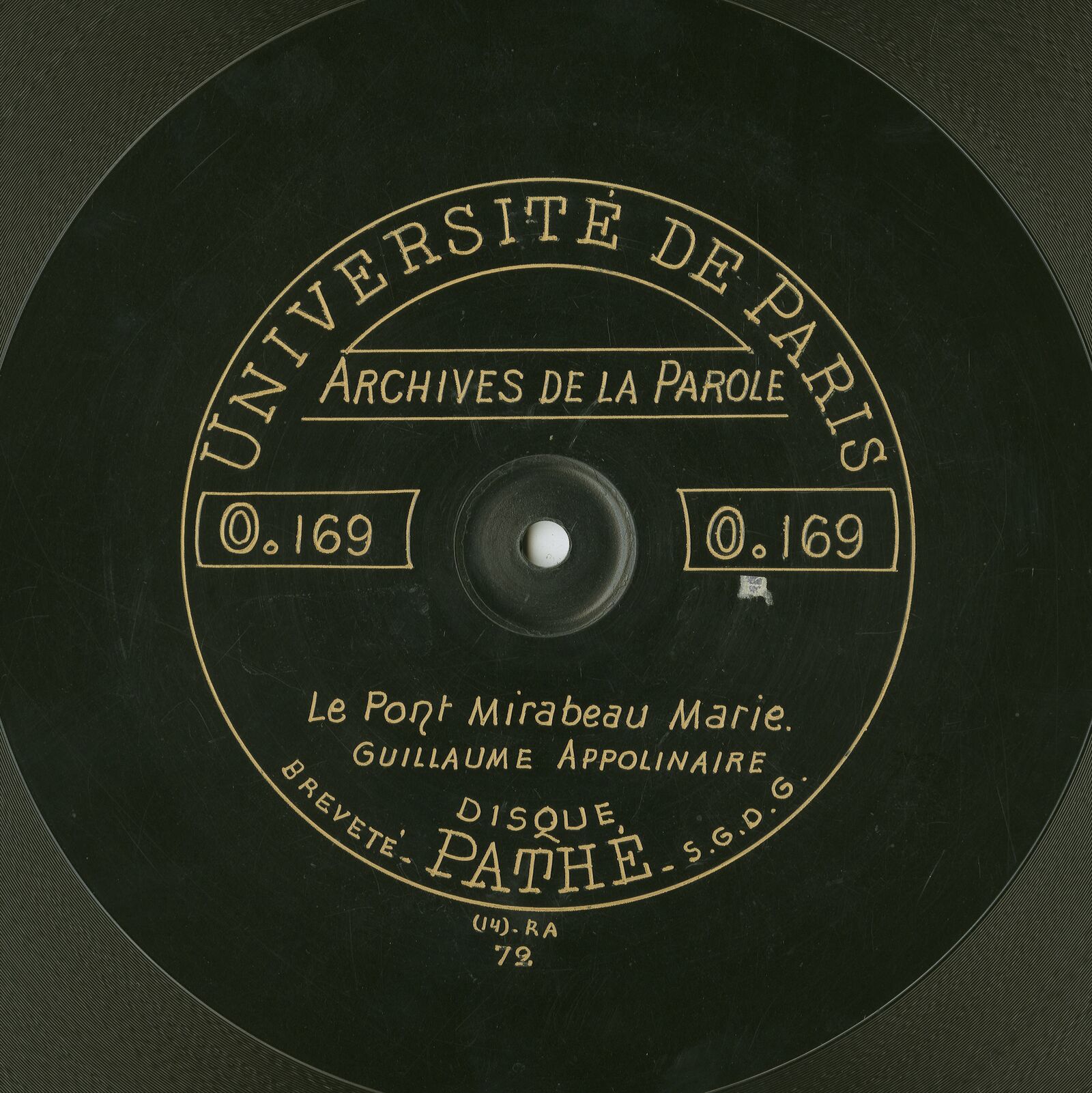
The Gallica object record supplies unusually tangible evidence for Apollinaire’s session. Its title joins three poems—“Le Voyageur,” “Le Pont Mirabeau,” and “Marie”—and dates the recording to December 24, 1913, at the University of Paris.[2] The scanned disc used as this article’s cover is not a decorative stand-in. Its label names the Archives de la parole, Apollinaire, “Le Pont Mirabeau,” “Marie,” Pathé, and the catalog number O.169. A scanned session sheet identifies the poet and the same date.[2] The image restores the machinery that a clean digital player tends to hide.
The date places voice and book almost side by side. Alcools, the volume in which “Le Pont Mirabeau” follows the radically modern opening poem “Zone,” appeared in 1913; its subtitle gathers poems written from 1898 to 1913.[4] The disc therefore does not capture an elderly poet explaining a settled classic. It catches a thirty-three-year-old writer performing a newly collected poem for a new kind of cultural institution.
The embedded copy is France Culture’s circulation of that BnF recording.[1] The frame below is convenient, but it is not the archive’s origin. Gallica preserves the object record and disc images; the BnF explains the collection that produced them; the Institut national de l’audiovisuel also offers an improved but still visibly—or rather audibly—worn transfer of “Le Pont Mirabeau” and “Marie.”[2][3][7] Keeping those layers distinct matters. A YouTube upload can disappear; provenance is the map that lets the work be found again.
The page builds motion out of recurrence
Before listening again, look at the poem’s small machine. Four main stanzas alternate with the same two-line refrain. The opening immediately overlays river and relationship:
Sous le pont Mirabeau coule la Seine
Et nos amours
The grammar briefly makes the Seine and “our loves” share one current. The verb coule—flows—belongs explicitly to the river, while the line break leaves love suspended beside it.[4] The bridge seems stable, the river mobile. But the bridge also becomes the position from which the speaker discovers that stability can be painful.
The refrain makes that discovery memorable:
Vienne la nuit sonne l’heure
Les jours s’en vont je demeure
Night may come; the hour may strike; days depart; the “I” remains.[4] The compact oppositions invite a simple reading in which the steadfast speaker defeats time. The full poem is harsher. To remain is not necessarily to endure intact. It can mean being left behind with memory while everything one wants has already moved on.
Apollinaire’s stanza design intensifies that pressure. The printed quatrains divide their inner material into conspicuously short lines—“Et nos amours,” “Tandis que sous,” “L’amour s’en va”—between longer lines. Benoît de Cornulier’s metrical study argues that these groups can also be heard as underlying ten-syllable tercets, alternating with seven-syllable refrain couplets, and connects their organization to older song form.[5] The page looks fractured; the ear keeps discovering continuity. Modern typography and inherited cadence do not cancel each other. They make the poem behave like its bridge: separate spans carrying one movement across an interval.
The third stanza states the analogy with almost dangerous clarity: “L’amour s’en va comme cette eau courante”—love goes like this running water.[4] Then the motion slows into “Comme la vie est lente,” only to be struck by the startling force of “Et comme l’Espérance est violente”: how slow life is, how violent Hope is.[4] Violente prevents hope from becoming consolation. Hope is an appetite that keeps the abandoned self attached to what cannot return.
Finally, the last stanza passes days and weeks through a sequence of repeated verbs before returning to the first line, “Sous le pont Mirabeau coule la Seine.”[4] The poem ends where it began, but the return does not restore the lost love. Repetition is the form taken by irreversibility: the line comes back; the moment does not.
The voice makes the refrain recur without becoming static
Apollinaire’s roughly eighty-second performance is strikingly patterned.[1][7] He gives the poem a pronounced rise and fall, leaning into its recurrent sounds and keeping the short inner lines attached to the longer phrases around them. It is not a neutral delivery in the contemporary sense of conversational understatement. Nor is it a private confession accidentally overheard. The diction is public, projected, and shaped for a recording horn.
The refrain is where the archival encounter becomes most revealing. On the page, its four appearances are typographically identical. In time, they cannot be. The first establishes a law; the next two arrive after the poem has supplied new images of clasped hands, exhausted water, departing love, slow life, and violent hope; the last follows the admission that neither past time nor old loves return.[4] Apollinaire keeps the contour recognizable, allowing memory to identify the refrain, while breath and position alter what it carries. Sameness accumulates consequence.
The disc’s noise participates in that effect without belonging to Apollinaire’s composition. Crackle occupies the pauses and rubs against consonants. The voice is close enough to feel embodied but damaged enough to remind us that the body is absent. INA explicitly warns that even its improved transfer remains low in quality, though audible.[7] The flaw is historically informative. We are not hearing “the voice itself.” We are hearing voice plus horn, groove, wear, transfer, compression, and playback.
That distinction protects the recording from a familiar mistake: treating an author’s performance as a verdict. A reading can reveal decisions about grouping, emphasis, pace, and tone, but it cannot abolish the poem’s other possible lives. Even testimony about Apollinaire’s preferences points in more than one direction. In a 1953 recollection relayed by Les Soirées de Paris, the actor Pierre Bertin said Apollinaire admired a “diction typographique”—precise and dry, resisting theatrical tremolo.[8] Modern listeners often hear the surviving recording as incantatory. The friction is useful. Vocal styles age; recording apparatus changes projection; words such as “dry” and “typographic” describe ideals, not measurable settings on a machine.
What the archive preserves—and what it cannot settle
The recording gives us evidence, not sovereignty. It strongly suggests that the poem’s broken-looking lines belong to larger audible movements. It demonstrates how emphatic a refrain can be without musical accompaniment. It also exposes the historical strangeness of early twentieth-century poetic delivery. But it cannot tell every reader where to pause, cannot make the speaker identical with the biographical Apollinaire, and cannot turn one Christmas Eve performance into the permanent score of the poem.
Its deepest value lies in a more modest revelation. “Je demeure” is no longer only a proposition when the poet speaks it. It becomes an action that lasts a few seconds and then vanishes. The groove makes that vanishing repeatable, but not reversible. Every playback begins again from the start; none returns us to the Sorbonne room in 1913.
That is also the recording’s legacy within the larger Archives de la parole. Brunot and Pathé’s project treated speech as something that could become an object of study and preservation, and it placed a famous poet among thousands of other records of spoken and sung life.[3][6] The institutional frame prevents Apollinaire’s voice from floating free as a miracle. Someone scheduled a session, operated equipment, labeled a disc, cataloged it, conserved it, digitized it, and made it legible to later systems.
The result does not refute the poem’s river of time. It makes that river audible. Apollinaire sounds present because the archive preserves the marks of distance along with the words. The refrain returns; the surface turns; the voice declares that it remains. What actually remains is more complicated and more moving: not an untouched self, but a performance carried forward by matter, institutions, and listeners willing to press play again.
Sources
- France Culture, “Guillaume Apollinaire lit ‘Le pont Mirabeau’” (YouTube video).
- Bibliothèque nationale de France, Gallica, [Archives de la parole]. Le voyageur ; Le Pont Mirabeau ; Marie (recording and digitized object record, December 24, 1913).
- Bibliothèque nationale de France, “Ressources numériques – Écouter dire: Les archives de la parole.”
- Guillaume Apollinaire, “Le Pont Mirabeau,” in Alcools (validated transcription with page scans of the 1920 edition), Wikisource.
- Benoît de Cornulier, “Sur la versification d’Apollinaire dans Alcools: À propos de ‘Zone,’ ‘Le Pont Mirabeau,’ ‘Palais,’ ‘Rosemonde,’” Fabula.
- UNESCO Memory of the World, “Les Archives de la Parole (1911–1953): mémoire de la voix humaine.”
- Institut national de l’audiovisuel, “Guillaume Apollinaire: ‘Le pont Mirabeau,’ ‘Marie’” (archival audio record).
- Philippe Bonnet, “Parole d’automate,” Les Soirées de Paris (September 7, 2022).