One way to misread Antony and Cleopatra is to treat it as if Shakespeare had built two clean verbal worlds and simply placed them in opposition: Rome equals discipline, Egypt equals pleasure; Caesar speaks one language, Cleopatra another.[1][2][4] The play certainly invites that first impression. Roman characters keep reaching for judgment words such as "dotage," "strumpet," and "business," while Antony and Cleopatra answer with a rhetoric of excess, spectacle, and appetite.[1] But the play's deeper technical achievement is less tidy. Shakespeare keeps letting one register infect another. Political dispatch turns lyrical. Seduction sounds like strategy. Mockery slips into grief. Public history becomes a contest over who gets the last image.
That is why a voice-and-style reading suits this play so well. Folger's introduction stresses that the final acts are not only about military defeat but about which images of Antony and Cleopatra will survive into later history: the humiliation Caesar wants, or the grandeur the lovers seize for themselves.[2] Britannica's summary gives the broad frame: the play was written around 1606-07 and first printed in the 1623 First Folio, drawing a world in which imperial consolidation and erotic attachment collide at full scale.[4] What makes that collision memorable, though, is not plot alone. Shakespeare writes the struggle as an argument among tones. His characters do not merely state who they are. They keep voicing and revising the scale on which their lives should be measured.
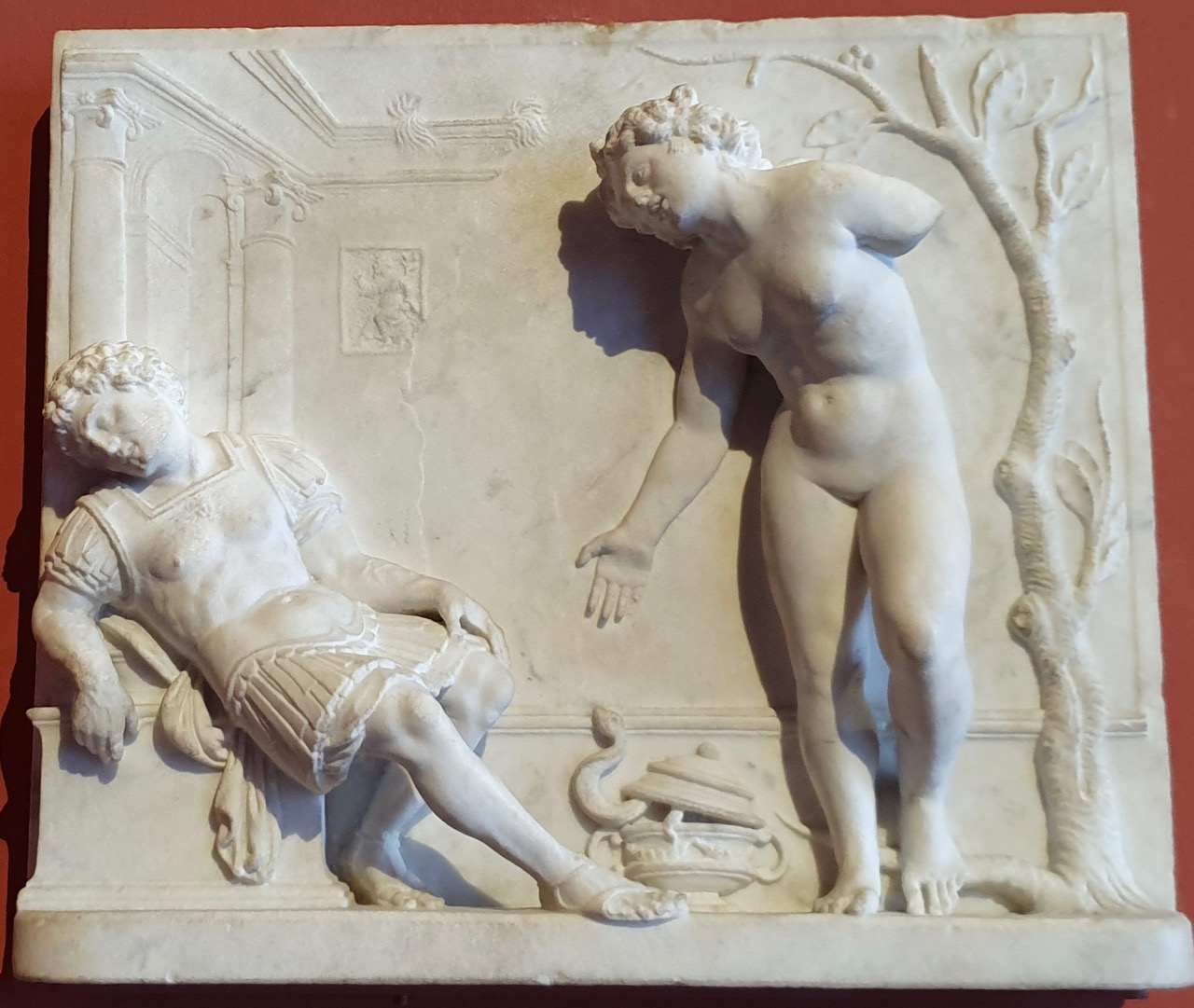
Image context: the cover uses a photographed Folio page rather than a later painting or a generic classical scene. That choice keeps the article close to its real subject. The argument here is about how the play sounds on the page: how Shakespeare arranges abrupt judgments, rolling images, messenger reports, and self-dramatizing last speeches into a form that never stays in one key for long.[6]
1) Rome enters the play trying to compress Antony into a verdict
The opening scene is already a lesson in stylistic pressure. Before Antony speaks for himself, Philo and Demetrius speak about him. Their language is supervisory, diagnostic, and irritated by excess.[1] Antony has become, in Philo's view, a hero melted down by appetite; a public man has fallen into private enthrallment. That is why the Roman opening matters technically. It does not merely provide exposition. It attempts to control tone in advance. The play begins with a frame that wants Antony to be legible as decline.
Antony's first great answer breaks the frame by enlarging the scale of speech almost immediately. "Let Rome in Tiber melt" is not just a declaration of preference for Cleopatra over administration; it is a change of verbal weather.[1] Rome's clipped condemnations are suddenly answered by dissolution, river, flood, and world-sized contempt for accounting. One hears, right away, that Shakespeare does not want public duty and private desire to remain abstract concepts. He wants them to become competing sentence habits. Caesar's camp keeps trying to reduce Antony to a case. Antony keeps answering as if measure itself were the enemy.
That is why the play's politics cannot be separated from its style. In a more stable tragedy, language might clarify who is right. Here language keeps redistributing magnificence and folly at the same time. Antony sounds expansive because he is resisting Roman reduction, but he also sounds dangerous because the expansion can become a refusal of limit.[1][4] The voice is thrilling and compromising in one motion. Shakespeare does not let the reader enjoy amplitude without hearing its cost.
2) Cleopatra's speech works by turning every exchange into performance
Cleopatra is often described as theatrical, but that shorthand can flatten what Shakespeare is actually doing with her voice. She does not merely "perform" in a general sense. She keeps changing the pressure of a scene by changing the kind of speech it is. A lover's question becomes a test; a taunt becomes a seduction; grief arrives already half-aware of its future audience.[1][2] When she says, "If it be love indeed, tell me how much," the line sounds playful and impossible at once.[1] It asks for proof while also revealing that proof will never be enough. Love is not being measured there. The act of demanding measure is itself part of the erotic game.
Folger's language note is useful on this point because it emphasizes how densely figurative the play is, even at moments that look conversational from a distance.[3] Cleopatra's scenes keep swerving into metaphor, personification, and verbal overplus because ordinary declarative speech would make her smaller than the play needs her to be. Antony speaks of "strong Egyptian fetters"; Enobarbus later gives her a barge so lavishly imagined that description itself starts behaving like ceremony.[1][3] Cleopatra's world is not only sensuous. It is linguistically dilatory. It expands time by refusing to say one thing in one way and move on.
That dilatory quality matters because it is one reason Caesar can never fully master her. He can defeat armies, seize territory, arrange marriages, and send orders. He cannot make Cleopatra stay inside the narrow language of report.[1][2] Even when messengers bring her information, she turns information into theater. She interrupts, revalues, threatens, jokes, and delays. Shakespeare writes her not as an emblem of irrational excess but as a force that keeps exposing how thin "plain fact" becomes once human beings begin living inside it.
3) The play keeps letting report become poetry
The most famous example is Enobarbus's account of Cleopatra on the Cydnus: "The barge she sat in, like a burnished throne."[1] The line matters for more than sheer beauty. Enobarbus is, structurally, reporting. He is giving another character an account of what happened. But the report cannot remain neutral. Its syntax rises into pageant because Cleopatra's political effect in the play is inseparable from the forms of speech people are forced to invent around her. Narrative, once it passes through her orbit, becomes stylized.
That is one reason the usual Rome-versus-Egypt binary does not quite hold. Shakespeare assigns different pressures to different worlds, but he also keeps showing how porous those worlds are. Roman speech is full of clipped commands and administrative impatience, yet even Romans are drawn into image and theatricality when they try to describe Antony and Cleopatra.[1][4] Egypt may be associated with abundance, but it also contains sharp strategic intelligence, mock cruelty, and sudden shifts into hard fact. The play is less a fixed contrast than a circulation system in which speech styles migrate, clash, and return altered.
Britannica's compact description of the play's history helps here because it reminds us that this is a tragedy about the founding moment of empire.[4] Founding moments require official narrative. They need order, succession, and explanation. What Shakespeare keeps dramatizing, by contrast, is the resistance of lived charisma to that official narrative. Enobarbus's speech does not merely adorn Cleopatra. It shows that verbal form itself has become a political site. Whoever can command the image can alter the scale on which history is felt.
4) The ending is a struggle over what style of memory will win
Folger's introduction states the point cleanly: the end of the play concerns which images of Antony and Cleopatra will be handed down, the image of captives in Caesar's triumph or the image of lovers who escape that reduction.[2] Cleopatra understands this perfectly. Her terror is not only of death. It is of being miniaturized into someone else's public show. In that sense, the last act is the purest form of the play's stylistic argument. Whoever controls the final scene controls the register in which the whole story will continue to live.
That is why Cleopatra's last speeches are so important. When she says, "I am fire and air; my other elements / I give to baser life," she is not merely choosing a noble death.[1] She is choosing a final diction. The line strips away Roman custody and revoices the self as element, purity, upward motion. Caesar wants a body for display. Cleopatra makes herself into an image that refuses the destination he has prepared. The triumph he planned becomes, at least in part, a failure of genre. He wins politically; she contests the terms of representation.
Read this way, the famous lushness of Antony and Cleopatra is not decorative surplus. It is the mechanism by which Shakespeare makes power unstable. Rome keeps trying to close meaning with verdicts, reports, and public form. Egypt keeps reopening meaning through metaphor, delay, and self-invention. The result is a tragedy in which no one fully owns the language that describes events, and therefore no one fully owns the events themselves.[1][2][3] Antony falls, Cleopatra dies, Caesar survives; yet the play does not sound like a clean victory for the survivor.
That is the real brilliance of Shakespeare's style here. He makes rhetoric itself carry the pressure of history. If Antony and Cleopatra still feels unusually alive, it is because every scene asks not only what happened but how it can be said without shrinking it. In that question, public power and intimate desire become the same problem: both are struggles over measure, over scale, over the difference between being described and becoming legendary.[1][4][5]
Sources
- William Shakespeare, Antony and Cleopatra (Folger Shakespeare Library full text).
- Barbara Mowat and Paul Werstine, "About Shakespeare's Antony and Cleopatra," Folger Shakespeare Library.
- Folger Shakespeare Library, "Reading Shakespeare's Language: Antony and Cleopatra."
- Encyclopaedia Britannica, "Antony and Cleopatra" (dating, publication, and plot context).
- Encyclopaedia Britannica, "William Shakespeare" (career context for the late tragedies).
- Wikimedia Commons, "File:Relief of Antony and Cleopatra by Giovanni Maria Mosca at Bode Museum.jpg" (source page for the lead image).