Anton Chekhov’s “Misery” gives its central fact away repeatedly: Iona Potapov’s son has died. The military officer hears it. Three young fares hear it. Iona tells it to a drowsy cabman who is asleep when he looks for a response. The reader hears it. Yet the story keeps insisting that the necessary thing has not happened. A death has been reported, but grief has not been told.[1][2]
That distinction makes the final stable scene more than a bleak joke about a man reduced to talking to his horse. The mare does not cure Iona, answer him, or restore a lost community. She changes one condition: for the first time that night, his speech is allowed to continue. Chekhov turns attention into duration. The scene asks how long another being must remain before a fact can become a story—and a bereaved father can become, briefly, more than the bearer of bad news.
The fact arrives; the story does not
Iona’s human encounters are variations on interruption. The officer initially asks what killed the son, but traffic abuse cuts off further telling; soon he closes his eyes. The three revelers crowd themselves into the sledge. When Iona mentions the death, one supplies the universal formula “We shall all die,” then returns to speed, threats, and arrival. A porter gives Iona no opening at all. Back at the yard, the young cabman wakes for water; Iona gives him the news, but by the time he looks for its effect, the young man has gone back to sleep.[1]
These people are not interchangeable villains. One is in a hurry, three are drunk and noisy, one is working, one is exhausted. Chekhov gives each a plausible claim on his own attention. That is precisely why the sequence hurts. The failure is ordinary enough to reproduce itself without conspiracy. Destination, traffic, fare, thirst, and sleep keep converting Iona’s attempted narrative into a delay.
Even abuse briefly lightens his loneliness because it acknowledges that he is there. But notice how little acknowledgment requires. The fares can register a sentence, joke at him, strike him, and still never enter the time of his loss. Hearing that somebody died is instantaneous. Hearing how a person died—and what the death did to the survivor—is not.
What “properly” demands
Near the stable scene, the narrator finally specifies what Iona has been trying to do. He wants to speak “properly, with deliberation.” He needs to recount the illness, the suffering, the last words, the death itself, the funeral, the trip to retrieve his son’s clothes, and the daughter still living in the country.[1] This is not a request for a more sympathetic verdict on the same information. It is a request for sequence.
The list is the passage’s hinge. Grief has broken ordinary time: the son who should have outlived and replaced his father has died first. Telling would not repair that reversal, but it would let Iona move through its parts in an order chosen by speech rather than forced on him by fever, hospital routine, burial, and work. His earlier fragments keep stopping at the announcement because every listener’s clock outruns his own.
Chekhov also makes us feel the difference formally. He tells us the episodes Iona wants to recount, but he does not yet stage the recounting. The outline accumulates behind a closed gate. By the time Iona walks to the mare, the reader knows not only that he needs to talk, but how much untold material is pressing behind his few repeated words.
The mare has been in the sentence all along
The ending does not introduce an emergency symbol. Chekhov pairs driver and horse in the opening paragraph: wet snow whitens both; both wait motionless; both have been displaced from fields into a city of glaring lights, noise, and hurrying bodies. Iona’s movements repeatedly pass into the mare’s—he pulls the reins, she starts; he decides to return, she trots. Their partnership is economic as well as visual. If he cannot earn the price of oats, she eats hay. If his son were alive, the younger man would be driving in the father’s place.[1][2]
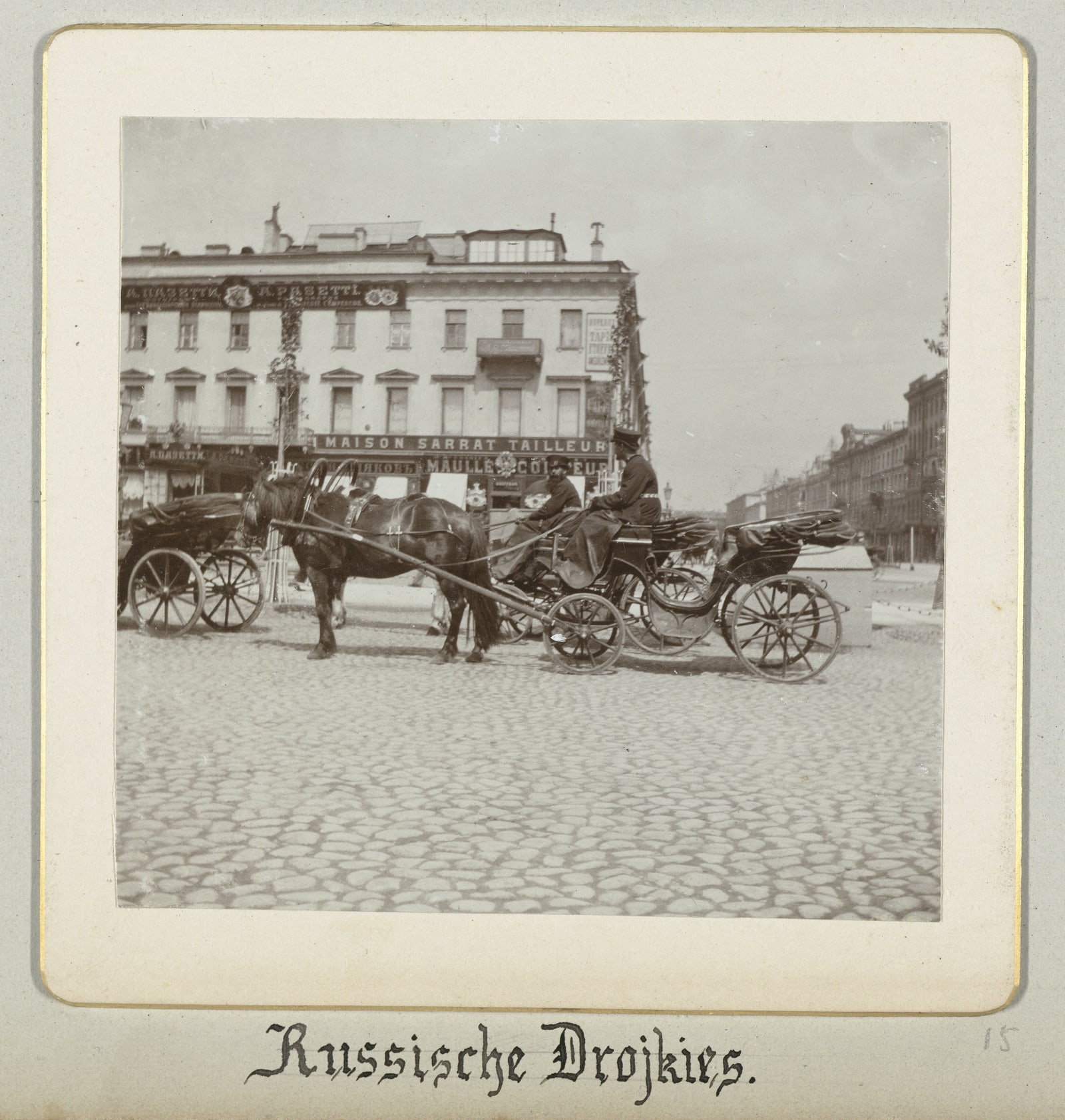
An 1898 albumen photograph in the Rijksmuseum, made twelve years after the story’s first publication, shows actual droshky drivers and horses waiting for passengers on a St Petersburg street.[6] It is not a picture of Iona, and its bare cobbles are not Chekhov’s snow. What it preserves is the arrangement the story makes consequential: a driver and a horse wait together while customers control when work begins, how fast it goes, and what it pays.
Robert Louis Jackson argues against treating the final exchange as merely absurd or grotesque, emphasizing the natural continuity between two creatures joined by displacement and isolation.[4] The text supports that humane reading, but it does not need the mare to possess miraculous understanding. Iona supplies the bridge himself. He asks her to imagine losing a colt. Paternal grief is translated into a possible experience available to the animal body before him.
That analogy matters because Iona does not simply pour language into an empty room. He adjusts his story toward a listener. The mare cannot confirm that she understands, but the thought of her as a mother lets him approach the most intolerable inversion: the child has died while the parent remains.
Silence is not the same as indifference
The mare’s response is almost aggressively unspectacular. She eats. She remains. She warms Iona’s hands with her breath. Chekhov writes that she “munches, listens, and breathes”—three simultaneous actions, only one of which names attention.[1] There is no consoling gesture and no fantasy of animal speech. The same chewing that could look like incomprehension also means she does not order him onward, close her eyes, change the subject, or fall asleep.
This is the delicate force of the verb listens. It does not prove that the mare grasps the story semantically. It marks the absence of resistance. Her body occupies the time in which Iona can keep addressing her. Human silence in the story has usually been a withdrawal; the mare’s silence is a presence.
Then Chekhov withholds the speech he has prepared us to expect. Iona is carried away and “tells her all about it,” but the story ends without reproducing that account.[1] We do not receive the last words, the funeral, or the hospital clothes after all. The omission protects the scene from turning Kuzma’s death into material for a reader’s consumption. We already know enough about what happened. The unresolved question has been whether anyone will stay while the father tells it.
Chekhov cut the instruction and kept the scene
“Misery” first appeared in Peterburgskaya Gazeta on January 27, 1886, under Chekhov’s early pseudonym A. Chekhonte. The scholarly notes to the Russian complete edition record that his later revisions were small but revealing: he removed direct authorial asides, including an explicit claim about the value of listening to a person.[3] The ethical instruction disappeared; the stable scene remained.
That revision clarifies Chekhov’s confidence in form. An authorial maxim would tell us what good listeners do. The sequence of failed starts makes us experience the cost of their absence. And the final omission—allowing Iona to tell everything while declining to transcribe it—makes listening look less like extracting information than granting another person custody of the time.
The Russian title, Toska, also resists a neat therapeutic ending. Gary Saul Morson notes that it is commonly translated as “Misery” or “Anguish” but carries loneliness, longing, and the ache of missing someone as well.[5] The stable does not abolish any of those meanings. It gives longing an address.
What the ending gives—and withholds
Nothing material has improved. Iona still lacks money for oats. His son is still dead, his daughter still far away, and the human city still unavailable to him. The mare cannot answer the social failure the story exposes. Reading her as a magical cure would turn Chekhov’s restraint into sentimentality.
But reading the ending as pure defeat misses the change that does occur. All night, Iona has been forced to compress a life and death into a clause. In the stable, he can expand it again. The mare’s gift is not wisdom, and perhaps not even comprehension. It is noninterruption: enough shared time for grief to take narrative shape.
Chekhov’s smallest ethical unit is therefore not the correct condolence. It is the interval after the condolence would normally end—the period in which a listener remains, the facts acquire sequence, and the bereaved are permitted to tell more than we need to know.
Sources
- Project Gutenberg, Anton Chekhov’s “Misery” in Constance Garnett’s The Schoolmistress and Other Stories — English primary text.
- Fundamental Electronic Library, Anton Chekhov, “Тоска” — Russian primary text in the Academy of Sciences complete edition, volume 4.
- Fundamental Electronic Library, textual and publication notes for “Тоска” — first publication, revisions, epigraph, and early reception.
- Robert Louis Jackson, “Grief: Once Again about the Ending of the Story,” in Essays on Anton P. Chekhov: Close Readings.
- Gary Saul Morson, “The Master of Toska,” The New York Review of Books — title, longing, and Chekhovian failures of listening.
- Rijksmuseum, “Russian droshky carriages with coachmen waiting for passengers in St Petersburg” — 1898 albumen photograph, object RP-F-2007-357-15.