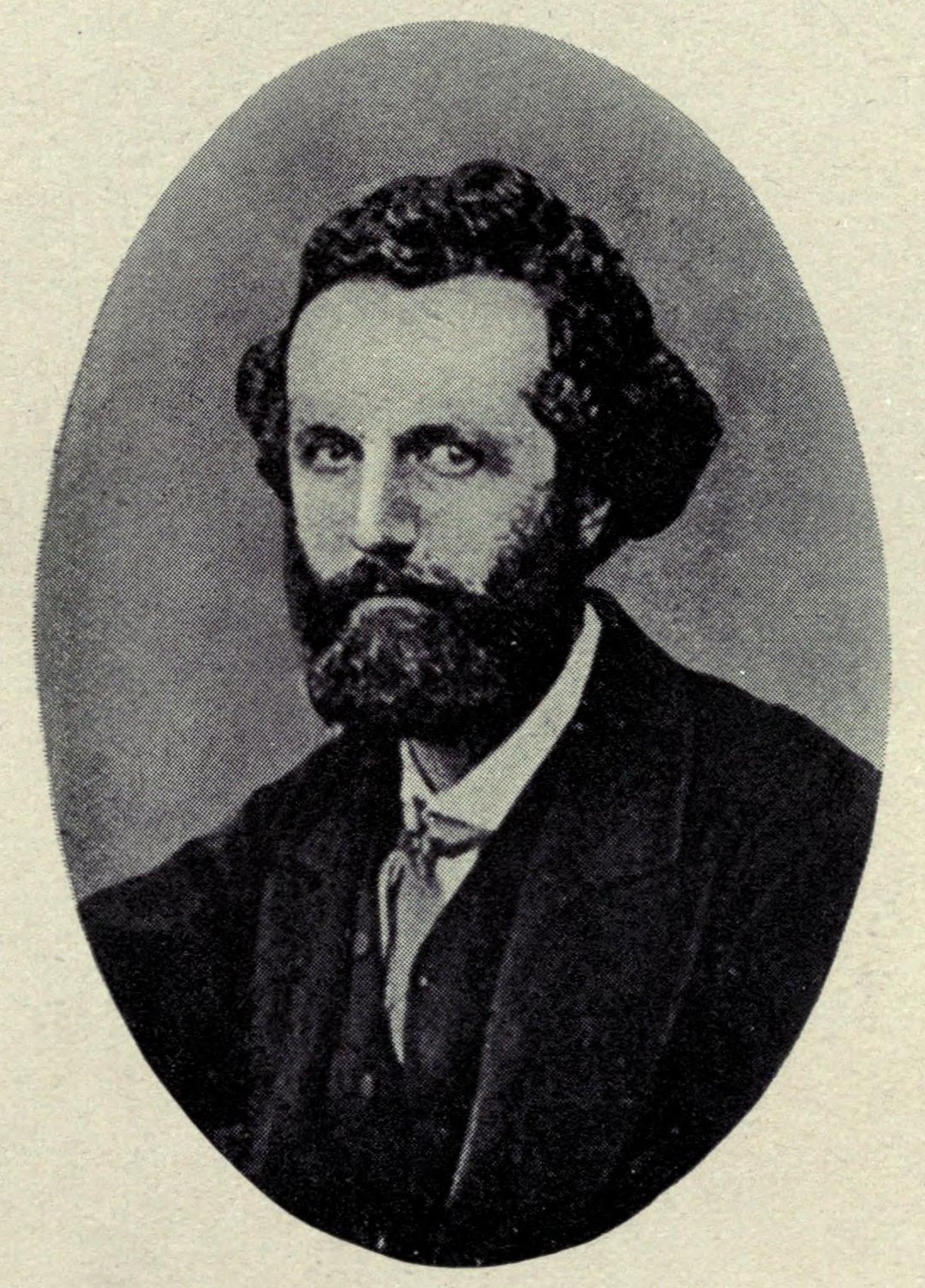
George Meredith begins Modern Love after the beginning. A man and woman lie awake in their “common bed”; he detects her suppressed sobs, and each pretends not to know what the other knows. No courtship is narrated, no betrayal established, no name supplied. The first words—“By this he knew”—make interpretation feel like an event already in progress. Sixteen lines later, the spouses have become effigies on a “marriage-tomb,” each wishing for the sword placed between them.[1]
That sounds like an ending. It is only sonnet I.
Published in 1862, Meredith’s sequence consists of fifty poems that he called sonnets, though each has sixteen lines rather than the customary fourteen.[2] The numerical oddity is easy to notice and too easy to treat as the whole experiment. What matters is what those extra lines permit across the sequence: a small chamber can snap shut around one emotional instant, while the story of the marriage keeps escaping into the blank space before the next chamber. Modern Love does not merely put a broken marriage into unusual sonnets. It makes local closure and narrative incompleteness work against each other.
Four locks on every door
Each section is built from four enclosed-rhyme quatrains: abba cddc effe ghhg.[4] A rhyme departs and returns within four lines, then a new set begins. On the page, this produces four compact cells. In the ear, the fourth line repeatedly brings the first line’s sound home. Meredith therefore supplies closure more often than a Shakespearean sonnet, whose final couplet gets one conspicuous chance to deliver a verdict.
But rhyme and thought do not always stop together. Sentences cross the quatrain boundaries; images mutate after a rhyme has apparently contained them; the sixteenth line may sting like an epigram without explaining the scene. The unit is closed acoustically and still unsettled causally. Because there is no obligatory couplet waiting at lines fifteen and sixteen, the turn can arrive almost anywhere—or arrive in stages, only to be revised by the next numbered poem.
The form’s basic motion is therefore not simply expansion from fourteen lines to sixteen. It is enclosure followed by leakage. Four rhyme-boxes stabilize the sound while syntax presses forward. Then the numeral changes, an interval opens, and the reader discovers that an action has happened offstage. Recent scholarship aptly treats the work as a verse-novel poised between lyric concentration and novelistic movement.[3] Its plot advances, but it advances like a life reconstructed from a packet of photographs: one arrested exposure, a gap, another exposure, and our inference in between.
Sonnet I closes the image, not the case
The opening section demonstrates that design before the reader knows the cast. Its first quatrain is a chain of bodily evidence: the husband’s hand quivers; the wife’s sobs stop; he interprets the stoppage as proof that she was awake. The knowledge is real only in his reading of her body. The poem gives us neither her account nor an external narrator who can certify his conclusion.
The last quatrain seems firmer because its likeness is monumental:
Like sculptured effigies they might be seen
Upon their marriage-tomb, the sword between;
Each wishing for the sword that severs all.[1]
The enclosed rhyme makes “seen” meet “between,” then “all” meet the omitted first line’s “wall.” Form has arranged the tableau perfectly. Yet the metaphor answers none of the questions a plot would normally answer. Who caused the rupture? What does either spouse want besides escape? Why do they remain side by side? The tomb image gives the marriage a finished shape before its history has been told. Fifty sections will elaborate that contradiction rather than solve it.
Even the voice participates in the uncertainty. The early third-person “he” later becomes an “I,” then returns near the end to “he.” The change can sound like distance collapsing into confession and then being rebuilt as trauma approaches its end. It also prevents a stable contract between speaker and reader. We cannot simply decide that an omniscient narrator has given way to a candid husband. The same consciousness keeps changing the grammatical distance from which it inspects itself.[3]
A dinner party becomes a perfect non-resolution
Sonnet XVII stages the couple before guests: “At dinner, she is hostess, I am host.” Social grammar is intact. They occupy matching roles, trade accomplished looks, and make others envy their “happy lot.” The scene’s polish is so complete that the speaker can give it a title: “Hiding the Skeleton.”[1][2]
Here the quatrains behave like rooms within the public performance. One admits the guests, one manages appearances, one lets glances circulate over dishes and wine. The final four lines close with “marriage-knot” and then “Love’s corpse-light.”[1] That last phrase performs a vicious little reveal: the bright domestic scene has been illuminated by decay.
Yet the reveal changes nothing in the dining room. No guest confronts the couple; neither spouse speaks honestly; the plot does not visibly move. Meredith has used a strong terminal line to produce recognition without consequence. The reader sees through the performance while everyone inside the scene continues it. That is a recurring distinction in the sequence: exposure is not the same as action, and insight is not repair.
The missing plot happens at the cuts
Numbered sequences teach us to treat adjacency as sequence. Meredith exploits that habit. Sonnet II begins “It ended,” without naming the antecedent. Later openings—“At dinner,” “Madam would speak with me,” “We saw the swallows”—drop the reader into a new arrangement with just enough deictic pressure to suggest continuity.[1] The connective tissue is usually ours.
This is why the work can contain a marriage plot without behaving like a compressed novel. Its major facts are sparse: the wife is attached to another man; the husband seeks another woman; gestures toward reconciliation fail; the wife dies. Motives, timings, and degrees of knowledge remain unstable. The poem magnifies looks, pauses, weather, and retrospective argument, while decisive transitions occur beyond the frame. Allen and Felluga observe that readers must form the narrative across the interstices; Alicia Williams similarly describes the sequence as tableau-like episodes whose lyric density slows its already halting plot.[3][5]
At the exact midpoint, sonnet XXV turns that method into a joke about conventional narrative. The speaker summarizes a French novel with “the usual three: / Husband, and wife, and lover.” Its adultery plot depends on a “tremendous If,” then restores propriety when the wife chooses her husband “like a proper wife.” The closing claim—“And life, some think, is worthy of the Muse”—sounds like a defense of realism.[1] It is also an indictment of plots that make cause, choice, and moral restoration look conveniently legible.
Placed twenty-five poems into a fifty-poem work, this miniature novel is a false hinge. It reaches an ending in sixteen lines, but the surrounding marriage cannot imitate its efficiency. Instead of accelerating the action, the center pauses to ask what kind of shape could truthfully represent it. Modern Love puts the neat plot where a structural turn ought to be and then declines to follow it.
Conversation is engineered not to happen
Sonnet XXXIV begins like a promised confrontation: “Madam would speak with me. So, now it comes: / The Deluge or else Fire!” Catastrophic nouns occupy the first two lines. What follows is weather, health, newspapers, and travel advice. Husband and wife exchange commonplaces while their eyes fire “scrutinizing snakes.” The last line seals the failure with comic exactness: “Niagara or Vesuvius is deferred.”[1]
The rhymes have not merely decorated a stalled conversation. They have paced it. Each return sound closes another opportunity to say the dangerous thing. The natural disasters shrink into destinations or news items; emotional crisis is converted into polite information. Sixteen lines are long enough for a scene of speech, but Meredith constructs that scene out of avoidance.
Near the end, sonnet XLVI repeats the mechanism more brutally. The husband senses that his wife is about to speak and declares his faith in her “ere she could speak.” Her face changes; she stares; the quatrain ends.[1] His sentence occupies the place where her account might have entered. Formally, the scene reaches its stop with impeccable timing. Ethically, its timing is the disaster. He converts anticipation into conclusion, and the poem closes on the evidence of what his confidence has prevented.
The sequence eventually states the principle without assigning a villain: “The wrong is mixed”; “Passions spin the plot”; “We are betrayed by what is false within.”[1] That is not a verdict from outside the marriage. It is another late attempt by the husband to shape experience. Still, its plural grammar matters. The poem’s architecture has repeatedly frustrated a single chain of blame, and now its moral language does the same.
Death ends the action, then the form refuses a solution
Sonnet XLIX supplies the event that no later episode can reverse. The wife calls during the night, asks for a kiss, and the husband discovers that “Lethe had passed those lips.” The last words are “he knew all.”[1] Nothing could sound more conclusive. But the reader does not know all: the immediate decision, the precise motive, and the inward experience that led to it remain outside the sequence. His knowledge may name the fact of death; it cannot retroactively turn fifty partial scenes into a complete explanation.
Sonnet L then closes again. “Thus piteously Love closed what he begat” appears to promise a summary, but the poem moves from the couple to “tragic hints,” from a domestic death to a midnight ocean. Its final force throws only a “faint thin line upon the shore.”[1] The image is a miniature of the entire design. Vast motion becomes one narrow mark; the mark is visible, bounded, and insufficient to contain the force that made it.
Meredith once called the poem a “dissection of the sentimental passion” of his moment.[2] A dissection exposes structure, but it cannot restore life to what it opens. So too with these fifty sonnets. Their repetitions let us inspect the marriage from multiple distances: bed, dinner table, remembered courtship, aborted dialogue, deathbed, shore. Every unit makes an exact incision. None produces the certainty the husband wants.
That is why the sequence’s apparent excess—two extra lines, repeated fifty times—is not ornamental. Each sixteen-line closure gives the mind more room to interpret and another boundary at which interpretation fails. Modern Love ends not because the marriage has become intelligible, but because death and the number fifty impose stops. Its form knows how to finish a poem. It is honest enough not to pretend that finishing settles a life.
Sources
- George Meredith, Modern Love (1891 bibliographical edition; complete scan), Internet Archive.
- Faculty of English, University of Oxford, “Modern Love by George Meredith.”
- Emily Allen and Dino Franco Felluga, “George Meredith and Knowledge,” in Novel-Poetry: The Shape of the Real and the Problem of Form, Oxford Academic.
- Florence S. Boos, “George Meredith, ‘Modern Love,’ 1862,” University of Iowa (text and formal study questions).
- Alicia Williams, “The Search for a Good Cause in George Meredith’s Modern Love,” Victorian Poetry 55, no. 2 (2017).
- Wikimedia Commons, “Portrait of George Meredith at 34” (circa 1862; source and public-domain record).