In the first pages of The Romance of a Shop, a portrait of Phyllis Lorimer is still sitting in a printing frame when she and her three sisters gather in their dead father's studio. The women are in mourning, nearly penniless, and trying to decide what can be salvaged. Phyllis looks at the group, makes a small joke about Lucy bringing them into focus, and everyone laughs for the first time in two weeks. A photographic word turns four bereaved figures into a composition. It also turns grief into a plan.[1]
That opening contains Amy Levy's whole method in miniature. The camera is an inheritance, a trade, a way of organizing people, and a joke that briefly changes the emotional light. Most important, it points in two directions. The sisters know how to make pictures, but Phyllis is already a picture. They can look through a lens without escaping the looks directed at them.
Levy published the novel in 1888 during a career of startling range: poetry, short fiction, essays, journalism, and three novels before her death at twenty-seven. She had entered Newnham College in 1879 as one of Cambridge's earliest women students and its second Jewish woman student, then made a literary life among the reading rooms, periodicals, streets, and arguments of late-Victorian London.[5] The Romance of a Shop is not a disguised diary, and its four sisters should not be collapsed into their author. It is, however, an unusually concentrated display of her craft. Levy takes a bright commercial premise—women open a photography business—and keeps turning it until both the freedom and the exposure come into view.
A private accomplishment becomes a public trade
The Lorimers do not choose photography because it sounds picturesque. Their father has died after a financial collapse, leaving roughly £500 to divide among them. They lack the credentials to teach and cannot wait for Gertrude's writing to find a publisher. What they possess is training, equipment, and a studio arranged for proper light. Gertrude's proposal is therefore thrilling because it is practical: turn the one shared competence into a profession and remain together.[1]
She calls a business “progressive; a creature capable of growth.” The phrase distinguishes an enterprise from the genteel, isolated tasks commonly offered to women of their class. A business can acquire customers, improve its premises, develop a reputation, and outlive the first emergency. Mavis Chia-Chieh Tseng's study places the book among New Woman writing and treats photography as a credible route into the urban encounters and mobility conventionally reserved for men.[2] Levy makes that argument tangible before she makes it heroic. The sisters inspect plumbing, rent two upper floors and a damaged glass studio at 20B Upper Baker Street, repair what they can, share domestic labor, study technique, and worry about cash flow.[1]
The details keep liberation from becoming a poster. Friends pose badly, demand punctual excellence, and assume women photographers should charge less. The first sympathetic rush of customers ebbs. Good light does not cancel overhead; skill does not stop a client from patronizing the person operating the camera. Levy's comedy lands because the indignities are itemized. The sisters have entered public work, but the public brings its habits with it.[1]
This is also why the studio's position matters. Workroom and home occupy the same narrow vertical domain. Customers enter below the rooms where the sisters eat, mend clothes, argue, and try to preserve an “atmosphere of home.” Their independence does not require them to discard domestic life. It forces domestic and commercial life into adjoining spaces, where each can interrupt the other.
The shop is a studio and a stage
Photography gives Gertrude and Lucy legitimate reasons to cross London, visit other studios, study at the British Museum, meet artists, take an omnibus, and form friendships outside the old circuit of calls and drawing rooms. David Wanczyk describes Gertrude as an artist-observer whose photographic habits sharpen her social vision, while also noting that the machine can filter and confine that gaze.[4] Levy dramatizes both effects. From behind the camera and from the windows above Baker Street, Gertrude sees more of the city. She is still, quite literally, looking from behind a frame.
Her aunt understands public space only as reputational danger. A male artist entering the sisters' rooms, or the sisters visiting his studio and a theatre, becomes evidence of scandal. Gertrude answers that people who must earn their living cannot also be “slaves of custom”; judgment and self-respect will have to replace chaperonage.[1] The speech is bold, but Levy does not reward it with immunity. Choosing one's own standard does not prevent other people from circulating a story.
The same problem enters the business as publicity. When trade is thin, Gertrude wonders whether refusing a newspaper interview was a mistake, then insists that they are “photographers, not mountebanks!” Later, an unauthorized society-paper item attracts customers. Some arrive because they care about women's work; some because they know people who do; others because four young women running a studio are a novelty. Elizabeth F. Evans's study names this the sisters' precarious balance: they produce images for the market while becoming spectacles within that market.[3]
Levy's sharpest move is to deny Gertrude a clean moral choice. Publicity is intrusive, yet it pays. Refusal preserves dignity, yet an empty appointment book has its own violence. The novel does not ask whether visibility is good or bad. It asks who controls the terms, who receives the proceeds, and whether work can be seen without the worker being consumed as a curiosity.
Phyllis crosses to the other side of the frame
The opening portrait of Phyllis looks almost innocent: a family photograph still being processed in a familiar room. The novel later enlarges that image into danger. Sidney Darrell, a celebrated male painter, makes Phyllis the subject of a life-size portrait. She enjoys the flowers, sweets, tickets, and attention; she jokes that he has discovered “how nicely my head turns round on my neck.” Gertrude senses trouble but cannot name a reasonable objection to the sitting.[1]
The symmetry is exact without being mechanical. In the Lorimer studio, posing is labor: directions, adjustments, exposure, delivery, payment. In Darrell's studio, Phyllis's pose becomes part of a private economy of gifts, fascination, and unequal knowledge. She is not stripped of all choice—her delight and curiosity matter—but Darrell controls the setting, the image, and more of the social script than she understands. The camera has not caused this imbalance. Levy uses the contrast between making portraits and being made into one to render the imbalance visible.
Gertrude cannot protect Phyllis merely by being the better observer. That limit is essential. Wanczyk's account of Gertrude's “piercing gaze” also stresses its mediation: a trained eye is not omniscience.[4] The older sister can read expressions, distrust Darrell, and recognize the social machinery around them; she cannot focus another person's life into safety. Levy's visual pattern gives Gertrude agency without granting her the fantasy of total control.
Nor does the novel reduce Phyllis's fate to a warning that women should stay home. Her serious illness, Darrell's conduct, family secrecy, and social vulnerability converge; the studio itself is not punished as the original sin. To read the plot as “public woman suffers” would ignore who continues working after the tragedy—and would accept Aunt Caroline's account of the world more readily than the novel does.
The epilogue keeps the profession in view
The Romance of a Shop ends with marriages, a fact that can make the novel look as though it opens a business only to close it inside a conventional romance. Levy writes a stranger and more interesting settlement. Lucy carries photography into her marriage to the illustrator Frank Jermyn. Their new home accommodates both studios; she specializes in portraits of children and wins a medal at an industrial exhibition. Domestic duties have not displaced her profession.[1]
The ending is not a utopia. Specializing in fashionable infants can look narrower than the sisters' first dream of a shared enterprise, and Gertrude's marriage into wealth changes the economic stakes. Yet Lucy's lens remains hers. Marriage is added to the working life rather than revealed as its secret replacement. The business has changed form, exactly as Gertrude said a living business could.
This persistence also clarifies Levy's choice of photography. A camera is neither an emancipation machine nor a trap. It is a practice embedded in rooms, money, bodies, reputations, and routes through the city. Its operator can make an image and be priced as an image; can gain a public and lose privacy; can turn observation into income and discover that observation has limits. Every advance changes the frame without abolishing it.
A portrait returns from the archive
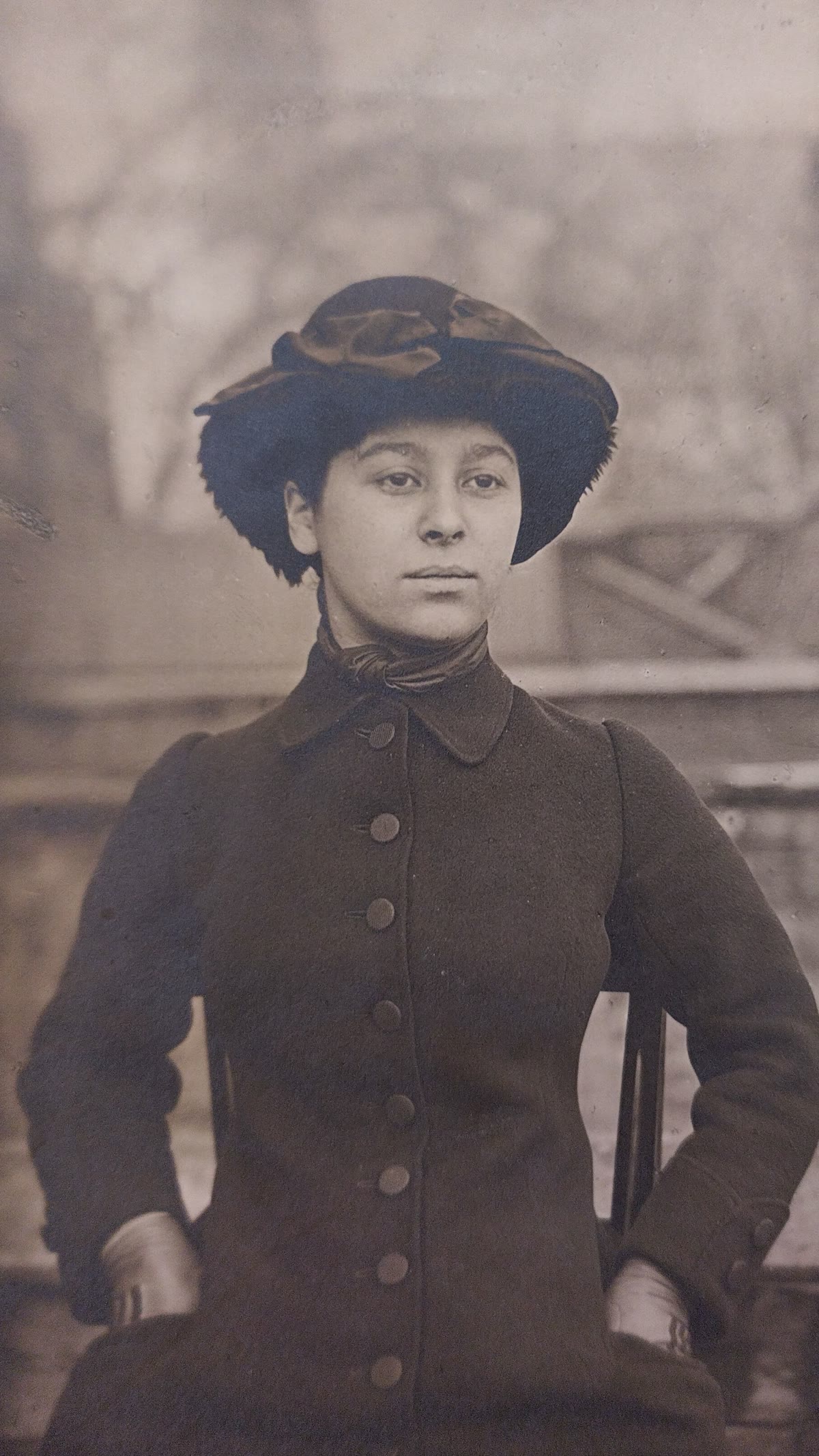
Cambridge University Library acquired Levy's long-private personal archive in late 2024 and opened it to researchers in 2025. The collection includes letters, manuscripts, sketches, a final-year diary, and photographs. Among the images is the studio portrait used here: Levy seated in a dark coat and broad hat, her arms set against the chair and her gaze directed toward the apparatus.[5]
It would be too neat to treat the photograph as a key that unlocks the novel. Its date and maker are not supplied on the Library's public page, and a posed portrait cannot tell us what Levy thought while sitting. Its relevance is formal, not biographical proof. Here is a writer who made looking one of her novel's central problems, returned to view as the subject of a photographer's composition.
The archive's arrival also revises a familiar kind of profile. Levy has often been compressed into labels—New Woman, Jewish writer, queer precursor, tragic young poet—or into the brevity of her life. Those contexts matter, but The Romance of a Shop asks us to attend to what she built. She places a joke in a mourning studio, cash anxiety beside aesthetic ambition, a kitchen above a shop, a woman behind a lens and another woman before a canvas. Then she refuses to let any single position become the whole truth.
Amy Levy made every camera face two ways. The achievement is not that her working women escape being seen. It is that the novel lets them look, work, earn, misjudge, and continue while showing exactly what public visibility costs.
Sources
- Amy Levy, The Romance of a Shop (1888), Project Gutenberg HTML edition—primary text used for chapter references, short quotations, and the epilogue.
- Mavis Chia-Chieh Tseng, “Who's Afraid of Women Photographers? Redefining Gender, Gaze, and Photography in Amy Levy's The Romance of a Shop,” in Women's Emancipation Writing at the Fin de Siècle (Routledge, 2018)—peer-reviewed chapter record and abstract on photography, independence, and women's access to urban space.
- Elizabeth F. Evans, “We Are Photographers, Not Mountebanks!: Spectacle, Commercial Space, and the New Public Woman,” in Amy Levy: Critical Essays (Ohio University Press, 2010), pp. 25–46—analysis of the sisters as image-makers and public spectacles.
- David Wanczyk, “Framing Gertrude: Photographic Narration and the Subjectivity of the Artist-Observer in Levy's The Romance of a Shop,” Victorian Literature and Culture 43, no. 1 (2015), pp. 131–48—analysis of photographic vision, framing, and Gertrude's limited agency.
- Cambridge University Library, “Sequel to a Reminiscence” (November 13, 2025)—official account of the Amy Levy Archive's acquisition and opening, with the archival studio portrait used as this article's image.