Sadeq Hedayat's narrator does not begin The Blind Owl by asking the public to believe him. On the official Grove page for D. P. Costello's English translation, he says, “I am writing only for my shadow.” The shadow leans over the wall as if it were consuming the words.[1] That is more than a declaration of loneliness. It is the novella's first structural instruction: the story is addressed to an image made by the storyteller's own body, distorted by light, and unable to answer.
Everything that follows obeys that rule. A pen-case painter repeats one miniature scene until he sees it outside his work. An old man, a young woman, a stream, a cypress, a flower, a knife, a vase, and a grating laugh recur in altered relations. The narrative breaks across a one-page hinge and seems to begin again in a coarser world. The figures look familiar, yet no second version settles what the first one meant.[2][3]
The result is often called dreamlike, but that word can make the book sound loose. The Blind Owl is tightly made. Its two unequal parts behave like impressions pulled from the same damaged plate: each carries the design, each changes its pressure, and neither can claim to be the clean original. Hedayat does not conceal a normal chronology behind a mist of symbols. He builds a form in which copying is the event.
This essay discusses the novella's complete design, including its ending.
The first copy was already a physical repetition
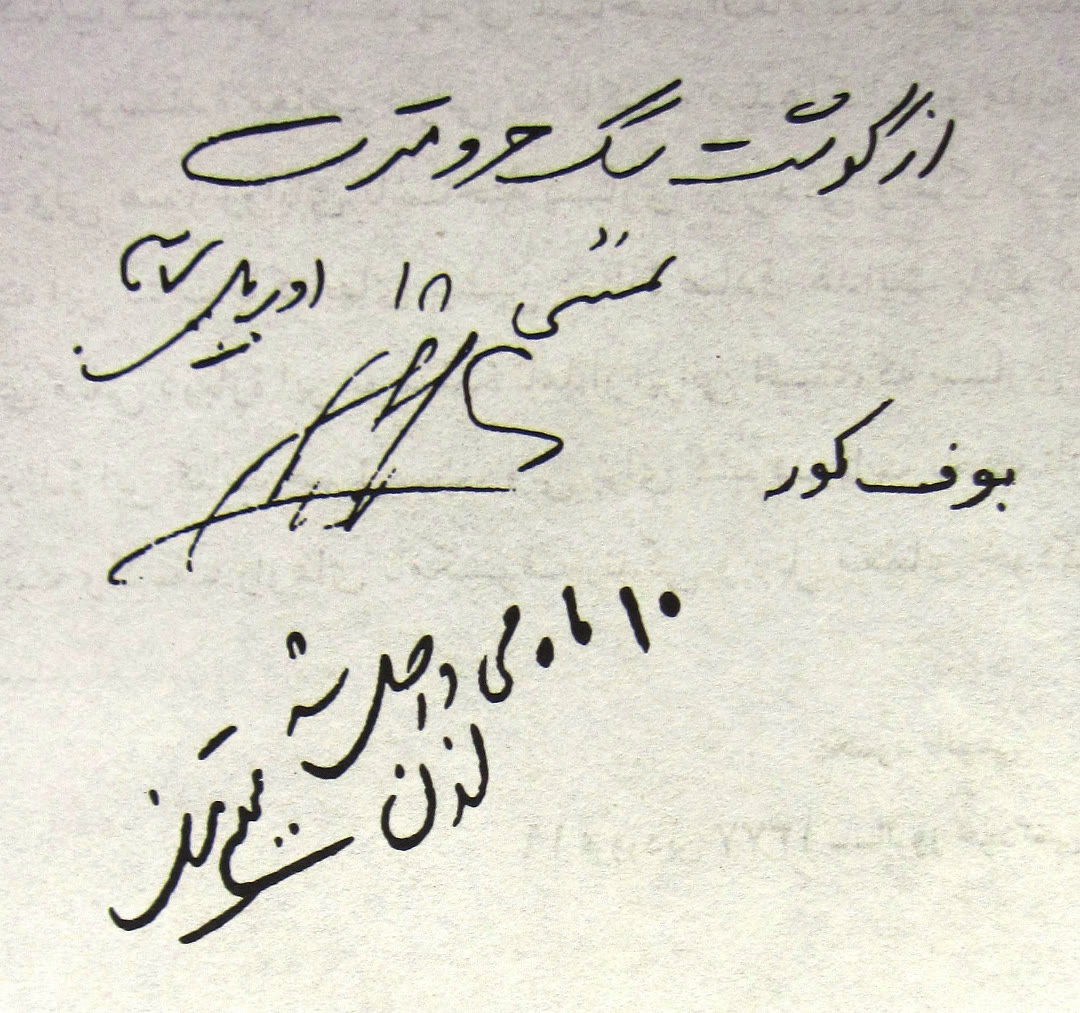
The book's publication history makes an unusually apt threshold to its form. Hedayat produced The Blind Owl in Bombay in 1936–37 as fifty handwritten, stenciled copies and distributed them among friends outside Persia. He had considered publication in Persia impossible at the time. After his return, the work was serialized in Tehran in 1941 and then issued in book form.[3][4]
The article image is a photograph of Hedayat's own handwriting on a copy sent from Bombay to the scholar Mojtaba Minovi in London, dated 18 April 1937.[6] It is not a generic manuscript sample. It belongs to the novella's first circulation: hand, stencil, copy, friend, distance. Before readers meet a painter condemned to reproduce one scene, they meet a book that entered the world through deliberate reproduction.
That does not mean the printing method explains the fiction. It gives the fiction's obsession a material echo. A stencil preserves form by repeating it, but each impression also carries the possibility of blur, pressure, and loss. The Blind Owl treats memory in much the same way. The narrator insists that something happened to him, yet every attempt to preserve it alters its edges.
The pen-case miniature contains the whole machine
In the first part, the narrator paints the same scene on every pen case: an old man sits beneath a cypress tree, separated by a stream from a young woman in black who bends to offer him a water lily.[2][3] He claims not to have chosen the design. His hand simply keeps producing it.
Then the wall of his room opens onto a view that resembles the painting. The copied image appears to have preceded an experience that now looks like its source. This reversal matters. In a conventional uncanny tale, art might predict reality or reality might explain art. Here the order cannot hold still. Did the narrator paint a memory he had suppressed, rehearse an event not yet lived, or force what he sees into the only pattern he possesses? The book offers evidence for all three motions and certifies none of them.
The miniature is therefore not just one symbol among many. It is a compact model of the narrative. It fixes characters into positions—old man here, woman there, water between—while repetition drains those positions of stable identity. The more often the scene returns, the less confidently a reader can say who the old man or the woman finally is.
The painter's trade sharpens the effect. He decorates useful objects with the same private picture. Art becomes both mechanical labor and compulsion. The image travels on cases made to hold writing instruments, while the narrator's own writing remains trapped in a room with a shadow. The book keeps crossing media—painting, handwriting, voice, printed copy—without finding one medium that can guarantee truth.
The hinge does not wake the dreamer
The Penguin Classics description identifies a two-part story joined by a one-page transition. At that turn, the narrator is bloodied and waiting for the police; the second part then appears to expose grim realities beneath the first part's haze.[2] “Appears” is the necessary word.
Part two changes the social texture. The ethereal woman becomes a wife the narrator describes with hostility. The supernatural old man acquires ordinary and familial versions. Desire becomes domestic resentment; an impossible corpse gives way to a killing enacted in bed. The earlier miniature seems to be translated into the vocabulary of marriage, kinship, appetite, jealousy, illness, and the old city of Ray.[3]
Yet translation is not solution. The second part repeats the first part's figures while redistributing their qualities. The same laugh moves between mouths. Faces inherit one another's expressions. The narrator becomes like the old man he fears. The woman's eye passes from object of adoration to an object held in a bloody hand. If the later section were simply the waking explanation of the earlier dream, these correspondences would reduce uncertainty. Instead they multiply it.
That is why the hinge is so powerful. It does not divide fantasy from reality; it changes the cost of the same design. In part one, repetition has the terrible beauty of an image encountered beyond the frame. In part two, it becomes degradation, bodily violence, and inheritance. The second half does not reveal what the symbols stand for. It asks what happens when the first half's aesthetic distance collapses.
Characters become positions before they become people
Encyclopaedia Iranica notes the book's persistent doublings: young and old, spiritual and physical, male and female, attractive and repellent. It also summarizes two incompatible possibilities. Perhaps a small set of characters appears in divided aspects; perhaps the narrator alone generates the surrounding figures.[3]
The form keeps both possibilities alive because character in The Blind Owl is less a roster than a set of positions. Someone looks, someone displays, someone obstructs, someone laughs. A woman crosses the stream but cannot be reached. An old man sits on the other side, then seems to invade the narrator's voice and body. The narrator tries to preserve the woman's eyes in a drawing, but the act of looking is already possessive: he wants an image that cannot look back.
This is where interpretation needs a boundary. The novella has supported psychological, political, cultural, biographical, and comparative readings. Critics have connected its old men to dictatorship, its divided figures to psychic fracture, and its imagery to both Iranian traditions and European Gothic or modernist writing.[3][5] Those contexts widen the work, but no single key makes every recurrence click into place.
My reading is formal rather than diagnostic. The doubles matter because they prevent narrative roles from staying attached to one body. The old man is frightening not only as a possible father, uncle, hearse driver, or future self. He is frightening because the structure lets an attitude migrate. His posture, laugh, and gaze can be copied. Identity becomes another impression pulled from the plate.
The shadow turns confession into a closed circuit
Many first-person narrators write to recover a public account: this happened, I was there, believe me. Hedayat's narrator removes that stabilizer. His chosen reader is his shadow, a projection that knows him only because it is made from him.[1] The address creates a perfect closed circuit. He writes to discover himself, but the only witness available is another version of himself produced by the same light.
The final owl-shape does not solve the title so much as complete the circuit. By the closing pages, narrator, shadow, reader, and owl have folded toward one another. The book has not moved from obscurity to testimony. It has shown testimony being consumed by the figure to whom it is addressed.
That circularity also explains why the repetitions remain pleasurable rather than merely baffling. On a first reading, they generate recognition: the flower, the cypress, the laugh, the eye, the vase. On a second reading, recognition becomes suspicion. A returned image does not confirm what came before; it changes the status of what came before. The reader begins to experience memory as the narrator does—not as storage, but as revision under pressure.
Translation extends the book's design
The novella moved into French in 1953 and English in 1957, and its international reception has accumulated around differently worded versions. Michael Craig Hillmann's Cambridge account calls it the best-known twentieth-century Persian book in Iran and traces a critical afterlife unusually large for a modern Iranian author.[5] The 2022 Penguin Classics edition, translated by Sassan Tabatabai, presents the two-part design in a more conversational, confessional English and won the 2023 Lois Roth Persian Translation Award.[2]
Those facts do not make every translation equivalent. A book so dependent on echoes can change when a repeated word, level of formality, or sentence rhythm changes. Even the narrator's address to the shadow varies across English versions. But translation does not sit outside the book's history. It continues the problem the form has posed from the beginning: how can an image survive another impression without pretending that the copy is neutral?
That is the cleanest way to read The Blind Owl: follow the returns before assigning them meanings. Notice which relation stays fixed, which quality migrates, and what grows more bodily after the hinge. Resist the wish to nominate one half as dream and the other as answer. The book's achievement lies in making that hierarchy impossible.
Hedayat prints the nightmare twice because one telling could still claim innocence. The second telling contaminates the first. By the time the shadow resembles an owl bent over the page, the reader has learned the novella's cruelest formal lesson: repetition does not bring us closer to an original. It reveals that the original was already a copy.
Sources
- Grove Atlantic, The Blind Owl by Sadegh Hedayat, translated by D. P. Costello—publisher page and official excerpt used for the narrator's address to his shadow.
- Penguin Random House, Blind Owl by Sadeq Hedayat, translated by Sassan Tabatabai—edition details, two-part synopsis, one-page transition, and 2023 Lois Roth Persian Translation Award.
- Michael Craig Hillmann, “Būf-e Kūr,” Encyclopaedia Iranica—publication history, plot architecture, repeated imagery, critical approaches, and translation history.
- Homa Katouzian, “Hedayat, Sadeq i. Life and Work,” Encyclopaedia Iranica—biographical context for Bombay, censorship, the fifty handwritten stenciled copies, and Hedayat's study of Middle Persian.
- Michael Hillmann, “The Title of Hedāyat's Būf-e Kūr (The Blind Owl),” in The Necklace of the Pleiades (Amsterdam University Press/Cambridge Core)—translation chronology and international critical reception.
- Wikimedia Commons, “Handwriting of Sadegh Hedayat (Boof-e koor)”—source page for the photographed 18 April 1937 dedication from Hedayat's Bombay edition used as the article image.