The first people in the Popol Vuh seem, for a moment, too successful. Formed from yellow and white maize, they can speak, listen, walk, grasp, and see. Their vision passes through forests and mountains to take in everything under the sky. After several failed creations, the gods have apparently made beings without a blind spot.
Then the gods blur their eyes.
The change can look like a jealous demotion: divine makers discover that their creatures know too much and take knowledge away. But its place in the creation sequence suggests something more exacting. Maize gives the first people viable bodies, intelligible speech, memory, and gratitude. Clouded sight gives them a human scale. They become creatures who must know from somewhere, depend on what lies near, and live with other people whose perspectives they cannot absorb into their own.
In this sequence, humanity is not perfected by approaching omniscience. It is created twice—first out of sustenance, then out of limits.
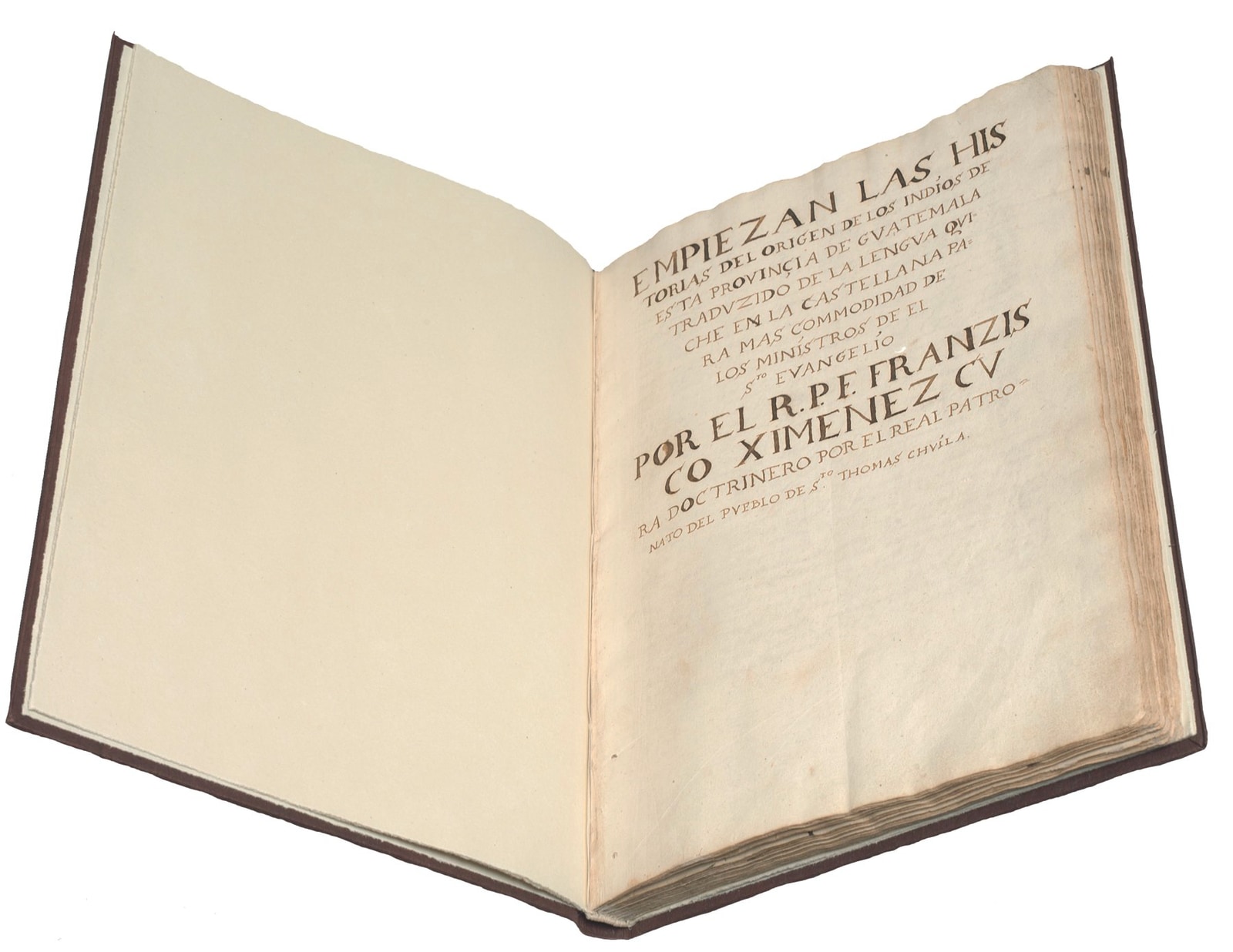
The Popol Vuh, or Popol Wuj, is at once a K'iche' Maya account of creation, a cycle of stories about the Hero Twins, and a history of K'iche' lineages. The best-known surviving witness is Francisco Ximénez's early-eighteenth-century manuscript, which places K'iche' in Latin script beside a Spanish translation. It likely descends from a text written by K'iche' authors in the sixteenth century after an earlier book could no longer be seen.[1][2][3] This essay follows Allen J. Christenson's English translation and commentary, while treating its line breaks and word choices as a mediated route into the K'iche' work rather than a transparent substitute for it.[1][5]
A failed person can still look like one
The creation story does not move directly from lifeless matter to finished humanity. It proceeds by trials, and each trial isolates a different kind of failure.
The animals receive habitats and voices, but their cries do not become mutually intelligible human speech. They cannot call the creators by name. The mud person gets closer: it speaks, but without knowledge; its body softens, collapses, and dissolves in water. The wooden figures look like people, speak like people, and even multiply. Yet they lack heart, mind, blood, and memory. Christenson translates one devastating judgment as: “They walked without purpose.”[1]
Appearance is therefore insufficient, and speech by itself is insufficient. The wooden figures can produce words, but cannot place themselves in relation to a source, a past, or an obligation. Their faces are described as masks. They resemble persons without developing the inward and social capacities that would make resemblance meaningful.
That standard should not be softened into a modern slogan about empathy. The relationship imagined here is unequal. The makers explicitly seek providers and sustainers who will call on them, remember them, and give them reverence; failed beings are violently displaced or destroyed.[1] The story does not hide creation's demand for service. Yet even within that hierarchy, the decisive distinction is relational rather than merely technical. A person must do more than function. A person must remember, understand, address, and answer.
The sequence also keeps revising what “better” means. A body that holds its shape but has no memory is no final advance over mud. A voice that sounds human but cannot recognize another being is not yet human speech. Progress is not an accumulation of features. Each new form is weighed by the kind of world it can enter with others.
Maize makes dependence visible
The successful material is not rare metal, immortal flesh, or light. It is food.
Four animals—fox, coyote, parakeet, and raven—show the gods the route to Paxil and Cayala, where yellow and white ears of maize are found. Xmucane grinds the maize nine times. Mixed with water, it becomes flesh, blood, strength, arms, and legs. The narration presses the point until metaphor feels physical: “Mere food was their flesh.”[1]
That sentence overturns the fantasy that a perfected creature should be self-sufficient. The first people are made from something cultivated, prepared, eaten, and needed again. Their origin is not a resource they leave behind at birth. Food remains the daily condition of being alive.
Even the discovery refuses a solitary maker. Animals reveal the path; a female creator performs the grinding; several deities deliberate together. Michela Elisa Craveri Slaviero's study of the work's rhetoric notes that the maize-creation passage favors coordinated clauses whose actions remain semantically interdependent. Its syntax emphasizes collaboration more than a single, descending chain of command.[4] Form and event agree: humanity comes from assembled knowledge and labor.
There is a particularly sharp reversal in the animals' return. Earlier, animal speech failed the creators' test. Here animals know where human substance can be found. Their inability to name the gods does not make them useless matter waiting for human meaning. They become guides in an act the gods cannot complete alone. That is an inference from the sequence, not an explicit moral announced by it, but it complicates any simple ladder with humans securely above the rest of life.
The broader cultural resonance of maize is larger than this episode. The Metropolitan Museum of Art's guide to Maya divinity describes maize as a staple closely joined to personhood and traces the Maize God's associations with regeneration in ancient Maya art.[6] Those objects come from different periods and regions and should not be used as illustrations of every line in a K'iche' text. They do, however, help resist a thin reading of maize as decorative local color. In the Popol Vuh, material dependence is the dignity of the human body, not an embarrassment the spirit must escape.
Perfect sight is another failed design
The maize people initially appear to satisfy every earlier lack. The first four men have breath, movement, speech, hearing, self-knowledge, and gratitude. They can see what is near and far without traveling. Their knowledge is complete, and they thank the makers who gave them mouths and faces.[1]
The thanks ought to prove that this version works. Instead, it exposes a new problem. The creators hear the men claim knowledge of everything great and small and decide that the result has gone too far. If their sight reaches every limit, the makers reason, their works will equal those of the gods.
So Heart of Sky alters them. Their eyes are “blinded like breath upon the face of a mirror.”[1] They can still see clearly, but only what is nearby. The image is wonderfully precise because breath does not smash the mirror or extinguish vision. It puts a temporary opacity between eye and world. The surface still reflects; the seer simply loses the impossible view from everywhere.
This is not a celebration of ignorance. The wooden figures fail because they cannot understand or remember. The maize people retain speech, listening, thought, movement, and the capacity to learn. What disappears is total knowledge without distance or effort. The text distinguishes a lack of understanding from the limit that gives understanding a location.
The distinction matters philosophically. Omniscience would eliminate testimony: no one could tell the first men something they had not already seen. It would eliminate travel as discovery and make disagreement look only like error. Situated vision, by contrast, creates the need for relation. If the world is clear only where one stands, knowledge must move through listening, memory, encounter, and trust.
The narrative's next movement is from solitary first men to wives, descendants, houses, and nations.[1] It would be too neat to claim that the clouding mechanically causes society, and the episode's gendered account of wives arriving for male progenitors carries its own hierarchy. Still, the order is suggestive. Limit enters before lineage expands. Human history begins not with four all-seeing individuals, but with people who cannot contain the whole world in a single gaze.
The manuscript preserves a work about partial access
The physical afterlife of the Popol Vuh repeats, without resolving, this problem of limited sight. No reader now possesses an untouched original that makes every stage of the work visible at once. The pre-Columbian book is lost. A sixteenth-century K'iche' alphabetic text survives through Ximénez's later transcription and translation; that manuscript then traveled through collectors before reaching Chicago's Newberry Library in the early twentieth century.[1][2][3]
The manuscript's corrections and repetitions have prompted scholars to consider its relationship to oral performance. The Library of Congress catalog describes a work designed for voicing, possibly involving more than one reciter; Craveri likewise reads its parataxis, semantic versification, repeated formulas, and paired expressions as evidence of oral communicative patterns.[3][4] More recent editions have increasingly treated the poetic line as meaningful rather than trimming repetition into smooth prose. The University of Oklahoma Press presents Christenson's literal poetic version as an attempt to preserve phrase, grammar, and structure so that interpretive nuance remains visible.[5]
That reception history offers a useful warning. A modern reader can easily turn the clouded mirror into a universal parable and forget the K'iche' language, colonial danger, communal performance, and editorial decisions that carried it forward. The story's philosophy of limits asks for the opposite posture: interpretation with a known position. We can make an argument about the sequence without claiming the view from everywhere.
The strongest argument the sequence permits is not that human beings should know less. It is that knowledge becomes human when it is embodied, answerable, and incomplete. The mud person cannot endure. The wooden figures cannot remember. The first maize people can know—but at first they know in the manner of gods. Only after the mirror clouds do they inhabit the scale at which memory, conversation, travel, and other lives matter.
The Popol Vuh therefore locates human worth between two failures: vacancy and totality. To have no understanding is to walk without purpose. To see everything is to leave no room for another perspective. A person lives in the harder middle, made from what must be received each day and able to see clearly only from here.
Sources
- Allen J. Christenson, trans. and ed., Popol Vuh: Sacred Book of the Quiché Maya People (2007 electronic edition of the 2003 University of Oklahoma Press volume)—primary English text and commentary, especially pp. 62–71 and 178–188.
- Newberry Library, “Popol Vuh”—research guide to Ayer MS 1515, including manuscript history, conservation, digitization, and the archival photograph used here.
- Library of Congress, “Popol Vuh: Transcription in Quiché Mayan and Translation into Spanish”—catalog record, digital facsimile, physical description, and account of the manuscript's oral and written transmission.
- Michela Elisa Craveri Slaviero, “Las palabras que contaron los antepasados: los recursos retóricos del Popol Vuh,” Estudios de Cultura Maya 26 (2005)—analysis of parataxis, parallelism, oral transmission, and the maize-creation passage.
- University of Oklahoma Press, Popol Vuh: Literal Poetic Version—Translation and Transcription by Allen J. Christenson (2007)—publisher's account of the line-by-line edition and its treatment of K'iche' poetic structure.
- The Metropolitan Museum of Art, “Lives of the Gods: Divinity in Maya Art”—institutional guide to maize, personhood, regeneration, Maya books, and the Popol Wuj in a wider material context.