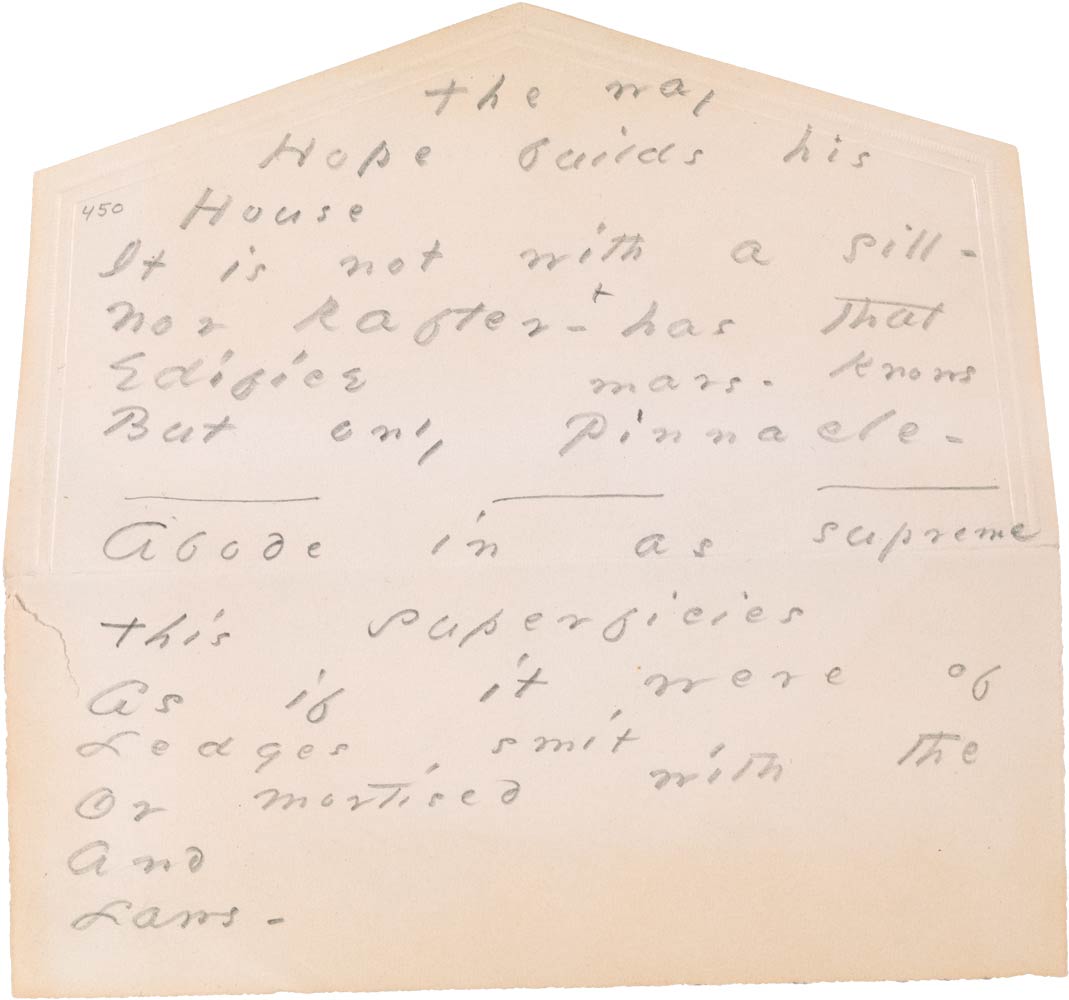

A plain-text transcription can preserve Emily Dickinson's words, dashes, and line breaks while quietly removing part of the poem. Consider “The way Hope builds his House,” written around 1879. The Morgan Library & Museum records that Dickinson took an envelope addressed to “Mrs. Edward Dickinson and Family” and carefully tore it into a unique shape; no other draft survives.[5] Read only as eight lines, the poem builds an edifice without sill or rafter. Seen on the envelope, it also occupies a piece of paper that rises to an irregular peak.
That does not make the manuscript a rebus with one correct visual solution. It does make the page evidence. Its folds, tears, laid lines, address, writing direction, and scale can support or resist a reading just as syntax does.
The best demonstration is a 2012 Woodberry Poetry Room event with Dickinson scholar Marta Werner and poet-artist Jen Bervin. Werner begins from one unusually assembled manuscript; Bervin later shows how facsimile editing can keep the physical object in view without pretending to reproduce it perfectly.[1][7] Their subject is often grouped under the convenient name “envelope poems,” though Werner has cautioned that the label can settle writings whose genres and relations remain uncertain.[2]
Image context: the cover is a color archival image of an actual Dickinson envelope manuscript, not a designed approximation. Its documented postal address and visible torn contour matter to the reading because the poem's house has been written onto a repurposed domestic and postal object.[5]
The Recording
The complete event runs about 56 minutes. The viewing guide below concentrates on four sequences: Werner's handling of manuscript A821 around 3:43, Bervin's account of omitted variants around 35:50, her close attention to envelope forms around 42:10, and the facsimile edition's hierarchy of image and transcription around 48:50.[1]
3:43 — A Poem That Must Be Turned
Werner's exemplary object is A821, the manuscript that supplied the phrase the gorgeous nothings for the later edition. It is not a rectangular leaf with decorative damage around the text. Werner describes two sections of envelope: a larger piece divided by a vertical crease and a smaller, triangular seal corner. A straight pin once held the pieces together. The writing runs in opposing directions across the larger fragment.[1] Bervin's published introduction confirms the manuscript number behind the edition's title.[6]
The physical consequence appears around 7:20. To follow the writing, Werner says, the reader must rotate the fragment through a full circle. A typeset version can choose an order and print the lines upright, but that choice converts a bodily action into an invisible editorial decision. On the object, reading means orienting, losing orientation, and turning again.[1]
Werner interprets the two sides as wings and their movements as a passage between day and night. The analogy is persuasive because the fold, slanted writing, and language of birds reinforce one another. But the video also preserves the boundary between observation and inference. That the fragment has a crease, separate pieces, pinholes, and changing directions is material evidence. That it becomes a bird is a reading of that evidence, vivid but contestable. The distinction is essential: material reading should create more accountable interpretations, not give one metaphor the authority of a laboratory result.
A821 also unsettles the fantasy of a self-contained lyric. One of its lines reappears, altered, in draft letters to Helen Hunt Jackson; its date and provenance remain uncertain.[1][2] Werner therefore treats it as something migrating among poem, letter, fragment, and object. The page contributes to meaning without supplying a final genre label.
35:50 — Variants Are Paths, Not Debris
Bervin approaches the problem through Dickinson's cross marks. In the fascicles, a cross can precede an alternate word, phrase, or line. Reading the variant means moving backward into the poem and trying another route. Bervin explains that earlier print presentation often failed to make these marks, line breaks, and other page features fully visible; her Dickinson Composites enlarges and layers the marks so that their patterned presence cannot be ignored.[1]
The archival history makes that concern concrete. Harvard holds forty hand-sewn fascicles, but early editors disbound them, and none survives exactly as Dickinson left it. The collection records both the contemplated word choices visible in the manuscripts and the physical alteration of the packets after her death.[4] The Emily Dickinson Museum likewise distinguishes among fascicles, loose sets, fragments, copies sent to others, and texts known only through someone else's transcription.[3]
This does not make print an enemy. A readable edition must normalize something: order, scale, orientation, typeface, or the relation between a base word and its alternatives. The problem begins when normalization presents itself as mere transfer. Bervin's crosses reveal that a seemingly clean line may be one route through a field of live possibilities.
42:10 — “Scrap” Describes Material, Not Value
When Bervin turns to the envelope writings, she pauses over the word scrap. It can accurately name reused or torn paper, but it can also imply that the writing is negligible or accidental. Her alternative is to attend to scale, cut, fold, and surface before deciding what kind of literary object is present.[1][6]
Around 44:30, she makes a simple test available to any viewer: open an ordinary envelope and try to reproduce the displayed shapes. The surviving pieces are not merely envelopes unfolded along every manufactured seam. Some were slit, cut, separated, or joined; in several, Dickinson angled her writing in relation to the paper's laid lines. Bervin describes the material vocabulary as epistolary and notes the double function of an envelope as a pocket, capable of being opened flat and folded private again.[1][6]
The cover manuscript makes the method visible on a smaller scale. Its poem begins:
The way Hope builds his House
It is not with a sill –
Nor Rafter – has that Edifice
But only Pinnacle –
The torn envelope does not illustrate every noun. There is no drawn sill or rafter. Instead, the material creates pressure around “Pinnacle”: the word names a structure defined by its summit while the writing surface itself has been cut into a peaked, unstable outline.[5] Hope's house is all upper limit and no conventional support; the object gives that paradox a contour.
Restraint matters here. The museum notes that folds can suggest a sheet may once have been intended for a recipient and that fragments can range from reused paper to partial ideas or less-finished work.[3] Shape alone cannot prove that Dickinson prepared every piece as a finished visual poem or anticipated a modern facsimile edition. The stronger claim is narrower: once those features survive, an edition and a reader should disclose rather than erase them.
48:50 — A Transcription Should Point Back
Bervin describes the first edition of The Gorgeous Nothings as a portfolio of full-color prints at actual scale, showing front and back. Its typographic transcriptions were designed as keys: aids that send the reader back to the manuscript, secondary to the object rather than replacements for it.[1] The subsequent New Directions edition presents all 52 surviving envelope writings life-size in color with accompanying transcriptions.[7]
Scale is not a luxury detail. A screen can enlarge a two-inch fragment until it resembles a poster, while a conventional book can shrink a larger sheet to fit a page. Either change affects how the eye understands blank space, handwriting, and the effort required to turn or hold the object. Harvard's online collection partly answers the access problem by making color digital facsimiles of nearly all surviving poetry manuscripts available for browsing and zooming.[4] Digital access improves inspection, but the zoom control still needs a stated scale.
At about 50:55, Bervin reveals how much construction is involved in making a facsimile look immediate: months were spent removing the photographed background around the fragments so that each appeared to float on the printed sheet. Readers reportedly touch the reproduction to test the illusion.[1] This is a useful editorial confession. Even a photograph is not transparent; cropping, background removal, color, paper stock, sequencing, and recto-verso arrangement frame what the reader sees.
The right response is neither to reject transcription nor to worship the artifact. It is to make the layers legible. A strong edition lets a reader distinguish Dickinson's marks from an editor's line drawing, an archival photograph from a cleaned reproduction, and an observed fold from a critic's metaphor. Werner and Bervin's recording is valuable because it exposes those layers while the pages are on screen and the interpretive choices are being spoken aloud.
What to Carry Back to Other Poems
The lesson travels beyond Dickinson. Before quoting any manuscript poem as settled text, ask five questions: What is the writing surface? Which way must it be held? Do words continue across a fold or onto the reverse? Which marks have been classified as punctuation, variants, damage, or noise? Has reproduction altered the object's scale?
Those questions do not replace close reading; they make it closer. Dickinson's envelope writings still require attention to diction, rhythm, metaphor, and grammar. They also show that grammar can have a hinge, a torn edge, or a pinhole. The page is not scenery behind the sentence. Sometimes it is one of the sentence's moving parts.
Sources
- Harvard University, “THE GORGEOUS NOTHINGS: Emily Dickinson's Envelope-Poems | Woodberry Poetry Room,” full event video on YouTube.
- The Editors, “Unsettling Emily Dickinson,” interview with Marta Werner, Poetry Foundation, October 17, 2013.
- Emily Dickinson Museum, “The Manuscripts,” overview of fascicles, sets, fragments, copies, and surviving manuscript evidence.
- Harvard Library, “The Emily Dickinson Collection,” Houghton Library collection history and digital-facsimile access.
- The Morgan Library & Museum, “The way Hope builds his House,” online exhibition record and archival manuscript image from Amherst College Archives & Special Collections.
- Jen Bervin and Emily Dickinson, “Studies in Scale,” Poetry Foundation, November 1, 2013.
- New Directions, The Gorgeous Nothings by Emily Dickinson, edited by Jen Bervin and Marta Werner — edition description and publication data.