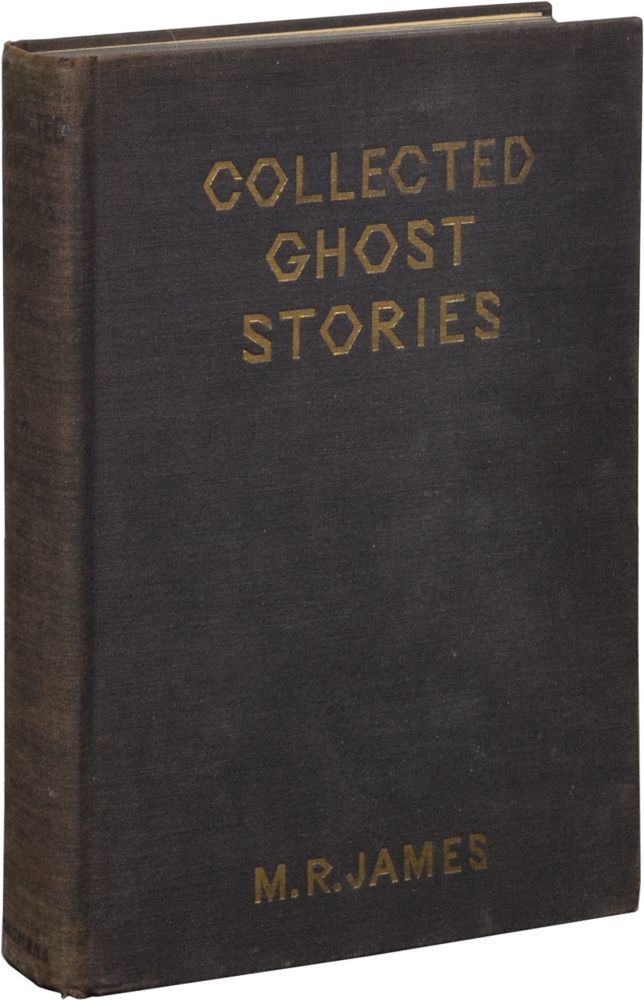
Many ghost stories ask whether a supernatural thing exists. M. R. James asks a more unnerving question: who has it now?
In “Oh, Whistle, and I'll Come to You, My Lad,” published in Ghost Stories of an Antiquary in 1904, Professor Parkins removes a bronze whistle from a cavity at a ruined Templar site, cleans it, pockets it, and blows it. In “Casting the Runes,” collected seven years later, the scholar Edward Dunning accepts a bundle of papers in the British Museum and unknowingly takes custody of a runic slip planted inside it. One object is found; the other is handed over. Both make possession into a supernatural fact.[1][2][3]
Read together, the tales reveal that James's famous cursed objects are not merely props that release monsters. They obey procedures. The whistle answers removal and use; the runes answer transfer. Rescue in the first story means throwing the object beyond anyone's reach. Rescue in the second requires returning it to its malicious sender through the same choreography of offer and acceptance. James makes horror out of chain of custody: the apparently neutral passage of a thing from earth to pocket, hand to hand, portfolio to ticket case.
One object is taken; the other is given
Parkins encounters the whistle while doing a favor for an antiquarian colleague. On a winter golf trip to Burnstow, he inspects the remains of a preceptory near the beach. He scrapes at a mound with his knife, opens a small rectangular cavity in the masonry, reaches inside, and removes a metal tube. The action is casual enough to feel innocent, but James gives it the verbs of an excavation without its safeguards: scrape, probe, withdraw, pocket. Parkins records the dimensions of the site yet never records the object's position before disturbing it. Context becomes souvenir.[1]
“Casting the Runes” begins at the opposite end of scholarly procedure. An association rejects Mr Karswell's proposed paper on alchemy after Dunning judges it worthless. The review is confidential, but Karswell traces the reviewer through the British Museum, where Dunning consults alchemical manuscripts. He engineers a dropped portfolio, returns a missing quire, and receives Dunning's polite confirmation that the papers are his. Only later does a narrow sheet marked in red and black flutter from the bundle.[2]
The contrast matters. Parkins creates his own exposure by taking an object out of place. Dunning is targeted because he has done his professional work correctly. Patrick J. Murphy's study of James argues that the author's medieval scholarship and ghost fiction illuminate one another, especially around the unstable boundary between disciplined academic practice and erratic antiquarianism.[4] These two stories distribute that tension rather than turning it into a simple warning against curiosity. The amateur excavator behaves carelessly and survives; the responsible evaluator becomes the victim of a man whose bad scholarship conceals effective malice.
The whistle turns interpretation into invitation
James does not make the causal boundary perfectly neat. After Parkins pockets the whistle but before he blows it, he notices an indistinct person struggling along the shore behind him without appearing to come closer. Taking the object may already have opened the relation. Back at the hotel, he empties its caked sand and discovers two inscriptions. He cannot solve the shorter one. The longer seems to mean “Who is this who is coming?” His answer is not further research but an experiment: he blows.[1]
This is the story's sharpest joke, and its governing error. Parkins believes himself a rigorous disbeliever in the supernatural, yet his method is the reverse of rigor. He strips an artifact of context, only partly reads its warning, and activates it before forming a hypothesis. The whistle's question is performative: to sound it is already to request an answer. Interpretation and invitation collapse into the same breath.
The response first enlarges the object's range. A little note seems audible for miles; wind strikes the casement; Parkins sees a mental picture of a distant figure on the shore. Then the haunting contracts into his room. The unused bed is found disordered. A boy sees something white signaling from the locked window. At night the spare bedding rises and approaches Parkins with a “face of crumpled linen.”[1]
That linen body is more than an economical monster. The summoned thing possesses no stable material of its own; it takes temporary form from whatever is available in the room. Parkins has transported a buried instrument into a hotel, and the haunting answers by turning hotel property into a body. The object does not bring an intact medieval ghost forward like cargo. It gives an old command access to new matter.
Even after the evidence accumulates, Parkins imagines taking the whistle back to Cambridge and perhaps presenting it to a museum. His reflex is accession: if an object is puzzling, move it into an institution that can classify and preserve it. Colonel Wilson proposes the cruder but wiser remedy—“live and learn”—and, after rescuing Parkins, throws the whistle into the sea while the bedclothes are burned.[1] The ending breaks the chain rather than repairing it. No one else must inherit the question.
The runes turn courtesy into a contract
“Casting the Runes” makes the handoff itself the ritual. Karswell's first victim, John Harrington, accepts a concert program from a stranger and later finds the runic strip inside. The paper burns before he can return it. A calendar then loses every date after the appointed day, while an impossible tram advertisement informs Dunning that “Three months were allowed.” The curse spreads its deadline across programs, calendars, advertisements, portfolios, correspondence, and print.[2]
This proliferation changes the story's rhythm. “Oh, Whistle” moves from discovery to apparition; “Casting the Runes” becomes an investigation into transmission. Henry Harrington compares his brother's experience with Dunning's. The two men infer a rule: hiding, copying, or destroying the paper will not do. It must go back to its source by “personal service,” and Karswell must take it as knowingly as either victim did.[2]
James then converts supernatural horror into a procedural thriller. On the boat train to Dover, Karswell leaves a ticket case behind. Dunning slips the runes into its cover, waits for him to return, and says, “May I give you this? I believe it is yours.” Karswell inspects the ticket and accepts.[2] The ordinary civility of the exchange is the mechanism. A coat pocket or open bag would be insufficient because covert placement would transfer location, not custody.
The scene reverses the British Museum encounter almost word for word. Dunning survives by repeating Karswell's social form more precisely than Karswell anticipates. Scholarship helps here not as mastery of occult symbols—the runes remain unreadable—but as comparison, testimony, and reconstruction. Dunning and Harrington establish provenance from two cases, identify the decisive action, and reproduce it under controlled conditions.
Their success is morally dirty. Returning the paper means assigning death back to the man who sent it. After Karswell boards the boat with an unseen companion, Dunning and Harrington wonder whether they have been justified and send telegrams warning him to examine the ticket case. The warning may never reach him; a falling stone kills him at Abbeville.[2] Unlike the whistle, the runic strip is never shown being destroyed. The story ends with one transfer completed and the larger apparatus still imaginable. Evil has a sender, but the procedure outlives him.
Two kinds of scholarly blindness
James knew the physical routines he was fictionalizing. Cambridge University Library's Special Collections account describes the manuscript catalogues he produced between 1895 and 1914 and notes that his stories repeatedly join a scholar, a characterful setting, and an antiquarian object.[3] A modern institutional history of his work similarly emphasizes that ancient objects in these tales reactivate violent histories when disturbed.[5] Biography does not decode the fiction, but it clarifies why James is so exact about containers, labels, papers, pockets, collections, and the small gestures by which objects change hands.
Parkins's blindness is confidence without provenance. He treats the whistle as a self-contained specimen and assumes that its meaning can be separated from where and how it was kept. His skepticism is not wrong because skepticism itself is foolish; it is wrong because he calls an impulsive trial an experiment and keeps explaining away results that should change his method.
Dunning's vulnerability is more disturbing because professional care cannot protect him. Confidential review, specialist knowledge, and library access create the trail Karswell follows. Yet Dunning survives once knowledge becomes collective. A tram conductor preserves an anomalous observation. A colleague listens. Mrs Gayton proposes contacting Harrington. Harrington supplies the earlier case. The solution emerges from witnesses whose evidence crosses class, household, family, and institution.[2] No solitary expert understands the curse; a network does.
The supporting figures make the same point in different registers. Colonel Wilson's folklore and practical attention initially look ridiculous beside Parkins's polished lecture. Harrington's grief and memory lack Dunning's specialist authority. Both men nevertheless know that an object's history includes what people have done with it. They restore relations that the scholars' private reasoning cannot see.
The horror is in the handoff
The two stories finally offer opposite solutions to the same material problem. The whistle must cease to be possessed. The runes must be accepted back by their sender. One ending abolishes custody; the other corrects it.
That difference explains why James's objects retain their force even after their monsters have become familiar. A bronze whistle and a strip of paper are small, portable, and almost empty of spectacle. Their terror lies in how readily they enter ordinary systems: a museum-minded pocket, a library portfolio, a train compartment, the reflex to return what someone appears to have dropped. The supernatural does not overthrow the rules of handling. It hides inside them.
James leaves the reader with a peculiarly durable suspicion. An object may have a provenance even when we do not know it, and acceptance may carry obligations no label discloses. Before the apparition comes, someone always picks something up—and says, in effect, that it is theirs.
Sources
- M. R. James, Ghost Stories of an Antiquary, Project Gutenberg eBook no. 8486—full text and publication record for “Oh, Whistle, and I'll Come to You, My Lad.”
- M. R. James, Ghost Stories of an Antiquary Part 2: More Ghost Stories, Project Gutenberg eBook no. 9629—full text and publication record for “Casting the Runes.”
- Liam Sims, “The ghostly world of M. R. James,” Cambridge University Library Special Collections, 12 June 2015—James's manuscript catalogues, institutional career, oral storytelling, and collection chronology.
- Patrick J. Murphy, Medieval Studies and the Ghost Stories of M. R. James, Penn State University Press, 2017—JSTOR book record and chapter overview on the relation between James's scholarship and fiction.
- Birkbeck Institutional Research Online, record and abstract for The Ghost Stories of M. R. James, British Library Press, 2018—critical framing of disturbed antiquarian objects, repression, and escalating dread.
- Wikimedia Commons, “File: Collected Ghost Stories - MR James.jpg”—archival photograph and metadata for the 1931 first-edition cover used as the article image.