Charles Baudelaire's L’Invitation au voyage is one of those poems that English readers half-remember too easily. The refrain looks portable, the room looks luxurious, the canals look still, and the whole thing can start to resemble a tasteful dream of escape. But the French poem is sharper than that memory. Its invitation works because tenderness, arrangement, and sensuality keep pulling against one another. Translation goes wrong the moment one of those pressures is smoothed into atmosphere.[1][2]
That is also why the poem has lasted so visibly beyond the page. Poetry Foundation's overview of Baudelaire places him at the center of modern poetry's formation, a writer whose formal control carried modern themes and later influenced modernism.[3] A. S. Kline's study of Baudelaire stresses the poet's appetite for the infinite, that Romantic hunger for elsewhere which he both inherited and disciplined.[4] L’Invitation au voyage sits exactly at that crossing. It offers an elsewhere, but not a vague one. Baudelaire builds it through address, furniture, mirrors, ships, and a refrain whose composure is inseparable from desire.[1]
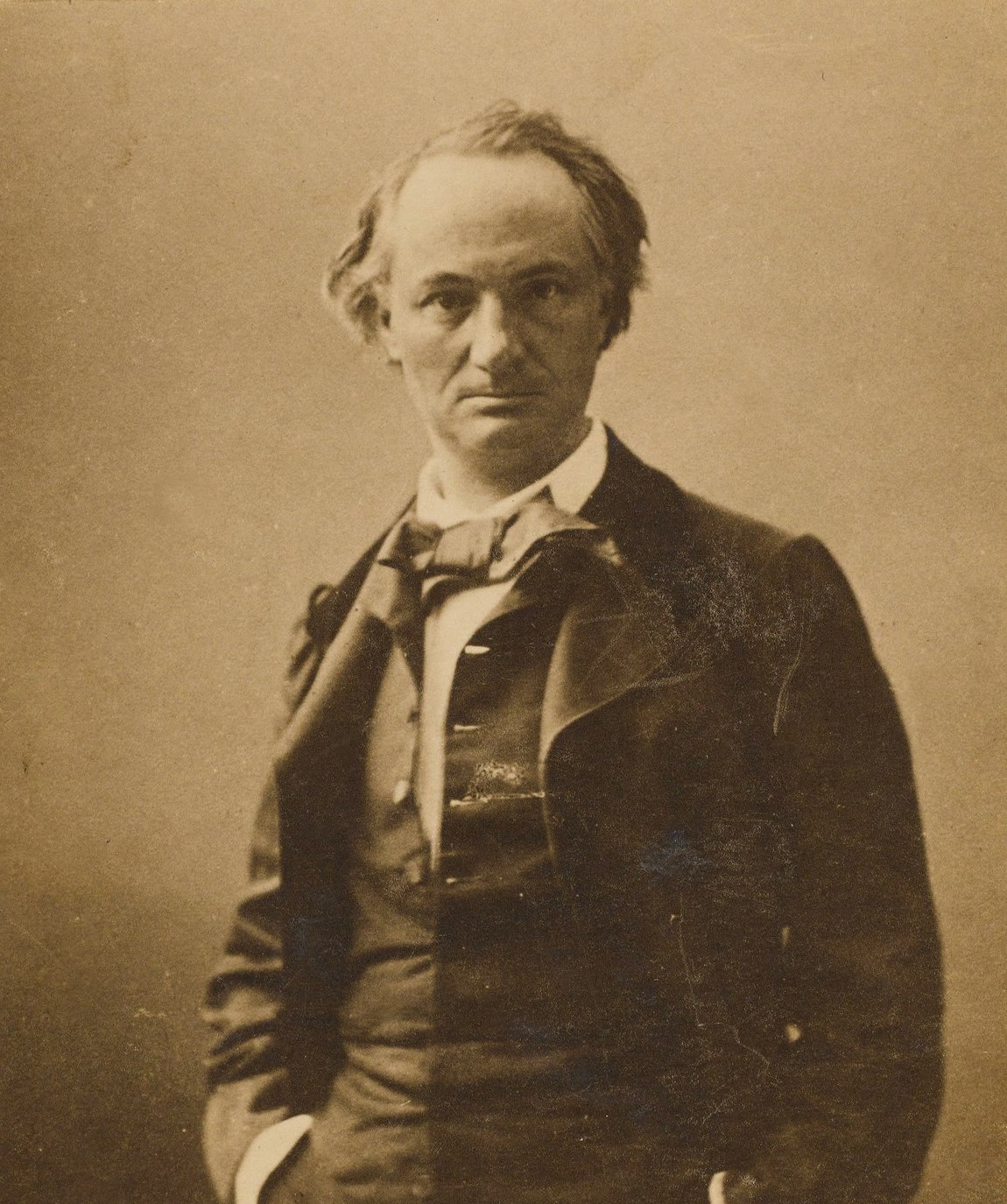
Image context: the cover uses a real 1855 portrait photograph by Nadar rather than an illustrated seascape or an art-historical detail from Matisse. That choice keeps the essay with the poet's own surface: elegant, controlled, and faintly severe. The poem does not offer paradise innocently; it offers it through a mind arranging desire with almost unnerving precision.[6]
1) "Mon enfant, ma soeur" should not become a generic love opening
The first translation trap arrives before the dream-country appears. Baudelaire begins, "Mon enfant, ma soeur."[1] That doubleness matters. The address is intimate, but it is not simple courtship language. "My child, my sister" is strange in English, yet the strangeness is part of the point. The speaker is not only wooing. He is placing the beloved inside a private kinship of likeness, protection, and impossible nearness.
William Aggeler keeps the oddness with "My child, my sister," and gains something important from that decision.[2] The phrase remains tender and slightly disorienting. Other English versions are tempted to relax it into something more conventionally lyrical, but relaxation is a loss here. The poem's first move is to make desire sound familial without becoming domestic in the ordinary sense. It turns intimacy into a closed circuit before the invitation has even named its destination.[1][2]
That also clarifies the line "Au pays qui te ressemble."[1] The country is not just beautiful. It resembles the beloved. The promised elsewhere is therefore less a travel brochure than an extension of her image, or perhaps of the speaker's wish to inhabit an environment tuned to her scale. Translation needs to keep that eerie fit. If the opening becomes merely romantic, the whole poem grows blander than Baudelaire meant it to be.
2) "Ordre et beauté" is arrangement, not tidiness
The refrain's first half is often translated with a misleading ease. "Là, tout n'est qu'ordre et beauté" sounds close enough to English that translators can become complacent.[1] Yet "order" here is not bureaucratic tidiness, and "beauty" is not a free-floating compliment. The line names a world in which sensual experience has been arranged into composure. That is why the next stanza can move so naturally into shining furniture, polished surfaces, mirrors, and "la splendeur orientale."[1]
Aggeler's "There all is order and beauty" is plain, and plainness serves him well.[2] It keeps the architecture of the line visible. By contrast, versions that veer toward "symmetry" or "loveliness" make the place sound either too geometric or too soft.[2] Baudelaire's paradise is softer than a system and harder than a sentimental room. It is an environment where every object seems to have been placed until desire itself can breathe more evenly.
That pressure toward arrangement matters for the poem's modern afterlife. The dream-country is seductive because it does not promise wild freedom. It promises a controlled abundance, a chamber in which feeling can recognize itself in objects. The furniture is gleaming because time has polished it. The mirrors are deep because the room is built for reflection, not clutter. Translation has to preserve that sense that beauty here is organized, almost curated, rather than merely abundant.[1][2]
3) "Luxe, calme et volupté" cannot lose the body
The second half of the refrain is where many English versions become too tasteful. "Luxe" is easy enough. "Calme" can become calm, peace, or quiet. The real hinge is "volupté."[1] If that word is thinned into pleasure alone, the poem loses its temperature. Baudelaire wants a word with bodily density in it, something slower and richer than happiness and less innocent than delight.
That is why the translation page at Fleurs du mal is so instructive. Aggeler ends the refrain "Luxury, peace, and pleasure," which is lucid but somewhat cooling.[2] Another version keeps "Voluptuousness, calm and luxury," sounding awkward but refusing to evacuate the body's role in the line.[2] A third offers "Luxury, calm and voluptuousness," which is heavy in English, yet the heaviness is productive because Baudelaire's French is not airy at this point. The line should feel upholstered, scented, and faintly overripe.
The translation problem is not simply lexical. It is structural. If "ordre et beauté" gives the place its composure, "luxe, calme et volupté" prevents that composure from turning sterile. The room is arranged, but not ascetic. The beloved is invited into repose, but not into moral cleanliness. Baudelaire's softness is dangerous because it is fully furnished by appetite.[1][2][4]
Kline's phrase about Baudelaire's "longing for the infinite" helps here.[4] The poem is not trying to reach infinity through sublimity or terror. It reaches through sensuous completion: amber scent, deep mirrors, warm light, and the fantasy that the soul might hear its "douce langue natale" in the midst of all this artifice.[1] Translation has to keep both the repose and the appetite, or the refrain collapses into decor.
4) The poem's stillness is built from secret speech and moving ships
One of Baudelaire's cleverest moves is that the dream-country never becomes fully static. In the middle stanza, "Tout y parlerait / À l'âme en secret / Sa douce langue natale."[1] Everything there would speak to the soul in secret, in its sweet native language. Aggeler's "All would whisper there / Secretly to the soul / In its soft, native language" is strong because it keeps both secrecy and inward recognition.[2]
That secrecy matters. The room is luxurious, but the poem's real promise is legibility. In this invented country, the soul would no longer be estranged from its surroundings. Objects would speak back in a language it already knows. That is a much stranger fantasy than expensive furniture. It is a fantasy of perfect atmospheric translation, where world and inward life no longer misread each other.[1][2]
Then Baudelaire adds the ships: "Vois sur ces canaux / Dormir ces vaisseaux / Dont l'humeur est vagabonde."[1] This is the point where a merely decorative reading breaks down. The vessels are asleep, but their temperament remains wandering. They come "du bout du monde" to satisfy the beloved's slightest desire.[1] Motion survives inside repose. World commerce, distance, and appetite all remain active beneath the room's calm.
That tension is essential to the poem's power. The invitation is not to a sealed toy world. It is to a place where movement has been domesticated without being abolished. The ships still carry the ends of the earth into the canal. The sunset still dresses the city in hyacinth and gold. Even the final warmth is a composed version of flux.[1][2] Translation should therefore avoid making the poem too restful. The fantasy works because wandering has been absorbed into order, not because wandering has disappeared.
5) The refrain survived because it names a dream with edges
The poem's later life in painting helps show what translators are trying to protect. The Metropolitan Museum notes that Matisse titled his 1904 Neo-Impressionist masterpiece Luxe, calme et volupté after Baudelaire's poem.[5] That borrowing is revealing. Matisse did not take the line because it names comfort in a generic way. He took it because Baudelaire's words balance sensuous fullness with formal control, exactly the kind of tension a modern painter could reimagine.
Poetry Foundation's account of Baudelaire's impact on modernism belongs here as well.[3] The poem endures because it is not merely lush. It is exact. It arranges desire until it becomes a portable formula without ceasing to feel dangerous. The refrain can travel into painting and criticism because each noun resists simplification. "Order" is not discipline alone. "Calm" is not emptiness. "Volupté" is not just pleasure. Together they name a dream whose serenity is inseparable from artifice and appetite.[1][2][5]
That is the standard an English translation has to meet. It does not need to sound identical in every register, and no version can preserve every pressure at once. But it does need to keep the opening's odd intimacy, the refrain's arranged beauty, the bodily weight of "volupté," and the secret reciprocity between soul and world.[1][2] Once those pressures remain visible, L’Invitation au voyage stops looking like a tasteful escape hatch and starts sounding like what it is: one of Baudelaire's most controlled, seductive, and quietly unnerving designs.
Sources
- Charles Baudelaire, "L’Invitation au voyage" in Les Fleurs du mal (1861), French text at Wikisource.
- Charles Baudelaire, "L'Invitation au voyage (Invitation to the Voyage)" with multiple English translations at Fleurs du mal / Flowers of Evil.
- Poetry Foundation, "Charles Baudelaire" (biographical note on his formal control and influence on modernism).
- A. S. Kline, Voyage To Modernity: A Study of the poetry of Charles Baudelaire (essay on Baudelaire's Romantic inheritance and longing for the infinite).
- The Metropolitan Museum of Art, "Henri Matisse (1869-1954)" (essay noting that Luxe, calme et volupté takes its title from Baudelaire's poem).
- Wikimedia Commons, "File:Charles Baudelaire.jpg" (source page for the 1855 Nadar portrait used as the article image).