The easiest way to misread The Tale of the Bamboo Cutter is to treat it as a delicate fairy tale that becomes tragic only at the end. The outline encourages that mistake: an old bamboo cutter finds a tiny radiant girl inside a stalk of bamboo; she grows into Princess Kaguya; noble suitors fail to win her; the emperor also loses her; moon beings arrive and take her away.[1][3] It sounds like a sequence of marvels, and the marvels are real. But the tale is sharper when read as a book about incompatible claims: household love, courtly possession, social rank, impossible proof, imperial desire, and a celestial origin that cancels every earthly arrangement without making earthly grief unreal.
For a first reading, do not rush toward the moon. Begin with the middle: the impossible tasks. They are the tale's best entrance because they teach the reader how Kaguya's world works. Each suitor wants to convert beauty into marriage, rank into entitlement, and performance into proof. Kaguya answers by asking for objects that cannot honestly be brought: sacred, legendary, distant, or absurdly unreachable things.[1][3] The requests sound like fairy-tale tests, but their function is social satire. They expose a marriage market in which men would rather counterfeit wonder than hear refusal.
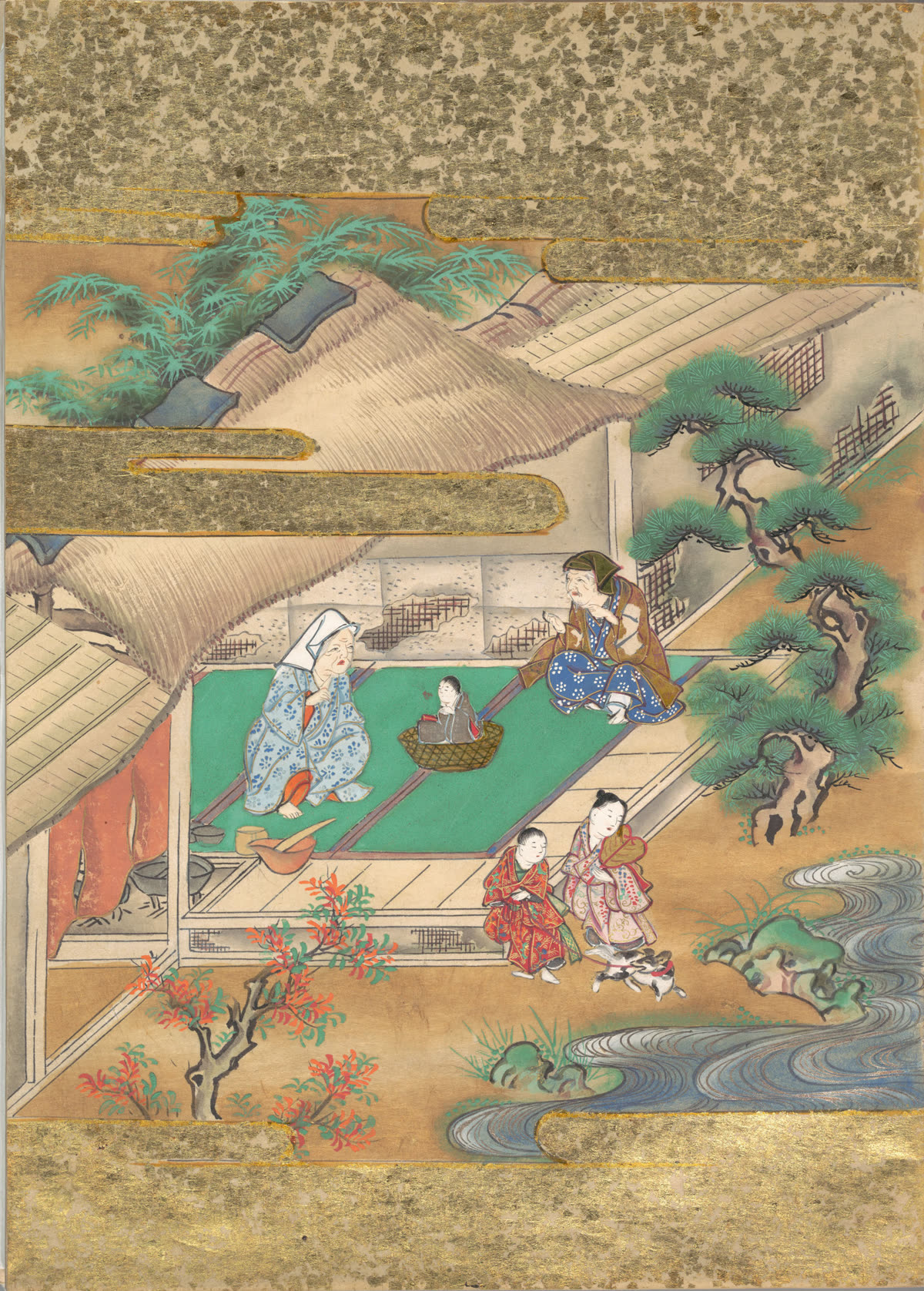
Image context: the cover image shows Kaguya as a child held within an earthly domestic scene, not the more famous moon departure. That matters for this guide. The story's force depends on both scales at once: a cosmic visitor and the ordinary couple who feed, raise, worry over, and finally lose her.[3][5]
Start With Refusal
Kaguya's refusals are often softened into modesty or mystery. Read them more actively. She is not merely waiting for the correct suitor, and she is not passively being tested by male persistence. She designs the tests. That distinction changes the whole story. The five noblemen come with status and expectation; she responds by making the courtship economy reveal its own fraudulence.[1][3]
The tasks are brilliantly calibrated. A suitor cannot complete one by being handsome, wealthy, or persuasive. He must produce an impossible object, and because the object is impossible, the social performance shifts from romance to fabrication. The suitors' failures are not only practical failures. They are failures of reading. They think Kaguya has named a high bride-price. She has actually named the limit of their claim.
This is why the episode should not be skipped as comic delay before the serious moon ending. It is the tale's first major lesson in desire under pressure. Courtly men who cannot accept refusal turn to display, proxy labor, deception, and reputation management. Kaguya keeps seeing through them. The old bamboo cutter may be moved by social pressure and by the conventional wish to marry off a daughter, but Kaguya herself understands that marriage proposals can be a form of capture when the proposed bride's will has already been treated as a detail.[3]
Read the suitor sequence almost like a series of failed translations. Each man translates Kaguya's task into the language he already knows: procurement, imitation, boasting, staged success. Each translation collapses because it refuses the central meaning of the request. Kaguya is saying no.
Notice How Wonder Becomes Household Labor
The opening miracle is small, not grand. The bamboo cutter finds the child inside bamboo, takes her home, and he and his wife raise her.[3] That domestic scale matters. The tale could have begun with a palace prophecy or a heavenly decree. Instead, it begins with manual labor, a glowing stalk, adoption, and care. Wonder enters through work.
That choice keeps the story from becoming a simple contest between earth and moon. Kaguya is otherworldly, but her earthly life is not fake. The old couple's attachment is not an illusion merely because she later leaves. Their love has weight because it is made through daily acts: taking her in, protecting her, watching her grow, negotiating the attention her beauty attracts, and fearing the sorrow she cannot yet explain.[3][4]
This is the reader's second key. The tale repeatedly asks what counts as real when something is temporary. Kaguya belongs to the moon, but she has also belonged, for a time, to a household. The phrase "for a time" should not make the household disposable. It should make the reader more alert to the value of temporary bonds. The old couple cannot keep her. That does not mean they did not raise her.
The old bamboo cutter's new wealth, found in bamboo after Kaguya's arrival, complicates this further.[3] The miracle improves the household materially, but money does not solve the book's emotional problem. Wealth can move the family into visibility, but visibility draws suitors, etiquette, and court pressure. The household that began as shelter becomes a contested social site. Kaguya's radiance brings blessing, but also exposure.
Read The Court As Comedy With Teeth
The tale belongs to a world of courtly refinement, but it does not bow before refinement. Ohio State's teaching page is useful here because it emphasizes that the transmitted Taketori monogatari is not only folktale material but also a creation for Heian nobility, with comic pressure aimed at the worthies who seek Kaguya's hand.[3] In other words, the aristocratic setting is not just decorative. It is part of the target.
This means the impossible tasks should be funny. The men are ridiculous because they keep trying to make impossibility serve ambition. But the comedy has teeth because it exposes how easily elegance can become coercion. A nobleman's desire arrives wrapped in rank, language, and convention. Kaguya's response strips those wrappings away. If he claims worth, let him produce the impossible object. If he produces a fake, the fakery will reveal the real quality of the desire.
The emperor's later involvement raises the scale without changing the underlying problem. Imperial desire is more impressive than noble courtship, but it still cannot annul Kaguya's other origin.[3] The emperor can command guards; he cannot command the moon. He can receive a letter or token; he cannot turn loss into possession. The tale lets political height meet metaphysical limit.
That is one reason the ending is so powerful. The moon people do not arrive as a rival court that can be negotiated with. They arrive from outside the social system the tale has spent so much time exposing.[3] Rank, force, and masculine persistence all meet a boundary they cannot cross.
Do Not Make Kaguya Merely Cold
Kaguya can seem distant, especially if the reader expects a heroine who explains herself in modern psychological terms. The story gives us feeling, but not through confessional abundance. Her tears before the full moon matter because they arrive before full explanation.[3] The body knows departure before the social world understands it.
That delayed explanation changes how to read her earlier behavior. Her resistance to marriage is not only personal independence, though it is that. It is also structural knowledge. She cannot truthfully enter the future the suitors imagine. She has a destination that earthly social contracts cannot absorb. The impossible tasks therefore look different in retrospect: they are not evasions until the right man appears, but forms of delay inside a life already under recall.
Still, the tale becomes weaker if Kaguya is read as pure celestial superiority. Her departure hurts because earthly attachment has formed. She grieves, the old couple grieve, and the emperor grieves.[3][4] The story's emotional intelligence lies in refusing a clean hierarchy. The moon has the stronger claim, but earth has made real bonds. Celestial origin does not cancel human sorrow.
For a first reading, keep that double truth active. Kaguya is not simply a victim of courtship pressure, not simply a heavenly being above human life, and not simply a romantic object withdrawn from everyone. She is a figure through whom the tale asks what happens when social systems treat beauty as claimable but beauty belongs, finally, to another order.
Let The Ending Return You To Earth
The moon return is spectacular, but the final movement should not leave the reader floating in spectacle. The tale ends with earthly grief and memory. Ohio State's summary notes the emperor burning his mementos and smoke billowing from Mount Fuji "to this day."[3] That ending matters because it transfers the story from event to landscape. Loss becomes a visible trace.
In practical reading terms, this means the tale does not end by escaping earth. It ends by marking earth. The moon people take Kaguya away, but the story remains below, in smoke, memory, letters, and retelling. Even the old printed and translated afterlife of the tale makes the same point. Keene's 1956 Monumenta Nipponica translation record, the University of Virginia Japanese Text Initiative, and the 1888 Dickins edition at the Internet Archive are all modern routes back to a much older tale whose survival depends on copying, teaching, translation, and reproduced images.[1][2][4][5]
That survival is not incidental. The Tale of the Bamboo Cutter is often introduced through its status in Japanese literary history, including the famous connection to The Tale of Genji, where it is remembered as a progenitor of tales.[3] But literary priority is not the main reason to read it. Read it because its structure remains alive. A child enters a home. Beauty draws social machinery. Refusal exposes fraud. Love forms despite impermanence. Authority reaches its limit. Departure does not erase attachment. A story returns to earth as smoke.
A First-Reading Route
Read the opening for scale. Notice how little the miracle is at first: bamboo, a worker, a child, a household.[2][3]
Read the suitor tasks slowly. Ask what each failed quest reveals about the person trying to satisfy it. The comic surface is part of the critique.[1][3]
Watch Kaguya's agency. She is not merely hidden, desired, or removed. She repeatedly shapes the terms under which others may approach her.[1][3]
Treat the moon not as a twist but as a pressure present from the beginning. Once the return is revealed, earlier refusals and tears become legible in a new way.[3]
Finally, return to the earthbound ending. The tale's last force is not only that Kaguya goes home to the moon. It is that those left behind must convert impossible loss into memory, ritual, and story.[3][4]
Read this way, The Tale of the Bamboo Cutter stops being a simple origin point for later Princess Kaguya retellings. It becomes a compact guide to several problems literature keeps revisiting: how refusal can be made legible, how temporary care can still be real, how social rank fails before absolute limit, and how stories preserve attachments that life cannot keep.
Sources
- Donald Keene, trans., "The Tale of the Bamboo Cutter," Monumenta Nipponica 11:4 (1956), pp. 329-55, article record with JSTOR link.
- University of Virginia Library Japanese Text Initiative, Taketori monogatari text page.
- The Ohio State University Classical Japanese Portal, "Taketori Monogatari" about page, plot and literary-context overview.
- F. Victor Dickins, trans., The old bamboo-hewer's story = Taketori monogatari, Internet Archive scan of the 1888 San Kaku Sha edition.
- Wikimedia Commons, "File:The Tale of the Bamboo Cutter - Discovery of Princess Kaguya.jpg," archival photographic reproduction of a seventeenth-century painted page used as the article image.