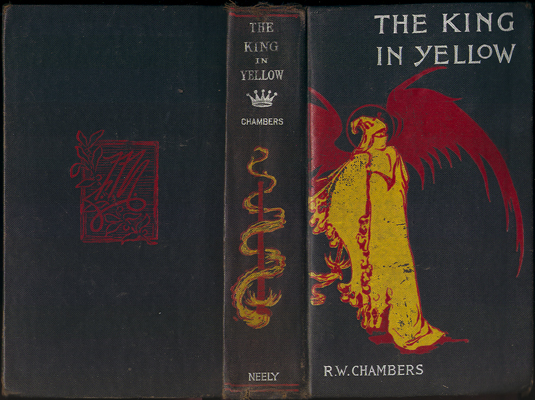
Robert W. Chambers's The King in Yellow is one of the strangest success stories in literary afterlife. The book is not a tidy mythos manual. It is a 1895 collection whose opening horror stories are linked by a forbidden play, a yellow sign, and a geography of names that never quite settles into an encyclopedia.[1] Then the collection drifts toward Parisian artist stories and romance. On paper, that should weaken the spell. In practice, the looseness is the engine.
The reason the book keeps returning is not that Chambers explained Carcosa better than later writers. It is that he refused, or failed, to finish explaining it. The invented play called The King in Yellow is presented as a cultural danger, but readers receive only shards: courtly names, a pallid mask, Act I fragments, rumors of Act II, and the repeated question, "Have you found the Yellow Sign?"[1] The missing play becomes more portable than a complete play could be. Later writers, game designers, television producers, and fans can inherit the aura without obeying a rigid canon.
That makes The King in Yellow less a source text than a contamination pattern. Its afterlife is built around gaps.
A Mythos Made From Borrowed Names
The first thing to notice is how little in Chambers begins as proprietary world-building. Project Gutenberg's edition lists the familiar opening sequence: "The Repairer of Reputations," "The Mask," "The Yellow Sign," "The Demoiselle d'Ys," and the later Paris stories.[1] The early tales feel connected, but they do not behave like chapters in one lore system. They share atmosphere, names, and a sense of artistic infection.
Even Carcosa was not born in Chambers. Ambrose Bierce's Can Such Things Be? includes "An Inhabitant of Carcosa," the earlier story that gives Chambers one of his most durable place names.[2] Chambers's achievement is not invention from nothing. It is recombination. He lifts names such as Carcosa into a Decadent fin-de-siecle mood, places them near artists, madness, opera, sculpture, manuscripts, and urban unease, then lets them echo more than they explain.
That borrowed quality helps the afterlife. A perfectly closed fictional system tends to punish later alteration. Chambers's system invites alteration because it already feels like a palimpsest. Carcosa sounds ancient before the reader knows what it is. Hastur, Hali, Yhtill, Cassilda, and Camilla appear as if retrieved from a damaged archive. The reader's imagination supplies connective tissue, and that private labor becomes part of the pleasure.
The Fake Play Is Stronger Than A Real One
The central device is the fictional play. Chambers does not give us a full dramatic text. He gives us evidence of a text: reputation, fragments, effects on readers, and social anxiety around publication.[1] That distinction matters. A real printed play would have to withstand ordinary reading. The fake play can remain absolute because it is never fully testable.
This is why the little mask exchange still works. "No mask? No mask!" is almost nothing as drama, but as a fragment of a forbidden play it becomes charged with absence.[1] The reader senses a ritual scene, a courtly crisis, and a revelation that has been deliberately withheld. The line is memorable because it sits at the edge of a missing whole.
Chambers turns reading itself into the horror mechanism. The danger is not a monster entering the room from outside. The danger is a text that reorganizes the reader's reality once encountered. Penguin Random House's modern edition frames the four macabre stories through that premise: a second act whose truths drive readers toward despair.[4] Whether taken literally or psychologically, the device is modern because it makes interpretation unsafe. A book does not merely represent danger; it becomes the vector.
That is also why later creators can adapt the idea without adapting the plot. They need only preserve the structure: an artwork, symbol, phrase, cult, or story fragment that seems to carry more reality than ordinary life can bear.
Lovecraft Canonized The Unevenness
H. P. Lovecraft's role in the afterlife is crucial because he did not simply imitate Chambers. He certified a small portion of Chambers as important. In Supernatural Horror in Literature, Lovecraft treats the early Chambers horror strain as genuine and artistically powerful, while also noting its unevenness and its 1890s studio atmosphere.[3] That is a useful judgment because it describes the book's later fate exactly. Readers keep extracting the horror core from a mixed collection.
Lovecraft's praise helped pull Chambers into the genealogy of cosmic horror, but it also changed the emphasis. Chambers's best effects are not fully Lovecraftian. They are more theatrical, urban, and artistic. His terror often begins in galleries, studios, churches, and printed pages rather than in geological deep time. The cosmos enters through aesthetic contamination.
The afterlife tends to flatten that difference by turning the King, Carcosa, and the Yellow Sign into mythos furniture. But Chambers is more unsettling when read as a writer of partial transmission. His world is not terrible because a stable alien truth has been mapped. It is terrible because fragments of a possible truth move through art, rumor, quotation, and obsession. Lovecraft recognized the power, then later culture converted that power into a shared toolkit.
Television Proved The Form Still Travels
The modern mass afterlife arrives most visibly through True Detective. GQ's recap of the show's second episode notes the diary references to a "yellow king" and Carcosa, then points readers back to Chambers's 1895 book as the literary frame behind those names.[6] Penguin Random House's edition now markets the book partly through that chain of influence, pairing Lovecraft and HBO's series in the same reception line.[4]
What matters is that True Detective did not need to stage Chambers's plots. It needed the afterlife structure: a hidden vocabulary that makes a crime story feel older, stranger, and less procedurally contained. "Carcosa" becomes not a mapped fantasy location but a pressure word. "The Yellow King" becomes not a clear supernatural monarch but a name around which violence, cult behavior, memory, and interpretation gather.
That is adaptation as atmospheric transfer. The television series borrows the permission Chambers created: the permission to let names imply a world without fully adjudicating that world. Viewers could read the references as literary Easter eggs, occult clues, or mood architecture. The ambiguity is not a failure of adaptation. It is exactly what made the material adaptable.
Los Angeles Review of Books makes a related point about Chambers's contemporary relevance: the empty spaces in the Carcosa material allow later writers to occupy the territory, and that open texture helps explain why the small group of stories has supported such a large afterlife.[5] The same openness lets the material move between weird fiction, role-playing games, prestige television, and internet clue-hunting.
The Afterlife Belongs To The Unsaid
The irony is that The King in Yellow survives because it is incomplete in the right way. Chambers did not give later culture a finished religion, map, monster taxonomy, or stage script. He gave it an object that seems to have already damaged the world before the reader arrives. The book's fragments feel like surviving evidence from a larger catastrophe.
That is why a reader can still come to the 1895 text after knowing Lovecraft, True Detective, or a dozen secondary references and find it stranger than expected. The famous parts do not occupy much space. They flare, vanish, and leave the rest of the book feeling almost embarrassingly uneven. But the unevenness is part of the historical fact. Chambers's horror did not become durable by filling every page. It became durable by creating a haunted remainder.
The best way to read the book now is therefore not as a lore sourcebook. Read it as a study in how little a fictional world needs in order to reproduce. A few names, a forbidden artwork, a mask that may not be a mask, and a city borrowed from another writer: that is enough. The King in Yellow keeps his power because Chambers never lets us see the whole play. Every afterlife writes another missing act.
Sources
- Robert W. Chambers, The King in Yellow, Project Gutenberg ebook no. 8492 - primary text and publication metadata.
- Ambrose Bierce, Can Such Things Be?, Project Gutenberg ebook no. 4366 - source collection containing "An Inhabitant of Carcosa."
- H. P. Lovecraft, "Supernatural Horror in Literature," The H. P. Lovecraft Archive - Lovecraft's assessment of Chambers and The King in Yellow.
- Penguin Random House, The King in Yellow, Deluxe Edition by Robert W. Chambers - modern publisher framing of the book's weird-fiction status and influence.
- Paul StJohn Mackintosh, "The Secret Chambers of the Heart: Robert W. Chambers and The King in Yellow," Los Angeles Review of Books, January 3, 2020.
- Gwynne Watkins, "The True Detective Recap, Episode 2: The King in Yellow," GQ, January 20, 2014 - contemporary reception note on the show's Carcosa and Yellow King references.
- Wikimedia Commons, "File:The King in Yellow.jpg" - scan of the front and back cover of the first 1895 edition used as the article image.