Julian of Norwich is easy to remember badly. The phrase usually detached from her work, "All shall be well," can sound like a pious shortcut, as if the hardest medieval woman writer in English had offered a soft sentence to quiet every difficulty.[1] Read inside Revelations of Divine Love, the line does almost the opposite. It does not cancel pain. It holds pain inside a grammar of repeated testing.
That matters because Julian's book begins in extremity, not serenity. The Middle English Texts Series introduction places the visions in May 1373, during a severe illness when Julian was thirty and a half; it also stresses that two versions survive, a shorter account written close to the experience and a much longer version shaped by decades of reflection.[2] The famous reassurance therefore belongs to a text that has had to think for a long time. Its calm is not first response. It is revision under pressure.
The better way to enter Julian is not through optimism, but through syntax. Again and again, she receives a showing, asks what it means, tests the answer against sin, suffering, creaturely fear, and theological difficulty, then returns to a plainer sentence with more weight than it had before. Her prose does not float above the wound. It circles the wound until ordinary words can carry more than ordinary comfort.
The small thing that changes scale
One of Julian's most useful scenes begins with a miniature object. She sees a "little thing," about "the quantity of an hazel-nut," in the palm of her hand.[1] The image is famous because it is so slight. A lesser writer might have turned it into an emblem immediately, but Julian's power lies in the delay between seeing and understanding. She looks, asks what it may be, and receives the answer that it is all that is made.[1][2]
That movement is the whole method in miniature. The object is not impressive by scale, but by relation. It exists because God made it, loves it, and keeps it. Julian's argument starts from vulnerability: creation appears almost too small to persist. Her answer does not deny smallness. It makes smallness the site of dependence.
This is why the hazelnut scene prepares the later assurance. Julian is not saying the world is obviously fine. She is saying the world is held. The difference is crucial. "Well" does not mean painless, orderly, or legible from the human position. It means kept inside a love larger than the creature's ability to secure itself.
Assurance as repetition, not slogan
The line everyone remembers works because Julian repeats it with variation. The sentence is not a decorative refrain; it is a pressure test. Each return has to answer a problem raised by the preceding meditation. If sin is real, how can all be well? If suffering is not imaginary, what kind of wellness can include it? If the creature sees contradiction, how can trust avoid becoming evasion?
Julian's answer is grammatical before it is emotional. She keeps arranging clauses so that divine action remains the subject. Human fear, creaturely ignorance, and the visible disorder of the world are real within the sentence, but they do not govern the sentence. The governing action belongs elsewhere. That is why the consolation lands with such unusual firmness: the prose has slowly trained the reader to hear agency differently.
The Middle English Texts Series introduction describes the Long Text as marked by a reasoned, circling consideration of the visions' doctrinal and devotional implications.[2] That is a useful guardrail against sentimental reading. Julian is not merely remembering a crisis. She is composing an inquiry. Her hope has an intellectual form.
Love as the final interpretive rule
Late in the work, Julian gives one of the simplest and strongest interpretive sentences in English devotional prose: "love was his meaning."[1] Its force comes from placement. By the time she can say it, love has stopped being one theme among others. It has become the rule by which the earlier showings can be read.
This does not make the book vague. Julian's love is not atmosphere. It is a discipline of interpretation. It tells the reader how to understand creation, suffering, prayer, sin, and divine patience without pretending that the human mind sees the whole design. The sentence is strong because it is not trying to explain every mechanism. It identifies the grammar that survives when mechanisms fail.
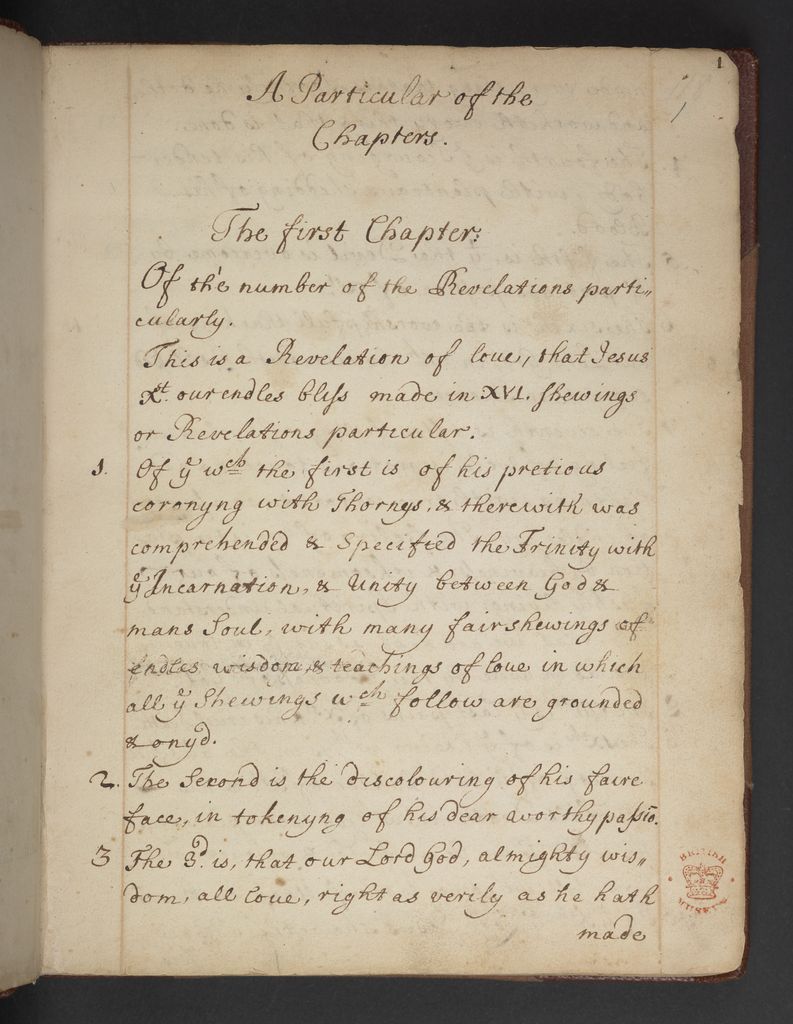
The manuscript history reinforces that point. British Library Sloane MS 3705 contains the Long Text and belongs to the early modern manuscript tradition that preserved Julian beyond her own century.[3] Stowe MS 42, another British Library witness, is connected with the 1670 printed edition associated with Serenus Cressy and English Benedictine networks in exile.[4] Those archival facts matter for close reading because Julian's voice reaches us through communities of preservation: copying, editing, devotional use, recovery, and modern publication. The book's confidence has survived by being materially kept.
The sentence after suffering
The temptation is to use Julian as a quotation source for easy consolation. The text resists that. Its assurance is earned by looking longer than comfort wants to look. The visions include bodily distress, fear, the problem of sin, and the difficulty of speaking spiritual sight in human language.[2] Julian's prose does not solve those pressures by becoming abstract. It becomes more exact.
That exactness is why modern editions still matter. Oxford's Barry Windeatt edition presents both short and long texts and frames Julian's development across the distance between immediate visionary report and later theological exploration.[5] The contrast helps explain why the famous sentence has depth: Julian's thought changes through duration. The Long Text is not simply a longer transcription of an event. It is a record of what sustained attention can make language do.
Read this way, "All shall be well" is not an escape hatch. It is the final shape of a hard grammar. First comes the showing, then the question, then the creature's fear, then the pressure of contradiction, then the return to love as meaning. Hope arrives not as a mood but as a sentence that has learned what it must carry.
That is Julian's continuing literary power. She makes consolation serious by refusing to make it quick. She teaches the reader that a phrase can be simple and still be the result of long labor. The smallest thing can hold all that is made. A copied manuscript can hold a voice across centuries. A repeated sentence can hold suffering without surrendering the claim that love, finally, is the meaning.
Sources
- Julian of Norwich, Revelations of Divine Love, edited by Grace Warrack; Project Gutenberg ebook page and HTML text for the public-domain Warrack version.
- Middle English Texts Series, The Shewings of Julian of Norwich, introduction by Georgia Ronan Crampton; context for the 1373 visions, short and long versions, and Julian's prose method.
- British Library Archives and Manuscripts Catalogue, "Sloane MS 3705: Julian of Norwich, Revelations of Divine Love (Long Text)" and digitized manuscript record.
- British Library Archives and Manuscripts Catalogue, "Stowe MS 42: Julian of Norwich, Revelations of Divine Love"; manuscript-transmission context and connection with the 1670 Cressy edition.
- Oxford University Press, Julian of Norwich: Revelations of Divine Love, translated with introduction and notes by Barry Windeatt; modern edition context for short and long texts.