At the end of Edgar Allan Poe's The Narrative of Arthur Gordon Pym of Nantucket, the sea turns milky, ash-like matter falls from the sky, and a cataract opens ahead. Then an immense shrouded figure rises in the path of Pym's canoe, its skin the “perfect whiteness of the snow.” The narrative stops.[1] Nearly sixty years later, Jules Verne sailed back into that sentence and supplied the sort of answer Poe had withheld: a separate, dusky, sphinx-shaped rock functions as a colossal magnet and explains what happened to Pym.[2][6]
That difference sounds like a contest between mystery and solution. It is more interesting as a disagreement about evidence. Poe keeps adding testimony—preface, logs, dates, latitudes, found documents, borrowed exploration history, diagrams, footnotes, an editorial note—until proof begins to feel stranger than invention. Verne's An Antarctic Mystery takes those same documentary habits and reverses their current. Coordinates match. Relics recur. A frozen witness carries a partly legible notebook. Each new fact narrows the possibilities until a physical mechanism closes the case.[1][2]
Read consecutively, the novels offer two distinct pleasures. Poe makes a reader feel the floor of authority giving way beneath an exact sentence. Verne lets the scattered pieces click together. One asks how much documentation a fiction can survive. The other asks how much fiction documentation can cure.
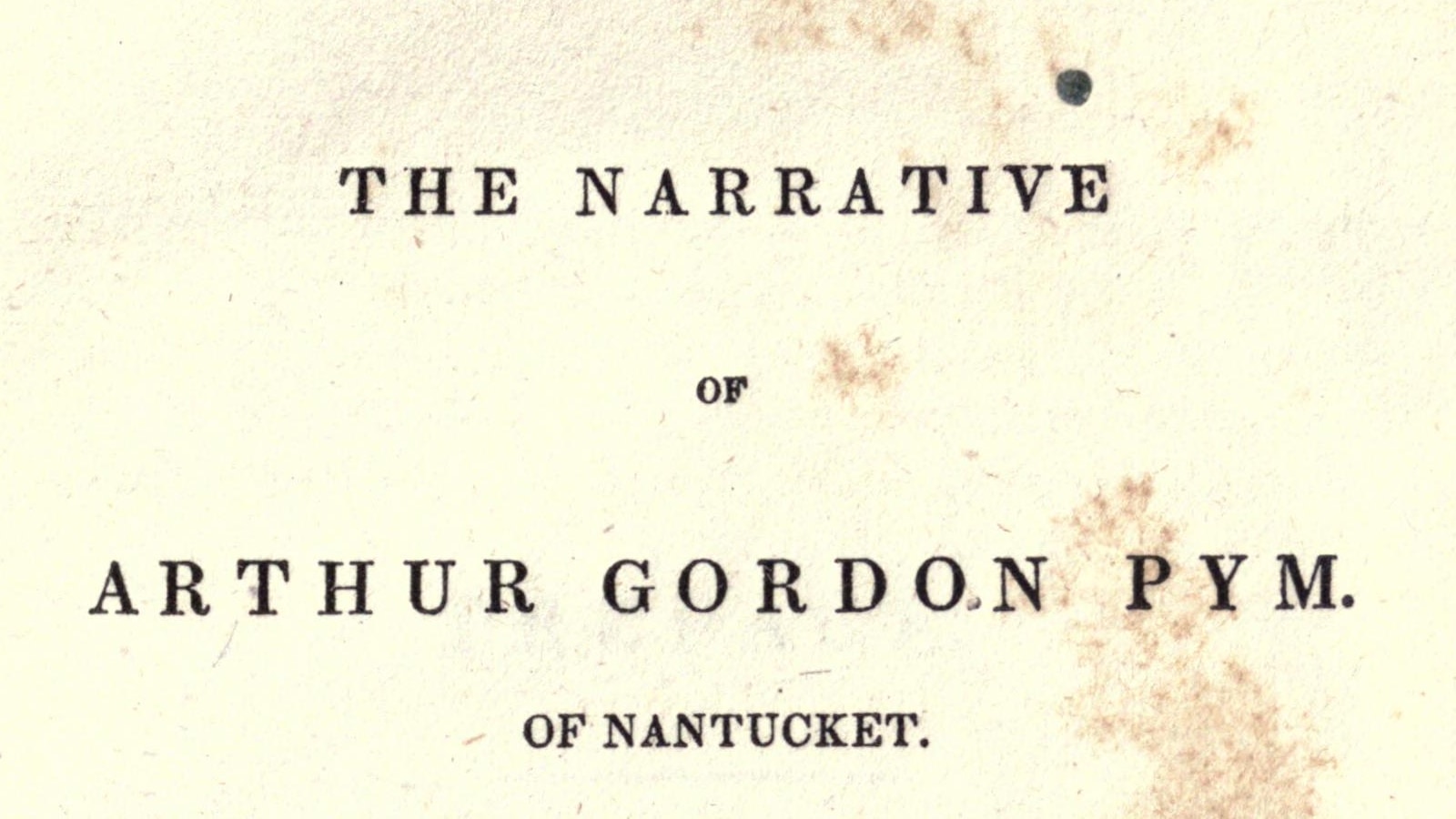
Image context: the cover is a real scan of the 1838 first edition's title page. Its exhaustive promise of mutiny, shipwreck, massacre, southern seas, and “incredible adventures and discoveries” resembles a filing label for facts; its omission of Poe's name makes the book itself part of the hoax. The American edition followed two 1837 magazine installments and is the only authorized complete text published during Poe's life.[4][8]
Poe makes a witness out of the book
Poe begins destabilizing authorship before Pym boards his first boat. In the Preface, Pym says he initially resisted publication because his adventures would be dismissed as fiction. Poe then offers to write the opening portion “under the garb of fiction,” signing it in his own name. When readers reportedly accept that magazine version as fact, Pym decides the remaining events will carry “evidence of their own authenticity.” He also claims the difference between Poe's style and his own will be obvious, though the book supplies no reliable seam between them.[1]
The joke is not simply that a fictional traveler pretends to be real. It is that authenticity has to pass through more and more hands. Pym admits he kept no journal during major parts of the voyage. Some events come from Augustus's later account. Polar history arrives through excerpts and paraphrases of previous explorers. A footnote deep into the journey concedes that apparent log entries were reconstructed from memory. Near Tsalal, a pocketbook supposedly preserves notes and drawings that would otherwise be lost. The final editor then interprets marks that Pym himself had rejected as writing.[1]
Exactness therefore does double work. Dates, cargo lists, soundings, temperatures, and coordinates make the voyage feel checkable. Yet each check leads to another compromised recorder. Hoeveler and Frank's Broadview edition usefully places Poe's novel beside its travel-writing and scientific sources, contemporary reviews, and later literary responses: the apparatus was assembled from an existing documentary world, not invented in a vacuum.[5] Poe borrows the sound of verifiable knowledge, then makes provenance part of the suspense.
The method becomes most exhilarating as the geography becomes impossible. Pym gives measured positions while the Jane Guy advances into warm polar water. On Tsalal, he subjects the island's peculiar streams to close inspection and insists that the water is “not colourless.” The prose reaches for experiment just as ordinary categories fail.[1] Measurement does not domesticate wonder here. It escorts wonder into the record.
Verne turns Poe's novel into a case file
An Antarctic Mystery begins with a reader who sounds sensible. Jeorling, an American traveling through the southern oceans, regards Pym's narrative as a romance by Edgar Poe. Captain Len Guy believes it describes real events, including the disappearance of his brother William, captain of the Jane Guy. Their dispute gives Verne an elegant starting point: before the sequel can continue Poe's plot, it must decide what kind of book Poe wrote.[2]
Verne decides by converting literary details into forensic objects. A drifting ice mass bears the frozen body of Patterson, the Jane Guy's mate. The notebook's partly effaced fragments name the ship, Tsalal, survivors, and a plea for help; Patterson's signature joins dates and physical identification. Jeorling's skepticism collapses under accumulated corroboration. Len Guy asks, “Do you believe—now?” and Jeorling yields.[2] Where Poe's intermediaries contaminate certainty, Verne's witnesses confirm one another.
This is more than a sequel's convenient declaration that the first book “really happened.” Verne stages a change in reading practice. Poe's title is no longer an unstable first-person performance but a dossier whose claims may be tested against bodies, handwriting, currents, and places. Later, a witness can distinguish a “romance signed ‘Edgar Poe’” from a truthful narrative signed by Patterson.[2] Authorship migrates away from the imaginative writer and toward the verifiable witness.
There is a translation boundary worth keeping visible. The public-domain text cited here is the early English version by Frances Cashel Hoey, published under the title An Antarctic Mystery.[2] SUNY Press describes Frederick Paul Walter's 2012 The Sphinx of the Ice Realm as the first complete English translation and pairs it with Poe's full novel and contextual material.[3] Chapter references and short phrases here follow Hoey; they should not be mistaken for the wording or full coverage of the modern translation.
Their coordinates travel in opposite directions
Both novels love a position fix, but their coordinates point toward different kinds of knowledge. Poe's latitudes and dated entries give the journey a forward tick even after familiar nature falls away. The farther south Pym travels, the more disciplined the record appears and the less stable its world becomes. Tsalal has water that separates into colored veins, animals with unfamiliar properties, and a population represented through the explorers' fearful racial categories. The instruments keep functioning, but they no longer guarantee that the reader understands what has been measured.[1]
Verne uses location as confirmation. The Halbrane reaches Bennet Islet where Pym's narrative places it. Material traces and familiar names make the old route recoverable. Tsalal is found devastated, yet William Guy survives to fill in missing history. A collar bearing Tiger's name connects an object in Verne's present to Pym's dog and thus to the prior book.[2] These are not merely nostalgic callbacks. They form a chain in which independent-seeming pieces converge.
The contrast is clearest in narrative rhythm. Poe records, qualifies, remembers, borrows, and appends. His evidence branches. Verne discovers, identifies, compares, and confirms. His evidence funnels. Poe makes the apparent log strange by revealing the fragile memory behind it; Verne makes a fantastic expedition credible by letting each relic answer an earlier line. One map leads beyond verification. The other leads back through the first novel with a pencil, ticking boxes.
Each ending builds the book it needs
Poe's final pages are not just a manuscript that happens to break off. They stage incompletion. After the white figure appears, an editorial Note announces Pym's sudden death, the loss of the last chapters, Dirk Peters's unavailability, and Poe's refusal to reconstruct the conclusion because of its supposed “general inaccuracy.” Then, with spectacular inconsistency, the editor offers confident linguistic readings of the chasm shapes on Tsalal.[1] Every possible guarantor is removed just before editorial authority makes its boldest claim.
The result is an ending made from aftereffects. There is no final explanation to subordinate the warm sea, the strange water, the black island, the white figure, or the disputed signs. Readers must decide whether the Note repairs the narrative, extends its hoax, or demonstrates the same appetite for patterns that the book has been provoking all along. The mystery survives because the frame refuses to stay outside the framed story.
Verne gives that appetite a magnificent machine. One chapter is bluntly titled “Eleven Years in a Few Pages,” and William Guy's account bridges much of Poe's missing interval.[2] At the voyage's end, the Antarctic Sphinx exerts violent force on iron objects. Pym's musket has drawn him to it; his body remains at the formation. What looked supernatural can be named: “simply a colossal magnet.”[2] Verne's answer to Poe's last image is topography, mechanism, and grave.
That act of closure is easy to caricature as a literal-minded explanation of a symbol, but it has its own audacity. Verne does not merely solve a riddle; he designs a world in which reading Poe correctly becomes navigation. The magnet is both an answer and a model for his novel. It pulls loose metal toward one center just as the sequel pulls coordinates, artifacts, signatures, survivors, and quotations toward one account.
Closure does not make the polar world innocent
The comparison becomes thinner if blackness and whiteness are treated only as pieces in an elegant formal game. Poe's Tsalal is rendered through colonial trade, extraction, fear, and sweeping racial fantasy. Its inhabitants are made emblems of treachery and blackness; the voyage culminates in overpowering whiteness. Verne returns to that geography, verifies much of Pym's route, and finds the island's social world largely erased by catastrophe.[1][2]
Toni Morrison's Playing in the Dark supplies an essential guardrail. Her argument concerns how ideas of American freedom, individuality, and authority were shaped against an imagined Africanist presence, with Poe among the writers under examination.[7] That framework does not provide a scene-by-scene key to Verne, and it should not be stretched into one. It does show why the explorer's freedom to classify Tsalal—and the book's movement from racialized blackness toward absolute whiteness—cannot be called politically neutral atmosphere.
Verne's corroborations do not solve that problem. If anything, his chain of proof asks a difficult question: what else gets naturalized when a sequel certifies the first expedition as true? The magnetic explanation disciplines the supernatural, but it does not undo the racial and colonial categories carried by the witnesses. A closed case can preserve a distorted record as readily as an open one can expose it.
Read the magnet as an argument, not a correction
Verne's novel is most enjoyable when it is not asked to defeat Poe's ending. Its satisfactions are those of pursuit, recognition, and recovery: the skeptic confronted by a body, the old name on a new object, the coordinate reached, the lost expedition partly restored. Poe's satisfactions are more corrosive. A convincing detail acquires a dubious source; a scientific note makes the world less intelligible; an editorial rescue becomes another layer of fiction.[1][2]
The two books finally disagree about what a reader deserves. Verne believes that sustained attention to traces should produce an answer. Poe makes sustained attention generate stranger questions about who recorded the trace, who interpreted it, and what the record excludes. That is why Verne's magnet feels at once ingenious and insufficient. It can account for Pym's body and musket. It cannot magnetize Poe's book into a single meaning.
Poe leaves a figure that invites continuation. Verne builds the continuation into a force that gathers fragments and arrests wandering. Reading them together makes both designs clearer: the first novel turns evidence into an abyss, and the second throws a bridge across it—sturdy, ingenious, and unable to abolish the depth below.
Sources
- Edgar Allan Poe, The Narrative of Arthur Gordon Pym of Nantucket, Project Gutenberg HTML edition.
- Jules Verne, An Antarctic Mystery, translated by Frances Cashel Hoey, Project Gutenberg HTML edition.
- SUNY Press, The Sphinx of the Ice Realm: The First Complete English Translation, translated and edited by Frederick Paul Walter.
- Edgar Allan Poe Society of Baltimore, publication and textual history of The Narrative of Arthur Gordon Pym.
- Marquette University e-Publications, Diane Hoeveler and Frederick S. Frank, eds., The Narrative of Arthur Gordon Pym (Broadview scholarly edition).
- Burton R. Pollin, scholarly headnote to The Narrative of Arthur Gordon Pym, including Jules Verne's continuation.
- Penguin Random House, Toni Morrison's Playing in the Dark: Whiteness and the Literary Imagination.
- Wikimedia Commons, 1838 first-edition scan of The Narrative of Arthur Gordon Pym of Nantucket.