The sentence that matters most in the story of Butcher Ding begins with a reversal: nevertheless.
Until then, the butcher's knife seems to move without resistance. He is cutting up an ox for Lord Wenhui, and the scene arrives as music before it becomes philosophy. Hand, shoulder, foot, and knee keep time; the blade's sounds fall into a ritual rhythm. Asked to explain, Ding says that he no longer meets the ox as a whole object. He follows its inherent openings, passing through spaces where the edge has room. After nineteen years, his knife remains as keen as if freshly sharpened.[1]
It is easy to stop there and turn Ding into the patron saint of effortless performance. But the parable does not stop. “Nevertheless,” he explains, a complicated joint sometimes appears. Then he becomes alert, “not allowing my eyes to wander from the place.” His movements slow, and only after careful attention does the joint come apart.[1] The difficult joint is not an embarrassing exception to his mastery. It tells us what his mastery is.
Read beside another craft parable, the encounter between Duke Huan and Wheelwright Bian, Ding's pause opens one of the Zhuangzi's most fertile questions: what can instruction give us when the thing worth learning cannot be reduced to instructions? The text is not simply against rules, books, or explanation. It is interested in the point where a rule runs out and judgment has to wake up.
The sentence that interrupts the dance
Ding's performance is dazzling because the prose first lets us hear it. The spectacle borrows the names of famous dances and music; slaughter becomes choreography.[1] Yet Ding's account of how he learned is much less miraculous. At first he saw the whole ox. Three years later he no longer saw it whole. Now perception and action meet so closely that ordinary looking seems to recede.[1] The sequence compresses years of apprenticeship into three stages, but it still gives mastery a history.
That history changes the meaning of “effortless.” Ding has not escaped the structure of the animal. He has become exquisitely answerable to it. A mediocre cook hacks and replaces a knife monthly; a good cook cuts and replaces one yearly. Ding preserves his blade because he neither attacks the bones nor forces his own plan across them. His freedom depends on constraint: joints, cavities, thicknesses, and the finite room available to an edge.[1]
Then comes the complicated joint. The familiar reading of skill as continuous flow would make hesitation look like failure. The parable instead makes hesitation diagnostic. Ding knows when the situation is no longer ordinary. His body does not blindly repeat a beautiful routine; it detects an anomaly and changes tempo. Alertness, narrowed attention, and slowness belong inside expertise, not outside it.
This is why the tale's traditional place in the chapter “Nourishing the Lord of Life” matters. Modern readers often borrow Ding as a general productivity mascot, but generations of commentators linked his work to the larger problem of preserving life while moving through danger.[5] The knife lasts not because nothing obstructs it, but because Ding can distinguish an opening from a collision. The parable's wisdom is less “never strain” than “do not mistake force for responsiveness.”
A wheelwright interrupts a book
Wheelwright Bian enters from below. Duke Huan is reading in his hall; Bian is making a wheel at the foot of it. The artisan puts down his tools and asks what the duke is reading. The words of the sages, Huan replies. Are the sages alive? No. Then, Bian says, what the ruler is reading amounts to their residue.[2]
It is a magnificently dangerous piece of literary comedy. A laborer interrupts a ruler, insults the ruler's book, and is ordered to justify himself on pain of death. Bian's defense returns to his hands. If he works the wheel too gently, the fit lacks firmness; if he strikes too hard, the parts will not enter. Somewhere between slackness and violence is a right pressure that his hand realizes and his mind answers: “there is a knack in it.” He cannot fully state it in words, and he has been unable to pass it to his son. At seventy, he is still making wheels.[2]
Bian's point is sharper than the slogan “experience beats theory.” He does not deny that he knows something. He gives a precise account of its field: a balance of pressure, firmness, and fit. What he denies is that a verbal formula can carry the whole capacity from one body into another. If it could, his son would have inherited the craft as readily as a sentence.
The scene's irony keeps that claim from hardening into anti-intellectualism. Bian's attack on dead words reaches us as dead words—or, more fairly, as writing copied, edited, translated, and read over centuries. The Zhuangzi uses literature to expose literature's limit. It does not burn the book. It makes the book stage a collision between a page and a hand.
What teaching can do
Placed together, the two parables almost disagree. Bian says his knack cannot be transmitted to his son. Ding explains his practice so persuasively that Lord Wenhui says he has learned how to care for life.[1][2] If skill will not become rules, what exactly has the ruler learned?
Not how to butcher an ox. Ding's speech offers orientation rather than a transferable procedure. It can direct attention toward openings, warn against forcing an edge through bone, and dignify the moment when unusual difficulty requires a slower hand. Those are meaningful lessons. None is a set of instructions sufficient to reproduce Ding's cut.
The distinction matters well beyond craft. Language can name constraints, preserve examples, correct a beginner's aim, and supply comparisons. Practice can then change what the learner is capable of noticing. What language cannot do is decide every future case in advance. No sentence can guarantee that the next seam is ordinary, or tell a hand exactly how much pressure a particular balance will require in unfamiliar wood.
Tacit knowledge, on this reading, is not mystical knowledge. It is not a secret essence sealed forever inside a genius. Bian talks; Ding teaches; their listeners can ask questions. The tales describe observable conditions and consequences. But the relevant knowledge is distributed across perception, timing, material resistance, memory, and action. A rule may participate in that arrangement without commanding all of it.
This balance also fits the philosophical character of the collection. The Zhuangzi favors brief, destabilizing encounters—craftspeople, rulers, animals, strange bodies—over a single doctrine laid out as a system.[3][4] Its parables rarely close after delivering one clean moral. They leave the reader doing the work a manual would have pretended to finish.
Care is not the absence of effort
There is a temptation to turn both craftsmen into emblems of total self-forgetting: stop intending, surrender control, and the Dao will act through you. But Ding's complicated joint resists that romance. At the crucial moment, he is cautious. Bian, too, describes an exacting coordination between hand and mind, not the disappearance of either.
The tendency to make spontaneous skilled responsiveness the Zhuangzi's ideal has itself been challenged. Eric Schwitzgebel argues that skill is at least as often criticized as praised across the Inner Chapters; even the Ding passage may direct admiration toward the knife's receptive passivity rather than the cook's virtuosity.[6] The disagreement is useful. Ding's caution at the difficult joint prevents either “flow” or “passivity” from becoming a mechanical answer. His freedom is freedom from clumsy imposition, not from the obligation to respond.
That obligation is ethical in form even when the scene is technical. Ding does not make the ox conform to an abstract pattern; he learns how this body's structure permits movement. Bian does not prove his authority by overpowering the wheel; he finds the pressure at which the parts can join. Neither tale tells us that every human problem is an ox or a wheel. Both ask what changes when agency means answering a situation instead of dominating it.
The limit should remain visible. The butcher's blade still divides a body. The wheelwright's speech still depends on a hierarchy in which a duke may threaten him. A philosophical analogy does not erase the violence or power inside its scene. The prose makes those pressures useful because it does not replace them with a bloodless diagram.
A book honest about its residue
“The Zhuangzi” is itself a convenient singular for a composite work. The received text has thirty-three chapters shaped by a long history of composition and editing; modern scholarship commonly distinguishes the seven Inner Chapters from later Outer and Miscellaneous chapters, while treating simple claims about one historical author's intentions with caution.[3][4] Butcher Ding appears in Inner Chapter 3. Wheelwright Bian appears in Outer Chapter 13. Reading them together traces a conversation across the collection, not necessarily a plan made by one writer at one moment.
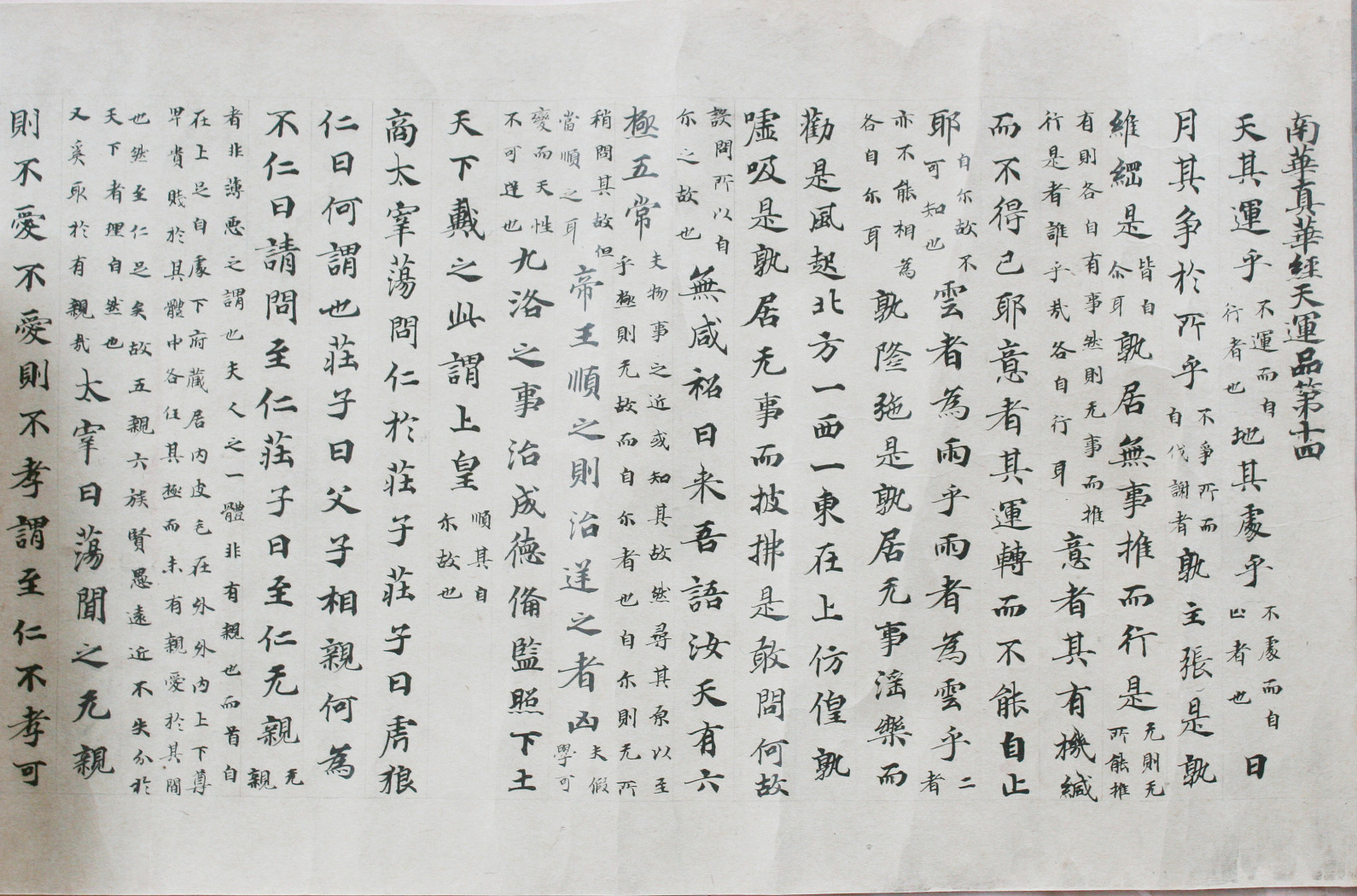
That textual history deepens the joke of Bian beside the book. An archival manuscript leaf can preserve ink, columns, chapter text, and evidence of transmission.[7] It cannot preserve the pressure of a vanished wheelwright's hand. Yet without written residue there would be no Bian to remind us of the difference. The page succeeds by carrying an account of what it cannot carry.
The best manual can do something similar. It can show where attention belongs and confess where prescription ends. It can keep earlier experiments available, give names to recurring mistakes, and prepare a learner to notice. Its failure begins only when it claims to eliminate the difficult joint.
The master cannot write a complete manual because mastery includes recognizing when the manual's case has changed. That recognition is not a final rule concealed behind the others. It is the cultivated judgment to pause after the dance, look closely, and let a different tempo begin.
Sources
- Chinese Text Project, “The Writings of Zhuangzi: Nourishing the Lord of Life” — Chinese text and James Legge translation.
- Chinese Text Project, “The Writings of Zhuangzi: The Way of Heaven” — Chinese text and James Legge translation.
- Stanford Encyclopedia of Philosophy, “Zhuangzi,” Summer 2024 archive.
- Internet Encyclopedia of Philosophy, “Zhuangzi (Chuang-Tzu): Chinese Philosopher.”
- John Williams, “A Note Concerning the Relationship between Butcher Ding and Nourishing Life in the Traditional Zhuangzi Commentaries,” Early China.
- Eric Schwitzgebel, “The Unskilled Zhuangzi: Big and Useless and Not So Good at Catching Rats” (2017 manuscript), University of California, Riverside.
- Wikimedia Commons, “File:Zhuangzi Tian Yun Ms.JPG” — source and rights page for the archival manuscript image.