Alfred Tennyson's Tithonus is often paraphrased as a warning label on immortality: be careful what you wish for, because eternal life without eternal youth will trap you in an endless old age.[1][2] That paraphrase is correct as far as plot goes, but it misses the poem's real precision. Tennyson does not make immortality terrifying by turning it into a supernatural spectacle. He makes it terrifying by making it repetitive. Dawn comes back. Beauty comes back. Tears come back. Tithonus alone cannot come back into proportion with the world that keeps renewing itself.[1][2][3]
That precision matters because the poem sits at an interesting angle inside Tennyson's career. Britannica describes him as the leading Victorian poet in England, a writer whose verse repeatedly returned to questions of human destiny, doubt, and the pressure modernity placed on inherited belief.[4] Victorian Web adds the sharper publishing fact here: Tennyson first wrote the poem as "Tithon" in 1833, then completed it in 1859 for Cornhill Magazine.[3] The poem therefore carries both early intensity and later finish. It reads less like a myth retold for ornament than like a sustained experiment in what endless duration would do to voice itself.
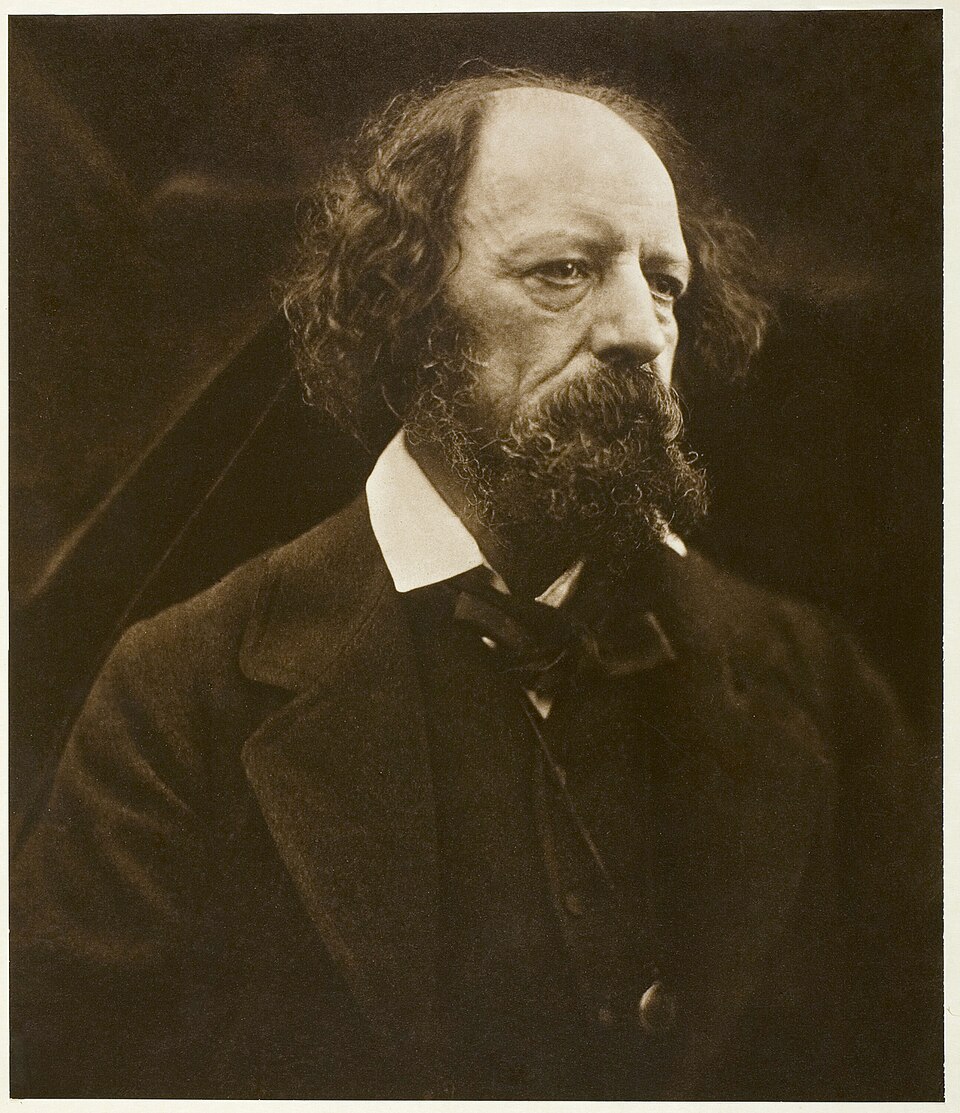
Image context: the cover uses Julia Margaret Cameron's 1869 photographic portrait of Tennyson from Wikimedia Commons. A real archival portrait is the right fit because this poem works through a single aging speaker, not through scenic mythological pageantry. The pressure is vocal, facial, and temporal: a human figure held still while dawn keeps moving.[5]
1) The opening makes death look ordinary and life look abnormal
The first ten lines are famous because they reverse the hierarchy many myths would prefer. The opening does not begin with divine wonder. It begins with decay: woods fall, vapors sink, human beings till fields and then lie beneath them, even the swan eventually dies.[1] Tithonus is not singled out as heroic against this backdrop. He is singled out as the lone creature excluded from the ordinary mercy that everything else receives.
That is why the line about "cruel immortality" lands so hard.[1] Tennyson does not describe endless life as privilege gone slightly wrong. He makes it sound like an active solvent, something that consumes from within. The world's rhythm remains intelligible; what has become unintelligible is Tithonus's relation to it. Mortality turns out to be the common measure linking woods, weather, labor, birds, and bodies. The speaker's curse is not simply that he grows old. It is that he cannot finish growing old.
This is a crucial difference. Plenty of literary laments fear death because it ends experience. Tithonus fears the opposite condition: experience without ending, age without burial, consciousness without the kindness of completion. When the poem later calls humanity the "kindly race of men," the phrase can sound strange at first.[1] But the opening has already prepared it. To belong to the human race is to share an ordinance, a limit, a stopping point that makes seasons and generations commensurate with one another.
2) Aurora's beauty hurts because it renews on schedule
The myth gives Tennyson a brutal contrast partner. Britannica's summary of Tithonus and Eos makes the background plain: the goddess secures eternal life for her mortal lover, forgets eternal youth, and thereby condemns him to withering duration.[2] Tennyson takes that old story and turns its emotional screw much tighter. Aurora is not cruel because she has become ugly, distant, or demonic. She is cruel because she remains radiant.
The poem's most devastating phrase may be "immortal age beside immortal youth."[1] It compresses the whole relation into one impossible tableau. Tithonus is not merely old while Aurora is young. He is old beside a youth that cannot age, beside beauty that keeps arriving with the regularity of dawn itself. Each morning repeats the difference. Each new redness of the sky sharpens the mismatch rather than healing it.
That is why the descriptive passages of Aurora do not function as decorative lyric relief. They are part of the wound. Her shoulders, eyes, and brightening cheek remain exquisitely alive; "Lo! ever thus thou growest beautiful" is admiration and accusation at once.[1] The line matters because it makes clear that beauty has become cyclical law. Tithonus is not trapped in one static scene. He is trapped in recurrence. What hurts him is not only that Aurora is beautiful. It is that she will be beautiful again tomorrow, and again after that, while he continues thinning into shadow.
3) The poem's worst word is "ever"
Tennyson's temporal language is more punishing than the plot summary suggests. The speaker lives in "ever-silent spaces"; Aurora "ever" scares him with her tears; he begs not to be held "for ever" in her East.[1] The word keeps reopening duration. It refuses closure at the level of grammar before the poem even reaches its final plea.
This is one reason the poem should not be reduced to a simple death wish. Victorian Web usefully quotes a critic who argues that Tithonus wants death because he loves life too much to submit to a living death.[3] That is a strong way to describe what the poem itself stages. Tithonus is not numb. He remains painfully susceptible to dawn, memory, and touch. He remembers earlier desire with almost unbearable vividness: the dim curls kindling, the blush returning, Ilion rising "like a mist" into towers.[1] Memory is not what saves him from endless time. Memory is one of the mechanisms by which endless time keeps cutting.
The repetition of "ever" therefore matters formally as much as thematically. Tennyson makes duration audible as a recurrence that language itself cannot escape. The word keeps placing the speaker back inside a cycle that no act of will can finish. If the opening stanza gives us attrition in nature, these middle movements give us attrition in syntax.
4) "Release me" is a plea for measure, not annihilation
The poem reaches its clearest moral statement when Tithonus asks why a man should desire "to vary from the kindly race of men" or pass beyond the point "where all should pause."[1] That is not resignation in a cheap sense. It is recognition. The speaker has learned that mortality is not a defect accidentally built into human life. It is the condition that keeps life proportionate to feeling, memory, labor, and love.
The final movement deepens that recognition by naming the mortals below as "happy men that have the power to die."[1] The phrase is startling because it defines happiness not by possession, youth, or divine intimacy but by finitude. Human beings remain enviable precisely because their lives can return to earth. Tithonus, by contrast, stands on glimmering thresholds without ever crossing them. He is suspended between divine renewal and human completion, excluded from both.
This is why the last request, "Release me, and restore me to the ground," should not be read as merely negative.[1] The poem is not fantasizing about oblivion as a dramatic escape hatch. It is asking to be returned to the order that the opening lines described: soil, season, burial, recurrence distributed across generations rather than trapped inside one undying body. Read that way, the ending becomes more severe and more beautiful. Tithonus does not discover that life is worthless. He discovers that life without limit cannot remain fully life.
That insight helps explain why the poem still feels contemporary. Britannica's account of Tennyson stresses how often his poetry faced questions about destiny and the strain placed on older consolations.[4] Tithonus does not answer those questions with doctrine. It answers them with proportion. By the end, immortality is no longer the grand exception to the human rule. It is the proof that the rule was humane all along.
Sources
- Alfred Tennyson, Enoch Arden, &c. (Project Gutenberg; includes the full text of "Tithonus").
- Encyclopaedia Britannica, "Tithonus" (Greek myth summary and later cicada version).
- Glenn Everett, "Alfred Tennyson's 'Tithonus'," The Victorian Web (monodrama form, 1833 draft, 1859 completion, and Cornhill publication context).
- Encyclopaedia Britannica, "Alfred, Lord Tennyson" (Victorian context, Hallam-grief period, and larger poetic concerns).
- Wikimedia Commons, "File:Alfred, Lord Tennyson by Julia Margaret Cameron.jpg" (source page for the article image).