
When Annie Ernaux sits down for the Nobel Prize's official interview in Stockholm on 6 December 2022, the setting threatens to flatten her into a laureate monument.[1][2] The clip is short, ceremonial, and easy to misread as a set of tasteful answers about childhood, books, and memory. What makes it worth revisiting is that Ernaux keeps turning the conversation away from prestige and toward method. Her answers about reading, honesty, and unreliable memory are not generic writerly wisdom. They are a compressed explanation of how her books convert lived experience into a social form that other people can enter.[1][2][3]
That distinction matters because Ernaux is still too often described as if she were simply a brave confessional writer, a recorder of shame, abortion, class mobility, and desire.[3][4] The Nobel material suggests something more exact. In her lecture the next day, she says she had to break with "writing well" in order to understand the rift running through her own life, and later insists that the book's "I" matters only if the reader's own "I" can occupy it.[3] On the Nobel Prize biographical page, she describes The Years as "a collective historical and social autobiography," a phrase that clarifies the interview retroactively.[4] The first person in Ernaux is not there to seal a private identity. It is there to make class, gender, and memory legible at a scale larger than one self.[3][4]
The official interview page also gives the clip's practical context. It was recorded during Nobel Week in Stockholm, the video is in French with English subtitles, and the published page breaks the conversation into timestamped segments about childhood, social justice, memory, and what writing means to her personally.[2] That structure makes the interview unusually useful for literary readers. Instead of treating the Nobel apparatus as an after-the-fact coronation, the clip lets you watch Ernaux restate her poetics in miniature.
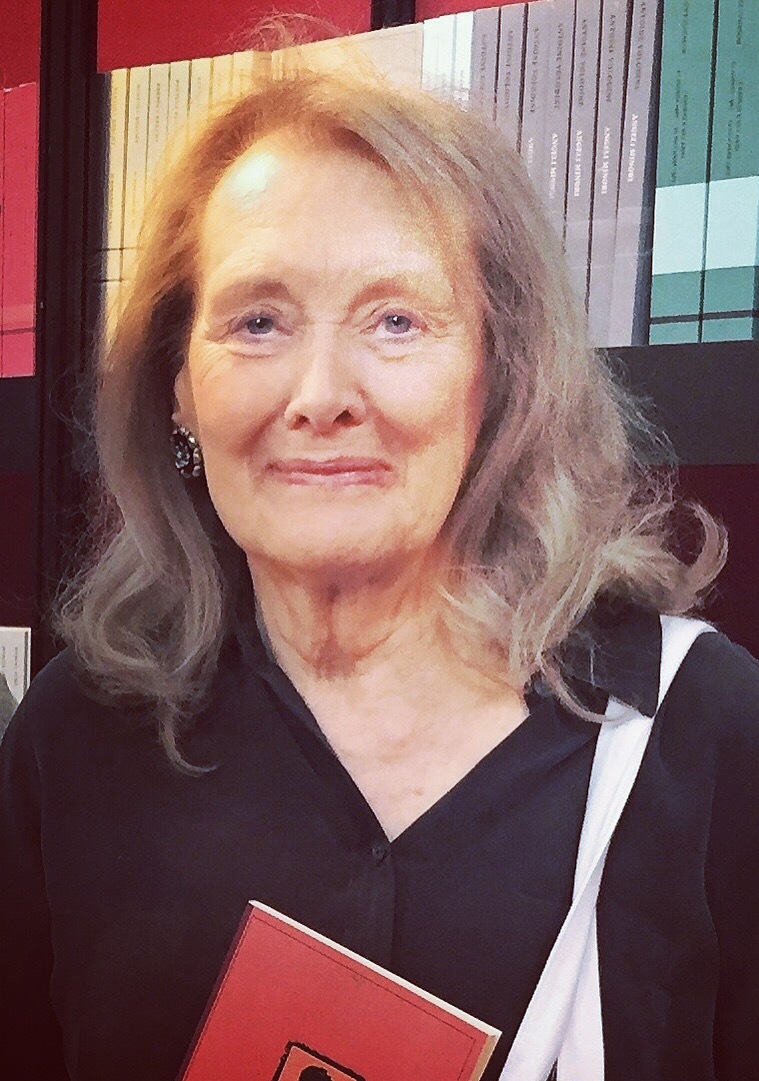
Image context: the cover uses a real 2017 photograph from the Turin International Book Fair rather than a book jacket or a symbolic still life. That choice fits the article because the interview is about literary presence in public. Ernaux appears composed and almost severe, while the ideas underneath keep returning to social origin, bodily memory, and formal discipline.[5]
The embedded video below is the official Nobel Prize upload of the full interview. It lasts just over ten minutes, but several brief stretches make Ernaux's method especially audible.[1][2]
Around 3:20, reading is the first social crossing
When Ernaux is asked whether reading is essential for writers, the answer sounds almost too obvious: yes, writers need to read a great deal.[1][2] But in her case that claim is never just apprenticeship advice. On the Nobel biographical page, she recalls childhood between two socially opposed worlds: her parents' cafe-grocery in a working-class district and the private Catholic school that marked entry into a different linguistic and cultural order.[4] In the lecture, she says books became her companions early and that literature turned into a "continent" she set against her social environment.[3]
That is why reading in Ernaux is never simple ornament or private refuge.[3][4] It is a crossing point. Books do not merely cultivate taste; they expose the distance between the world one comes from and the world one learns to speak toward. If her prose later becomes so attentive to embarrassment, aspiration, and the shame carried by accent or manners, this is partly because reading first taught her that language is never socially neutral.[3][4] Even the interview's calm surface carries that history. When she recommends reading, she is really naming the first mechanism by which a life can become doubled, estranged from itself, and therefore writable.
Around 4:29, honesty is a formal decision, not a moral pose
The interview's most useful moment may be the turn toward social justice, women's rights, and what literature can do in relation to them.[1][2] Ernaux does not talk like someone assigning novels a simple program of reform. Her work has always been tougher than that. In the lecture, she recalls the promise to "avenge" both her people and her sex, then explains that this required a break with polished sentences and conventional literary beauty.[3] The aim was not ugliness for its own sake. It was to stop style from flattering the very hierarchies the writing claimed to expose.[3]
This is where her famous advice in the telephone interview on the same Nobel page becomes more revealing than it first appears: young writers should not strive to write well, she says, but to write honestly.[2] In Ernaux, honesty is not a moral perfume and not a pledge of raw confession. It is a technical demand. The sentence must not decorate class injury, reproductive constraint, humiliation, or desire into something socially comfortable.[2][3] That is why the neutral, "flat" mode she describes in the lecture matters so much.[3] The writing does not become emotionless. It moves the violence out of rhetorical display and back into the facts themselves.
Seen from that angle, the Nobel interview is not a summary of themes. It is a miniature defense of form. Literature matters to justice not because a book automatically changes policy, but because form can strip away the false nobility, euphemism, and inherited language that keep domination looking natural.[3] Her public calm in Stockholm makes that claim sound even harder, not softer.
Around 5:50 and 6:53, memory matters because it fails
The two memory questions in the interview are easy to underestimate.[1][2] Ernaux is asked first about the role of memory in her writing and then whether memories can be trusted. Her answers refuse both nostalgia and certainty. That refusal is central to her method. In the lecture, she says the first person is an exploratory tool that captures sensations buried by memory as well as sensations the present keeps giving.[3] The point is not to recover a sealed, authentic past. It is to use writing to decipher what a lived situation actually contains.
That is why Ernaux's books do not treat memory as sacred interior property.[3][4] Memory is partial, wounded, classed, and socially edited. It arrives with gaps, cliches, and borrowed phrases already inside it. Yet those defects are not obstacles that writing must transcend before it begins. They are the material. The unstable memory of a clandestine abortion, a parent's speech, a supermarket, a classroom, or a passing sexual arrangement becomes interesting precisely because it exposes the forces that shaped it.[3][4]
The interview condenses that whole procedure into a few plain sentences. Ernaux sounds modest, but the underlying claim is radical: memory becomes usable when it stops belonging only to the remembering self. It must be written through until it reveals the structures that made the self possible in the first place.[2][3]
Around 7:29, the "I" matters only when others can live inside it
The final answers about what writing means to her and whether she keeps reading are the interview's quiet culmination.[1][2] By this point the clip has already moved from childhood books to justice and memory, so the personal question lands differently. What writing means to Ernaux cannot be separated from the reader's future use of it. Her lecture says this outright: the goal is not to tell the story of her life for its own sake, but to reveal something that writing alone can bring into being and perhaps pass on to the consciousness and memory of others.[3] The decisive line follows a few sentences later, when she says the book's "I" must become "transpersonal."[3]
That word helps explain why the Nobel interview feels larger than its runtime. Ernaux is not defending a cult of authenticity. She is defending a way of making the first person porous. The autobiographical material matters, but only because it can be cleared of vanity and private possession long enough to carry common experience: shame, desire, class departure, maternal speech, bodily history, the pressure of the times.[3][4] Her "I" is built to be occupied.
This is also why the interview's composure should not be mistaken for abstraction. The answers are short because the structure is already settled. Reading creates the initial split from one's environment. Honesty chooses a form adequate to social injury. Memory is worked on because it is unstable, not because it is pure. And the first person survives only by ceasing to belong exclusively to the person who utters it.[2][3][4]
The result is a strikingly concentrated piece of literary self-interpretation. One need not treat Nobel-week interviews as sacred authorial keys to hear how much Ernaux clarifies here.[1][2] She gives a theory of literature severe enough to reject decorative eloquence, but generous enough to imagine a sentence becoming common property once it is stripped to the truth of experience. That is why this interview keeps paying attention back. It makes literary honesty sound less like exposure than like social exactness.
Sources
- Nobel Prize, "Annie Ernaux, Nobel Prize in Literature 2022: Official Interview," YouTube video (recorded 6 December 2022).
- NobelPrize.org, "Annie Ernaux - Interview" (December 2022 interview page and translation).
- NobelPrize.org, "Annie Ernaux - Nobel Prize lecture" (delivered 7 December 2022).
- NobelPrize.org, "Annie Ernaux - Biographical."
- Wikimedia Commons, "File:Annie Ernaux al Salone del Libro (cropped).jpg" (lead image source page).