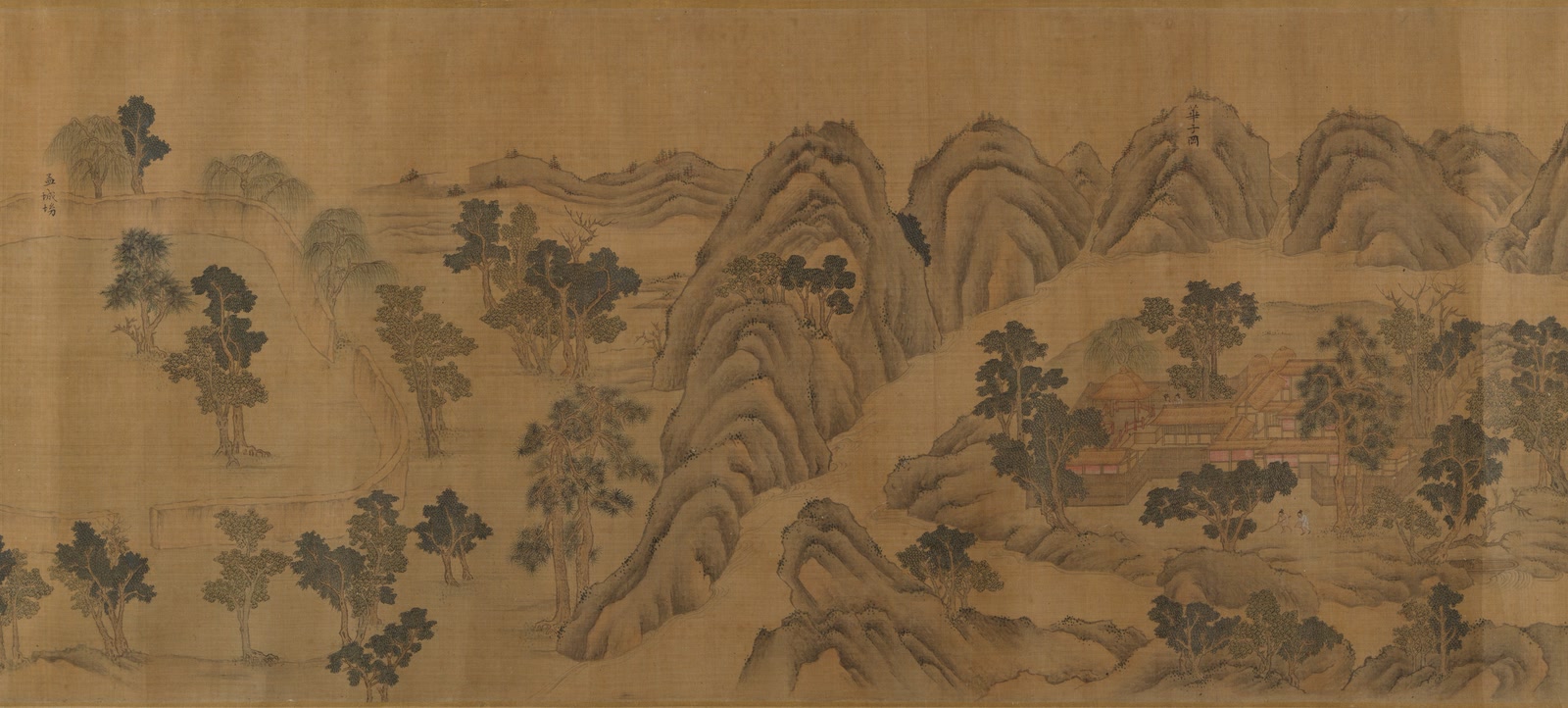
Wang Wei's Deer Enclosure is often made to sound like a perfect miniature of solitude: an empty mountain, distant voices, evening sunlight, green moss. The scene seems so clear that translation can look like a matter of choosing the prettiest English nouns. Yet the poem's twenty characters do something less settled. They withhold a viewer, repeat the same word for the people who cannot be seen and the speech that can be heard, then send indirect light into a forest whose last grammatical movement remains open to dispute.[1][3][4]
鹿柴
空山不見人,
但聞人語響。
返景入深林,
復照青苔上。[1]
A deliberately stiff crib would be: “Empty mountain—not see person; only hear person-speech resound. Return/reflected light enters deep forest; again shine/luster—blue-green moss—upon/rise.” The awkwardness is useful. It keeps visible the decisions that fluent English usually makes in secret.
The title names a site, not a sighting
Lù zhài can become “Deer Fence,” “Deer Enclosure,” “Deer Park,” “Deer Grove,” or “Deer Hermitage.” Each title changes the reader's first picture. “Park” suggests designed leisure; “fence” foregrounds a boundary; “grove” supplies vegetation before the poem does. None is simply wrong, but none is neutral.
Most important, there are no deer in the four lines. The title identifies one of the places in the Wang River estate and poem cycle rather than promising an animal encounter. The Met describes Wang Wei's lost painted handscroll and the twenty poems attached to named sites on the property; later rubbings and paintings preserved that composition long after the original vanished.[5] The title therefore works more like a location pin than a subject label. An English reader who waits for a deer has already been sent into the wrong poem.
“Enclosure” is the least misleading common choice because it keeps both place and boundary in view without pretending to reconstruct the estate. It also prepares the poem's real action: not an animal appearing inside a frame, but perception repeatedly reaching a limit.
“Empty” need not mean “uninhabited”
The first line, kōng shān bù jiàn rén, is commonly rendered as some version of “No one is seen in the empty hills.” Stephen Owen's authorized translation begins, “No one is seen in deserted hills,” a graceful line that supplies number, a passive construction, and a stronger reason for the absence.[2] The Chinese supplies none of those with certainty.
Classical Chinese can omit a grammatical subject and leave number unstated. The line gives us “empty mountain,” then negates the act of seeing, then gives “person” or “people.” Martin Kern presses this distinction hard: bù, “not,” directly modifies jiàn, “see,” rather than declaring that no human being exists there.[4] His is a deliberately revisionary reading, not a rule that cancels every earlier translation. But it reveals the cost of “deserted.” The very next line lets human speech be heard. The mountain is empty as an experience of sight; it is not certified vacant.
English has no painless solution. “No one is seen” preserves the uncertainty about who looks, but sounds bureaucratically passive. “I see no one” invents a first-person observer. “One sees no one” introduces a formal, generalized spectator. “The empty mountain does not reveal a person” gives the mountain agency that the syntax only permits, not requires.
The best translation should resist solving the emptiness too early. This is not scenery with its population count attached. It is a limit placed on vision.
The unseen human returns as sound
Line two begins with dàn, “only” or “yet”: dàn wén rén yǔ xiǎng. The poem repeats rén, the same human term that closed the first line. English versions often hide that return by moving from “no one” to “voices.” The result is idiomatic, but Wang Wei's hinge disappears. Person cannot be seen; person-speech can be heard.
Then xiǎng complicates the hearing. It can carry sound, resonance, reverberation, or echo. “Human voices echo” produces a vivid acoustic scene, but a plural group and a mountain echo have both become explicit. “The sound of human speech is heard” stays cautious and dies on the tongue. “Human speech resounds” keeps the auditory event active, though it risks sounding grander than the five compact characters.
What matters is the indirection. The human arrives as an effect without a visible source. The poem does not move from loneliness to company; it moves from failed seeing to partial hearing. The voices do not fill the mountain. They make its emptiness harder to define.
The light follows the echo
The third line is usually treated as the easy scenic turn: fǎn jǐng rù shēn lín. But fǎn jǐng has been read as returning, reflected, or cast-back sunlight—the low light of late day that reaches where direct sun does not. Some textual traditions write “shadow” in place of “light,” while commentators still connect the phrase to slanting dusk.[4]
That makes the couplets structurally close. First comes speech without a speaker in sight; then light that is itself returned or reflected. Neither sensation offers direct access to its source. “Echo” and “reflected light” are not ornaments placed on a tranquil landscape. They are the poem's method: the mountain becomes knowable through aftereffects.
The verb rù means “enter.” That direction matters. English often lets sunlight “come deep into the woods,” quietly positioning the reader as the destination. Wang Wei's grammar sends light into shēn lín: deep, dense, or dark forest. The forest is not merely a depth measurement—“deep in the woods”—but a resistant body that the light penetrates.[4]
A translation that smooths this into “the setting sun shines through the trees” gives the eye an attractive picture and removes the journey. It turns indirect light into ordinary illumination.
The last word refuses to sit still
The conventional final line is simple: the light “shines again upon the green moss.” It is supported by generations of reading and gives the poem a memorable close-up after mountain and forest. Qīng also exceeds plain “green,” ranging through blue-green or azure; even the moss's color asks English to choose a narrower band.
Kern identifies a more radical possibility in the final written character, 上.[4] The familiar postposition “on” or “upon” corresponds to a departing-tone reading: light shines on moss. Kern argues that the poem's rhyme can instead call for the historical rising-tone reading, in which the character functions as the verb “rise.” Ordinary modern romanization as shàng can conceal the prosodic distinction on which that argument depends. On Kern's account, the line might let answering brightness rise from the blue-green moss. He also suggests that zhào may function as “luster” rather than simply as the verb “shine.” The settled landscape picture becomes a reciprocal event: reflected light enters the woods, and moss returns light upward.
This alternative should not be advertised as a newly discovered correct answer. Its value is diagnostic. It shows how much the familiar “upon the moss” depends on English choosing grammar that the compressed line does not fully lock down. Even the last character can decide whether moss is a passive surface or a source of returning brightness.
Two cribs make the trade-off audible:
Empty mountain: no person is seen;
only human voices echo.
Returned sunlight enters the deep wood
and shines again upon blue-green moss.
And:
Empty mountain: one cannot see a person;
only hears human speech resounding.
Reflected light enters deep forest;
answering luster from blue-green moss rises.
The first gives a clean scene. The second preserves more grammatical friction and follows Kern's disputed upward ending. Neither can claim all the poem's possibilities. Read together, they reveal that translation is not choosing synonyms for a finished picture; it is deciding how perception moves.
A tiny poem became a translation laboratory
Eliot Weinberger built an entire book around successive versions of these four lines. The expanded New Directions edition of Nineteen Ways of Looking at Wang Wei ranges from transliteration to loose interpretation; its catalog record makes the poem's translation history part of the object readers now encounter.[3] “Deer Enclosure” is no longer only a Tang quatrain in English. It is also a record of what different eras want Chinese poetry to be: spare, mystical, visual, universal, or productively strange.
The archival image carries a related warning. The Met's handscroll is not Wang Wei's lost original. It is a sixteenth- or seventeenth-century work by an unidentified artist, made in the style of Guo Zhongshu, preserving the estate through a chain of remaking.[5] That does not make it counterfeit context. It makes transmission visible. Mountain, poem, painting, copy, and translation survive by returning in altered forms.
The most faithful English version, then, may not be the calmest one. It should keep the sequence alive: a named place with no deer, a mountain empty to the eye but not the ear, a person repeated as speech, light arriving only after it has been turned back, and moss that may receive brightness or answer it. Wang Wei's poem does not simply show a quiet landscape. It lets sound enter before light—and makes both arrive without surrendering their source.
Sources
- Chinese Text Project, “鹿柴” (Deer Enclosure)—the twenty-character Chinese text, title reading, and lexical record.
- Asia for Educators, Columbia University, “Selected Poems by Wang Wei”—biographical context and Stephen Owen's authorized English translation of “Deer Fence.”
- Google Books, Eliot Weinberger, Nineteen Ways of Looking at Wang Wei: (with More Ways)—catalog record for the expanded 2016 New Directions edition and its translation scope.
- Martin Kern, “Ends and Beginnings of World Literature,” Poetica 49 (2017/2018), pp. 1–31—close grammatical analysis of “Deer Enclosure” and its English translations.
- Metropolitan Museum of Art, “Wangchuan Villa,” 16th–17th century—curatorial object record and source for the public-domain archival handscroll detail used as the lead image.