The 1972 Convention Concerning the Protection of the World Cultural and Natural Heritage is now so familiar that its strongest invention can disappear behind its brand. "World Heritage" sounds like a label for places already loved: temples, reefs, old cities, parks, ruins. Read closely, the convention is less sentimental. It is a legal machine for turning emergency rescue into permanent cooperation. Its core move is to say that some cultural and natural places remain under national sovereignty while also becoming matters of common international concern.[1]
That balance did not come from nowhere. UNESCO's own history of the convention points back to two streams: cultural-site preservation and nature conservation, merged into a single treaty in 1972.[2] The more dramatic prehistory was Nubia. In 1959, Egypt and Sudan asked UNESCO for help as the Aswan High Dam threatened monuments and archaeological sites. In 1960, UNESCO's Director-General launched the International Campaign to Save the Monuments of Nubia; by the time the campaign ended on March 10, 1980, temples had been moved to higher ground, objects recovered, and hundreds of sites recorded.[3]
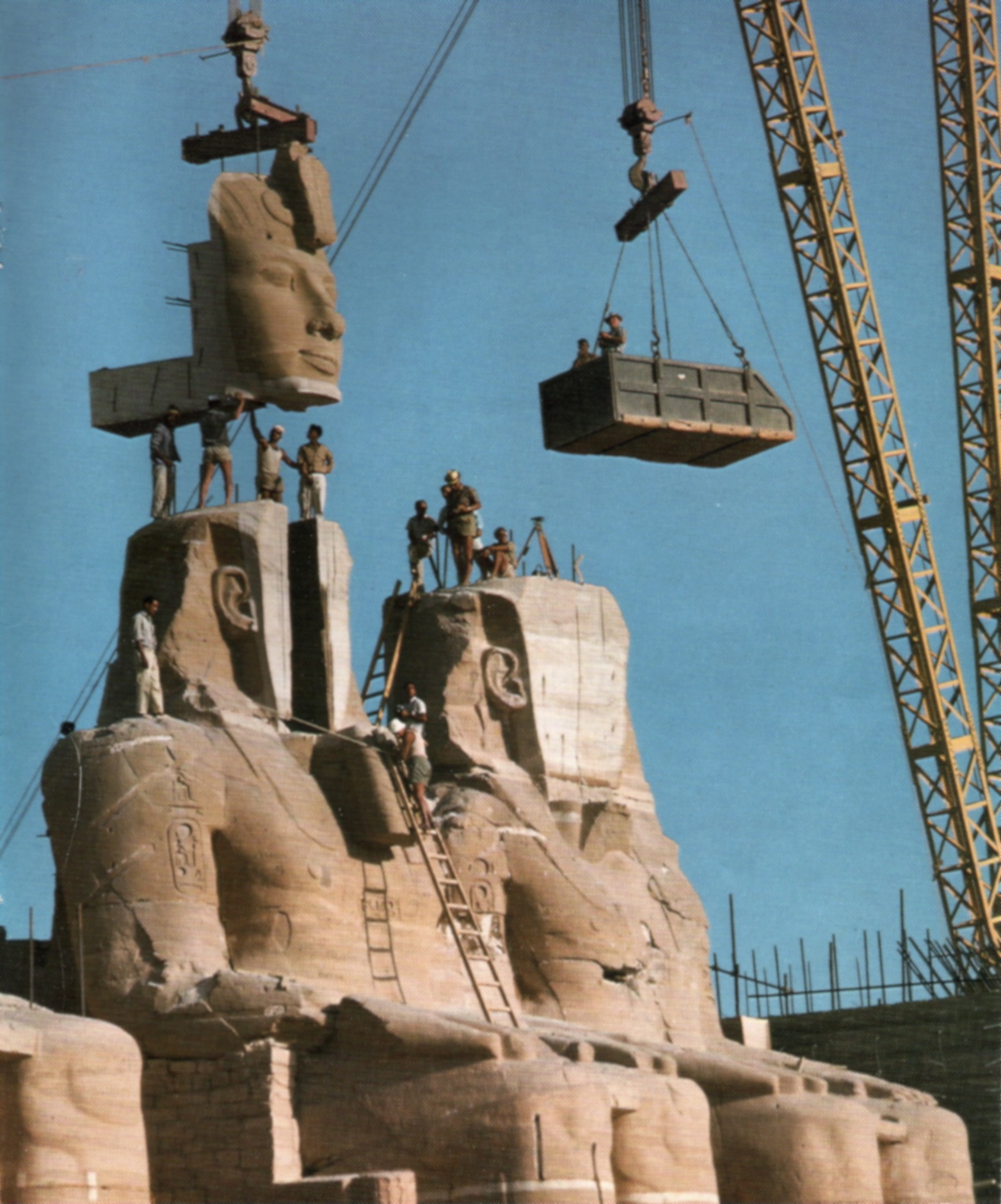
Abu Simbel makes the treaty's abstraction visible. UNESCO's account of the campaign says 22 monuments and complexes were saved by 40 technical missions from five continents, with a total cost of US$80 million, half donated by about 50 countries.[4] The numbers matter because they show the problem the 1972 text tried to generalize. If saving a threatened monument required technical expertise, money, diplomacy, and state consent, then heritage protection could not be only local reverence or scholarly alarm. It needed standing procedures.
The preamble begins with loss, not beauty
The convention's opening does not begin by praising famous places. It begins with threat. Cultural and natural heritage, the preamble says, are increasingly endangered not only by ordinary decay but by changing social and economic conditions that intensify damage and destruction.[1] That framing is crucial. The treaty is not a prize system first. It is a response to modern pressure: development projects, insufficient national resources, technical gaps, tourist growth, urban change, conflict, abandonment, and disaster.
The next move is more ambitious. The text says the deterioration or disappearance of any item of cultural or natural heritage is a harmful impoverishment of all nations, then argues that some heritage has such outstanding interest that it should be preserved as part of the world heritage of humankind.[1] That is the convention's moral leap. A site remains in a particular place, under a particular state, with particular communities and laws around it. But its loss is framed as more than local loss.
This is why the treaty had to write sovereignty and cooperation into the same grammar. Without sovereignty, international protection could look like cultural takeover. Without cooperation, the phrase world heritage would be decorative. The convention's achievement is not that it dissolves the tension. It makes the tension administratively usable.
Articles 1 and 2 make a joined category
Articles 1 and 2 define cultural and natural heritage separately, but the treaty's historical novelty lies in making them part of one instrument.[1][2] Cultural heritage includes monuments, groups of buildings, and sites, including combined works of nature and human beings. Natural heritage includes physical and biological formations, geological and physiographical formations, habitats of threatened species, and natural sites of outstanding value.[1]
The categories are not identical, and the treaty does not pretend they are. A carved temple, a historic urban ensemble, a reef, and a fossil-bearing landscape require different methods. But the shared legal frame matters. It says cultural preservation and nature conservation are not rival moral languages. They are parallel claims about inheritance, vulnerability, evidence, and public duty.
UNESCO's convention overview still treats that merger as the treaty's most significant feature: one document links nature conservation and preservation of cultural properties, recognizing human interaction with nature and the need to preserve balance between them.[2] In close-reading terms, Articles 1 and 2 are doing quiet political work. They prevent "heritage" from meaning only old stone, and they prevent "nature" from being imagined as detached from human history.
Article 4 puts duty before prestige
The convention's most important sentence may be Article 4. Each state party recognizes that the duty of identifying, protecting, conserving, presenting, and transmitting the relevant heritage situated on its territory belongs primarily to that state.[1] The order is bracing. Before the list, before inscription, before tourism, there is duty.
Article 5 then turns duty into capacity: policy, services, staff, studies, legal measures, administrative measures, financial measures, training centers, and research.[1] This is the anti-postcard part of the convention. A place does not survive because the world admires it. It survives if a state can inventory it, staff it, protect it, monitor it, plan around it, and respond when danger changes form.
That is also where the Nubia precedent matters. In the rescue campaign, UNESCO acted as coordinator and intermediary between donor states and the Egyptian and Sudanese governments; an executive committee and trust fund were created in 1960.[3] The campaign worked through state request, international organization, technical missions, funding, and physical intervention. Article 5 turns that kind of emergency competence into a general expectation.
Article 6 makes cooperation conditional, not imperial
Article 6 is the treaty's hinge. It says that, while fully respecting state sovereignty and property rights, the states parties recognize that such heritage constitutes world heritage whose protection requires international cooperation. It also says states undertake to help when the state on whose territory the heritage sits requests that help.[1]
That request condition is not bureaucratic fussiness. It is the political bargain that makes the whole system possible. The treaty does not authorize a free-floating world public to seize control of another state's monuments or landscapes. It builds an assistance system that depends on national responsibility and international support meeting each other.
This is why "world heritage" in the convention is not the same thing as world ownership. The public may feel that a place belongs to everyone, but the treaty is more careful. It says the world has a duty to cooperate; it does not say the world owns. That distinction is one reason the text could travel widely after it entered into force in 1975.[2]
Article 11 turns judgment into a list
The familiar World Heritage List appears in Article 11. States submit inventories; the committee establishes, updates, and publishes a list of properties it considers to have outstanding universal value according to criteria it has established.[1] The list is the convention's public face, but the article shows that listing is only one step in a chain. First comes national identification. Then documentation. Then committee judgment. Then publication and updating.
Article 11 also creates the List of World Heritage in Danger.[1] That second list is essential to understanding the first. Inscription is not merely honor. It is a monitoring relationship. The same article that makes a site visible as outstanding also gives the system a way to mark serious and specific danger: accelerated deterioration, large projects, rapid urban or tourist development, land-use changes, abandonment, armed conflict, calamities, earthquakes, landslides, volcanic eruptions, water-level changes, floods, and tidal waves.[1]
The Nubian Monuments were inscribed in 1979, after the convention had begun operating, and UNESCO's site record explicitly links the first five component parts to temples moved during the 1960-1980 international campaign to save them from flooding by the Nile and Lake Nasser.[5] That inscription is more than a victory lap. It shows how the new list absorbed an earlier rescue into a permanent memory of collective action.
The fund makes admiration material
Article 15 establishes the World Heritage Fund. Article 20 and related assistance provisions explain what help can mean: studies, experts, technicians, skilled labor, training, equipment, loans, and in exceptional cases non-repayable subsidies.[1] This is the convention's practical conscience. It knows that global admiration without money and expertise can become a burden placed on the states least able to pay.
The fund does not erase inequality. Nor does it guarantee that international attention will always arrive in time. But it gives the treaty an answer to one of the preamble's sharpest observations: national protection often remains incomplete because of the scale of resources required and insufficient economic, scientific, or technological capacity.[1] The convention is therefore built around a modest but important correction. If the world claims an interest in a place, the world must be able to contribute something more concrete than applause.
Article 24 adds a discipline borrowed from technical rescue: large-scale international assistance should be preceded by detailed scientific, economic, and technical studies, using advanced methods and seeking rational use of resources.[1] That clause could have been written in the shadow of Abu Simbel's cranes. It insists that heritage intervention is not only moral urgency. It is engineering, conservation science, planning, and cost control.
The public is part of the machinery
Article 27 is easy to overlook because it sounds soft beside lists, committees, and funds. It requires states to strengthen appreciation and respect for heritage through educational and information programs and to keep the public broadly informed of dangers and protective activities.[1] The clause matters because heritage protection cannot survive as a conversation among diplomats and specialists alone.
This is the point where the convention's list-making power can become double-edged. Public visibility brings support, but it can also bring crowding, branding, simplified memory, and political pressure. The treaty anticipates at least part of that problem by making public information about danger part of the duty, not just celebration. The public is supposed to learn why protection is necessary, not merely consume the prestige of inscription.
The close-reading judgment
The 1972 convention did not invent love for old places or awe before natural landscapes. It did something harder and less romantic. It gave that love a legal sequence: define, identify, protect, cooperate, list, monitor, assist, educate, report. Its genius is procedural.
That is why Abu Simbel remains the right image for reading it. The photograph of a colossal face being lifted back into place captures the convention's founding pressure better than any emblem could. Heritage is heavy. It sits in terrain, law, budgets, machines, diplomatic requests, expert hands, and public stories. The 1972 text made a promise that such weight should not fall on one state alone when the loss would diminish everyone.
The promise remains imperfect, contested, and vulnerable to politics. But the document's structure is still sharp. World heritage, in the convention's close grammar, is not a claim that the world owns a place. It is a claim that the world has obligations when certain places face danger, and that those obligations need permanent institutions before the emergency arrives.
Sources
- UNESCO World Heritage Centre, "Convention Concerning the Protection of the World Cultural and Natural Heritage" - complete 1972 convention text, including definitions, state duties, cooperation, lists, fund, assistance, education, and reporting.
- UNESCO World Heritage Centre, "The World Heritage Convention" - official overview and brief history of the convention's merger of cultural preservation and nature conservation.
- UNESCO World Heritage Centre, "Monuments of Nubia - International Campaign to Save the Monuments of Nubia" - official campaign history, 1959 request, 1960 appeal, coordination role, and 1980 conclusion.
- UNESCO World Heritage Centre, "Working Together: Abu Simbel" - account of the Nubia rescue's monuments, technical missions, countries, and cost.
- UNESCO World Heritage Centre, "Nubian Monuments from Abu Simbel to Philae" - official World Heritage listing linking the moved temples to the 1960-1980 UNESCO campaign.
- Wikimedia Commons, "File:Abusimbel.jpg" - Per-Olow Anderson's 1967 archival photograph of a Ramses face being lifted into place during the Abu Simbel relocation, used as the article image.