The Lindisfarne Gospels are not hard to praise. The harder question is where praise should leave them. A book made on Holy Island around the early 8th century now sits in the British Library; a manuscript formed for Northumbrian sacred memory has become a national treasure, a digitized object, an exhibition loan, and a recurring political argument about regional belonging.[1][2]
That is why the manuscript is best read here as a memory-and-commemoration problem rather than only as a masterpiece of Insular art. Its pages matter, but so does the chain of custody around them. Every modern display asks a historical question that the book itself cannot answer: does an object remember most truthfully where it was made, where it survived, where it can be conserved, or where the largest public can encounter it?
The British Library catalogue gives the institutional skeleton. Cotton MS Nero D IV is a Gospel-book, now catalogued as the Lindisfarne Gospels, and it belongs to the Cotton collection. Sir John Cotton bequeathed that collection for public use; it became one of the British Museum's founding collections in 1753, and later passed into the British Library's custody after the library was created.[1] That record makes the manuscript a national collection object. It does not erase the north-eastern claim. It explains why the claim has to be made against a legal and institutional history, not merely against neglect.
A book made for a northern saint
The first layer of memory is local and devotional. The British Library's medieval manuscripts account identifies the book as the work of one scribe, probably also responsible for its decorated initials, and ties the late 10th-century colophon to Eadfrith, bishop of Lindisfarne from 698 to 721.[2] In that colophon tradition, the manuscript was not an anonymous luxury object. It was associated with named makers and with the cult of St Cuthbert.
That naming matters. Commemoration often begins when a community can attach memory to people, not just to beautiful things. Eadfrith gives the book a hand. Cuthbert gives it a sacred center. Aldred, who added an Old English gloss centuries later, gives it an afterlife in another language.[2] The manuscript therefore carries more than text. It carries a succession of communities asking the same physical object to do different kinds of work: worship, authority, translation, scholarship, regional identity.
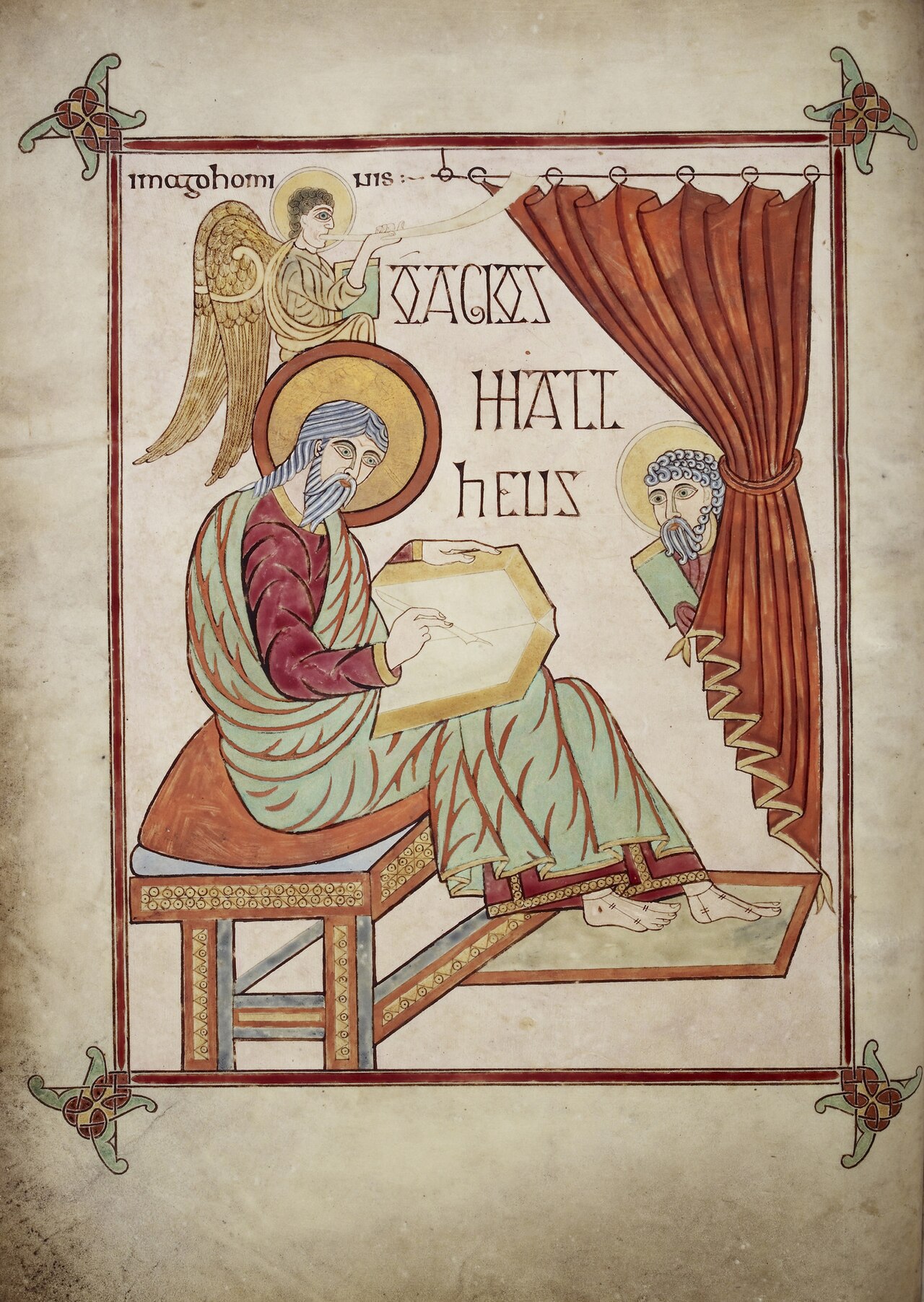
The page image used here sharpens that point. St Matthew is not a neutral illustration dropped into a book. It is a visual threshold into a Gospel, made in ink and pigment on vellum and now encountered through a digital photograph released from British Library collections.[6] The image compresses the problem beautifully. We see a page that once belonged to liturgical and monastic use; we encounter it through a modern preservation pipeline.
The national-library argument
By 1998, the question of where the Gospels belonged had become explicit enough to reach the House of Lords. The debate record preserves competing claims: one side emphasized the manuscript's Northumbrian origin and sacred context; the other stressed conservation conditions, legal custody, national access, comparison with other early medieval objects, and the risks of moving a fragile vellum manuscript.[3]
The strongest London argument is not simply "we own it." It is that care is also a form of commemoration. A manuscript on vellum, dating from around 700, requires controlled light, stable climate, security, and specialist handling.[3] In this view, the British Library does not sever the book from memory; it protects the material conditions under which any memory can continue.
But that argument has a weakness if it is allowed to become too complete. Conservation can sound like closure. If the only valid form of care is permanent central custody, then the place of origin becomes scenery rather than evidence. The North East's claim is not that humidity and transport risk are imaginary. It is that cultural meaning is also damaged when a region's defining object is mostly encountered elsewhere.
Returning without returning
The compromise has been exhibition. The catalogue's exhibition history records repeated northern displays: Durham Cathedral in 1987, the Laing Art Gallery in Newcastle in 1996 and 2000-01, Palace Green Library in Durham in 2013, and other major displays in London.[1] These loans are not permanent restitution, but they are not trivial either. They let the manuscript periodically re-enter the landscape whose memory it helps organize.
The 2013 Durham exhibition shows how strong that pull remained. A Research Excellence Framework impact case records visitor data during the run and notes that by late July tens of thousands had already attended, with a large majority of sampled visitors coming from the North East.[5] The point is not just ticket volume. It is evidence that the manuscript's regional meaning produces a different public than a standard national-gallery encounter.
The 2022 Laing Art Gallery exhibition made that logic even more explicit. North East Museums announced the display as a high-profile loan from the British Library, paired with a supporting exhibition at Newcastle City Library, and framed the show around personal, regional, and national pride and identity.[4] That language is revealing. The Gospels were not being presented only as old pages. They were being used to stage a modern identity argument with the manuscript as witness.
This is the commemorative middle ground: the book can be legally and physically housed in London while still being periodically asked to answer northern memory. That arrangement is imperfect, but imperfection may be the honest form. A permanent move would solve one claim and reopen others: conservation cost, access, precedent, and the meaning of a national collection. Permanent centralization solves different claims while leaving the place-of-making wound open.
What the manuscript remembers now
The Lindisfarne Gospels survive because many institutions and communities have treated them as more than old property. The medieval community made and glossed them. Cotton collectors preserved and transmitted them into a public collection. The British Museum and British Library absorbed them into national custody. Curators digitized and displayed them. Northern exhibitions returned them, temporarily, to the region that still recognizes itself in their making.[1][2][4][5]
That chain is not a tidy story of rescue. It is a custody argument that keeps changing form. In the early medieval period, the question was how a sacred community marked Cuthbert's authority and the Gospel text. In 1753, it became how a private manuscript collection could be turned toward public use. In 1998, it became how national access and regional context should be weighed against each other. In 2013 and 2022, it became how a fragile object could generate living public memory without being permanently relocated.[1][3][4][5]
The best answer may be to stop pretending there is only one belonging. The Lindisfarne Gospels belong to Holy Island as origin, to Northumbria as memory, to the British Library as custody, to scholars as evidence, and to readers as a surviving encounter with early medieval making. None of those claims cancels the others. The manuscript's afterlife is powerful because they remain unresolved.
That unresolvedness is the point. A commemorative object that never leaves its case can become mute; an object moved too casually can be damaged into symbolism. The Lindisfarne Gospels ask for a harder discipline: keep the page alive, keep the place audible, and keep the argument visible enough that care does not become forgetting.
Sources
- British Library Archives and Manuscripts Catalogue, "Cotton MS Nero D IV" - catalogue record for the Lindisfarne Gospels, including contents, Cotton collection custody, digitised content, and exhibition history.
- British Library Medieval Manuscripts Blog, "The Lindisfarne Gospels in the Treasures Gallery" - curatorial account of the manuscript, Eadfrith attribution, late 10th-century colophon, and British Library display context.
- UK Parliament Hansard, "The Lindisfarne Gospels," House of Lords debate, April 2, 1998 - parliamentary record of arguments over North East relocation, conservation, public access, and British Library custody.
- North East Museums, "Lindisfarne Gospels to go on display at Laing Art Gallery" - 2022 exhibition announcement framing the loan around personal, regional, and national identity.
- Research Excellence Framework Impact Case Study, "The Lindisfarne Gospels Exhibition, Durham 2013" - visitor data and public-impact record for the Durham exhibition.
- Wikimedia Commons, "File: St. Matthew - Lindisfarne Gospels (710-721), f.25v - BL Cotton MS Nero D IV.jpg" - British Library digitized image used as the article image.