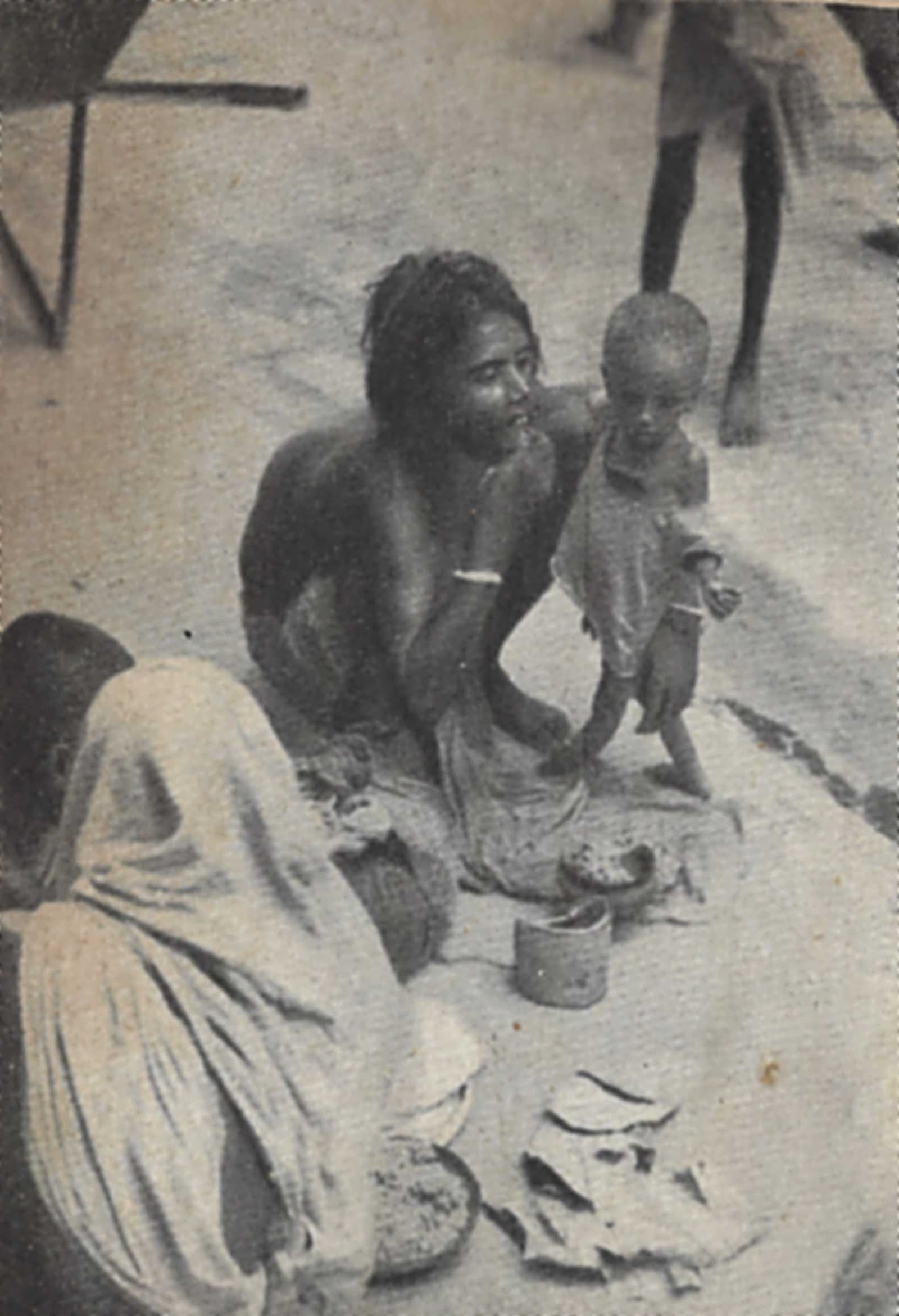
The hardest question about the Bengal famine of 1943 is not whether there was a single cause hiding under the evidence. There was not. Burma's fall cut off a rice buffer, the October 1942 cyclone damaged crops and transport, wartime procurement and inflation changed who could buy food, coastal "denial" policies disrupted boats, traders hoarded, officials hesitated, and relief arrived after mass migration had already turned roads and Calcutta pavements into famine archives.[1][5]
The sharper historiographical question is how much weight to give each layer. If the famine is treated mainly as a food-availability crisis, the story begins with rice, crop disease, lost imports, shipping, and a province already near subsistence. If it is treated mainly as an entitlement crisis, the story begins with purchasing power: food may exist somewhere in the system, but laborers, fishermen, artisans, and smallholders lose the command over it. If it is treated as an imperial crisis, the story widens again: wartime priorities, colonial legitimacy, political detention, censorship, and delayed emergency imports become central rather than background.[2][4][5]
That is why the Bengal famine remains a live historical argument. The evidence does not let any careful reader say "only nature" or "only Churchill" or "only markets." But it also does not let responsibility dissolve into complexity. The deaths were not the automatic result of a bad harvest. They were produced through a chain in which ecological shock, price movement, administrative failure, war logistics, and colonial hierarchy interacted.
The official inquiry: shortage, panic, and administration
The Famine Inquiry Commission's 1945 Report on Bengal is the unavoidable starting point because it recorded the official explanation after the catastrophe. It framed Bengal as a rice economy exposed to wartime stress, lost Burmese imports, crop damage, speculation, and failures of policy coordination. The report did not read the famine as a single villain's act. It saw a chain of warning, price rise, procurement confusion, local distress, and late relief.[1]
That framing has two strengths. First, it keeps the calendar visible. The crisis did not suddenly appear in the photographs that shocked urban readers in August 1943. It had been forming through 1942, worsened in early 1943, and became unmistakable by the middle of that year. Second, the report makes administration part of causation. A shortage becomes famine only when information, transport, price control, procurement, public relief, and medical response fail to protect vulnerable groups.[1]
But the official inquiry also has an interpretive limit. Because it was produced by the colonial state after the fact, it could describe mismanagement more easily than it could indict the larger political order that made mismanagement so durable. In that sense, the report supplies evidence for later critics even where its own conclusions remain cautious. It shows a state trying to explain a disaster without fully trying the state itself.
Sen's intervention: famine without simple food disappearance
Amartya Sen's famous intervention changed the debate by refusing to equate famine with aggregate food disappearance. In his 1977 article on starvation and exchange entitlements, Sen used Bengal to argue that people starve when their entitlement to food collapses - when wages, assets, prices, employment, legal claims, and social position no longer let them command enough food to live.[2]
This matters because Bengal's victims were not distributed randomly. Rural laborers, fishermen, transport workers, artisans, and land-poor families were hit hardest. Many did not die because every grain of rice had vanished. They died because rice prices outran wages and assets. A boatman stripped of work by wartime disruption, a laborer paid in cash while rice prices climbed, or a smallholder forced into distress sales could lose food access even while merchants, military buyers, or priority urban groups still obtained supplies.[2][3]
Sen's model remains powerful because it explains the social pattern of famine. It asks who could buy, sell, work, move, borrow, and receive relief when prices broke away. It also moves policy responsibility from harvest statistics to public action. If famine is an entitlement failure, governments cannot wait for perfect crop data before intervening. They have to protect purchasing power, employment, ration access, and relief channels before starvation becomes visible on city streets.
The weakness of a simplified Sen reading is that it can sound as if physical shortage barely mattered. That is not the best version of the argument. The strongest entitlement interpretation does not deny crop shocks, lost imports, or war transport pressure. It says those shocks became mass death through unequal access and policy failure.
Greenough's peasant lens: survival strategies broke unevenly
Paul Greenough's work pushes the debate downward into household behavior. His 1980 article asks what peasants actually do when famine threatens: sell jewelry, reduce consumption, borrow, protect seed and cattle, migrate, cling to production assets, or liquidate them.[3] That question is important because it restores sequence. Famine is not only a death count; it is a long chain of decisions made under worsening constraint.
This lens complicates both official and macroeconomic accounts. Rural families did not passively wait for relief. They tried to manage scarcity, debt, labor, and future cultivation. But their strategies were not equally available. A family with ornaments, cattle, grain, kinship credit, or land had options that a landless laborer did not. A household that sold productive assets could survive one month and lose next year's livelihood. A household that refused to sell assets might cut food intake first and enter physiological danger earlier.[3]
Greenough's contribution is therefore not just local color. It helps explain why the same price shock could produce different outcomes across class, caste, gender, occupation, and district. The famine was a market event, but markets reached people through social position. That is why the phrase "Bengal starved" is too blunt. Some Bengalis sold, some bought, some hoarded, some migrated, some administered relief, some watched, and some died.
The imperial and wartime frame: shipping, troops, and legitimacy
The wartime imperial frame does not replace the rice-and-price story; it changes its moral and institutional scale. A 29 April 1944 telegram from Winston Churchill to Franklin Roosevelt, printed in the Foreign Relations of the United States series, shows the war cabinet still negotiating the food problem after the worst famine year. Churchill wrote that at least 700,000 people had died in Bengal the previous year, that Wavell estimated India needed about one million tons of imports in 1944, and that Britain had arranged 350,000 tons of wheat from Australia but lacked ships for more.[4]
That document is useful precisely because it does not fit a cartoon. It shows real shipping constraints and competing military needs. It also shows how late the imperial emergency response was in relation to mass mortality. By the time London was seeking additional shipping in spring 1944, famine had already done enormous damage, and disease continued to exploit bodies weakened by hunger.[4]
Benjamin Robert Siegel's account of the Bengal famine's political afterlife widens the frame again. He argues that reports, photographs, plays, charity appeals, and vernacular journalism turned a provincial catastrophe into a national atrocity that energized the case for self-rule.[5] This was not simply retrospective nationalism. In late colonial India, hunger became evidence that an unrepresentative government could not be trusted with sustenance. The famine made "food" and "freedom" part of the same political vocabulary.[5]
That interpretation is strong because it explains why the famine's memory exceeded the immediate food crisis. Bengal became a case against imperial governance: not because every official enjoyed suffering, but because the system's priorities, distrust, racial hierarchy, and distance from accountable local politics made delay easier to sustain.
Two strong interpretations, and what each sees best
The first strong interpretation is the entitlement-centered account. It sees the famine as a collapse in command over food. Its best evidence is social distribution: those with weak purchasing power died first and worst. It explains why prices, wages, employment, and relief mattered as much as acreage. Its policy lesson is urgent: prevent famine by protecting access before starvation announces itself.[2][3]
The second strong interpretation is the imperial-political account. It sees the famine as a crisis of colonial wartime governance. Its best evidence is institutional: delayed imports, military priority, disrupted transport, political detention, weak provincial-central coordination, and the later nationalist reading of the famine as proof that India needed accountable rule.[4][5]
These interpretations are not enemies unless they are flattened. Entitlement analysis explains the mechanism by which hunger selected its victims. Imperial analysis explains why the machinery that should have interrupted that mechanism did not do so fast enough. The shortage-oriented official record still matters, but it is most convincing when treated as one layer: rice stress and war disruption created danger; price and entitlement failure distributed danger; colonial governance failed to arrest danger; memory turned that failure into an indictment.
What would change the balance?
The debate would shift toward a stronger food-availability reading if better district-level evidence showed a far deeper aggregate rice collapse than the entitlement literature allows, and if that collapse alone tracked mortality closely. It would shift toward a narrower administrative-error reading if records showed that relief delays were mostly local and technical rather than connected to imperial war priorities. It would shift toward a harsher imperial-intent reading if archival evidence demonstrated a deliberate decision to let Bengal starve despite feasible relief options.
The evidence we have points to a more disciplined conclusion. The Bengal famine was neither a natural disaster with unfortunate paperwork nor a monocausal morality play. It was a famine made from interaction: a fragile rice economy, wartime shocks, market panic, unequal entitlements, coercive and distracted governance, and relief that lagged behind the speed of hunger. The tragedy of 1943 is that every layer made the next layer more lethal.
That is why the archival photograph is so difficult to look at responsibly. It cannot by itself adjudicate crop data, shipping tables, or cabinet minutes. But it prevents the debate from becoming bloodless. The people on Calcutta sidewalks were not abstractions inside a model. They were the historical test of the model. Any account of Bengal that explains causes while losing sight of them has explained too little.
Sources
- Government of India, Famine Inquiry Commission Report on Bengal, Government of India Press, 1945 - official inquiry report on Bengal's food position, policy failures, mortality, and relief administration.
- Amartya Sen, "Starvation and exchange entitlements: a general approach and its application to the great Bengal famine," Cambridge Journal of Economics, 1977 - article page for Sen's entitlement analysis.
- Paul R. Greenough, "Indian Famines and Peasant Victims: the Case of Bengal in 1943-44," Modern Asian Studies, 1980 - peasant-survival and vulnerability framing.
- U.S. Department of State Office of the Historian, Foreign Relations of the United States, 1944, Document 281 - Churchill to Roosevelt telegram on India's food imports and shipping constraints, 29 April 1944.
- Benjamin Robert Siegel, "The Bengal Famine and the Nationalist Case for Food," in Hungry Nation: Food, Famine, and the Making of Modern India, Cambridge University Press, 2018 - chapter on the famine's nationalist political afterlife.
- Wikimedia Commons, "Destitute mother and child Bengal famine 1943.jpg" - file page for the 1944 Bengal Speaks archival photograph used as the article image.