On November 3, 1918, the steamship Sonoma reached Pago Pago after recording fourteen influenza cases and one death on its voyage from San Francisco. Two people still had pneumonia. American Samoa's naval administration isolated them, placed the three passengers who were actually landing under five days of home quarantine, fumigated their belongings, and kept everyone else aboard. The surviving record attributes no local infection to that arrival.[3]
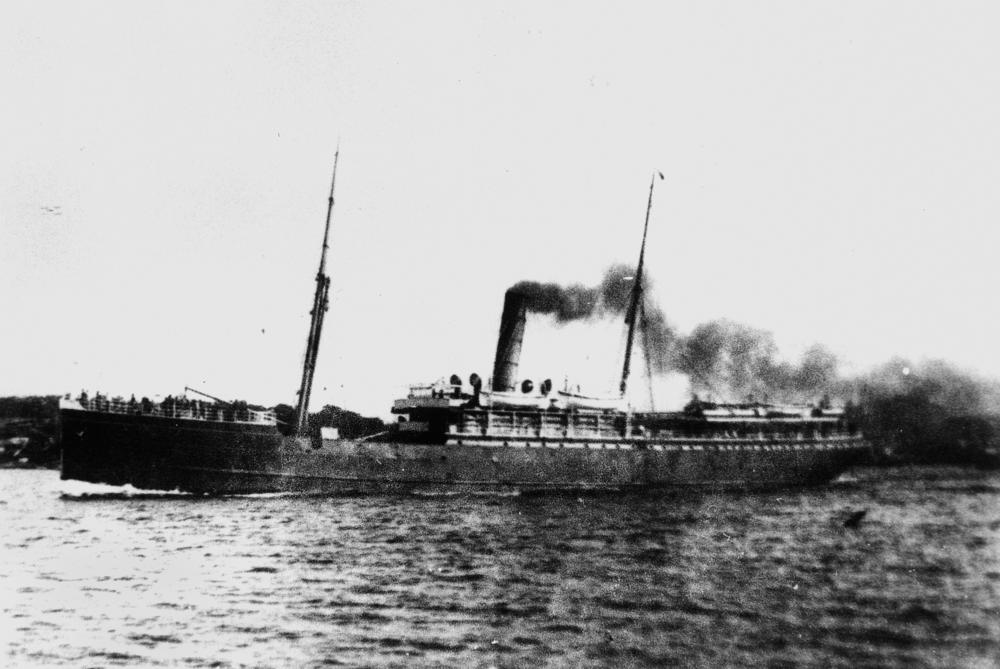
Four days later, the Talune anchored at Apia with at least six passengers ill. One soldier had to be carried ashore. The ship had already been held under restrictions at Suva and Levuka, but its captain presented clean bills of health and did not explain those earlier quarantines to Apia's inexperienced port health officer. Between the anchor dropping at 9:35 a.m. and cargo work beginning at 10:50 a.m., the ship was inspected, cleared and opened to the port. Passengers landed; Samoans boarded to greet relatives; freight moved.[1][3]
The comparison is almost brutally compact: two arrivals in the same pandemic wave, at two ports in one island chain, four days apart. Yet it should not be told as a contest between culturally separate peoples. The archipelago had been partitioned by foreign powers only in 1899. In 1918, New Zealand's military occupation governed Western Samoa—the islands that form today's independent Samoa—while the United States Navy governed American Samoa. Families, churches and travel still crossed that imposed line.[3][6]
What separated the outcomes was not a line on a map. It was whether a warning could interrupt a ship's ordinary routine.
Both ports had rules; only one had a practiced bottleneck
Western Samoa did not meet the Talune with no law at all. A 1917 proclamation required a medical officer to examine incoming vessels before the harbor master granted pratique, the clearance that allowed contact with shore. The rule sounds adequate on paper. Underneath it, however, sat incompatible administrative habits. Officials variously relied on regulations inherited from the former German government, older tripartite rules, or New Zealand practice. The principal medical officer and the acting port health officer were not even aware of the same local framework.[1][3]
Nor had Apia turned quarantine into a physical process. There was no permanent isolation station. Colonel Robert Logan later said there were not enough military tents to create one; a missionary testified that a house capable of holding about sixty people had been offered. Whichever account best describes the available space, the operational fact is the same: when an exposed passenger stepped off a ship, the administration had no settled place, staff or sequence ready to receive that person.[3]
Pago Pago possessed only modest facilities, but it had made the harbor itself controllable. Since 1902, its health officer had been expected to board incoming ships before anyone else approached. A small quarantine station opened on Goat Island the following year. It could hold only a handful of people, so crews could be kept on their vessels offshore under boat guard while residents were isolated in the naval dispensary or Samoan hospital. Just as important, Pago Pago was American Samoa's only legal overseas port. An arriving ship encountered one gate, not an aspiration to watch every landing equally.[3]
The difference was therefore larger than “strict” versus “lax.” Apia had a rule that depended on a correct decision during one inspection. Pago Pago had accumulated a workflow: board first, withhold clearance, separate the ill, hold the exposed, keep the vessel apart, watch the water.
Apia treated a certificate as a diagnosis
The Talune left Auckland on October 30 while influenza was spreading there. Because New Zealand had not yet made influenza formally notifiable, the vessel departed with a clean bill of health. At Suva on November 4, medical officers found illness and quarantined the ship alongside the wharf while allowing cargo work. Levuka imposed restrictions again the next day.[1]
On November 6, New Zealand added influenza to the diseases subject to public-health and quarantine law. The Apia wireless station was working, but neither the Health Department nor the Defence Department sent the change to Western Samoa. The official commission appointed in 1919 later judged that failure, the misleading Auckland paperwork, the captain's silence about Fiji, and confusion inside the Apia administration as linked breaches rather than one unlucky mistake.[1]
The clean bill was especially treacherous because it described conditions at a departure port; it did not certify that everybody aboard remained well. Apia's officer read it as reassurance about the ship in front of him. He did ask about health, but accepted “colds and seasickness” as an explanation and did not learn that the Talune had twice been restricted. A document that should have been one input displaced the evidence of sick bodies.[1]
This is the first major contrast. Pago Pago's response to the Sonoma began with illness aboard and overruled the convenience of landing. Apia's response to the Talune began with paperwork and allowed convenience to overrule illness. Quarantine failed before anyone debated how long it ought to last.
Pago Pago made waiting enforceable
Governor John Martin Poyer had received no special influenza order from Washington. He followed newspaper reports and radio summaries, then used his own authority to restrict outside traffic. The Sonoma became a live rehearsal: sick travelers went into isolation, the three landing passengers waited five days under observation, belongings were fumigated, and contact between shore and the remaining passengers and crew was refused.[3]
When news of Upolu's epidemic reached Tutuila, the rules tightened. By November 14, travel from Western Samoa was already blocked. On November 20, Poyer sent Apia a radiogram requiring vessels to complete five days of absolute quarantine before exchanging passengers, mail or cargo. In December, American Samoa's consul at Apia stopped issuing bills of health for Pago Pago until ten days after Western Samoa's last confirmed case.[1][3]
The refusal extended to things that normally seemed harmless. When a Western Samoan government vessel tried to transfer mail, Poyer met it outside the harbor and said that entering would subject both crew and mail to five days' quarantine. The packet went back. That episode captures what made the policy real: no convenient exception was small enough to escape the same chain of control.[3]
Waiting imposed costs. Teachers and other American Samoan residents were stranded in Upolu. Schools were disrupted. Family contact and trade stopped. American Samoan children attending mission schools in Western Samoa were among those who died. The protected territory did not stand outside the disaster; it prevented the infection from establishing local transmission while people connected to it suffered across the colonial border.[3]
Samoan patrols completed the line that the Navy could not
A port order alone could not close an archipelago. Samoans had traveled between the islands for centuries, and small craft could avoid both Apia and Pago Pago. People fleeing a lethal epidemic or trying to return to family had every reason to attempt an unrecorded landing. One infected arrival on an unwatched beach could have defeated the naval station's precautions.[3]
The outer layer of American Samoa's quarantine was consequently built by Samoans. With the support of the district chiefs Mauga, Satele and Tufele, local patrols watched Tutuila's coast day and night, stopped landings, and directed boats toward Pago Pago for inspection. Later epidemiological work likewise attributes the exclusion not only to naval control of the base but to residents' control of the wider coastline.[3][5]
That evidence corrects the simplest hero story. Poyer's speed mattered, and his freedom to act without waiting for Washington mattered. But a governor could issue an order more easily than a few naval personnel could watch every reef opening. The quarantine succeeded as a coalition between centralized port authority and chiefly influence at village level.
It was also colonial and unequal. In 1919, healthy Samoan passengers from quarantined vessels could be confined in the Native Hospital while white residents were allowed to isolate at home. Later rules imposed different waiting periods and temporarily barred Samoan travel more broadly. Protection from infection and racial hierarchy operated inside the same system. A comparison that notices only the death totals would miss who carried the burden of making the border hold.[3]
The numbers show exclusion, not a controlled experiment
The 1919 Samoan Epidemic Commission found no epidemic pneumonic influenza in Western Samoa before the Talune arrived. Within seven days, it reported, the disease was epidemic on Upolu and soon spread to Savai‘i. Its count reached 7,542 deaths by December 31; adding the abnormally high mortality in the following months produced a later estimate of about 8,500, roughly 22 percent of the population.[1][2]
Contemporary and later accounts report no local influenza illness in American Samoa during the pandemic period; the firmest measurable claim is that they record no influenza deaths. Modern comparative studies place its reported mortality at zero while identifying Western Samoa at about 220 deaths per 1,000 people. They also warn that early twentieth-century Pacific records were uneven and that diagnoses made without laboratory confirmation cannot carry modern precision.[4][5]
Those limits matter, but they do not make the contrast mysterious. Evidence that influenza circulated in American Samoa in 1918, or that Western Samoa had community transmission before November 7, would weaken the central comparison. The surviving official, consular, naval and later scholarly records point the other way: one administration admitted an infectious ship, while the other repeatedly intercepted exposed arrivals.[1][3][5]
The evidence does not tell us how severely American Samoa would have suffered had the 1918 virus entered. Population density, medical capacity, prior respiratory exposures and the timing of an epidemic could all affect mortality. Quarantine explains the observed absence of a local epidemic; it cannot supply the missing counterfactual.
That boundary becomes clearer in 1926, when influenza finally reached American Samoa. At least a quarter of residents reportedly became ill, yet estimated mortality was about one per 1,000—far below Western Samoa's 1918 toll. Researchers treat the later episode as evidence that exclusion delayed exposure beyond the deadliest pandemic wave, not as proof that isolation made the population permanently immune or that the two outbreaks were biologically identical.[5]
The real comparison is between systems of attention
It is tempting to compress the history into Poyer the decisive protector and Logan the negligent administrator. The record gives that judgment some support. Poyer acted before orders arrived; Logan's administration failed to convert warnings and visible illness into a quarantine. During the crisis, Logan also failed to pursue nearby American medical help and briefly cut wireless communication with Pago Pago after a dispute over quarantined mail. The 1919 commission conceded that Poyer's offer of “service or assistance” was ambiguous, but judged that Logan should have asked directly for the doctors and orderlies only hours away.[1]
But personality is not a sufficient mechanism. Poyer inherited a single legal port, an inspection routine, isolation spaces, naval command authority and working relationships with Samoan chiefs. Logan presided over a military occupation with confused inherited regulations, no settled quarantine site, thin medical staffing and a shipping process that allowed a clean certificate to outrank present sickness. Individual choices activated—or failed to activate—those structures.[1][3]
The political afterlife belonged to those structures too. New Zealand's own commission found failures of duty and administration. In Samoa, the catastrophe became part of a larger case against New Zealand rule; institutional histories trace the epidemic's grief and resentment into the environment from which the Mau independence movement grew.[2][6]
The two harbors make one durable historical point. A quarantine is not the sentence “ships must wait.” It is the authority to say it before certainty arrives, a place for exposed people to go, a rule that survives pressure from mail and cargo, information that reaches the person granting clearance, and enough public cooperation to extend the port around an island's shore. In November 1918, that chain held at Pago Pago. At Apia, it broke in the seventy-five minutes between anchor and unloading.
Sources
- New Zealand Samoan Epidemic Commission, Report of the Samoan Epidemic Commission, H-31c (1919) — digitized parliamentary report, testimony synthesis, mortality tables, findings on the Talune, and the Pago Pago radiogram.
- Manatū Taonga — Ministry for Culture and Heritage, “Influenza in Samoa” — institutional overview of the outbreak, estimated toll, administrative findings, and political memory.
- John Ryan McLane, Setting a Barricade against the East Wind: Western Polynesia and the 1918 Influenza Pandemic (University of Otago doctoral thesis, 2013) — comparative reconstruction from Samoan, New Zealand, U.S. naval, missionary and consular records.
- Nick Wilson et al., “Protective Effect of Maritime Quarantine in South Pacific Jurisdictions, 1918–19 Influenza Pandemic,” Emerging Infectious Diseases 14, no. 3 (2008) — comparative mortality and quarantine analysis.
- G. Dennis Shanks et al., “Pacific islands which escaped the 1918–1919 influenza pandemic and their subsequent mortality experiences,” Epidemiology & Infection 141, no. 2 (2013) — American Samoa's exclusion, 1926 epidemic, coastal control, and evidence limitations.
- Museum of New Zealand Te Papa Tongarewa, “The New Zealand Administration of Sāmoa” — museum history of the occupation, epidemic commission, administrative failure, and Mau movement.
- John Oxley Library, State Library of Queensland, “Steamship Talune” — undated public-domain archival photograph of the ship, reproduced via Wikimedia Commons.