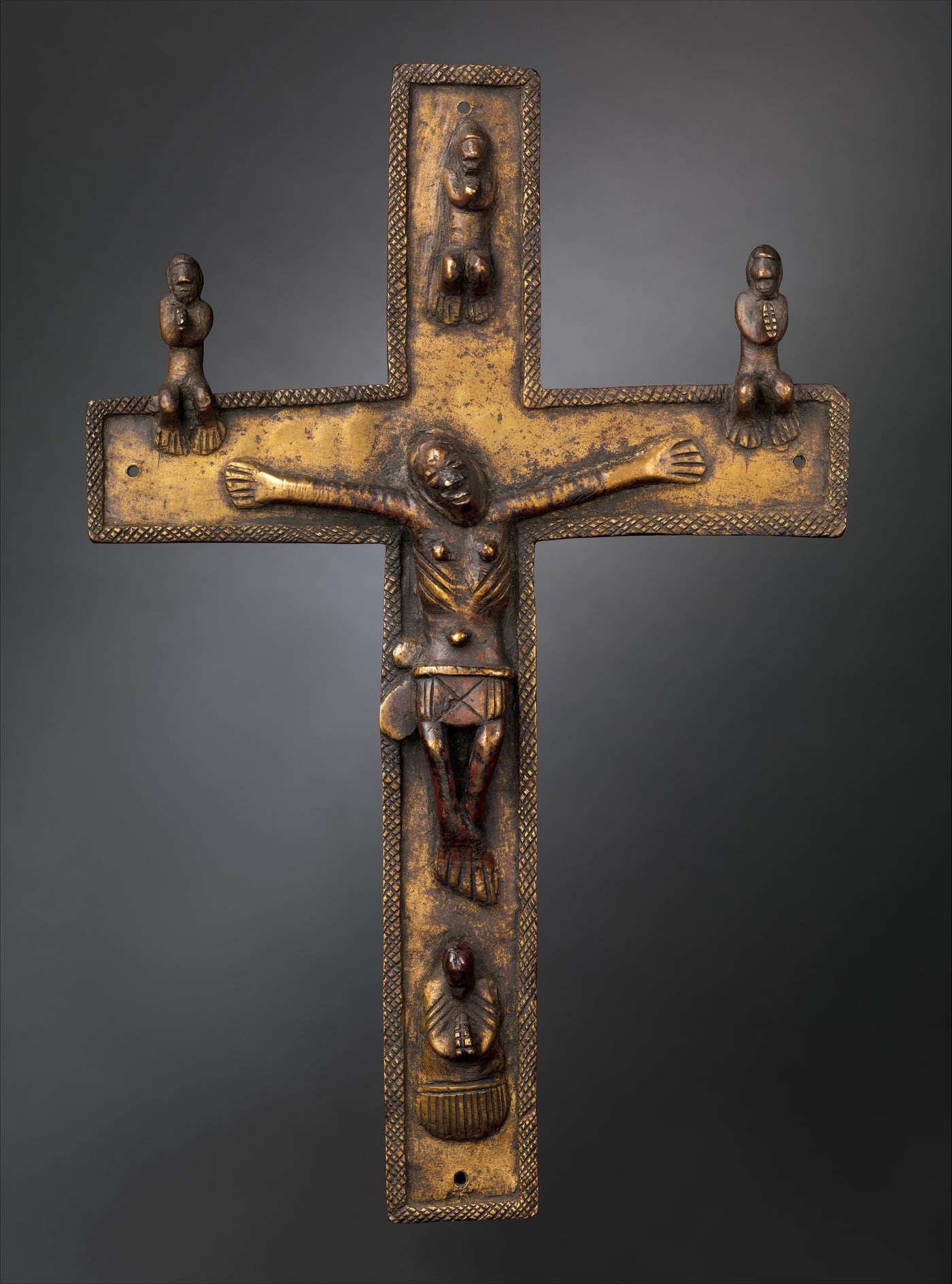
On July 6, 1526, Afonso I of Kongo told João III of Portugal that his kingdom was “being lost.” He blamed merchants who bypassed royal controls, fed an appetite for imported goods and carried away people whom thieves brought for sale. At its most drastic, his remedy was an embargo: Portugal should send neither merchants nor merchandise, because he wanted no slave trade or outlet for enslaved people in his realms.[1]
Then, on October 18, 1526, Afonso wrote again. This second letter supplied the details often folded into the first in modern excerpts: nobles and relatives taken secretly or at night, captives placed in irons and branded, buyers unable to name their sellers, and “free and exempt” people nearly carried aboard ship. It also announced a law. Three court officials would examine every purchased person; only those judged captives rather than free could be exported.[1]
Read in sequence, the letters draw a boundary more limited—and more historically revealing—than universal abolition. Afonso's July shutdown demand was real. His October procedure nevertheless preserved a legal traffic in some captives while trying to keep protected Kongolese subjects out of it.[3][4] That contradiction is the point of a close reading: his sharpest question was not how many people left Kongo, but how a person recognized as free at home could arrive at the coast as cargo.
Letters between kings, not pleas from a stateless victim
Kongo was an established Central African kingdom before Portuguese ships reached the Congo River in 1483. Its capital, Mbanza Kongo, was a political and spiritual center on a high plateau, organized around a royal residence, customary court, sacred places and long-distance connections. Portuguese contact added new buildings and institutions to that city; it did not create the state to which Afonso succeeded.[5][6]
The royal court adopted Christianity after a Portuguese mission arrived in 1491, and Afonso made Catholic practice central to his reign. That choice joined belief to statecraft. It connected Kongo to Lisbon, Rome and a written diplomatic world while giving the king new sacred language for authority at home. A surviving 1517 letter asks Portugal for a silver cross and small altarpieces; his son Henrique studied in Portugal and became a bishop.[3][7]
The photographed crucifix above comes from the Kongo world that grew from this encounter. Its form is Christian, but its African Christ, geometric surface and attendant figures are the work of a Kongo artist who transformed an imported model. The object warns against treating Afonso's Christianity as either a European costume or an uncomplicated surrender. Kongo elites appropriated Catholic forms for their own political and spiritual purposes.[7]
That context changes the posture of the 1526 letters. Afonso writes in the deferential conventions of correspondence with the Portuguese crown, but he writes as a ruler asking another ruler to discipline subjects under that ruler's authority. His complaint assumes a Kongo jurisdiction, a category of protected people and guards empowered to restore wrongfully seized subjects to freedom.[1]
They also reach us through an uneven archive. John Thornton has warned that surviving Portuguese records naturally magnify Portugal's place in Kongo history and can tempt historians to read a sixteenth-century alliance through the template of much later colonial domination.[5] The letters give unusually direct access to an African monarch's argument, though they were products of his Portuguese-language chancery rather than transcripts of an unmediated voice; the July text closes by naming João Teixeira as its writer and carries Afonso's royal sign.[1] They do not preserve every perspective within Kongo—least of all those of people seized in the trade. Reading them closely requires preserving all three facts.
The July letter turns from sacrament to merchandise
Afonso's central commercial grievance is easy to hurry past. After acknowledging an arriving ship and asking for priests, teachers and sacramental supplies, he turns to Portuguese agents who have allowed merchants to establish shops and spread goods that the king had prohibited. His vassals can now obtain imported things in greater abundance than the crown itself. The result, he says, is damage to obedience, jurisdiction, security and peace.[1]
This is not a preface unrelated to the kidnappings that follow. It is the first link in Afonso's causal chain.
Imported goods had political force because the king could distribute them through relationships of service and loyalty. If Portuguese merchants sold directly to provincial nobles or other buyers, those buyers no longer needed the royal channel. To pay for the wares, people whom the letter calls thieves seized others and sold them onward. A commercial shortcut around the crown became a route around the crown's protection.[1][3]
The document therefore describes two trades at once. Merchandise travels inland, away from royal control. Captured people travel toward the coast, also away from royal control. Each movement finances the other. Afonso is not merely condemning foreign demand or blaming an undifferentiated Europe. He names a network made from Portuguese officials, Portuguese merchants, Kongolese consumers, local kidnappers and elites willing to exchange people for imported goods.[1]
That distribution of agency matters. It prevents a flattering story in which the Kongo king stands outside the system and simply denounces strangers. It also prevents the opposite simplification, in which European buyers are incidental because African actors performed the captures. The letter's mechanism requires both sides: demand and merchandise gave kidnapping a ready conversion into wealth, while local participants supplied people whom the Atlantic market could remove.
‘Free and exempt’ is the document's decisive category
Afonso builds the July letter's list of victims through political relationships. Merchants are taking natives and sons of the land; sons of nobles and vassals; even members of the royal family. The October follow-up makes the legal category explicit: people who are “free and exempt” are being seized alongside nobles and relatives.[1]
The list is not a neutral census. It moves from territorial belonging to vassalage, rank and kinship, accumulating reasons why these particular people fall under the king's protection. Its force comes from the collapse of distinctions. If even nobles and royal relatives can be hidden, sold and branded, status inside Kongo no longer guarantees recognition at the point of export.
Linda Heywood's study of slavery in Kongo supplies the essential boundary. During Afonso's reign, the kingdom maintained a pronounced distinction between freeborn Kongolese people and foreign captives. The latter, often acquired through war beyond the kingdom's protected body, could be enslaved and exported. Over later centuries, civil conflict and political fragmentation eroded that separation until Kongolese identity itself no longer reliably protected a person from sale.[4]
This evidence supports two readings that are often made to compete. The July letter really does demand that the slave market be closed; its language should not be diluted into a routine complaint about tax revenue. But October shows that Afonso is not articulating a universal right against enslavement. He is defending a ranked political community whose freedom depended partly on leaving other people outside it.[1][3][4]
Calling him simply an abolitionist projects a later category backward. Calling him simply a monopolist misses the people whom his guards tried to recover and the genuine danger he describes. The harder conclusion is that Afonso opposed a trade capable of swallowing his own protected subjects while still accepting a system in which captives classified as outsiders could be sold.
The October letter follows a captive toward the ship
The October letter becomes most precise when it follows a captured person toward the ship. People are concealed or brought during the night so they will not be recognized. Once Portuguese buyers possess them, they are put in irons and branded. If royal guards intercept the group on the way to embarkation, the buyers claim a purchase but cannot identify a seller.[1]
That sequence describes an information problem with a human body at its center:
- Kidnapping removes the person from witnesses who know their status.
- Night transport prevents recognition.
- A sale inserts a buyer's property claim between the captive and the crown.
- Iron and branding give the transaction a visible appearance of completion.
- Embarkation moves the captive beyond the practical reach of Kongo justice.
The buyer's claim is powerful because it is thin. Purchase is asserted without a traceable seller or a review of whether the seller had any right to transfer the person. When guards try to restore a free person, Portuguese subjects present themselves as injured owners. Kongo's duty to correct kidnapping collides with a merchant's expectation that possession proves title.[1]
This is why “free and exempt” matters more than the letters' dramatic language of depopulation. Afonso offers no population count that could measure that claim. He does offer a testable administrative failure: the market is converting people into exportable property faster than officials can verify who they are.
The document is consequently not only moral protest. It is an anatomy of failed inspection. Freedom exists in law, family knowledge and royal obligation, but those forms of evidence arrive too late at the port.
Christianity turns regulation into an appeal between peers
Afonso's proposed July embargo is rhetorically severe. Kongo needs priests and teachers, he says, and only the wine and flour required for the sacrament—not the stream of merchandise feeding illicit sales.[1] The contrast places Catholic exchange on one side and destructive commerce on the other.
It would be too simple to decide that this language proves either pure faith or cynical performance. Christianity was already part of how Afonso governed, educated elites, represented kingship and communicated abroad. It was also a diplomatic resource. By addressing João as a Christian sovereign, Afonso makes the kidnapping of Christian subjects a shared breach of order rather than a local inconvenience for Kongo alone.[3][7]
The appeal also exposes a dependency. Sacramental wine, flour, clergy, teachers, technical knowledge and long-distance correspondence all moved through the same Portuguese connection Afonso was threatening to narrow. He wanted to separate a Christian alliance from the commercial machinery attached to it. Portugal had little economic reason to accept that separation.
João's reply turns Afonso's mechanism against him
João III's answer is undated; the critical edition conventionally places it in late 1529 from its internal evidence, and it responds to several of Afonso's letters rather than securely answering July alone.[1][3] João rejected Afonso's alarm about depopulation, claiming to have heard that Kongo was so large and populous that departures had scarcely diminished it. More revealingly, he argued that it would be more praiseworthy to draw out each year 10,000 enslaved people, 10,000 copper bracelets and as many ivory tusks. This was a commercial proposal, not evidence of a fulfilled quota. One ship carrying sacramental supplies, he said, would be a poor substitute for ordinary trade.[1][2]
The Portuguese king then addressed power. If a Kongo noble rebelled while receiving Portuguese merchandise, he asked in effect, how would Afonso preserve his greatness without access to the same commerce?[2]
This reply does not refute the mechanism in Afonso's letter. It confirms it and reverses the conclusion. Imported goods did shape loyalty. Commercial access did affect the balance between crown and nobles. For Afonso, those facts justified stopping an uncontrolled trade that dissolved his authority. For João, they proved that Afonso needed the trade—and should expand it.
The exchange is conducted in the idiom of two Christian kings, but their leverage is not equal. Portugal controlled ocean shipping and a supply of desired imports; its crown expected human exports on a scale Afonso had described as destructive. The uncertain date cautions against turning a scattered royal correspondence into a neat exchange of proposal and answer. Whatever the interval, letters carried across the Atlantic were a weak instrument for policing kidnappings that could reach a ship in days.
By October, embargo had become inspection
The slave trade did not end. By October—before the Portuguese reply—Afonso said that he had appointed Pedro Manipunzo, Manuel Manisaba and Gonçalo Pires to examine people offered for export. Their task was to decide who was a captive and who was free. A captive who passed review could embark; a merchant who bought without review would forfeit the purchase.[1]
Read beside the July demand, that law can look like a rapid retreat or contradiction. It is also the regulatory answer implied by the letters' detailed account of failure.
If an unverifiable purchase claim allowed a captive to pass, then review had to happen before the transfer became irreversible. Witnessing a sale could ask who the person was, who offered them, and whether Kongo law recognized the seller's right. The attempted remedy moved the boundary of freedom to the transaction itself.
Nothing about that system deserves romantic treatment. Inspection protected some people by authorizing the enslavement of others. It preserved a political distinction rather than rejecting human ownership, and the Atlantic demand that made evasion profitable remained in place. João's later answer proposed its own designated market with two of Afonso's officials present—accepting the need for review while pressing for continued trade.[1][2] Heywood's longer history shows how vulnerable such protection became when conflict weakened the institutions that defined and defended freeborn status.[4]
The October commission nevertheless clarifies what Afonso had seen in 1526. Slaving was not only a succession of raids or a count of ships. It was a process that attacked the ability of a state and its communities to make status legible. A person known at home as a relative, vassal or free subject could be made anonymous on the road, converted into a buyer's possession at the coast, and removed before a competing claim could catch up.
Afonso's letters matter because they record an African critique from inside the early Atlantic system, not from a safe distance outside it. Their moral limit is stark: freedom for the protected did not mean freedom for all. Their historical insight is equally stark. A market in people becomes especially dangerous when it can erase the evidence that any particular person was never lawfully for sale.
Sources
- António Brásio, ed., Monumenta Missionaria Africana, vol. I — open-access critical edition of the Portuguese primary texts: July 1526, pp. 468–471; October 1526, pp. 488–491; undated reply conventionally placed in late 1529, pp. 520–538.
- W. W. Norton, “The Perils of Trade in Kongo” — English translations of passages from Afonso's July letter and João III's answer.
- John K. Thornton, Afonso I Mvemba a Nzinga, King of Kongo: His Life and Correspondence. Hackett Publishing, 2023 — biography and modern English translations of Afonso's extant letters.
- Linda M. Heywood, “Slavery and Its Transformation in the Kingdom of Kongo: 1491–1800,” The Journal of African History 50, no. 1 (2009), pp. 1–22 — study of the changing distinction between freeborn Kongolese people and enslaveable outsiders.
- John K. Thornton, “Early Kongo-Portuguese Relations: A New Interpretation,” History in Africa 8 (1981), pp. 183–204 — source criticism of the Portuguese archive and early political relationship.
- UNESCO World Heritage Centre, “Mbanza Kongo, Vestiges of the Capital of the former Kingdom of Kongo” — institutional history and archaeology of Kongo's political and spiritual capital.
- The Metropolitan Museum of Art, “Crucifix,” Kongo artist, 16th–17th century, object 1999.295.7 — museum record and public-domain documentary photograph used for the cover image.