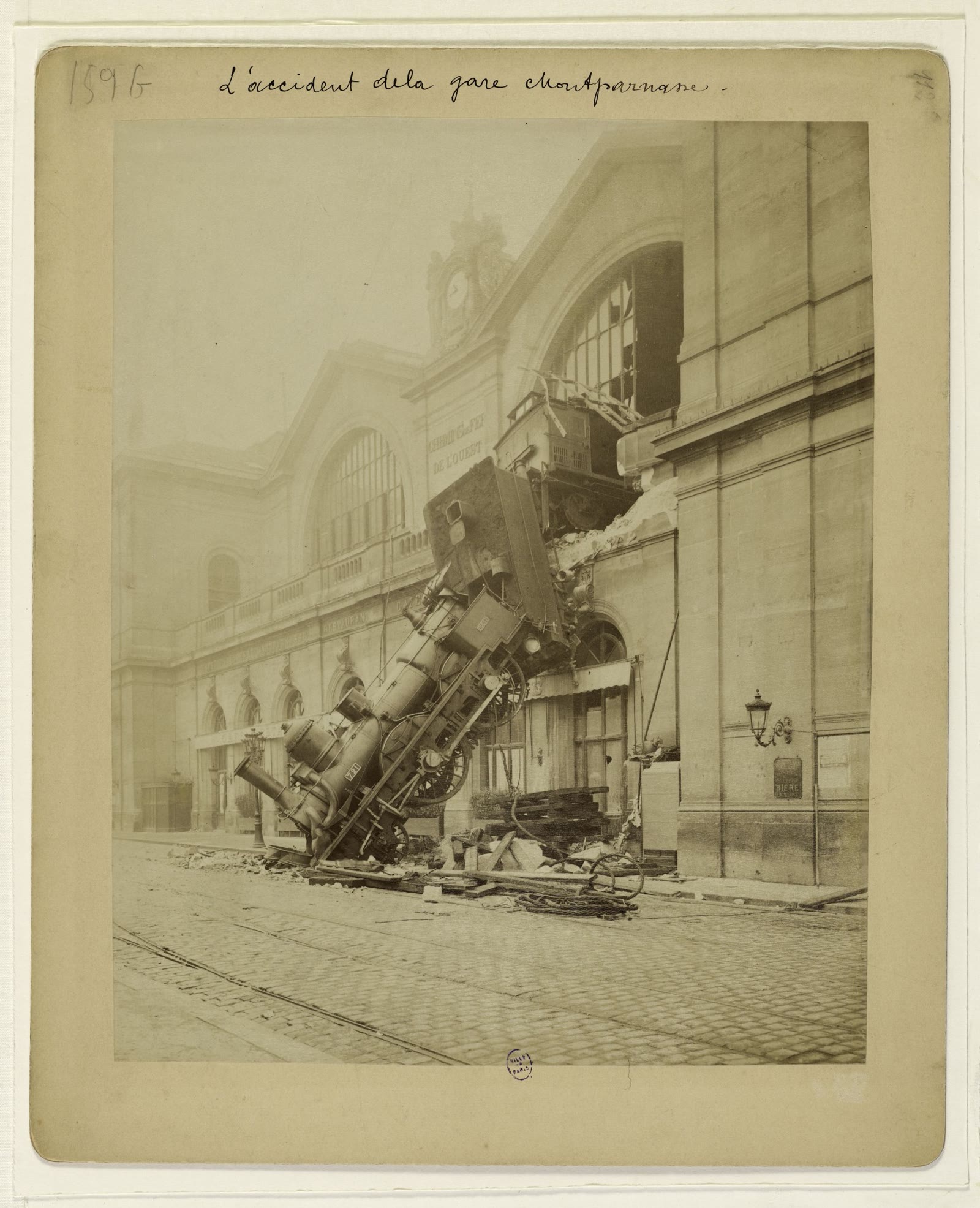
At about 4 p.m. on Tuesday, October 22, 1895, train No. 56 from Granville entered Paris's Gare Montparnasse and did not stop. It broke through the buffer at the end of the track, crossed the broad space between the rails and the facade, and carried its locomotive through the building. The locomotive pitched nose-first toward the Place de Rennes while its tender followed only partly through the opening; the passenger carriages stayed above.[1][2][5]
The passenger carriages remained upstairs. Inside them, people were shaken and several railway workers were injured; below, one woman was killed by falling material from the station. The imbalance between spectacle and toll was extraordinary. A train had apparently driven out of a second-storey window, yet the mass-casualty disaster suggested by the wreck did not occur.[1][2]
That is where the familiar story usually ends—and where the photograph begins. The crash took only seconds, but the locomotive was not removed until October 27. For five days, an accident became a Paris attraction. Crowds gathered. Professional and amateur photographers worked the scene. Newspapers made the machine seem almost animate, while prints isolated its impossible posture from the braking decisions, the woman beneath the wall, and the uncertainty that would follow the crew into court.[1][3][4]
The Montparnasse wreck became enduring not because a camera caught the train in motion. It endured because the aftermath held still.
Before 4 p.m.: the last approach
The express was due at Montparnasse at 3:55 p.m. and arrived a few minutes late. The station then called the Gare de l'Ouest occupied a raised site: its tracks and arrival hall stood roughly a storey above the square. That elevation made the terminus convenient for railway approaches and gave the final overrun its terrifying geometry. Beyond the end of the track lay a transverse concourse, the facade, and then open air above a working street.[1][2]
Accounts agree that the train entered too fast, but even contemporary estimates do not settle on one number. The French press synthesis preserved by RetroNews gives roughly 40 kilometres per hour. Scientific American, writing the next month, reported 30 to 35 miles per hour, a materially higher estimate. The discrepancy is a warning against pretending that a famous photograph makes every fact around it equally sharp.[1][2]
The braking story is more complicated than the durable phrase “the brakes failed.” Fireman Victor Garnier told a reporter that the continuous brake had worked near Ouest-Ceinture, before the crew accelerated again. When they tried to slow near the Rue du Château, he said, it no longer answered. Driver Guillaume-Marie Pellerin signalled for the guard's hand brake while Garnier opened the sanders; the crew also tried to reverse the locomotive's steam to resist its motion.[1]
Those statements came from men who had just survived the wreck, and railway officials disputed a total failure of the Westinghouse system. Railway historian Clive Lamming makes the useful distinction between a defective brake command at the locomotive and a complete failure along the train. The continuous brake could still be applied from the guard's van, but not soon enough to deliver a normal arrival. In his reading, the accident may have involved the difficult coordination—or “conjugation”—of continuous and manual braking rather than one system simply vanishing.[5]
The surviving evidence therefore supports a bounded claim: the train approached a terminus too quickly, the crew did not obtain the deceleration they needed when they needed it, and several braking actions were attempted in the final moments. It does not prove that every Westinghouse component failed at once. The later verdict would assign responsibility more confidently than the technical record explains mechanism.
4 p.m.: the station spends the train's momentum
The express struck the buffer, crossed the space at the head of the tracks, and burst through the facade. But each obstacle also took energy out of the moving train. The buffer, floor, masonry, and the coupling sequence between locomotive, tender, vans, and coaches turned a single moving consist into different outcomes. The locomotive reached the street, the tender remained partly suspended, and the passenger accommodation stayed at platform level.[1][2][5]
The layout mattered. Lamming emphasizes the unusually broad area between the track ends and the outer wall, as well as the luggage and postal vans marshalled ahead of the passenger coaches. The contemporary Scientific American report instead credited the guard's application of the continuous brake with saving the carriages from following the engine. These explanations need not cancel one another. Late braking, resistance from wreckage, the depth of the concourse, and the train's arrangement could all contribute to stopping what remained upstairs.[2][5]
On the Place de Rennes, ordinary city movement happened to sit directly below railway movement. Contemporary reports describe a tram or horse-drawn vehicles near the impact point; frightened horses moved clear as the facade gave way. The only fatality was a woman working beside or for a street kiosk. Museum and newspaper records disagree over whether she was selling newspapers or flowers and whether masonry or another falling part struck her. The Musée Carnavalet record describes her as the wife of a newspaper seller, helping at his stand and knitting when material from the facade killed her.[1][4]
Those differences are not an excuse to erase her into “only one death.” They show the uneven focus of the archive. Reporters recorded the locomotive's dimensions, posture, mechanisms, and recovery in loving detail; the person killed beneath it survives in conflicting occupational labels. The low toll made the event seem miraculous to observers, but it was miraculous from the viewpoint of the passengers, not from the pavement.
October 22–27: the wreck acquires an audience
By the next day, the machine had two lives. It remained damaged railway property awaiting recovery, and it became a public spectacle. RetroNews's survey of French coverage shows papers competing to personify it as a runaway creature, an acrobat, or a machine taking a walk in the street. The comic framing was repeatedly qualified by the fatality, but the visual joke was already difficult to resist: engineered order had produced a locomotive in a pose no designer intended.[1]
The photographs intensified that effect. The Musée d'Orsay notes that onlookers included both professionals and amateurs and that the sensational scene circulated in many photographic versions. Its own 1895 citrate print is attributed to Léopold Mercier but bears no professional stamp. The Musée Carnavalet holds a different albumen print credited to Neurdein Frères, mounted on card and stamped by the City of Paris. That print is the image used here.[3][4]
This matters because “the Montparnasse photograph” is often remembered as if one shutter release fixed the event. In fact, multiple photographers approached a scene that remained available for days. They chose slightly different positions and made different material objects: negatives, prints, cards, later reproductions. The iconic view was not a lucky fraction of a second. It was the product of access, duration, circulation, and the wreck's uncanny willingness to keep its pose.[3][4]
The camera also edited by standing still. It removed the noise of braking and breaking glass. It could not show which control answered in the cab, when the guard acted, or how the passenger coaches stopped. It made the locomotive appear to have arrived gently in its final position, even though the torn facade and debris record violence. Most of all, the image directed attention upward, toward the machine suspended against architecture, rather than sideways to the street life it had interrupted.
October 27: engineers end the spectacle
Recovery had to reverse the visual impossibility without causing a second accident. Workers built a timber support and used a winch rather than simply allowing the locomotive to fall. RetroNews, drawing on period coverage, places the decisive movement at 2:55 p.m. on October 27: twelve men operated the winch while police held spectators back. The rear wheels were kept above street level so the machine could be brought into a position suitable for loading and removal.[1]
Lamming reports that the locomotive was raised, returned to the railway, and eventually put back into service. That ending is almost too ordinary for the picture. The object that looks irreparably expelled from the transport system was recoverable railway equipment. The station wall and street could be repaired; the rolling stock could again become a working machine. Photography preserved the interval when none of that seemed plausible.[5]
The recovery also closed the public exhibition. Until then, the company needed to solve an engineering problem under the eyes of a crowd. Afterward, attention could move from the square to responsibility: why the train had entered so fast, why the crew's braking sequence failed to stop it, and who would answer for the death below.
March 31, 1896: a verdict smaller than the image
The case reached trial on March 31, 1896. According to the press record gathered by RetroNews, the court favored human fault over a purely technical explanation. Pellerin received a suspended two-month prison sentence and a 50-franc fine; chief guard Mariette received a much smaller fine.[1]
A legal judgment must decide responsibility. A historical explanation can remain more layered. Approaching too fast and braking too late are compatible with uncertainty about the brake command, the timing of the guard's intervention, and the contribution of the station and train layout to the limited toll. The verdict supplied closure for the company and court. It did not reduce the accident to one clean mechanical cause.[1][5]
Nor could the judgment compete with the picture. A fine has no silhouette. A technical distinction between continuous and manual braking has no torn window framing it. The locomotive above the Place de Rennes compressed a chain of actions into one instantly legible contradiction: a railway vehicle had left the railway and entered the city vertically.
That compression is why the photograph still works, and why it must be read with care. It truthfully preserves the physical result, the station's elevation, the crowd's access, and the sheer contingency that kept the coaches inside. It does not preserve motion, causation, or proportional attention to the person killed. The seconds of the crash made the wreck. The five days before recovery made its archive.
Sources
- Michèle Pedinielli, “Le jour où une locomotive s'est envolée de la gare Montparnasse,” RetroNews / Bibliothèque nationale de France (2018, updated 2025) — synthesis and excerpts from contemporary French reporting on the approach, crew accounts, fatality, crowds, recovery, and trial.
- “A French Railway Accident,” Scientific American 73, no. 22 (November 30, 1895), p. 340 — contemporary account of the train's speed, station height, braking, consist, injuries, and street-level death.
- Musée d'Orsay, “Accident à la gare de l'Ouest” — object record for Léopold Mercier's 1895 citrate print, with contemporary description and the museum's account of photographers, circulation, and provenance.
- Paris Musées / Musée Carnavalet, “L'accident de la gare Montparnasse” — collection record and image source for the Neurdein Frères albumen print used as this article's hero photograph, inventory PH10241.
- Clive Lamming, “L'accident le plus célèbre du monde à Montparnasse en 1895: les vraies raisons” (2020, updated 2024) — railway historian's analysis of continuous and manual braking, station geometry, train arrangement, and recovery.