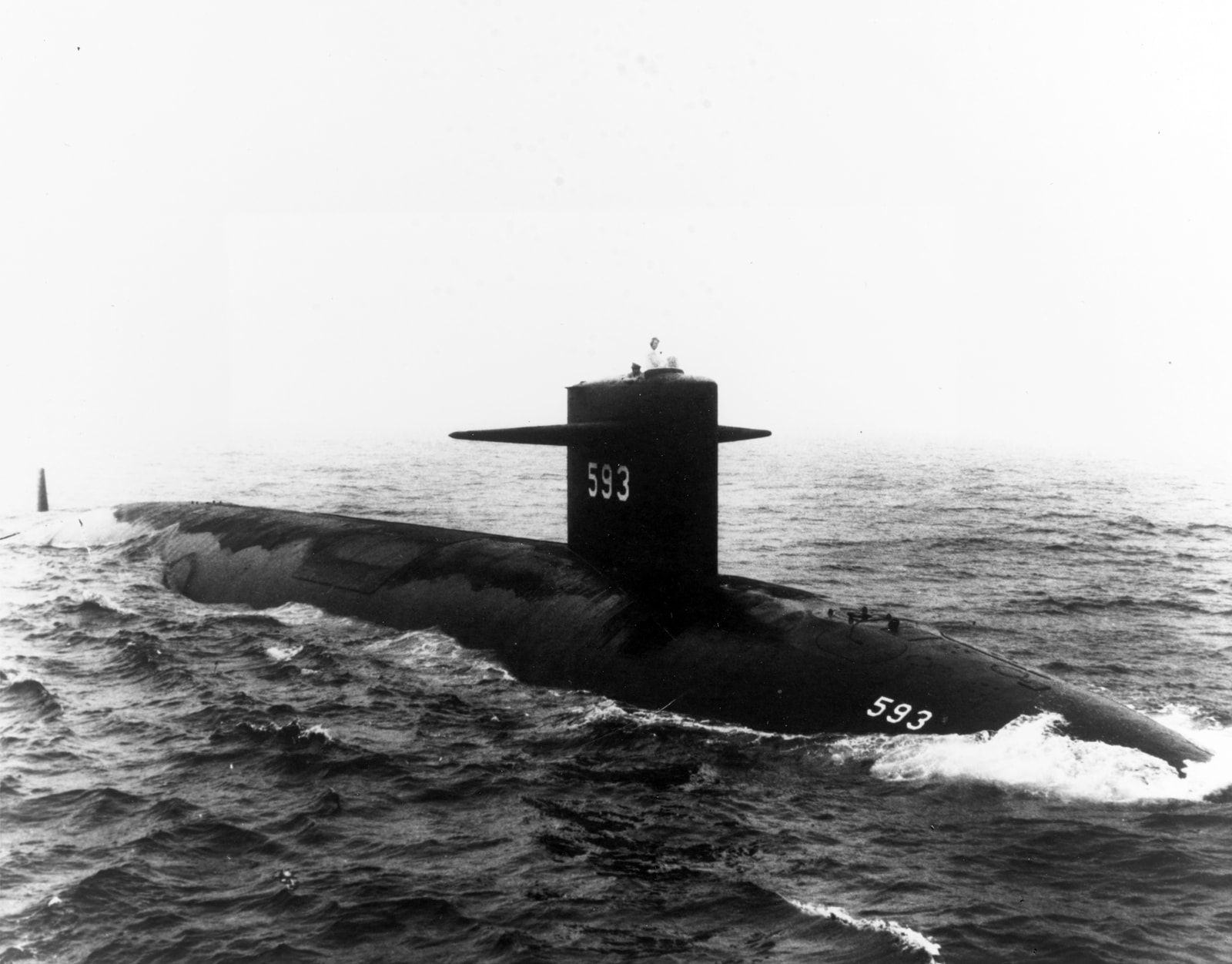
At about 9:13 a.m. on 10 April 1963, the submarine rescue ship Skylark received USS Thresher's last substantially intelligible trouble report. The Court of Inquiry described it cautiously: a message to the effect that the submarine had a minor difficulty, held a positive up-angle, was attempting to blow ballast, and would keep the surface ship informed. A garbled transmission followed around 9:16, then another fragment around 9:17 that witnesses could not resolve. Below, 129 men were inside a submarine near its authorized operating limit. At about 9:18, acoustic stations recorded the pressure hull collapsing.[1][2][3][6]
No audio recording survives in the released record. The contemporaneous written evidence is a handwritten underwater-telephone log, supplemented by testimony whose wording varied. The report's familiar sentence is therefore a composite, not a verbatim quotation from the control room.[1][2][3] It tells us that the crew recognized a problem, angled the bow upward, and tried to expel water from the main ballast tanks. It does not identify what failed first, how much flooding occurred, whether propulsion had already been lost, or why the emergency blow did not arrest the descent.
The distinction is the key to reconstructing the disaster. The Navy's inquiry developed a probable sequence, but it could not recover a single initiating component and prove the chain beyond doubt. Later analysis of once-classified acoustic evidence complicated the original theory rather than settling it. The lasting response was therefore larger than replacing one pipe or revising one maneuver. SUBSAFE turned assumptions hidden inside a deep dive into a chain of evidence required for unrestricted operation to a submarine's design test depth.[4][5][6]
An overhaul changed the boat that the crew knew
When commissioned on 3 August 1961, Thresher was the lead boat of a new class: faster, quieter, and able to operate far deeper than most earlier U.S. submarines. In July 1962, she entered Portsmouth Naval Shipyard for a post-shakedown availability—an extended period in which trial experience was converted into repairs and alterations. The work lasted about nine months. Systems were opened, joints were made or disturbed, equipment was changed, and personnel turned over.[3][5]
The sea trial was supposed to show that the completed boat could safely return to service. Yet the boundary between shipyard work and operational readiness was already blurred. During a late-March “fast cruise,” when the moored submarine simulated being at sea, equipment failures interrupted the exercise. A drill for isolating simulated engine-room flooding took about 20 minutes. The crew completed the scheduled evolutions after repairs, but the episode showed that signing off individual jobs was not the same as proving that the whole boat and crew could recover quickly from a deep casualty.[5]
Inspection carried a similar gap. Critical seawater systems used thousands of silver-brazed joints. An ultrasonic method capable of detecting defective bonds had become available, but only a fraction of Thresher's older, untouched joints received that examination during the availability. The rationale was understandable: joints that had survived earlier deep dives, shock tests, and pressure tests appeared proven, while inspecting all of them would delay the boat. Court records later showed a more basic problem. The documentation was not good enough to establish cleanly which joints had received which tests.[5]
On the morning of 9 April 1963, Lieutenant Commander John Harvey took Thresher out of Kittery, Maine. The 129 aboard included the ship's company, naval observers, and 17 civilian specialists—13 Portsmouth Naval Shipyard employees and four contractor representatives—with reason to see how the overhaul performed. Skylark accompanied her as the surface safety vessel. Shallow dives and propulsion trials that day revealed no reason to stop. The two ships arranged to meet beyond the continental shelf, where more than 8,000 feet of water lay beneath the planned deep-dive test.[2][3][6]
The descent produced reports, not visibility
At 7:47 a.m. on 10 April, Thresher began the deep dive. She descended in stages while Skylark remained on the surface. At 8:35, the log placed her 300 feet short of test depth; at 8:53 she reported that she was still proceeding to test depth; at 9:02 communications were good. Around 9:13, the routine rhythm broke.[1][2]
The evidence from the final minutes comes in different forms, and they should not be flattened into one perfect transcript:
- Skylark personnel remembered a report about a minor difficulty, a positive angle, and an attempt to blow ballast, but they differed on its exact words.
- A garbled transmission around 9:16 appeared to mention test depth. Another around 9:17 may have included “nine hundred North,” but witnesses could not turn either fragment into a reliable statement of depth or course.
- The surface ship called repeatedly and tried coded taps when voice communication failed.
- Underwater acoustic records preserved machinery changes, attempts to blow high-pressure air, and finally the signature of hull collapse, but not a view inside the compartments.[1][2][3][5]
This separation matters. A positive up-angle describes orientation, not motion. A submarine can point upward while continuing to sink if it has become too heavy or has lost enough propulsion. An attempt to blow ballast describes an action, not its success. High-pressure air had to pass through reducing valves and displace seawater from the main ballast tanks quickly enough to create positive buoyancy. The report therefore records a recovery attempt while leaving both the initiating casualty and the effectiveness of the response unknown.
Skylark was a rescue ship, but the water was about 8,400 feet deep. Rescue hardware could not reach a submarine on that seabed, and the surface crew had no operational way to intervene during the few minutes between the first trouble report and collapse. The role that looked protective on the trial plan became observational at the decisive depth. Once communications stopped, Skylark could report an overdue submarine, mark the area, and summon a search. It could not reach the people below.[3][4]
The inquiry found a probable chain, not a recovered first link
The Court of Inquiry convened on 11 April. It heard 120 military and civilian witnesses over eight weeks and assembled testimony, drawings, photographs, directives, debris, and test records. Its most influential reconstruction began with engine-room flooding through an opening estimated as equivalent to roughly two to five inches. A failed silver-brazed joint was one possible source, not the court's uniquely identified first part. High-pressure spray and flooding could then affect electrical equipment, trigger or accompany a reactor shutdown, remove propulsion, and leave the submarine unable to drive toward the surface. An emergency ballast blow began but did not supply enough buoyancy before Thresher passed collapse depth.[2][4]
Tests performed during the inquiry made the recovery problem more concrete. On the sister submarine Tinosa, an extended ballast blow revealed that airflow restrictions could ice over as high-pressure air expanded and cooled. The blow system had previously been tested only briefly and at shallow depth. A maneuver that existed in procedure had not been demonstrated under the duration and pressure conditions that mattered most.[2][5]
The court's flooding sequence remained a probability, not a recovered physical narrative. The wreck lay scattered at great depth, and the search could establish that the hull had collapsed without retrieving the initiating component. A later reading gives the acoustic evidence more weight. Analysts have argued that a major seawater rupture at test depth should have made a distinctive sound that the record does not contain. Machinery-frequency changes and the timing of air-blow sounds may instead point to a reactor and propulsion casualty with less initial flooding than the court envisioned.[3][5]
These are the strongest two interpretations, but they are not equal to two solved cases. The first connects known weaknesses in sea-connected systems, possibly including a brazed joint, to a plausible flooding cascade. The second challenges the expected acoustic signature of that cascade and asks whether loss of propulsion itself made a negatively buoyant boat unrecoverable. Missing data remain on both sides. An absence in a remote acoustic record cannot identify every event inside the pressure hull; damaged debris cannot recreate a compartment-by-compartment clock.
More important, the two interpretations converge on the same system boundary. Thresher depended heavily on propulsion to recover at depth. Its emergency blow had not been fully proved under deep, sustained conditions. The integrity of critical joints could not be demonstrated from complete records. Crew readiness, material condition, design assumptions, and test practice met for the first time as an integrated system during the dive itself. Whatever the first failure was, too many protections became uncertain together.[4][5]
SUBSAFE moved proof to before the dive
The Navy established the Submarine Safety Program within two months of the loss. Its stated aim is carefully bounded: provide maximum reasonable assurance that a submarine will retain watertight integrity and that the systems needed to recover from flooding will operate. SUBSAFE does not certify every aspect of submarine safety or promise that every hazard and human error has been eliminated. It identifies the parts of the boat whose failure could cause unrecoverable flooding, then controls their design, material, fabrication, installation, testing, and maintenance.[6]
That changed what counted as readiness. A component could no longer be accepted merely because an experienced person recognized it, because the same design had worked elsewhere, or because a pressure test produced no leak on one occasion. Material had to be traceable to its source. Work had to be performed by qualified people using approved procedures. Inspections and tests had to produce objective quality evidence—records that another reviewer could audit. Every re-entry or maintenance job within the SUBSAFE boundary had to preserve or re-establish certification.[6]
The intellectual shift is easy to miss because its artifacts are ordinary: tags, weld procedures, inspection results, serialized material, test reports, signatures, retained files. Yet those records answer the precise failure of knowledge exposed in 1963. If investigators could not determine which old joints had been tested, the next program would make test status retrievable. If a full ballast blow had not been demonstrated in relevant conditions, recovery performance would become an explicit certification concern. If an overhaul altered a safety-critical system, the evidence chain would have to follow the alteration through installation and test.
SUBSAFE also resisted the seductive idea that the disaster had yielded one bad part to remove. A single-cause repair would have been fragile because the single cause was never proved. The program instead treated seawater boundaries and recovery systems as a connected class of risk. It linked designers, shipyards, suppliers, maintainers, inspectors, commanders, and crews through the same certification boundary. The lesson was not that paperwork could save a sinking submarine. It was that disciplined evidence could prevent unrestricted deep operation with an unrecognized break between specification and reality.[4][6]
The reconstructed report is valuable because it remains incomplete
The reconstructed 9:13 trouble report is often repeated as though it opens a window into the control room. It does less, and that is why it matters. It records professional action under pressure: recognize difficulty, establish an upward angle, blow ballast, report. It also marks the limit of what the surface and the later inquiry could know from words alone.
An honest reconstruction therefore ends without choosing a definitive first failure. The court's flooding theory explains much of the physical and maintenance evidence. The later acoustic challenge shows why “probable” must not harden into “observed.” Both expose a recovery architecture with too little margin and an assurance system unable to show, component by component, what had actually been proved.[2][4][5]
The durable historical consequence was to make uncertainty actionable. Thresher's final minutes could not be made traceable after the fact. SUBSAFE made traceability a condition of unrestricted operation within its safety boundary. That is a quieter legacy than the broken transmission, but a more exact one: when failure would unfold too deep and too fast for rescue, evidence had to arrive before the next unrestricted deep dive.
Sources
- U.S. Navy, USS Skylark (ASR-20) deck log for 10 April 1963, National Archives identifier 216989459 — primary surface record of the deep-dive communications and the response after contact ended.
- U.S. Navy, Court of Inquiry into the Loss at Sea of USS Thresher, Interim Release 8 (1963; declassified) — primary findings and opinions on the communications record, probable flooding casualty, possible sources, recovery limits, and recommendations.
- U.S. National Archives, “A Modern Submarine on Eternal Patrol: A Tribute to the USS Thresher (SSN 593)” (2023) — archival reconstruction using deck logs, inquiry records, search material, and later acoustic evidence.
- Rear Admiral John F. Grenfell, USN, “USS Thresher (SSN-593): 3 August 1961–10 April 1963,” U.S. Naval Institute Proceedings (March 1964) — near-contemporary account of the search, court's probable-cause chain, and early design and inspection response.
- Captain James B. Bryant, USN (Ret.), “What Did the Thresher Disaster Court of Inquiry Find?” U.S. Naval Institute Proceedings (August 2021) — analysis of declassified testimony on deep recovery, ballast-blow icing, joint inspection, records, and competing causal interpretations.
- Naval Sea Systems Command, “USS Thresher: A Loss. A Legacy.” (6 April 2023) — official account of the final communications and SUBSAFE's bounded scope, certification, material traceability, and lifetime record requirements.
- Naval History and Heritage Command, “NH 97544 USS Thresher” — official catalog record for the 24 July 1961 archival U.S. Navy photograph used as the article image.