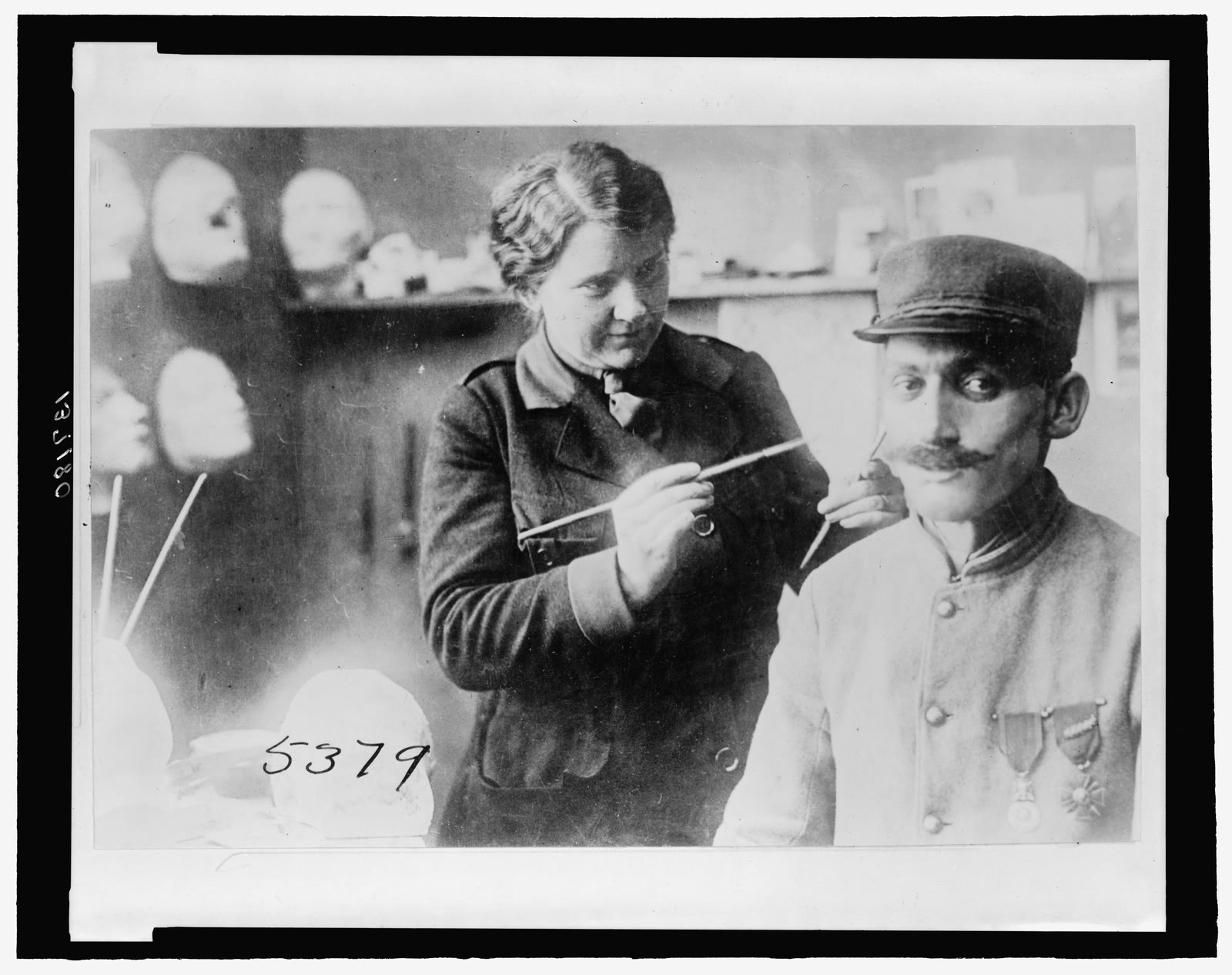
In July 1918, a photographer entered Anna Coleman Ladd's Paris studio just as a portrait was becoming wearable. A French soldier sits in uniform and cap, looking past the camera. Ladd stands beside him with two long brushes, painting a thin mask while it rests on his face. Behind them, pale plaster heads line a shelf. The Library of Congress catalog describes the photograph plainly: Ladd is painting a mask worn by a soldier with a severe facial injury.[5]
The scene looks like a final touch, but it records the end of a long chain. This portrait did not stop when a likeness appeared. It had to fit against scarred tissue, stay in place as its wearer moved, match skin under changing light, leave room for speech, and survive removal at meals and bedtime. It also had to resemble someone whom family and friends remembered from before the war. A conventional portrait is made to be looked at. Ladd's had to manage the act of being seen.
That distinction turns a familiar story about a gifted sculptor into a workshop microhistory. Ladd founded the American Red Cross Studio for Portrait-Masks, and her name deservedly became attached to it. Yet no mask was hers alone. A wounded veteran brought his body, preferences, patience, and often a prewar photograph. Surgeons determined when their work had reached its limit. Sculptors modeled; a metalworker translated plaster into copper; painters adjusted color on the wearer; administrators arranged referrals, money, rooms, and repairs. When Ladd left France in December 1918, the studio did not close. Following one mask from cast to street—and then following the workshop after its founder departed—shows what her achievement was without turning either the men or her collaborators into supporting scenery.
A sculptor entered where surgery ended
Ladd was not a medical practitioner looking for an artistic sideline. Born in 1878, she had built a career in Boston making fountains, reliefs, portrait busts, and small bronzes. Between 1907 and 1915, her work appeared in solo exhibitions in New York, Washington, and Philadelphia, as well as at the Panama-Pacific International Exposition. The archival papers that survive at the Smithsonian document a working sculptor and writer long before they open onto the folders for her wartime mask studio.[1]
The bridge to that studio ran through another sculptor. During the war, Francis Derwent Wood had established a mask workshop at London's Third General Hospital for soldiers whose facial injuries could not be fully addressed by the surgery then available. Ladd visited Wood in 1917, studied his approach, and carried the idea to France. Late that year she founded a Red Cross studio; by January 1918, soldiers were arriving at 70 rue Notre-Dame-des-Champs in Montparnasse.[1][2]
The order of care matters. Most of the studio's clients had already endured multiple operations. A mask could not close a wound, restore movement or sensation, or replace the functional work of maxillofacial surgery. Ladd summarized the boundary with unusual precision: "We do not profess to heal." Her work began after a surgeon had finished and a patient had left the hospital.[2][3]
Calling the objects cosmetic does not make them frivolous. Facial injury placed veterans in an especially exposed relation to strangers. The damage could affect eating, speech, breathing, and vision, while the reactions of onlookers added another barrier to shops, work, transport, and family life. The studio addressed that social encounter with a removable surface. Its promise was narrower than cure and more complicated than concealment: give a man an option for deciding how he would enter public view.
A face became a sequence of negotiated copies
The process began with contact. Several sittings were needed. First, the workshop made a plaster cast of the wounded face. From that record, and from a photograph taken before the injury when one was available, the artists modeled a second cast proposing the missing contours. The goal was not a generic symmetrical face. It was a recognizable likeness—an ear, cheek, eye socket, nose, or jaw shaped in relation to the features that remained.[2][3]
That second plaster model was still too heavy and rigid to wear. Metal fabrication converted it into a thin copper shell. The Library of Congress's original caption records the next stages: the copper reproduction was silvered, coated with enamel, and finally painted in flesh colors.[5] Other institutional accounts describe Ladd painting the mask while the soldier wore it, where she could compare its tone directly with living skin. Eyebrows, eyelashes, and mustaches might be made from hair or fine metal. Spectacle frames commonly held the piece in position; other fittings used a narrow strip behind the ears or adhesive.[2][3][4]
Every step introduced a different kind of evidence. The wounded face supplied dimensions. The old photograph supplied memory, but only from one angle and one moment. The unwounded side could suggest proportions without dictating them. The plaster cast froze a form; copper made it portable; paint tried to place that form back into variable daylight. Ladd's skill lay not in discovering one lost face inside the material, but in negotiating among records that could never fully agree.
The wearer remained essential after modeling. Color was adjusted on his face. Fit could only be judged against pressure, movement, glasses, scars, and the edge where metal met skin. The lips were generally left slightly open so that speech was not sealed off, and the mask came off for eating and sleeping.[2] In that sense, the finished object was less like a statue than a fitted garment. It became complete only in use—and use could expose problems no studio portrait revealed.
A still surface could change an encounter, not erase an injury
Contemporary publicity often presented the masks as miracles. That language made good Red Cross copy, but it compresses the wearer's experience into a before-and-after image. Metal did not move like muscle. Paint could discolor. Edges could show, copper or adhesive could irritate skin, and a single mask might need repair or replacement. Reid Hall's reconstruction of the studio record notes both enthusiastic testimonials and historians' evidence that facial prostheses remained a limited, sometimes uncomfortable solution.[2]
The distinction changes how the 1918 photograph should be read. The seated soldier is not raw material on which Ladd bestows an identity. He has already chosen to come, to sit through casting and fitting, and to be photographed wearing the result. The mask offered control over one kind of public encounter; choosing not to wear it was also a form of control. Neither choice made an uncovered face a failure.
Later scholarship has widened the frame beyond invention. David M. Lubin places Ladd's work within the visual culture of mutilation and modernity, where photography, portraiture, prosthesis, and wartime spectatorship met.[6] Julie M. Powell reads facial prostheses within the gendered politics of postwar France: wearing an idealized prewar likeness could answer pressure to resume a familiar masculine role, while organizations formed by facially wounded veterans created other ways to renegotiate what public presence and masculinity could mean.[7] These interpretations need not cancel the studio's practical value. They prevent value from being measured only by how completely a wounded man could pass unnoticed.
The famous studio had more hands than one name
Ladd's biography gives the workshop a clear founder, but the surviving records make solitary authorship impossible. French sculptor Jane Poupelet joined in March 1918. Diana Blair brought experience as a curator of medical specimens. French-American sculptor Marie-Louise Brent arrived in September and handled correspondence, finance, visitors, and daily administration. Robert Wlérick, a French sculptor who had worked in a facial-surgery unit, also joined. Ladd herself traveled to hospitals and surgical centers to build referral relationships, which made somebody else's presence at the studio indispensable.[2]
Even the production count reveals why attribution must be handled carefully. A Red Cross list reconstructed by Reid Hall records 57 masks delivered by November 23, 1918, with 14 more begun. Ten of those works in progress were completed after that date, bringing the studio's 1918 delivery total to 67. Those numbers describe overlapping labor at a particular set of cutoffs; they should not be casually converted into a lifetime total personally made by Ladd.[2]
The Smithsonian finding aid explains why the record is richer than the legend. Series 7 of the Anna Coleman Ladd papers contains letters, notes, clippings, photographs, and scrapbooks from the Studio for Portrait-Masks. Those materials preserve the founder's work, but they also preserve clients, assistants, institutional negotiations, and the ordinary paperwork by which an exceptional object became repeatable.[1]
This is not an argument for shrinking Ladd. She brought a mature portrait practice into a field with few established routines, persuaded military and medical authorities to send patients, financed and organized a studio, and made its work publicly intelligible. It is an argument for seeing what she built: not a private atelier producing signed objects, but a care system in which artistic judgment had to coordinate with bodies, photographs, hospitals, metalwork, money, and time.
Ladd left; the work changed hands
Ladd returned to Boston in early December 1918, after roughly eleven months of studio work. Funding was uncertain, Red Cross operations were contracting, and her husband could resume his prewar practice. She left lists of men who had received masks and men still waiting.[2] A heroic biography could end there, with the artist sailing home after the armistice. The workshop's biography cannot.
Brent took responsibility for daily operations, supported by Poupelet and Wlérick. During 1919, the studio moved, became the Bureau of Portrait Masks, and passed more fully under Red Cross administration. Space, staffing, and leadership produced conflicts preserved in correspondence. Yet masks continued to be fitted and repaired, and the rooms also served as a place where veterans could meet without having to manage strangers' reactions. Red Cross support ended at the start of 1920, while records trace an attempted transfer of the practice and funding to the French health service.[2]
That continuation supplies the most revealing correction to Ladd's fame. Her departure did not prove that the studio was merely her temporary performance. Nor does later work make her incidental. A founder's success can be measured by whether a method travels beyond her hands. Plaster casting, photographic reference, copper forming, painting on the wearer, fitting, repair, referral, and recordkeeping became a workflow other people could carry forward.
Anna Coleman Ladd made portraits that had to be worn, but she also made a workshop that had to outlast a sitting. Its products were ingenious and imperfect. They could soften an encounter without healing an injury, resemble a remembered face without recovering it, and expand a veteran's choices without dissolving the prejudices that made concealment useful. The honest achievement sits inside those limits. A portrait mask was neither a miracle nor a deception. It was a negotiated, wearable tool—and the person who wore it remained more than the likeness it presented.
Sources
- Archives of American Art, Smithsonian Institution, A Finding Aid to the Anna Coleman Ladd Papers, 1881–1950 — biographical chronology and archival scope, including the American Red Cross Studio for Portrait-Masks files.
- Columbia University Reid Hall, "Studio for Portrait Masks, 1918–1920" — source-rich reconstruction of the studio's address, personnel, fabrication process, Red Cross counts, Ladd's departure, and the workshop's continuation.
- U.S. National Library of Medicine, "World War I Centenary Forum: Masking Devastation" — interview on the surviving 1918 film, fabrication sequence, and the medical boundary between surgery and cosmetic masking.
- U.S. National Archives, "Anna Coleman Ladd: An Artist Who Created Hope for Wounded Soldiers" — archival overview of the studio environment, portrait masks, facial-hair details, and spectacle or wire mounting.
- Library of Congress, "When Mrs. Ladd has completed the moulded resemblance…" (July 1918) — catalog and rights record for the American Red Cross photograph used as the article image.
- David M. Lubin, "Masks, Mutilation, and Modernity: Anna Coleman Ladd and the First World War," Archives of American Art Journal 47, nos. 3–4 (2008) — visual-culture analysis of portraiture, prosthesis, and wartime spectatorship.
- Julie M. Powell, "About-Face: Gender, Disfigurement and the Politics of French Reconstruction, 1918–24," Gender & History 28, no. 3 (2016) — analysis of wearer agency, masculine ideals, and veterans' postwar self-organization.