
Near the end of a Belgian television interview, the physicist and Catholic priest Georges Lemaître is offered a tempting shortcut. If the universe had a physical beginning, the question suggests, does that not bring science close to religious creation? Lemaître declines the invitation. He does not deny his faith; he denies that cosmology can do theology's work. A scientific theory, he argues, should not turn God into a mechanism inserted at the first instant.[1][2]
That refusal is the key to a remarkable film that disappeared into a broadcaster's archive for almost six decades. The roughly twenty-minute conversation, conducted in French and subtitled in Dutch, was transmitted by Belgium's BRT service on February 14, 1964. VRT, BRT's successor, recovered the complete reel during a digitization project and released it on December 31, 2022. Until then, only about three minutes were believed to survive. The catalog card had been filed incorrectly, Lemaître's name was misspelled, and the item had been classified under the wrong subject.[2][3]
The recovery matters for more than rarity. According to the researchers who produced the first complete English transcript, it is the only known video interview with Lemaître. It also catches him at an unusually revealing moment: he is defending an evolving universe against the steady-state model, revisiting his own “primeval atom,” and policing the boundary between scientific explanation and religious belief—all shortly before cosmic microwave background observations transformed the debate.[2][4]
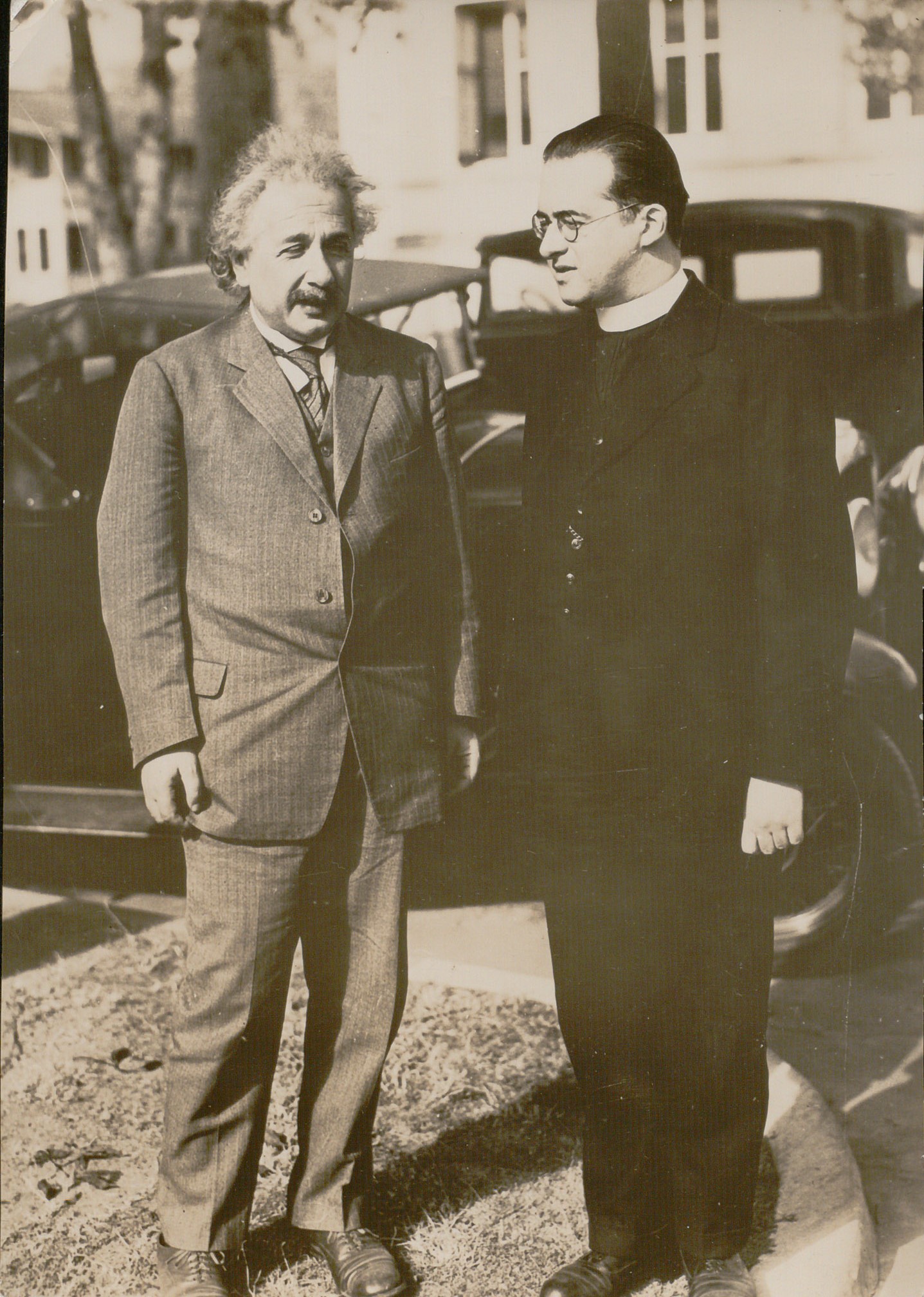
Image context: the cover is an authentic 1933 archival photograph, not a video still. Albert Einstein stands at left and Lemaître, then a young priest-professor, at right in Pasadena. The image makes their intellectual world tangible without pretending that Einstein simply endorsed every version of Lemaître's cosmology. UCLouvain Archives identifies the photograph as an item in Lemaître's personal collection.[8]
A film with two historical dates
The footage carries at least two dates. The first is 1964, when journalist Jérôme Verhaeghe interviewed Lemaître in French for a Belgian audience; the surviving copy retains Dutch subtitles. The exact recording date is unknown, so it is safer to call February 14 the broadcast date rather than the day the camera rolled. The second date is 2022, when archival description and digitization returned the full interview to public view.[2][3]
That distinction is part of the film's meaning. An archive can lose an object without destroying it: a weak label may make a reel functionally invisible even while the film remains on a shelf. Here, recovery depended on a staff member recognizing the person on screen while reviewing endangered material. The story is therefore not a romantic discovery in a sealed vault. It is a demonstration of how cataloging, spelling, format migration, and human recognition decide what becomes searchable history.[3]
The official VRT upload below runs in French with Dutch subtitles. The written account that follows is self-contained, while the English translation published by Satya Gontcho A Gontcho, Jean-Baptiste Kikwaya Eluo, and Paul Gabor provides a guide to the full exchange.[1][2]
First watch: the universe is allowed to change
The opening argument is easy to miss because Lemaître begins in the middle of a thought. At roughly 1:25–2:10, he distinguishes local physical laws from a global description of the universe. Fred Hoyle's steady-state cosmology, in his account, imposes too much global order: the universe must look broadly the same not only everywhere but at every time. Expansion can occur, yet average density remains constant because new matter continuously appears.[1][2]
Verhaeghe then proposes that experience might favor an unchanging cosmos. Lemaître answers with sudden force: “Not at all.” The static universe, he says, was an a priori expectation. Observations made change unavoidable. This is the first moment to watch closely. The elderly professor is courteous, but the quiet archival portrait breaks; his voice and expression sharpen when the logic is reversed.[1][2]
His own route to this position had begun decades earlier. In 1927, Lemaître published a relativistic model of a universe with an increasing radius and connected cosmic expansion to the observed recession of extragalactic nebulae. In 1931, he proposed a singular origin in what became known as the primeval-atom hypothesis. Those achievements did not create modern Big Bang cosmology single-handedly: Alexander Friedmann had developed expanding solutions, Edwin Hubble supplied pivotal observational work, and George Gamow, Ralph Alpher, and Robert Herman later developed the physics of a hot early universe. Lemaître's place is central, but the history is cumulative.[5][6]
The interview is valuable precisely because Lemaître does not narrate this history as an inevitable march toward himself. He treats cosmology as a live contest among models. The steady-state theory associated with Hermann Bondi, Thomas Gold, and Hoyle was not merely an eccentric foil. In the 1950s and early 1960s it offered a coherent rival picture with consequences that observations could test.[2]
Second watch: disagreeing without flattening an opponent
From about 2:10 to 6:24, Lemaître develops his objection to the continuous creation of matter needed to preserve steady-state density during expansion. He calls the new material “ghostly hydrogen” and presses a conservation problem: what physical account licenses its appearance? His gestures matter here. He handles papers, searches for formulations, and builds the criticism rather than delivering a polished lecture. The reel preserves thinking as performance—pauses, qualifications, and all.[1][2]
Then he does something that makes the interview better history than a victory montage. While rejecting Hoyle's cosmology, Lemaître praises Hoyle and his collaborators for first-rate work on the production of elements inside stars. A scientific adversary can be wrong about the universe's global history and right about stellar nuclear processes. Lemaître keeps those judgments separate.[2]
That separation prevents a common retrospective error. Because steady state later lost broad support, it is easy to edit its proponents into people who simply resisted evidence. The conversation shows a more useful picture: rival frameworks shared some observations, disagreed over what the universe must be like across time, and exposed themselves to further tests. Lemaître's criticism is severe because the rival is serious.
Third watch: the primeval atom is not a modern slogan
The primeval atom is named at about 7:12; the most substantial account runs roughly 8:27–11:35. Lemaître reaches back to his 1931 proposal and argues that Hoyle had attacked a simplified version rather than the hypothesis he actually advanced. In Lemaître's description, an extremely concentrated initial state breaks into increasing multiplicity; radiation, matter, and structure emerge through physical development. He permits himself the phrase “primeval fireworks,” then immediately recognizes that it is partly poetic.[1][2]
The qualification matters. Lemaître's primeval atom belongs to the history of modern cosmology, but it is not a word-for-word preview of today's model. Its quantum language, proposed mechanisms, and emphasis on cosmic rays reflect the science available to him. Later work supplied different and more precise accounts of primordial nucleosynthesis and relic radiation. NASA's history of the Cosmic Background Explorer, for example, credits Gamow, Alpher, and Herman with developing the hot-origin prediction that a faint radiation field should remain across the sky.[6]
The camera therefore gives us neither a prophet reciting settled truth nor a curiosity rescued only because later scientists proved him right. It gives us a researcher distinguishing his real proposal from a caricature, conceding where his language becomes imagery, and locating an idea inside an unfinished field.
The hinge year: before the microwave sky changed the contest
The broadcast date makes the reel unusually well timed. When Belgian viewers saw it in February 1964, the cosmic microwave background had not yet been publicly reported. Arno Penzias and Robert Wilson's measurements appeared in 1965, alongside an interpretation from Princeton researchers. Radiation arriving from every direction at a temperature near three kelvin supplied crucial evidence for a hot, dense early universe and sharply reduced the appeal of classical steady state.[4][6]
It would still be misleading to say that one observation “proved the Big Bang.” Measurements of the radiation's spectrum, small temperature variations, element abundances, and expanding large-scale structure accumulated into the modern model. NASA notes that COBE later measured an extraordinarily precise blackbody spectrum and detected the tiny variations from which structure could grow.[6] The interview sits just before that evidentiary shift. Its uncertainty is not ignorance added by an old film; it is the honest uncertainty of its date.
This timing also changes how the viewer reads Lemaître's confidence. He is not commenting after a consensus has congealed. He is arguing from expansion, theory, and the evidence then available. The archival camera captures the risk in a scientific position before later data made the outcome look inevitable.
Final watch: refusing the watchmaker
From about 12:50 to the 19:47 end of the reel, the interview changes register. Verhaeghe asks whether Lemaître's cosmology serves a religious position. Lemaître says his primeval-atom hypothesis was not constructed with that ulterior purpose. More surprisingly, he argues that a physical beginning does not give the theologian a convenient point of supernatural entry. Treating God as the agent of an initial mechanical push would shrink creation into a gap in physics.[1][2]
This is not a claim that science has disproved creation, nor that Lemaître kept his religious and scientific lives in sealed compartments. It is a narrower methodological boundary visible in the source: a cosmological beginning and theological creation answer different kinds of question. The film supports that statement. A broader claim about everything Lemaître believed would require other evidence.
Watch his tone as much as the translated argument. After the technical dispute over density and atoms, the exchange becomes almost playful. Lemaître rejects the image of God as a watchmaker who supplies a first flick, then laughs. The laugh does not trivialize the question. It punctures the expectation that a priest with an origin theory must be using one vocation to smuggle conclusions into the other.[1][2]
What resurfaced with the reel
Lemaître died in 1966. His historical position continued to change after his death. In 2018, International Astronomical Union members approved a recommendation to use “Hubble–Lemaître law” for the relation between distance and recession velocity, explicitly recognizing both Lemaître's 1927 theoretical work and Hubble's 1929 observational paper.[7] The decision did not transfer a discovery from one heroic owner to another; at its best, the double name warns against that style of history.
The rediscovered interview performs a similar correction at human scale. Textbooks can compress Lemaître into three labels: priest, primeval atom, precursor of the Big Bang. The reel restores distinctions those labels erase. He could defend a changing universe while criticizing a rival's mechanism; reject Hoyle's cosmology while praising Hoyle's stellar physics; propose a beginning while refusing to turn it into a proof of God.
The most important recovery is therefore not a triumphant prediction. It is a method of intellectual housekeeping. Keep observation distinct from prior expectation. Keep an opponent's good work distinct from his disputed framework. Keep a 1931 hypothesis distinct from the mature theory that followed. Keep a physical model distinct from a theological conclusion. A mislabeled reel preserved those boundaries for fifty-eight years. Digitization made them visible again.
Sources
- VRT, “Eindelijk teruggevonden: het historische interview over de oerknaltheorie” — official upload of the recovered French-language interview with Dutch subtitles.
- Satya Gontcho A Gontcho, Jean-Baptiste Kikwaya Eluo, and Paul Gabor, “Resurfaced 1964 VRT video interview of Georges Lemaître” (2023) — archival provenance, French transcript, and complete English translation.
- VRT NWS, “La VRT a retrouvé dans ses archives une interview de 1964 de Georges Lemaître” (December 31, 2022) — broadcaster's account of the misfiled reel, digitization, and recovery.
- Lawrence Berkeley National Laboratory, “Lost Video of ‘Father of the Big Bang’ Recovered” (January 26, 2023) — broadcast context, recovery, translation project, and the interview's place in cosmological history.
- UCLouvain Archives, “Archives de Georges Lemaître” — institutional chronology of Lemaître's 1927 expanding-universe paper and 1931 primeval-atom proposal.
- NASA, “COBE Science” — official history of hot-origin cosmology, the 1964–65 microwave-background discovery, and later precision measurements.
- International Astronomical Union, “IAU Members Vote to Recommend Renaming the Hubble Law as the Hubble–Lemaître Law” (October 29, 2018) — official resolution and historical rationale.
- UCLouvain Archives, “Georges Lemaître et Albert Einstein” — catalog record for the 1933 Pasadena photograph, reference BE A4006 FG LEM-622.