On the evening of November 22, 1909, thousands of garment workers packed Cooper Union in New York. After a procession of cautious speeches, 23-year-old waistmaker Clara Lemlich rose and made the motion the room had been waiting for: a general strike. Hands went up in a collective oath. By the next morning, workers were leaving shirtwaist factories across the city.[1][3]
That scene explains ignition. It does not explain endurance.
The workers who joined what became known as the Uprising of the 20,000 were mostly young immigrant women with little money to absorb a missed payday. Employers could hire strikebreakers, redirect production, and call on police and courts that treated picketers as the problem. Winter was arriving. Yet the strike held for thirteen weeks and secured contracts covering roughly 15,000 workers before the union called it off on February 13, 1910.[1][3]
Its real achievement was therefore organizational. A walkout became a survival system: factory grievances supplied urgency; shop-floor networks supplied scale; unions and neighborhood institutions supplied food, meeting space, and discipline; reform allies supplied money and a partial shield from violence; publicity raised the political cost of repression; and the fashion trade's short production clock put pressure on manufacturers. None of those mechanisms was sufficient alone. Together they kept a dispersed workforce in motion long enough to win material gains—though not long enough to force every major firm to recognize the union.
The job made time itself a grievance
The strike did not begin with an abstract demand for labor rights. It began with the ordinary accounting of the shirtwaist shop.
In an account published on November 28, 1909, Lemlich described regular workers earning about six dollars a week while reporting at seven in the morning and staying until eight at night, with half an hour for lunch. Workers beyond the front row sewed by gaslight even during the day. Damaged cloth could be charged to the operator whether or not she had caused the damage, and two dollars might be deducted at the start of the slow season without explanation.[2]
Her testimony should not be treated as a statistical description of every factory. It is more useful as a map of control. Long hours, piece rates, deductions, seasonal unemployment, subcontracting, and the foreman's discretion all transferred uncertainty downward. A worker did not merely sell hours; she absorbed the shop's damaged material, changing demand, and arbitrary penalties.
That helps explain why the strike's immediate demands concentrated on wages, a shorter working week, an end to abusive deductions and harassment, and a durable union presence. The Smithsonian notes that safety was not the campaign's strongest organizing demand, even though conditions were dangerous.[5] The distinction matters. The later Triangle fire can make the 1909 walkout look like a failed fire-safety campaign in retrospect. The workers were confronting a broader system of shop authority whose most frequent injuries arrived in the pay envelope and the working day.
A famous motion worked because organization came first
Lemlich's speech is often made to carry the whole uprising. The sequence before Cooper Union shows why that is too simple.
In September 1909, workers at Triangle and another shop had already struck. The Triangle action was brief, and its organizers were dismissed, but the dispute mobilized members of Local 25 of the International Ladies' Garment Workers' Union. In October, local officers advanced the idea of a trade-wide strike. By the time Lemlich spoke on November 22, the room contained workers who had seen smaller walkouts, argued about a general action, and built relationships capable of carrying the vote back into hundreds of shops.[3]
The oath at Cooper Union mattered because it synchronized those prior efforts. A worker leaving one factory could reasonably believe that workers elsewhere would also leave. That expectation changed the risk calculation: victimization was still likely, but a coordinated stoppage made it harder for employers to isolate every organizer as one troublesome employee.
The mass meeting also turned a union proposal into a public promise. Lemlich's intervention shifted authority from the platform to the workers who would bear the cost. It did not create solidarity from nothing. It gave existing solidarity a common clock.
Early settlements made the strike expand
The garment industry looked large from the street but fragmented behind its doors. Shops could open with little capital, disappear quickly, and compete through subcontracting. That instability weakened workers in ordinary times. During the first days of the strike, it also meant employers did not respond as a single block.
Ann Schofield's history records that more than 10,000 workers returned within four days under union contracts as smaller manufacturers conceded higher wages, an end to harassment, and union recognition. Those fast agreements did two things at once. They produced visible proof that walking out could work, and they reduced the number of firms the union still had to fight.[1]
This was not one negotiation followed by one victory. It was a rolling campaign. Each settled shop converted a portion of the crowd back into paid union labor while the remaining strike concentrated on larger holdouts. The mechanism helped a weak treasury: winning workers back onto payroll was itself a form of strike support.
But rolling settlement contained a future weakness. The same process that isolated hard-line employers could gradually dissolve the general front. Once enough shops reopened under separate agreements, the remaining strikers faced winter with less leverage from a trade-wide shutdown. The structure made partial victory easier and complete victory harder.
Winter turned solidarity into logistics
By December, manufacturers had organized their own association. Larger firms used strikebreakers, outside production, police, and the courts. By December 22, Schofield reports, 707 strikers had been arrested; nineteen were sent to the workhouse on Blackwell's Island, while others were fined. A movement of workers who could scarcely afford to stop working now had to fund bail, meals, rent, legal defense, and repeated picket shifts.[1]
This is where the strike became more than a workplace action. Union halls served as coordination points. The ILGWU, the Women's Trade Union League, socialist organizations, and the United Hebrew Trades raised money and kept public meetings going. When January wore down both morale and household budgets, the WTUL opened a soup kitchen.[1]
Wealthy supporters—mocked as the “mink brigade”—also contributed money for food, rent, and bail. Some joined picket lines. Their presence could make police less willing to assault a group openly, and the arrest of WTUL president Mary Dreier generated public outrage.[4]
That alliance should not be romanticized. Its effectiveness exposed the class hierarchy it claimed to bridge: violence became more scandalous when a socially prominent woman might receive the blow. Working women could feel patronized, while some wealthy allies withdrew when strikers rejected compromise. The coalition was neither class harmony nor decorative charity. It was temporary infrastructure. It helped workers survive, altered how repression appeared in public, and remained contingent on political differences it could not erase.[1][4]
Publicity changed the price of force
Employers did not lose access to police or courts. What changed was the audience.
Reports of young women being beaten, arrested, or sentenced made the picket line a citywide argument about legitimate authority. Sympathetic newspapers and clergy widened that audience. College students and reformers walked beside garment workers. Society supporters brought reporters with them. Violence that might have remained a routine instrument outside an individual shop became evidence in a public case against the manufacturers.[1][4]
This reputational pressure worked because it joined, rather than replaced, economic pressure. Public sympathy could refill a strike fund, recruit a picketer, or make a judge's sentence politically costly. It could not sew a shirtwaist or compel an employer to recognize Local 25. The decisive question was whether the strike could keep disrupting production while the coalition kept people fed.
Fashion's short clock squeezed the manufacturers
The waist trade was unusually vulnerable to delay. Styles changed quickly, firms held limited inventories, and a missed season could turn finished stock into yesterday's fashion. A prolonged strike therefore attacked the industry's calendar as much as its payroll.[1]
Manufacturers tried to buy time. Their association pooled resistance; larger firms brought in strikebreakers and shifted work elsewhere. Yet subcontracting could spread the conflict too. When Philadelphia shops receiving diverted work struck on December 20, one of the employers' escape routes narrowed. Three days later, the association and union reached a proposed compromise covering most demands on wages, hours, and shop conditions—but not the closed shop or full union security.[1]
The strikers rejected that offer on December 27. Their decision reveals the central dispute. A raise could improve the next pay envelope. Without recognition strong enough to keep the union inside the shop, management might recover its old discretion once public attention moved on. The workers were bargaining not only over terms but over who would enforce them.
The employers understood the same point. They could concede money more easily than a permanent counter-authority on the factory floor.
The ending was a map of the system's limit
January was not a dramatic final confrontation. Individual firms continued to sign agreements; other workers drifted back. By February 1, the trade was operating at nearly full production. On February 13, the union ended the general strike.[1]
Cornell's Kheel Center summarizes the result as higher-wage contracts for about 15,000 workers after thirteen weeks. Triangle's owners raised pay but refused the union-shop demand, and Local 25's presence there weakened during the following year.[3][5] The outcome was neither the clean victory of commemoration nor a simple defeat. Thousands gained better terms and union contracts. The most resistant firms preserved the power to keep the union institutionally outside.
The distinction became brutally visible after the Triangle Shirtwaist Factory fire of March 25, 1911. It would be wrong to claim that recognition alone would certainly have prevented the disaster, or that the 1909 strike centered on the exact hazards that caused it. It is fair to say that a nonunion holdout had defeated the workers' attempt to establish an enduring shop-floor counterweight before 146 people died there.[5]
What the uprising proved
The Uprising of the 20,000 did not demonstrate that courage inevitably defeats capital. It demonstrated something more practical: workers described as too young, too female, too immigrant, too divided, or too replaceable to organize could construct the conditions under which collective action lasted.
The system had five linked parts. Shop networks created the first scale. A public oath synchronized risk. Rolling contracts turned early wins into proof and payroll. Community and reform organizations converted sympathy into food, bail, rooms, and witnesses. The fashion calendar made delay costly to employers. When those parts reinforced one another, the strike survived. When separate settlements restored production and the coalition frayed, its leverage narrowed.
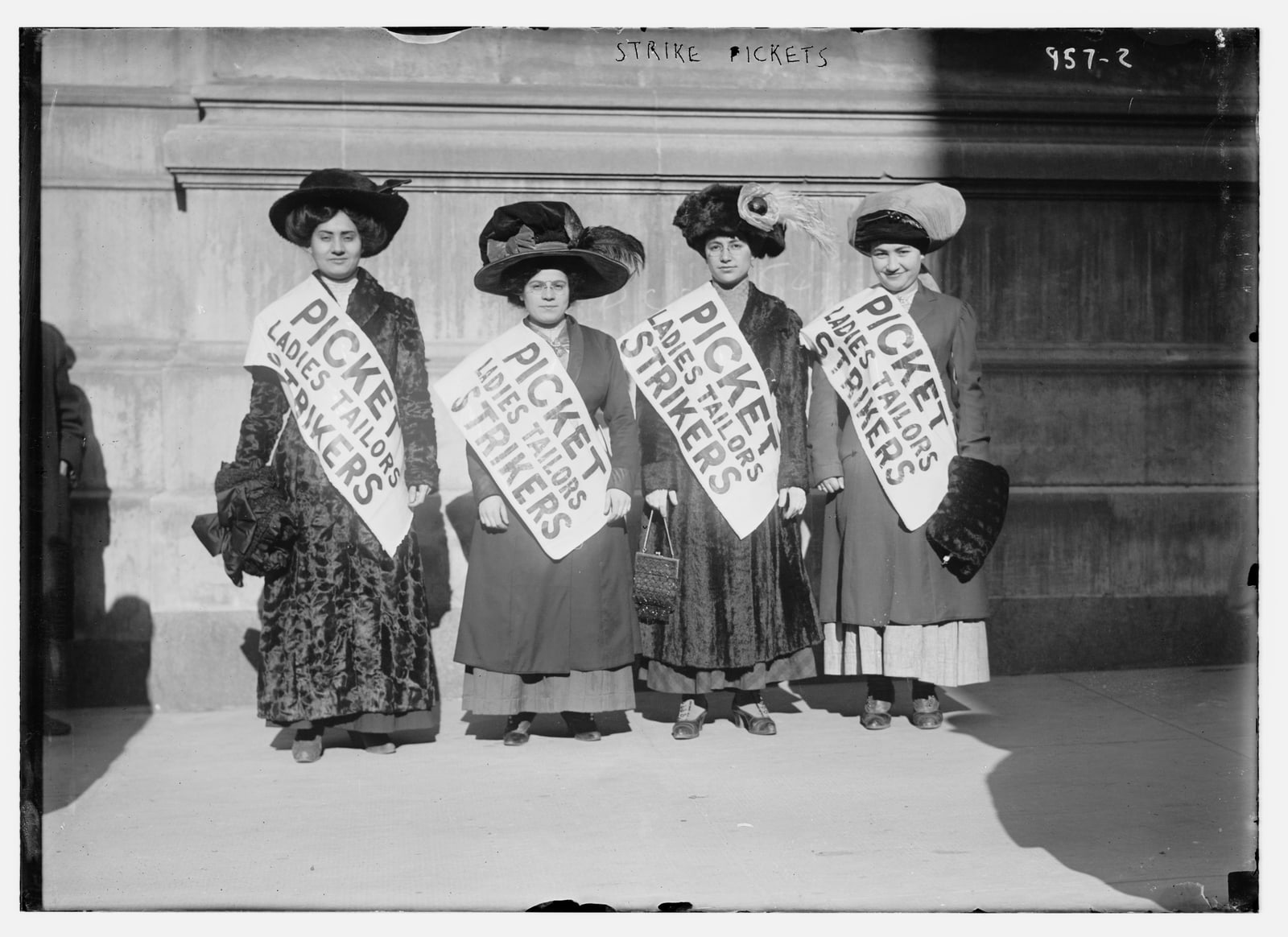
The next great garment strike, the cloakmakers' revolt of 1910, built on networks and expectations the waistmakers had made visible; together, the two actions helped establish the ILGWU as a durable force.[1][6] That is the deeper inheritance of the photograph. Four pickets stand in heavy coats, their hand-lettered sashes doing the plain work of identification. They are not waiting for history to remember the speech that began the strike. They are maintaining the system that allowed it to continue.[7]
Sources
- Ann Schofield, “The Uprising of the 20,000: The Making of a Labor Legend,” in A Needle, a Bobbin, a Strike: Women Needleworkers in America, Temple University Press and North Broad Press — open scholarly chapter on the industry's structure, strike logistics, negotiations, outcome, and historiography.
- Clara Lemlich, “Life in the Shop,” New York Evening Journal (November 28, 1909), reproduced by Cornell University's Kheel Center — contemporary worker account of hours, pay, light, deductions, and shop discipline.
- Cornell University ILR School, Kheel Center, “Strike sweeps through NYC garment industry” — timeline of the September shop actions, November general-strike vote, thirteen-week duration, contracts, and Triangle holdout.
- U.S. National Park Service, “Mink Brigade” — account of the Women's Trade Union League coalition, financial and picket-line support, policing, and class tensions.
- National Museum of American History, “What you may not know about the Triangle shirtwaist factory fire” — strike demands, the boundary between economic and safety claims, and Triangle's refusal of a union shop.
- U.S. National Park Service, “International Ladies' Garment Workers' Union” — institutional history of the ILGWU, the 1909 and 1910 strikes, membership growth, and later labor influence.
- Library of Congress, “Strike pickets,” Bain News Service (February 1910), reproduction no. LC-DIG-ggbain-04508 — catalog record and high-resolution source for the article's archival photograph.