On July 22, 1953, the first rebuilt tenement houses of Warsaw's Old Town were put into use, completing the first phase of a reconstruction that would continue for years.[8] In Japan that same year, Ise Jingu held its fifty-ninth Shikinen Sengu. That renewal had been scheduled for 1949 and delayed amid postwar hardship; Ise's official history also marks 1953 as the point when support for the ceremony shifted chiefly from the state toward public contributions after the occupation's Shinto Directive.[2][7]
The two events had no causal connection. Their shared year is valuable because it places two radically different kinds of return side by side.
At Ise, sanctuary buildings are remade on a twenty-year rhythm at paired adjoining sites. At Naiku, Amaterasu's sacred mirror—the shintai housed in the main sanctuary—is transferred from the old structure to the new one.[1][2] Warsaw began from the opposite condition. Fighting during the 1944 Warsaw Uprising damaged the historic centre; after the uprising, German units systematically burned and demolished what remained as part of the intended destruction of the capital.[3][9]
Ise renews before decay can end ritual use. Warsaw reconstructed after violence had already broken urban and material continuity. One is a prescribed succession; the other was an emergency answer to attempted erasure.
The comparison is therefore not a general claim that any declared copy can become authentic. It asks something more exact: what authorized these two returns, and why did new fabric count as continuity in one recurring sacred sequence and one exceptional urban reconstruction?
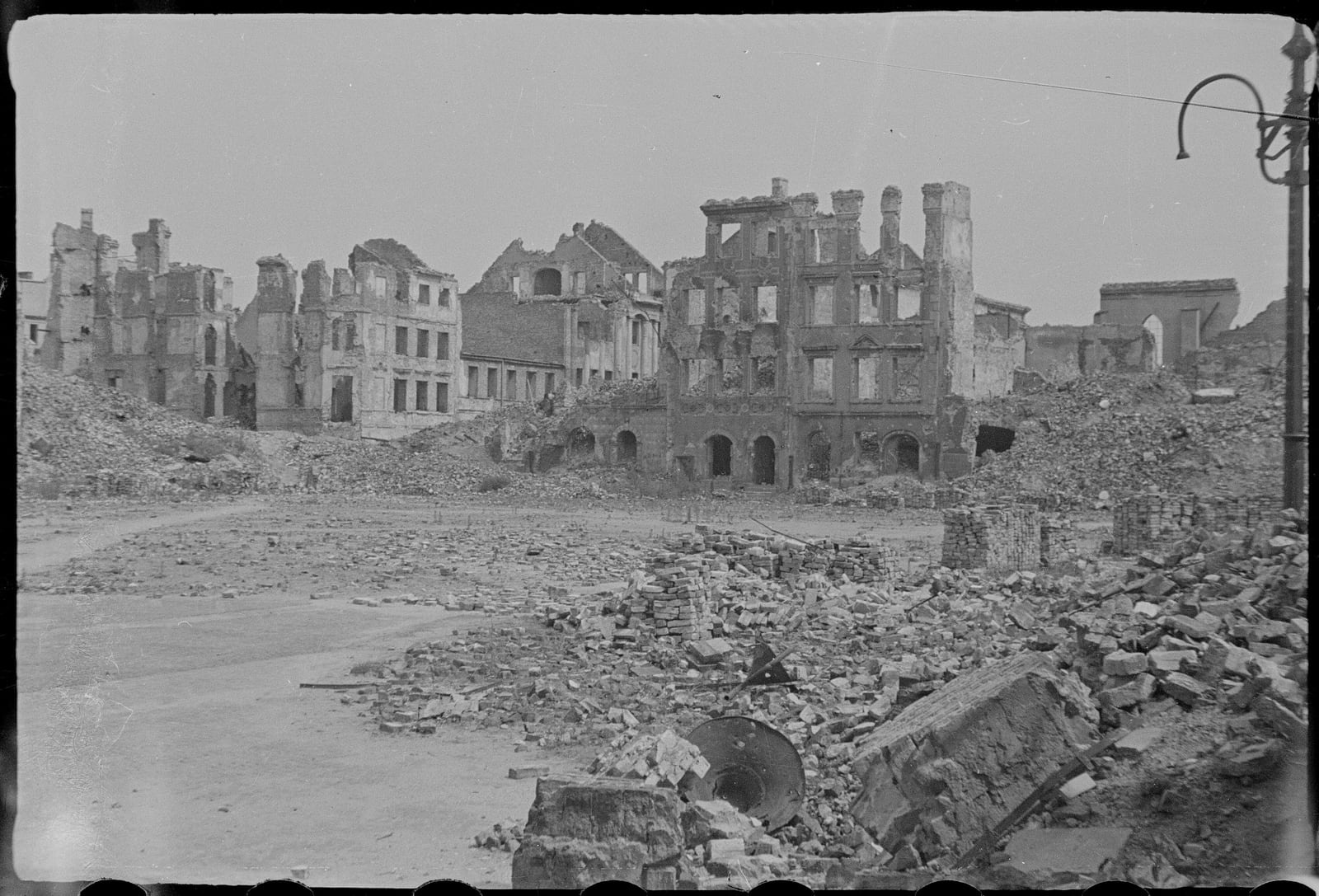
The photograph above keeps that question from becoming abstract. Leonard Jabrzemski's nitrocellulose negative, made in 1945 or 1946, records Warsaw's Old Town Market Square as open sky, roofless facades, a damaged streetlamp, and banks of loose brick.[6] The district later placed on the World Heritage List could not be conserved through ordinary repair. Ise's next sanctuary, by contrast, was not an attempt to recover from destruction. Its planned replacement was part of the ritual order itself.
1953 joined two clocks, not two causes
Ise's clock is anticipatory. The Sengukan museum describes Shikinen Sengu as a periodic renewal in which sanctuary buildings alternate between two adjoining sacred sites every twenty years. Sacred adornments, treasures, and objects used in worship are also made anew. The 2013 ceremonies completed the sixty-second renewal.[1]
The first recorded renewal at Naiku took place in 690, but “unbroken” would be inaccurate. Architectural historian Cassandra Adams documents a long interruption from 1463 to 1585 amid civil war and poverty, as well as the postwar delay from 1949 to 1953. Ise's official history similarly acknowledges a late-medieval interruption before revival through fundraising and elite support.[2][7] Its continuity is not the absence of historical disruption. It is the repeated restoration of a prescribed relationship among paired sites, sacred objects, ritual offices, artisans, materials, and worship.
Warsaw's clock began with emergency. UNESCO dates the design work of the Warsaw Reconstruction Office to 1945–1951. The Museum of Warsaw places the office's creation in 1945 and the final state decision to reconstruct the Old Town in 1949. The July 1953 handover covered only the first phase. Work in the Old Town continued into the mid-1960s, and the reconstructed Royal Castle opened to visitors in 1984.[3][4][8]
The difference in tempo reveals different systems of authority. At Ise, Jingu's ritual authorities and the imperial institution defined the religious sequence; artisans executed it; worshippers and contributors sustained it. The postwar fifty-ninth renewal altered the funding and administrative setting without turning Sengu into a war-damage project.[1][7] In Warsaw, the Reconstruction Office and conservators established the historical program, the Communist state approved and staged it, and compulsory levies, public fundraising, cultural-event income, and voluntary labor supplied resources.[4]
Those layers should not be collapsed into a single heroic “people rebuilt” story or a single cynical “regime propaganda” story. Design historian David Crowley argues that the post-1949 government sought legitimacy through reconstruction and promoted the 1953 Old Town inauguration as public spectacle. He also warns that ordinary Polish responses cannot simply be read off official rhetoric or later oppositional accounts.[10] Warsaw's first phase was simultaneously conservation work, housing policy, state theater, paid and voluntary labor, and a widely legible refusal of the city's destruction.
Ise authorizes continuity through succession
At Ise, the durable inheritance is not one particular set of boards. It is the capacity and authority to perform renewal in sequence.
Adams describes planning, timber procurement, fabrication, assembly, and Shinto ceremonies as interleaved work. Carpenters do more than reproduce an elevation. Senior workers transmit proportions, joints, tool use, material judgment, and work order. Recruitment favors craftspeople able to return for a later cycle, because continuity between renewals is itself a practical problem. The building process preserves knowledge that could not survive as a drawing alone.[2]
This is why the label “replica” can obscure more than it explains at Ise. Each renewed sanctuary is made for present ritual use within a prescribed alternation of sites. At Naiku, transfer of the sacred mirror changes which main sanctuary is active. The new building then receives worship, ages, and eventually yields to its successor. Visual fidelity matters, but resemblance alone does not perform that succession. Newness is not disguised as old substance; it is ritually authorized as the next sanctuary.[1][2]
Nor does renewal discard all older material without remainder. Adams notes that sound timber from dismantled buildings has long been redirected to subsidiary shrines and repairs.[2] The cycle distributes material inheritance while placing the strongest claim of continuity elsewhere: in the sequence of sites, the transferred shintai, the religious offices, the skilled work, and continued use.
The actors are therefore specific. Jingu's priesthood conducts the ceremonies. The imperial relationship remains part of Sengu's official meaning. Carpenters and other artisans reproduce a demanding material practice. Worshippers and contributors participate in a living institution rather than inspect a reconstruction sealed at the moment of completion.[1][2][7] Remove those relationships and a similar-looking building elsewhere would not become Ise.
Warsaw authorizes continuity through an argued reconstruction
Warsaw could not rely on ritual succession between prepared sites. Its claim had to be constructed from ruins, surviving fragments, memories, inventories, photographs, drawings, and the documented intention to destroy the city.[3][9]
UNESCO identifies two guiding principles for the Old Town project: use reliable archival documents where available, and recover largely a late-eighteenth-century appearance, the period supported by detailed records. Prewar and post-destruction inventories were combined with the expertise of architects, art historians, and conservators. Extant medieval and early modern structures were incorporated where possible, along with the old street network, squares, market, and circuit of walls.[3]
This was meticulous, but it was not a neutral rewind. Interior plans were altered to meet postwar housing standards. Historic plots remained legible along the street while some block interiors became shared open space. Certain rear structures were omitted to clarify the defensive walls and the panorama from the Vistula. Artists created facade decoration with traditional techniques, including sgraffito, rather than pretending that every surface had survived 1944.[3]
The result can be read in layers. Some basements, ground floors, and wall sections predate the destruction. Some buildings reproduce forms documented before the war. Others reconstruct earlier architectural states selected through conservation research. Behind many historic-looking facades are postwar residential arrangements. UNESCO accordingly locates the site's authenticity not in an untouched medieval fabric but in a coherent and fully declared postwar reconstruction.[3]
Its authority was divided. Conservators and the Warsaw Reconstruction Office supplied evidence and design judgment. The state supplied law, finance, political sponsorship, and spectacle. Working people supplied compulsory contributions; fundraisers and volunteers added money and labor; residents turned the rebuilt quarter back into a lived place.[4][10] UNESCO recognition in 1980 later confirmed the reconstruction's international significance, but it did not create the project or settle every contemporary response to it.[3]
Warsaw therefore preserves an argued city. Its continuity rests on the match among a documented catastrophe, surviving fabric, a declared reconstruction method, the institutions that made choices, and renewed urban use. A visually similar square built without that chain would not carry the same history.
Two systems of authorization
The comparison becomes clearest when the old “Japan values spirit; Europe values stones” contrast is set aside. Warsaw itself defeats that geography. What differs is not East against West, but the historical work each rebuilding had to perform.
Ise's system authorizes succession. The paired sites establish where the next sanctuary belongs. Ritual specifies the transfer. Skilled repetition links one generation of builders to another. Present worship makes the new structure operative. The test is whether the renewal remains inside that sequence—not whether a maximum percentage of the previous building survives.
Warsaw's system authorizes reconstruction. Wartime records establish the rupture. Ruins and surviving elements anchor the work materially. Archives and conservation study constrain the selected form. Planners, state institutions, workers, contributors, and residents give the project competing kinds of public force. The test is whether the rebuilt district remains answerable to that evidence and declares the postwar choices embedded in it.
Material matters in both systems, but it does different work. Fresh cypress and thatch at Ise permit sacred form, craft, and use to advance to another cycle. Surviving masonry at Warsaw ties the project to the damaged city, while salvaged and new material recover a street pattern that could again hold homes and public life.[2][3] Neither case is credible merely because the finished buildings look old.
Nara explains why the standards cannot be identical
The 1994 Nara Document on Authenticity was written decades after Warsaw's first reconstructed phase and does not serve as either project's original authorization. It is useful as later analytical language. Nara says authenticity judgments must respect the cultural context of the heritage under examination. Relevant information may come from form and design, materials and substance, use and function, traditions and techniques, location and setting, and spirit and feeling.[5]
That framework does not make material optional or give reconstruction an automatic pass. It expands the questions. Which values are being continued? Who has standing to continue them? Which physical, written, oral, and practiced sources make the claim credible? What has changed, and is that change disclosed?
Applied to Ise, those questions lead to the paired sites, sacred objects, ritual authorities, artisans, imperial relationship, worship, and the recorded interruptions and adaptations. Applied to Warsaw, they lead to ruins, inventories, plans, conservators, state decisions, mass financing and labor, residents, and the explicit fact of postwar reconstruction. The answers are not interchangeable. Context is precisely what prevents the comparison from turning two unlike histories into one permissive theory of copying.
What 1953 did—and did not—join
The shared year did not make Ise and Warsaw versions of the same project. Ise's fifty-ninth Sengu continued a scheduled sacred succession, even as occupation policy and postwar scarcity altered how it was supported. Warsaw's July handover opened the first phase of an emergency urban reconstruction after deliberate destruction, within the pressures of conservation, housing, state legitimacy, and public participation.[7][8][10]
What 1953 joins is a question of authorized continuity. At Ise, the next building became meaningful through its place in a ritual sequence enacted by identifiable institutions and craftspeople. In Warsaw, new and surviving fabric became meaningful through an evidentiary reconstruction argued over by conservators, government, workers, contributors, and residents.
Ise rebuilds before loss; Warsaw rebuilt after destruction. Their difference is the point. One advanced an inherited cycle. The other refused a planned ending. Each return remained credible only because the new work stayed answerable to the particular history that required it.
Sources
- Sengukan, Ise Jingu, “What is Shikinen Sengu?” — official English museum account of the twenty-year renewal, alternating sacred sites, renewed sanctuary objects, and the sixty-second ceremony in 2013.
- Cassandra Adams, “Japan's Ise Shrine and Its Thirteen-Hundred-Year-Old Reconstruction Tradition,” Journal of Architectural Education 52, no. 1 (1998), pp. 49–60 — scholarly study of materials, labor, craft transmission, ritual sequence, timber reuse, and historical interruptions, hosted by the University of Vienna.
- UNESCO World Heritage Centre, “Historic Centre of Warsaw” — official statement of destruction, reconstruction principles, archival basis, retained fabric, urban adaptations, chronology, integrity, and authenticity.
- Museum of Warsaw, “Old and New Town in Warsaw” — institutional account of the 1945 Warsaw Reconstruction Office, the 1949 rebuilding decision, financing, voluntary labor, and the first Old Town phase.
- UNESCO World Heritage Centre, “Nara Document on Authenticity” (1994) — international conservation text on cultural context and the multiple information sources used in authenticity judgments.
- Museum of Warsaw Collections, Leonard Jabrzemski, “Ruins of the buildings at the Old Town Market Square,” 1945–1946, inventory AN 60592 — catalog record and high-resolution source for the article's archival photograph.
- Ise Jingu, “History of Shikinen Sengu” — official Japanese history dating the first renewals, the late-medieval interruption, the 1953 fifty-ninth Sengu, and the postwar shift toward public support.
- Museum of Warsaw, “Old Town Festival” — official Polish account stating that the first rebuilt Old Town tenement houses were put into use on July 22, 1953, completing the first reconstruction phase.
- UNESCO Memory of the World, “Archive of Warsaw Reconstruction Office” — official account of wartime destruction, the intentional burning and demolition of Warsaw after the 1944 uprising, and the documentary archive of reconstruction.
- David Crowley, “People's Warsaw / Popular Warsaw,” Journal of Design History 10, no. 2 (1997), pp. 203–223 — scholarly analysis of state legitimacy, public spectacle, and popular reception around Warsaw's 1953 reconstruction ceremonies.