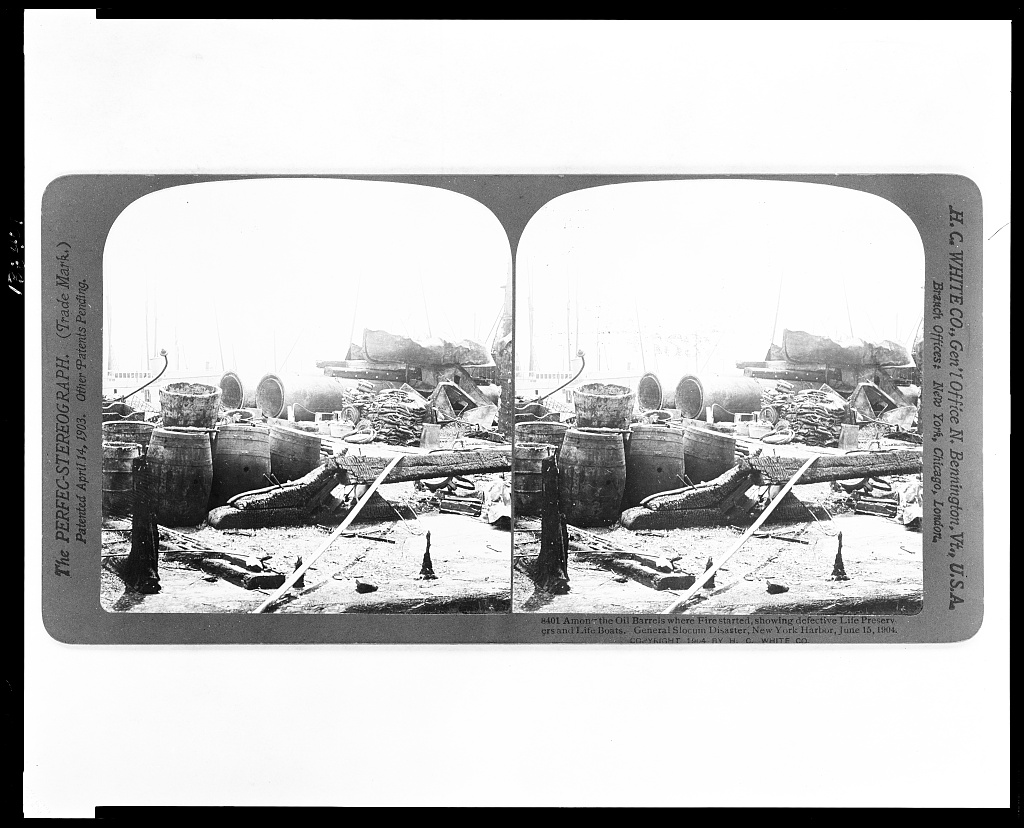
The certificate was only forty days old. Federal inspectors had examined the wooden excursion steamer General Slocum on May 5, 1904, and its new certificate was issued the next day. It authorized the vessel to carry as many as 2,500 passengers around New York Harbor and Long Island Sound. On June 15, with 1,358 church excursionists aboard, a fire found the difference between equipment that was present and protection that could actually work.[1]
That distinction is the key to reconstructing the disaster. The Slocum was not saved by being below its legal passenger limit. A fire pump could not compensate for a hose that had never been pressure-tested. Lifeboats could not help if nobody could launch them. Life preservers could not protect passengers who could not reach, trust, or put them on. A certificate could not turn a seasonal crew into an emergency organization.
The event is often compressed into one accusation—rotten life jackets, a cowardly crew, or a captain who would not stop. The federal commission appointed after the fire found all of those explanations too small. Its report reconstructed a system in which combustible construction, a hidden ignition, delayed warning, failed equipment, absent drills, forward speed, and a poor final landing amplified one another. The Slocum became catastrophic because every layer that should have interrupted the sequence instead passed the emergency to the next.[1]
The morning, placed in order
- May 5–6, 1904: assistant inspectors examined the Slocum, and the New York inspection office issued its annual certificate.[1]
- June 15, about 8:00 a.m.: the steamer reached the East Third Street recreation pier and began taking aboard the annual excursion of St. Mark's Lutheran Evangelical Church.[1][2]
- Between 9:30 and 9:40 a.m.: the vessel left for Locust Grove on Long Island Sound. Of the 1,358 passengers, the commission estimated that roughly nine in ten were women and children.[1]
- On the approach to and passage through Hell Gate: smoke from the forward cabin became visible, but testimony conflicted over exactly when the bridge learned of the fire. The commission concluded that the warning arrived earlier than the captain and pilots claimed.[1]
- Less than twenty minutes after the emergency became general: the burning vessel had reached North Brother Island, and all remaining passengers were forced to choose between fire and the East River.[1]
- June 23 and October 8, 1904: a federal commission began its inquiry and then delivered a report that widened responsibility from the ship to the inspection system itself.[1]
The casualty total is one place where the record should remain visibly unsettled. The commission's revised police list counted 955 passengers dead or missing; later New York Public Library and Library of Congress accounts use more than 1,000, commonly 1,021.[1][2][3] Those figures reflect different acts of reconciliation after a mass-casualty event, not a meaningful disagreement about scale. Even the lowest official count meant that seven in ten passengers did not survive.
A fire began where no passenger was watching
The federal report did not claim to know the spark. It judged that the fire probably began in packing hay inside one of three barrels used to carry bar glasses, and that an unknown person's carelessness likely supplied the ignition. The word “probably” matters. Later retellings often convert an inference into a witnessed fact.[1]
What investigators could establish was the room around it. The forward cabin, below the main deck, had become a storeroom and lamp room. It held oil barrels, lamps, paint, canvas, charcoal, and other combustible material. Its surfaces were wood, its only entrance was a wooden companionway, and the lightweight structure above it offered the flames a route upward. The ship itself was a repeatedly painted wooden shell without fireproof hatches or bulkheads. Once the fire climbed out of that compartment, the architecture became fuel.[1][4]
The location also corrupted the warning chain. The fire was below the people who needed to see it and ahead of most of the crowd. Early puffs of smoke did not immediately become a ship-wide alarm. Witnesses on different decks remembered different moments of discovery; crewmen and bridge officers had powerful reasons to place their own knowledge as late as possible. After comparing testimony with landmarks and the time passengers still had to carry buckets, the commission decided that the pilot house knew before the ship passed the eastern end of Wards Island.[1]
That finding created a genuine dispute over the captain's course. Captain William Van Schaick's account made North Brother Island the first practicable landing after he learned of the fire. The commission rejected that timing. It argued that an earlier turn into Little Hell Gate or the Bronx Kills could have grounded the vessel sooner and, crucially, put its stern into the wind. Instead, the Slocum continued at roughly 12 to 15 miles per hour over the ground. Its motion drove a strong current of air from bow to stern, carrying fire toward the passengers who had retreated aft.[1]
The first hose became evidence
At the forward standpipe, the machinery initially did what it was meant to do. The steam fire pump was already running. Crewmen uncoiled a linen hose, opened the valve, and brought its nozzle close to the fire. Then the hose burst in several places and tore away from its coupling before delivering a useful stream. A replacement rubber hose could not be attached because the old coupling remained on the standpipe. The crew abandoned the attempt.[1]
This was not bad luck at the nozzle. The linen hose was several years old, of the cheapest grade, and had apparently never carried water during a test aboard the vessel. Fire buckets on the main deck were empty and out of reach. Newer hose existed aft but was never brought forward. No fire or boat drill had been held that season, and only one of that year's deckhands had previously served on the ship. Hardware failure and organizational failure arrived together.[1]
The May inspection should have broken that chain. It did not include the pressure test that would almost certainly have exposed the hose. After the disaster, outside inspectors re-examined 268 New York passenger vessels. Among excursion steamers—the class carrying the greatest concentrations of leisure passengers—they found about 33 percent of life preservers and 26 percent of fire hose missing, defective, or needing repair. The Slocum was horrifying, the commission argued, precisely because it was not an isolated freak. It revealed the condition of a precarious seasonal business in which owners could economize on safety equipment that routine operations rarely forced them to use.[1]
The certificate had another weakness: the senior local inspectors who signed it did not themselves perform the physical inspection. Assistants did the fieldwork; superiors certified facts they had not directly observed. The commission described that arrangement as structurally improper. A signature traveled upward, while firsthand knowledge did not.[1]
Rescue equipment existed, but rescue did not
The Slocum carried six metal lifeboats and two cylindrical life rafts that investigators considered in reasonably good condition. None was successfully lowered. Many life preservers had rotten covers that split during handling and spilled granulated cork. Others were difficult to pull free from the wires that held them. More fundamentally, the crew had no practiced system for distributing equipment or directing a crowd. Most passengers received no preserver at all.[1]
One popular detail needs an evidence boundary. The commission's appended Justice Department report did describe cork blocks fraudulently weighted with iron bars. But those blocks were discovered in a shipment of new preservers produced after the Slocum disaster, during the rush to replace equipment on passenger vessels. The commission's findings about the Slocum itself concern rotten covers, inaccessible mounting, poor distribution, and distrust—not proof that its preservers contained concealed iron.[1] The true record is damning enough without borrowing a later fraud.
When the vessel struck North Brother Island, its bow stopped in relatively shallow water while the stern—the place to which fire had driven the crowd—remained tens of feet from shore in deep, fast-moving water. The commission estimated that 400 to 600 people drowned at that location after the beaching. Within about ten more minutes, flames and a collapsing upper deck forced everybody still aboard into the water or the fire.[1]
The geography makes the outcome especially brutal: land was visible, help was nearby, and neither became access. Tugs and small boats pulled alongside quickly enough to prevent an even larger toll. The commission estimated that outside rescuers saved hundreds and that, without them, perhaps no more than five percent of passengers would have survived. Safety had migrated off the certified vessel and into improvised boats around it.[1]
What the wreck made visible
The investigation did not reduce responsibility to a single villain. It faulted the captain's delayed landing and lack of drills, the crew's preparation, the owner's equipment, the inspectors' methods, and laws that made defective gear easier to certify than to destroy. Its recommendations followed the sequence of failure: pressure-test every length of hose; handle and stress-test each life preserver rather than inspecting it by sight; make lifeboats quick to release; require drills; increase the inspection force; and give inspectors power to stop unsafe vessels from operating.[1]
Criminal accountability was narrower. On January 27, 1906, Van Schaick was convicted of criminal negligence for failing to maintain required fire drills and received a ten-year sentence; the company and its directors escaped comparable punishment. He was paroled in August 1911, then received an unconditional presidential pardon effective on Christmas Day 1912.[2][3][6] The mismatch between the commission's systemic diagnosis and the court's individual sentence is part of the history, not an administrative footnote.
So is the community that had chartered the ship. St. Mark's drew its excursionists largely from Manhattan's German American Lower East Side. The loss tore through families and congregational networks at once. NYPL's archival account describes deaths, depression, suicide, and departures from the neighborhood.[3] It would be too simple to make one disaster solely responsible for the long decline of Kleindeutschland: residents had already begun moving north to Yorkville before 1904 as the Lower East Side neighborhood changed around them.[7] But no demographic abstraction can soften what happened on one morning: a neighborhood sent its children and caregivers out together and received only a fraction back.
The H.C. White stereograph used above was made after investigators had reached the wreck. Its paired view shows oil barrels and the burnt remains of lifeboats and life preservers in the same ruined space.[5] That proximity is the article's answer to why the disaster became so lethal. The ignition was uncertain. The safeguards were not. They stood close to the danger, passed inspection, and failed when converted from inventory into action.
Sources
- United States Commission of Investigation, Report upon the Disaster to the Steamer “General Slocum”, October 8, 1904 — primary investigation, witness synthesis, casualty table, inspection findings, and recommendations; digitized by Google Books.
- Library of Congress, “General Slocum Steamboat Tragedy: Topics in Chronicling America” — event overview, contemporary newspaper archive, and public-response timeline.
- Valerie Wingfield, New York Public Library, “The General Slocum Disaster of June 15, 1904” — passenger community, legal aftermath, memorialization, and Gustav Scholer archival materials.
- Barbara Voulgaris, National Coast Guard Museum, “Written in Blood,” 2025 — Coast Guard historical synthesis of the fire, failed inspection, and resulting safety reforms.
- H.C. White Co., “Among the oil barrels where fire started, showing defective life preservers and life boats,” Library of Congress, 1904 — institutional record for the archival stereograph used as the article image.
- William Peirce Handel, “The Flames of Hell Gate,” American Heritage, October–November 1979 — narrative history of the disaster, prosecution, parole, pardon, and community aftermath.
- Lower East Side Preservation Initiative, “Kleindeutschland: Little Germany in the Lower East Side” — neighborhood history documenting the population shift toward Yorkville before 1904 and the disaster's impact.