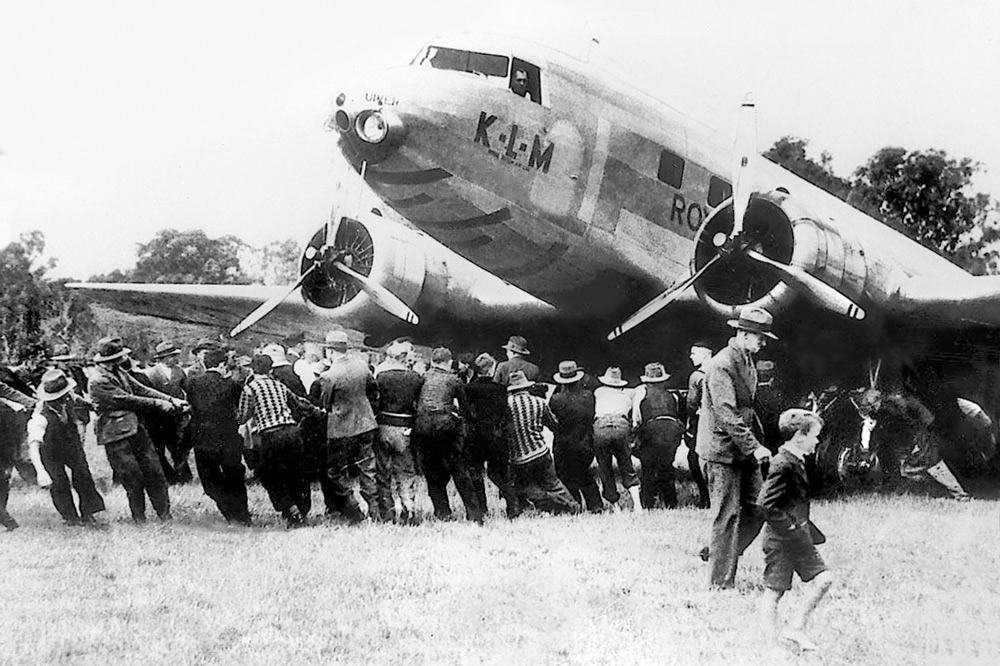
In the photograph, the airliner towers over its rescuers. Beneath the KLM lettering, men in hats lean into ropes; a child passes through the foreground. The machine has crossed continents. For the moment, it needs people on foot to move it across a field.[3]
This was Albury, New South Wales, on October 24, 1934, after the Dutch airliner Uiver had landed at the town's racecourse in a storm. The familiar story celebrates motorists illuminating the ground with headlights. Follow the episode through the night and into daylight, however, and the rescue becomes a succession of different jobs: attract attention, assemble a landing ground, bring the aircraft down, then make departure possible.[4]
October 20: an airliner enters a race
The MacRobertson Trophy Air Race began at RAF Mildenhall in England on October 20. Sponsored by confectionery businessman Sir Macpherson Robertson for Melbourne and Victoria's centenary celebrations, it combined a speed competition with a handicap section. Compulsory stops at Baghdad, Allahabad, Singapore, Darwin, and Charleville punctuated the route to Melbourne. Purpose-built de Havilland Comets competed alongside machines with more everyday work to demonstrate.[1]
KLM's entry carried three passengers as well as its crew. Its Douglas DC-2 embodied a change in the airline's equipment: KLM identifies 1934 as the year it introduced its first all-metal aircraft. The company already operated a scheduled Amsterdam–Batavia service, begun in 1930, linking the Netherlands with the capital of the Dutch East Indies, now Jakarta.[1][2]
That background changes the meaning of the race. A passenger cabin and a load of cargo made speed a commercial proposition. The question was whether an airline could carry useful loads across immense distances quickly enough to reshape expectations of travel. KLM's later corporate history accordingly remembers the Uiver through both its handicap victory and what it carried.[2]
October 23: the last leg becomes the dangerous one
After Charleville, on the final stage toward Melbourne, the Uiver encountered an electrical storm. Captain Koene Dirk Parmentier and First Officer Jan Moll faced disrupted communications, uncertain position, and icing. In an interview reported by the Grey River Argus on October 25, Parmentier identified ice forming on the wings at altitude as a central cause of the Albury emergency and said the storm had affected the wireless.[6]
The Uiver Memorial Community Trust's reconstruction describes attempts to find a route toward the coast, retreat from icing, and dwindling fuel. An available landing ground mattered more urgently than progress toward the finish.[3] RAAF signallers at Laverton tried to reach the aircraft while warnings went out along its possible route. Railway signal lamps and naval searchlights joined the effort to make the ground visible.[4]
After midnight: listeners become participants
In Albury, newspaper sub-editor Clifton Mott, municipal electrical engineer Lyle Ferris, and postal official Reg Turner brought different practical skills together. The Trust credits them with using the town's streetlights to flash its name in Morse code.[3] A lighting network built for streets became an attempted message to an aircraft.
There is an important limit to that celebrated detail. Heritage NSW's account records Parmentier saying that the crew saw the signals but could not read them in the turbulence.[5] Flashing the town's name and successfully communicating that name are different claims. The rescue can be extraordinary without making every improvised measure work exactly as intended.
Meanwhile, announcer Arthur Newnham needed to reach local motorists through radio station 2CO. Heritage NSW describes a small but consequential obstruction: he lacked the technician needed to interrupt the relayed program. Telephone staff helped connect him to the Corowa transmitter, allowing his telephone handset to serve as the broadcast microphone.[5]
His appeal sent car owners to the racecourse to illuminate a landing area.[4] Broadcast radio changed the role of its audience. People following an international sporting event could now leave their receivers, drive somewhere specific, and contribute equipment they already owned. Each headlamp had limited reach; the gathering made those separate lights useful to the same aircraft.
About 1:20 a.m.: finding the ground
The Uiver dropped parachute flares and came down on the racecourse's wet interior. The Trust gives the landing time as 1:17 a.m.; Albury Airport's account gives 1:20 a.m. The defensible reconstruction is a landing at about 1:20, rather than a claim that every surviving account shares one synchronized clock.[3][4]
Car headlights had made a possible landing area visible. They could not give it the surface of an aerodrome. Albury Airport describes the aircraft bouncing over uneven ground before stopping. By daylight, the heavy machine was bogged.[4]
The problem had changed. A successful arrival left the crew, passengers, and aircraft safe on the ground, but still stranded short of Melbourne. The same place now had to support a second operation under very different conditions: daylight recovery and takeoff.
Daybreak: the airliner needs a ground crew
Mayor Alfred Waugh rallied roughly 300 people to help free the aircraft.[4] The photograph preserves the physical imbalance: a large metal fuselage above a cluster of small bodies, with the pulling effort concentrated underneath. It cannot tell us how long the work took, or identify every participant. It does show why “the town helped” needs to be understood as actual labor.[3]
Heritage NSW preserves a later recollection by Cecil Meredith, a worker on the Hume Reservoir project. In 1984, he recalled diverting to the racecourse on his way to work and helping organize the hauling. This is retrospective testimony, recorded fifty years afterward, rather than a contemporary work log.[5]
The aircraft also had to shed weight. The Trust's race history records that the three passengers and two crew members remained in Albury while the two pilots continued to Melbourne. The Uiver finished second on elapsed time and took the handicap prize.[1]
Those outcomes were not yet settled in the first reports. The October 25 Grey River Argus warned that leaving passengers and extra crew behind might damage the aircraft's handicap prospects. Its report catches the interval between a practical decision and knowledge of the final award: unloading made departure possible, while its competitive consequences were still being discussed.[6]
October 24, evening: thanks travel back through the network
A surviving telegram offers a contemporary counterweight to later commemoration. Sent from Sydney to 2CO's manager on October 24, it carried the thanks of Bakker, Royal Netherlands Airways' chief representative in Australia. He singled out the station for “continuously keeping your wireless organisation available” during difficult navigation, adding that its help was appreciated in Holland and Java.[7]
The wording recognizes availability as an achievement. Aircraft performance depended, that night, on people maintaining communications and finding ways to act on incomplete information. The telegram is evidence of immediate gratitude; it does not settle every later argument over who first proposed which measure.
Seen beside the photograph, it also gives the rescue its two necessary scales. Messages moved between distant places, but the decisive work required people to gather at one wet racecourse. Albury made itself useful to an aircraft overhead, then stayed to help the aircraft leave.
Sources
- Uiver Memorial Community Trust, “The MacRobertson Trophy Air Race” — race structure, commercial load, recovery, and finishing outcome.
- KLM, “History of KLM,” entries for 1930 and 1934 — the Batavia service, introduction of the DC-2, and the airline's account of the Uiver.
- Uiver Memorial Community Trust, “Albury and the Uiver” — flight reconstruction, local participants, landing time, and AlburyCity Collection photograph ARM 11.182.
- Albury Airport, “The Uiver story” — regional alerts, car headlights, approximate landing time, and morning recovery.
- Heritage NSW, “The Uiver Collection,” Historical Notes, item 5063160 — telephone and broadcast arrangements, the unread Morse signals, and later witness recollections.
- “Air Race,” Grey River Argus, October 25, 1934, page 5, National Library of New Zealand, Papers Past — contemporary reporting of Parmentier's explanation and uncertainty about the handicap result.
- National Communication Museum, telegram from Royal Netherlands Airways to ABC station 2CO, October 24, 1934, identifier 7466, Victorian Collections — surviving message and transcription.