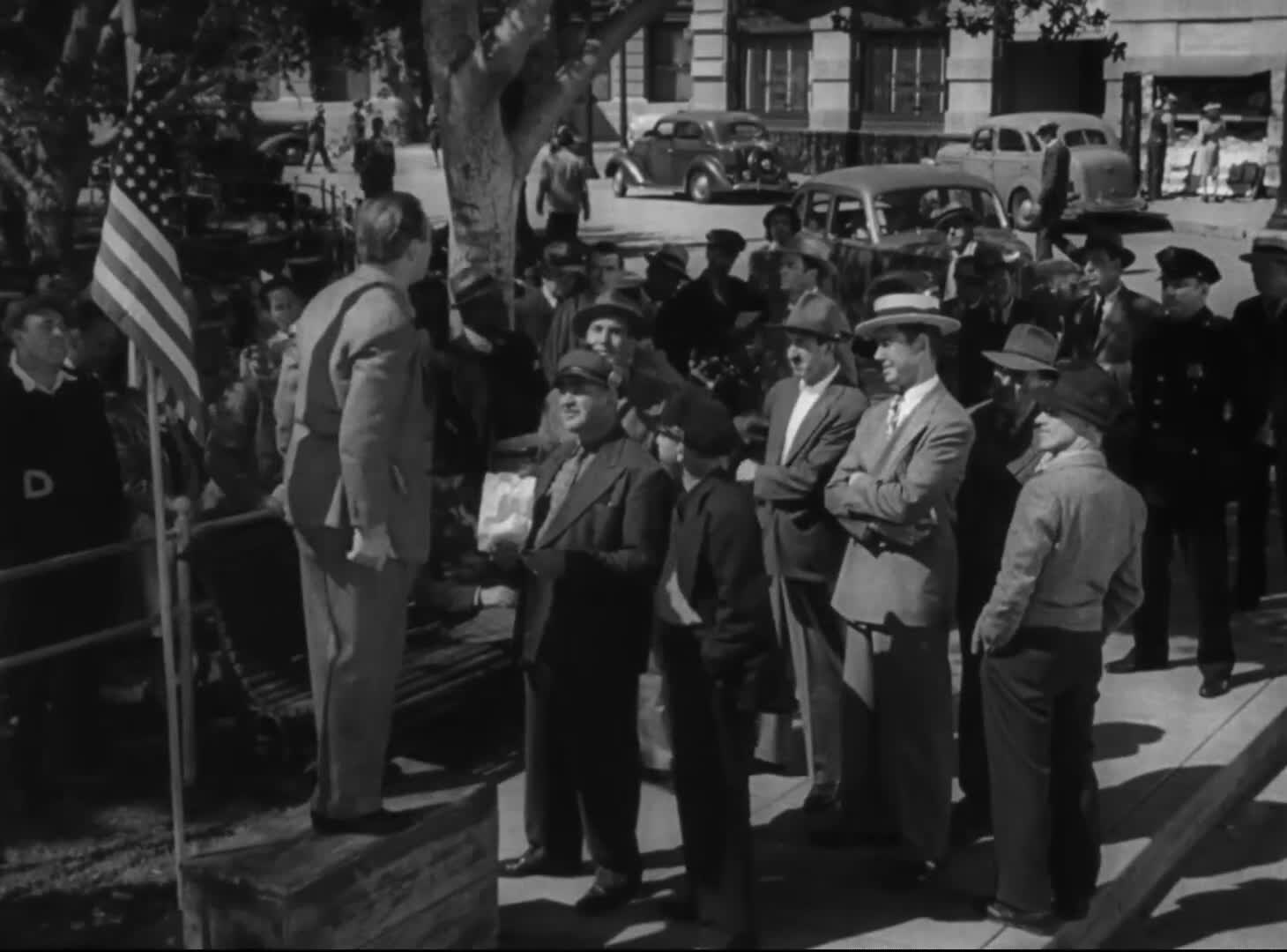
The street speaker does not begin by asking his listeners to abolish democracy. He offers them an explanation for disappointment. Jobs, money, and national belonging have supposedly been stolen by people with foreign accents, Black workers, Catholics, and other convenient targets. Mike, the film's representative American, listens. Only when the speaker adds Freemasons—Mike's own affiliation—to the list does agreement become alarm. The scene in Don't Be a Sucker is blunt, but its mechanism is exact: exclusion can feel like common sense while somebody else is being excluded.[1]
The U.S. National Archives dates the film to 1945, identifies it as Educational Film No. 6 in the Army Signal Corps collection, and describes its purpose as dramatizing the destructive effects of racial and religious prejudice.[2] The official YouTube copy runs about 23 minutes; a preserved high-resolution transfer also supplies the street-crowd frame above.[6] It mixes a staged American encounter, a staged reconstruction of Nazi Germany, and wartime images into an argument about how a plural society can be dismantled. This is government persuasion, not an unmediated record of events. Its construction is precisely why it deserves close viewing.
There is also an unusually revealing check on that construction. In 1947–48, the American Jewish Committee's Department of Scientific Research studied how adults and high-school students actually responded to the film; Eunice Cooper and Helen Dinerman published a journal analysis in 1951.[3][5] Read together, film and study produce a double history. The movie identifies prejudice as a confidence trick. The research shows how readily viewers could accept that lesson while inventing reasons it did not apply to them.
Viewing note: the film contains staged racist and antisemitic speech, Nazi symbols, scenes of violence, and period racial language.
0:20–3:22 — prejudice enters as a swindle
The opening does not begin with Hitler. It begins with fixed games: a rigged wrestling match, a crooked card table, a man lured into a robbery. The narrator groups their victims under the title's insult, then introduces Mike as the owner of something much larger that can also be stolen. His stake is “America,” visualized through farms, factories, mines, cities, worship, voting, work, and people of different origins and skin colors.[1]
That sequence establishes the film's governing metaphor. A demagogue is not merely wrong; he is running a racket. The audience is invited to recognize the setup before pride admits complicity. This is shrewd persuasion because it shifts the threatened object. The immediate victim of bigotry is still the person targeted, but the person tempted by bigotry is told that he, too, is being robbed—of liberty, association, and eventually power over his own life.[1][3]
The appeal also sets a limit. Moral solidarity is translated into enlightened self-interest. The film asks Mike to defend another person's freedom because persecution will eventually reach him, not because the first injury is already intolerable. That is less generous than a claim grounded in equal dignity alone, but the 1948 study suggests the choice was deliberate: researchers described self-interest as the picture's principal route to its wavering audience.[3]
3:28–6:58 — the list works until Mike appears on it
The American speaker stages authority with cheap signals. He promises “facts,” calls himself an ordinary citizen, repeats a narrowed definition of the real American, and converts economic frustration into a list of human causes. A flag stands beside him. The camera alternates between his low-angle performance and listeners whose faces register agreement, doubt, or passivity. Nothing in the scene requires a uniformed movement yet. The first infrastructure of division is a speaker, a pamphlet, a grievance, and an audience willing to sort neighbors.[1]
At about 5:05, the list reaches Freemasons. Mike's response exposes the bargain he thought he was making: other people could be reduced to categories, while he remained an individual. Once his own category becomes suspect, the principle suddenly looks dangerous. The Hungarian-born professor beside him does not congratulate that discovery. He asks why the word Mason should make a difference when the earlier targets did not.[1]
This is the film's strongest piece of staging. The speaker's list is cumulative, but Mike's recognition is selective. The camera therefore makes hypocrisy visible without requiring a lecture about it. Prejudice is shown as a permission structure: each listener accepts the removal of someone else's protection and assumes the sequence will stop before arriving at the identity he values.
The conversion happens too cleanly, however. Mike is handed a hate pamphlet, hears his own group attacked, listens to the professor, and soon tears the pamphlet up. That compact reversal keeps the plot moving. It will also become the opening through which some real viewers escaped the warning.[3]
7:07–12:08 — Berlin becomes a sequence of separations
The professor's flashback begins in Berlin in 1932. Five acquaintances arrive as fellow Germans and are separated visually as a Nazi speaker names Jews, Catholics, and Freemasons, while promising land, work, and profit to those left inside the favored category. Hans, an unemployed metalworker, receives a uniform and the emotional wage of belonging to a “master race.” Material improvement never arrives; the party gains the power.[1]
Watch what the film does with space. Each named person becomes isolated within the crowd. Later, unions and political parties appear as organizations that must be broken because people might resist through them. Division is not presented only as hatred between private individuals. It is a way of disabling the places where coordinated opposition could form.[1]
As causal history, the sequence is too neat. The Nazi rise involved electoral gains amid depression and political crisis, conservative elite bargaining, President Paul von Hindenburg's appointment of Hitler as chancellor on January 30, 1933, and then emergency decrees and legislation that dismantled constitutional restraints. Antisemitism, racial ideology, propaganda, organized violence, and the destruction of political opposition operated together.[4] The film compresses that history into a parable of divide and conquer. Its value lies in the mechanism it isolates, not in completeness.
That boundary matters because the professor speaks with the authority of a refugee witness while the film arranges his memories for an American lesson. Germany becomes a finished catastrophe that can explain the danger; America remains the place where recognition can still interrupt the sequence. The structure gives viewers agency, but it also makes foreign disaster look easier to diagnose than domestic prejudice.
12:10–17:32 — truth is embodied, then arrested
The middle of the film changes the object under attack. Books burn; outside radio and newspapers become forbidden; Joe Louis and Albert Einstein appear as refutations of racial hierarchy; clergy speak and are punished. Finally, a professor uses the Nazi leadership's own faces to mock the supposed physical ideal, rejects the idea of a master race, and insists on judging people as individuals. Uniformed men enter the classroom and take him away.[1]
The sequence presents truth as more than accurate information. Truth needs carriers—books, broadcasts, schools, churches, teachers—and those carriers need enough freedom to contradict power in public. Once organizations have been split and opponents isolated, censorship no longer looks like the first authoritarian act. It looks like consolidation.
Yet the film's American panorama is a proposition, not proof that audiences accepted it. The later study separated attitudes about Black people, Jews, employment discrimination, religious persecution, and majority-minority power instead of treating pluralism as one yes-or-no belief. That choice exposed what the montage could conceal: viewers could accept some claims while resisting others, and recognition of persecution abroad did not ensure changed attitudes toward Black or Jewish people at home.[3][5]
17:32–22:31 — the ending makes solidarity practical
The professor returns to the five Germans and follows the bargain to its cost. The farmer loses control of his labor, the shopkeeper loses economic independence, the worker remains poorly supplied and becomes useful to war, and the men who tolerated attacks on others lose freedom themselves. The chain ends not with the triumphant insider ruling the excluded but with bodies distributed across battlefields.[1]
Back in the park, the film broadens the meaning of minority until it includes religion, occupation, birthplace, association, and even ordinary traits. Its memorable conclusion is that America does not merely contain minorities; America is minorities. The final appeal remains strategically selfish: guard everyone's liberty because no identity can guarantee permanent membership in the protected majority.[1]
That formulation does two things well. It refuses the fantasy of a single default American who generously tolerates everybody else. It also converts solidarity from sentiment into shared maintenance. Freedom survives through reciprocal defense, not through confidence that one's own status is secure.
But making every difference equivalent can blur unequal danger. The audience report itself refused to score those differences as equivalents: it tested prejudice against Black people and Jews, job discrimination, knowledge of religious persecution, and beliefs about majority-minority power separately. Effects varied by message and group.[3] The film's universal minority principle is a strong civic claim. It is not a measurement of how power was actually distributed.
The audience found an escape hatch
The contemporary audience research is what turns this from a familiar civic film into a revealing historical object. The American Jewish Committee's 1948 report did more than ask whether viewers liked it. Its exploratory phase included content analysis, interviews with 148 viewers, questionnaires from another 326, and moment-by-moment like-or-dislike responses from 44 people. A later phase compared questionnaires from 368 Long Island City high-school students who saw the film with 491 students in a matched control group who did not.[3]
The design should not be mistaken for a modern randomized trial. Students within academic and commercial tracks were initially divided at random, but investigators later removed cases to equalize background characteristics; the final groups came from one school, and attitudes were measured indirectly by questionnaire. The report also used period categories that are unacceptable now—including racial language and a crude division of students into “intelligence” levels according to course track.[3] Its results are best read as evidence about one historical research program and its audiences, not a timeless estimate of media effects.
Within that boundary, the central finding is striking. The film successfully routed some specific messages: Catholic and Protestant viewers became more aware of how their counterparts had suffered under Nazism. It also made parts of its self-interest argument land. But it did not reduce measured prejudice against Black people and Jews, and viewers who learned lessons about Germany often failed to transfer them to the United States.[3][5]
Some participants treated the American street speaker as a clown whom sensible citizens would ignore. Mike's quick recovery helped. If only an unusually gullible man could be taken in—and if one conversation could restore him—then the audience could condemn the demagogue while feeling safely unlike his followers. The report found that part of the film actually increased complacency among some viewers: the warning became evidence that race hatred could gain no serious American foothold.[3]
That is the escape hatch. A story designed to reveal manipulation can flatter the viewer who recognizes the manipulator. Seeing the trick is not the same as recognizing one's own susceptibility to it. The film's tidy contrast between failed Germany and recoverable America made the danger visible, then gave viewers a national and psychological distance from it.
What survives the test
The study does not make Don't Be a Sucker a failed artifact. It makes the film more useful to watch. The opening confidence-game metaphor remains sharp; the progressive list of targets still shows how conditional solidarity works; the destruction of unions, parties, schools, churches, and media still connects interpersonal prejudice to institutional power. What fails is the hope that clarity automatically produces transfer.
The most important moment is therefore not Mike tearing up the pamphlet. It is the moment before that conversion, when he accepts every category except his own. The camera asks viewers to locate themselves beside him. The audience study asks a harder follow-up: after recognizing Mike's mistake, did they examine their own permissions—or merely congratulate themselves for not being suckers?
Watch the film with both questions active and its historical contradiction becomes productive. A persuasive government film explained division as theft. A near-contemporary research team then discovered that viewers could understand the theft abroad while discounting its possibility at home. Democracy's defense, the combined record suggests, begins neither with spotting an obvious villain nor with admiring a correct message. It begins when the first exclusion is treated as the test, before the list reaches us.[1][3]
Sources
- U.S. National Archives, “Don't Be a Sucker” — official YouTube upload of the complete Army Signal Corps educational film used for the timestamps and close viewing.
- U.S. National Archives / DocsTeach, “Don't Be a Sucker” — catalog record dating the item to 1945 and identifying Educational Films, 1942–1947, Record Group 111, National Archives Identifier 24376.
- Eunice Cooper and Helen Schneider, “Don't Be a Sucker”: A Study of an Anti-Discrimination Film, American Jewish Committee Department of Scientific Research, March 17, 1948 — full research report on audience response, methods, selective perception, and boomerang effects.
- United States Holocaust Memorial Museum, “The Nazi Rise to Power” — historical context on electoral support, Hitler's appointment, political crisis, propaganda, and the destruction of parliamentary democracy.
- Eunice Cooper and Helen Dinerman, “Analysis of the Film ‘Don't Be a Sucker’: A Study in Communication,” Public Opinion Quarterly 15, no. 2 (1951), pp. 243–264 — peer-reviewed publication of the audience study and its communication findings.
- U.S. National Archives via Wikimedia Commons, “Don't Be a Sucker (high resolution 35mm transfer)” — preservation file and provenance page for the 1460 × 1080 archival frame used as the article image.