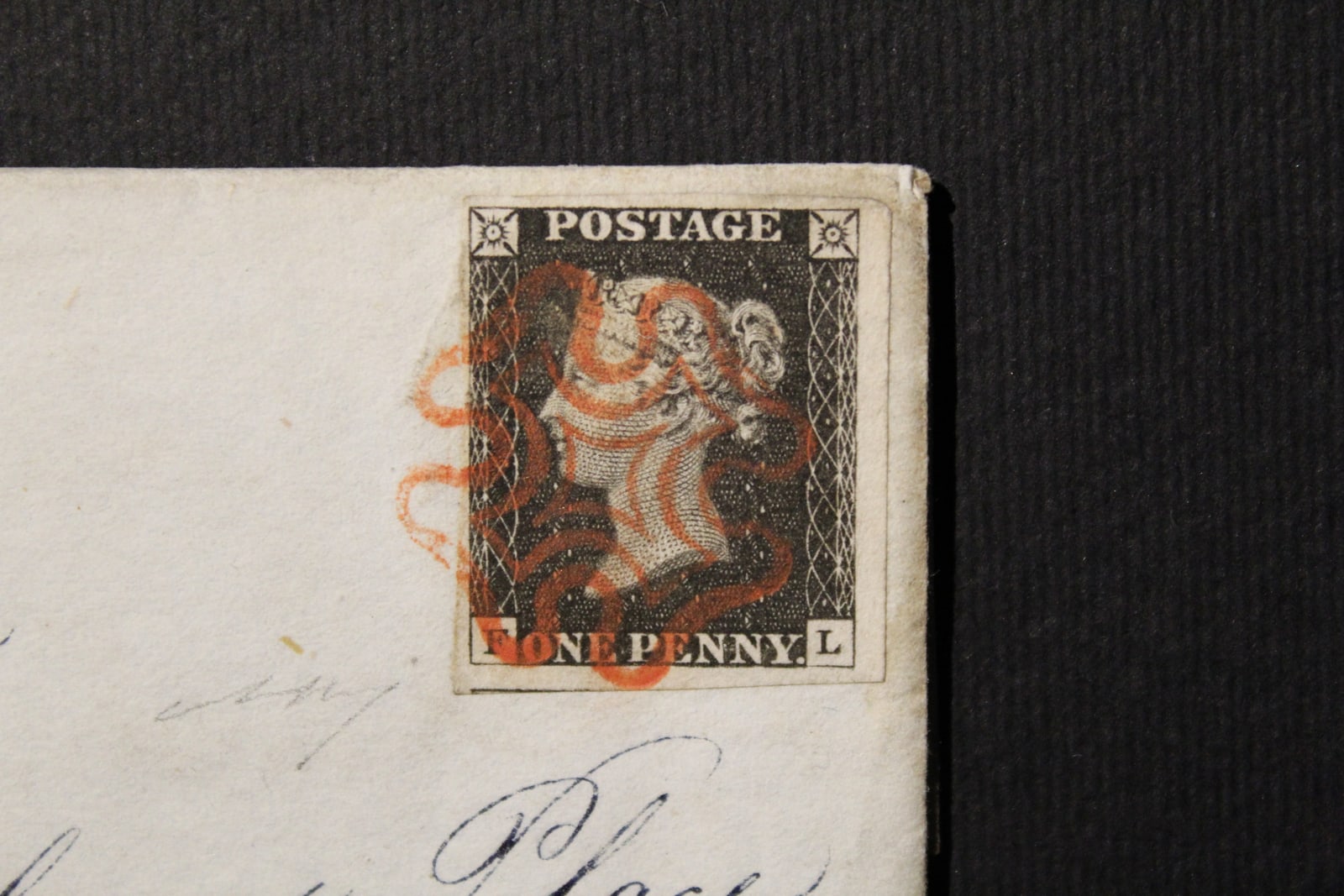
Britain’s penny post began on January 10, 1840. The Penny Black became valid for postage on May 6. That gap matters: the famous stamp arrived after the price reform it would come to represent. A prepaid letter weighing up to half an ounce could already travel for a penny. The little portrait of Victoria gave that payment a portable, recognizable form.[1]
What made the combination powerful? It changed the work surrounding a letter: calculating its charge, collecting the money, and proving that the charge had been settled. The reform joined a simpler tariff to a different sequence of transactions. To understand its success, follow those transactions from the writer’s desk to the recipient’s door.
The cost hidden inside the journey
Before reform, British postal charges varied with distance and the number of sheets. Payment usually fell to the recipient, while privileged correspondents could send letters free. Adding a sheet therefore meant adding a financial consequence at the other end.[1]
Rowland Hill attacked the logic behind those charges in his 1837 campaign. His later autobiographical account explains the crucial calculation: carrying an ordinary letter from London to Edinburgh cost, by his estimate, only one thirty-sixth of a penny. This was the transport component, not the entire cost of providing a postal service. Receiving, handling, delivering, and accounting still consumed resources.[3]
The distinction allowed Hill to question why distance should dominate the tariff. His calculation concerned mail carried together along an established route; it was no proof that every remote delivery cost the same. Indeed, he acknowledged the difficulty of places away from major routes. Read with that qualification, the argument was about designing a workable common charge around the postal system’s shared costs.[3]
Move the money to the beginning
Prepayment addressed another source of work. Collecting money on delivery required accounts that followed unpaid charges through the organization. Hill wanted to remove that machinery. He initially hoped to make prepayment compulsory, but accepted a choice: a cheaper prepaid letter or a more expensive unpaid one. His memoir presents simplification and protection against accounting error and fraud as connected objectives.[3]
Think of the difference for a correspondent arranging an ordinary exchange. A known price makes it easier to decide whether a short message is worth sending. Payment at dispatch settles the obligation before the letter arrives. These are complementary conveniences: a cheap rate attracts use, and a settled charge makes that use less troublesome. Neither requires a faster horse or a shorter road.
Give the payment a body
The museum photograph above preserves that relationship. A Penny Black sits on a folded letter dated June 28, 1840, held by the Museo dei Tasso e della Storia Postale in Italy. The handwriting, worn paper edge, and postal markings place the stamp inside an actual act of correspondence.[2]
An adhesive stamp let proof of payment travel with the letter. But it also needed to become unusable afterward. The original red Maltese Cross cancellation could be removed without sufficiently damaging the black stamp. Within a year, the stamp changed to red-brown and the cancellation to black.[1]
That small material problem exposes a large administrative requirement. A receipt that can be used again ceases to establish a fresh payment. Ink, paper, and cancellation therefore belonged to the same reform as the tariff. Cheap postage depended on making a paid letter easy to recognize and a spent stamp difficult to pass off as new.
More letters, less money
Parliament did not approach the reform as a guaranteed bargain for the Treasury. During the Commons debate of July 5, 1839, the government sought a pledge to make good a revenue shortfall. Robert Peel challenged the uncertainty: how much would be lost, when would Parliament have to act, and would further taxation follow? Those were substantial questions about financing a popular service.[4]
The early results explain their force. Joshua Leavitt’s 1848 pro-reform pamphlet reproduced estimates showing chargeable letters rising from roughly 76 million in 1839 to 169 million in 1840. Its reproduced parliamentary accounts also showed net revenue falling from about £1.63 million in the year ending January 5, 1840, to about £501,000 in the following year. These are the reported accounting periods, rather than two neatly aligned calendar years.[5]
Leavitt was campaigning for cheap postage in America; his enthusiasm needs to be read alongside his tables. The traffic figures count letters, not newly literate people or unique correspondents. They demonstrate much heavier use without measuring how equally the benefit was distributed. The revenue figures show that increased use did not immediately replace the income sacrificed through lower charges.[5]
Even the accounting boundary remained contested. In a May 16, 1845 Commons debate, Benjamin Hawes objected to charging the Post Office with packet-service expenses previously borne by the Admiralty. The Chancellor defended including the costs associated with collecting postal revenue. Comparisons of “profit” depended partly on which operations the account contained.[6]
The reform’s achievement is clearest when those measures stay separate. Britain made correspondence easier to buy and administer; the fiscal return followed a more difficult course. The surviving letter gives that institutional change a modest scale. Someone wrote an address, attached proof of payment, and sent a message whose recipient no longer had to settle that charge at the door.
Sources
- The Postal Museum, “The first ever stamp: the Penny Black” — collection history covering the January rate, May issue, and cancellation changes.
- Museo dei Tasso e della Storia Postale, photograph of a letter dated June 28, 1840, bearing a Penny Black — museum-contributed photograph on Wikimedia Commons, CC0.
- Rowland Hill and George Birkbeck Hill, The Life of Sir Rowland Hill and the History of Penny Postage, volume I (1880), pp. 248–252 and 314–316 — retrospective primary account of costs, uniformity, and prepayment.
- UK Parliament, Hansard, “The Budget—Postage Duties,” July 5, 1839 — debate over the revenue guarantee and Peel’s objections.
- Joshua Leavitt, Cheap Postage (1848), “Mr. Hume’s Table” and Appendix, table II — contemporary advocacy pamphlet reproducing letter estimates and parliamentary revenue returns.
- UK Parliament, Hansard, “Supply—Navy Estimates,” May 16, 1845 — dispute over packet-service costs and the definition of net postal revenue.