Lord Carnarvon died in Cairo on April 5, 1923. By the next day, a newspaper interview was circulating in which Arthur Conan Doyle suggested that an “evil elemental” might have caused his fatal illness.[5] That proximity gives the legend of Tutankhamun’s curse its cleanest shape: enter a king’s sealed room, fall sick, die.
The actual sequence is less supernatural and more revealing. A contemporary Nature obituary reported that an insect bite on Carnarvon’s cheek, presumed to be from a mosquito, led to erysipelas and blood poisoning; pneumonia followed.[12] His death was real, unexpected, and close enough to the opening of the burial chamber to invite a story. But one death cannot establish a curse. The legend grew through a repeatable method: widen the circle of supposed victims, vary the meaning of “exposed,” accept almost any cause or interval, and leave the survivors outside the frame.
That is why the best evidence against the curse is not a competing anecdote about Howard Carter living for years. It is a denominator. Once a fixed exposure rule is applied—even retrospectively, with imperfect records—and the living are counted beside the dead, the famous roll call of victims no longer yields a statistically discernible pattern.
The plot arrived after the stairway
The excavation archive gives the discovery a slower rhythm than the legend. Carter’s team uncovered the top step of a buried staircase on November 4, 1922. A sealed doorway appeared the next day. Carnarvon reached Luxor on November 23, and on November 26 Carter made a small breach in a second sealed doorway and looked by candlelight into the crowded antechamber.[1]
This was not yet one explosive moment called “opening the tomb.” Recording and clearing continued for years. Oxford’s excavation archive dates the opening of the sealed burial-chamber doorway to February 16, 1923.[1] It assigns the lifting of the sarcophagus lid to the 1923–1924 season, then places the lifting of the three coffin lids between October 13 and October 28, 1925, followed by the mummy’s unwrapping and examination from November 11 to November 20.[11][13] Different people attended different thresholds. Some worked at the site for years. Others witnessed one ceremony. Still others visited the valley without entering a newly opened space.
The curse story flattened those distinctions because it needed only two positions: inside and doomed. Carnarvon supplied the dramatic bridge. He had stood at the entrance in November and at the burial chamber in February; he died on April 5. Hawass’s account and the contemporary obituary trace his illness from an infected insect bite through erysipelas or blood poisoning to pneumonia.[4][12] Neither source needs a mysterious pathogen from the tomb to explain the death.
Nor did contemporary supernatural claims identify one. The Glasgow Herald’s April 6 report of Conan Doyle’s interview proposed an occult force, not a bacterium, gas, or fungus. The explanation was powerful precisely because it could not be tested against the excavation schedule: an elemental did not require a measurable dose, a consistent incubation period, or even direct contact with an object.[5]
The tomb did not have to supply the curse
In 1934, when another Egyptologist’s illness revived the headlines, Metropolitan Museum curator Herbert Winlock publicly attacked the legend. Time reported his claim that he had read every inscription in the tomb and found no threat against intruders. The same article counted 40 people who had seen the inner tomb or sarcophagus opened: six had died, each from an identified cause, while all ten men present when the mummy was unwrapped were still alive.[6]
Winlock’s count was a contemporary rebuttal, not a perfect modern dataset. It nevertheless exposed the legend’s basic asymmetry. A dead associate became a curse victim; a living witness generated no headline. A distant relative could be pulled into the story, while the many workers, officials, specialists, and visitors who continued living were treated as irrelevant.
The absence of a discovered death sentence did not leave reporters without language. Mummy curses already belonged to nineteenth-century fiction and rumor. The 2002 study points to Louisa May Alcott’s 1869 story “Lost in a Pyramid; or, The Mummy’s Curse.” Roger Luckhurst’s history pushes the genealogy beyond a single tale, tracing earlier Victorian stories about collectors supposedly punished by Egyptian objects.[2][3] Tutankhamun’s tomb did not originate the plot. It gave an old plot a new setting and cast.
That distinction matters. Ancient Egyptian funerary practice did include protective gods, ritual objects, and invocations intended to secure the king’s afterlife; the Metropolitan Museum’s account describes such material in the burial chamber and treasury.[8] Turning those practices into a literal death threat against intruders is an act of reception, not a translation of one clear inscription from KV62.
Restricted news made rumor more valuable
One explanation treats the curse as a press retaliation. Carnarvon granted The Times privileged access to excavation news, leaving rival reporters with fewer fresh facts from inside the tomb. Hawass argues that this restriction helped produce the flood of curse stories after Carnarvon’s death.[4] The mechanism is plausible: if one newspaper controls the next object and chamber, competitors can still own omens, prophecies, illnesses, and funerals.
But access alone is not a complete explanation. Newspapers could amplify the curse because readers already recognized mummy fiction, spiritualism, and tales of dangerous antiquities. Conan Doyle did not sound like a reporter inventing a theme from nothing; he connected Carnarvon to a supernatural vocabulary he already endorsed. The strongest interpretation therefore joins two causes. Restricted archaeological news increased the commercial value of an alternative story, while older Gothic and occult traditions supplied its ready-made form.[3][4][5]
There is a further historical irony. The discovery unfolded amid arguments over foreign control, Egyptian authority, access to antiquities, and who could narrate the tomb.[10] Yet the curse displaced those modern conflicts with a fantasy in which ancient Egypt itself punished intrusion. That reading is an inference, not something an inscription states. It helps explain the legend’s durability: the story could register discomfort about possession and disturbance without requiring readers to follow permits, press contracts, conservation work, or Egyptian political claims.
The denominator changes the verdict
In 2002, epidemiologist Mark Nelson turned the legend into a retrospective cohort study. The paper is playful, but its central move is clarifying: apply one exposure rule consistently across the surviving records. Nelson used Carter’s writings to identify 44 Westerners present in Egypt at relevant times. Twenty-five were classed as potentially exposed because they attended at least one of four openings or examinations that Nelson dated between February 17, 1923, and November 11, 1926.[2]
There is an important problem inside that classification. Nelson’s last three operational dates fall in 1926, while the current Oxford archive assigns the sarcophagus lid to the 1923–1924 season and the coffin opening and examination of the mummy to October and November 1925.[2][11][13] The discrepancy does not create evidence for a curse. It can, however, change who belongs in a very small exposed or comparison group, so it weakens any categorical conclusion drawn from the reconstruction.
The exposed group’s mean age at death was 70, compared with 75 among unexposed people for whom death dates were found; the difference was not statistically significant. Mean survival after potential exposure was 20.8 years for the exposed group and 28.9 years for the comparison group, also with no significant difference. After adjustment for age and sex, exposure was not significantly associated with death within ten years, and additional supposed exposures produced no dose-response pattern.[2]
Those results do not prove that no imaginable supernatural force exists. They show that this reconstruction did not recover the pattern the legend predicts. If entering newly opened spaces triggered premature death, one would expect the people most directly exposed to die sooner or more often than a defined comparison group. The study detected no such association.[2]
The study also states its limits. Documentation favored prominent Western participants and excluded Egyptian workers, whose life records and baseline conditions differed. Death dates were complete for all 25 exposed people but for only 11 of 19 unexposed people. The sample was small, the confidence interval around early death was wide, and the boundary of “exposure” had to be imposed retrospectively.[2] A careful verdict is therefore narrower than a joke about statistics defeating magic: the available cohort contains no mortality signal that supports the curse, and its weaknesses do not rescue the sensational victim lists.
What the victim list leaves out
The curse survives by refusing the discipline that the cohort imposed. It has no stable population, no consistent exposure event, no fixed waiting period, and no agreed cause of death. That flexibility lets every new obituary confirm it. A curse that can kill by infection, stroke, suicide, accident, or ordinary late-life disease—and can wait months or decades—cannot be falsified. It is a story that cannot lose on its own terms.
Howard Carter remained alive when Winlock made his 1934 rebuttal and died on March 2, 1939, more than sixteen years after the first breach.[6][7] His longevity is not decisive by itself; one survivor no more disproves a curse than one death proves it. It matters because popular retellings so often make Carnarvon representative and Carter exceptional. The defined cohort reverses that habit: neither man gets to stand in for everyone.
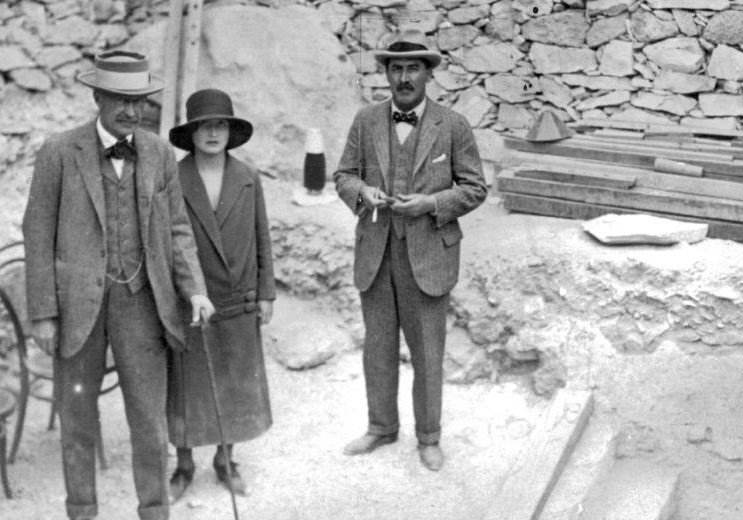
The archival photograph at the top of this article offers a better way to remember the threshold. The Commons record identifies the scene as Carter, Carnarvon, and Lady Evelyn beside the excavated steps in November 1922, photographed by Burton.[9] It records a specific place, group, and moment—not a cloud of undifferentiated victims. Burton would go on to help create roughly 1,400 glass-plate negatives documenting a ten-year effort to record more than 5,000 objects.[8] That patient archive is the opposite of the curse list. It preserves context instead of stripping it away.
Tutankhamun’s curse was not discovered in the tomb. It was assembled outside it from selected deaths and omitted survivors. Its most dangerous adversary was never another anecdote. It was a defined, if incomplete, comparison group that counted the living too.
Sources
- Tutankhamun Spatial Archive, “1st Season (1922–1923)” — excavation chronology from the discovery of the stairway through the burial-chamber opening and Carnarvon’s death, linked to Carter’s archaeological journal.
- Mark R. Nelson, “The mummy’s curse: historical cohort study,” BMJ 325 (2002) — exposure definition, 44-person cohort, survival results, medical account of Carnarvon’s death, and study limitations.
- Roger Luckhurst, “The mummy’s curse: a study in rumour,” Critical Quarterly 52, no. 3 (2010) — scholarly history of curse narratives that circulated before Tutankhamun’s tomb was opened.
- Zahi Hawass, “The Curse of Tutankhamun,” in Discovering Tutankhamun: From Howard Carter to DNA, American University in Cairo Press, 2025 — Carnarvon’s illness and the effect of The Times access agreement on rival press coverage.
- The Glasgow Herald, “An Evil Elemental,” April 6, 1923 — contemporary report of Arthur Conan Doyle’s supernatural explanation for Carnarvon’s death, transcribed with the original page image.
- Time, “A Curse on a Curse,” February 5, 1934 — contemporary account of Herbert Winlock’s inscription check, witness count, survivor count, and response to renewed curse reporting.
- Tutankhamun Spatial Archive, “Howard Carter” — institutional biographical record of Carter’s excavation work, archive, and death in 1939.
- The Metropolitan Museum of Art, “Discovering Tutankhamun: The Photographs of Harry Burton” — excavation scale, Burton’s ten-year photographic record, and the protective objects and invocations documented in the tomb.
- Wikimedia Commons, “Howard Carter, Lord Carnarvon and Lady Evelyn Herbert at Tutankhamen’s tomb” — source page for Harry Burton’s November 1922 archival photograph used as the article image.
- Christina Riggs, “How 20th-century colonial politics shaped the story of Tutankhamun’s tomb,” The British Academy — Egyptian sovereignty, the foreign press agreement, antiquities administration, and disputes over control of the excavation narrative.
- Tutankhamun Spatial Archive, “4th Season (1925–1926)” — Carter’s journal-based chronology for opening the three coffins and unwrapping and examining Tutankhamun’s mummy in October–November 1925.
- Nature, “Lord Carnarvon,” April 14, 1923 — contemporary obituary identifying his April 5 death and the sequence from a presumed insect bite through erysipelas, blood poisoning, and pneumonia.
- Tutankhamun Spatial Archive, “2nd Season (1923–1924)” — archive chronology assigning the lifting of Tutankhamun’s sarcophagus lid to the second excavation season.