

Before the dial, an ordinary telephone call began with another person. A subscriber lifted the receiver, reached an operator, named a destination, and waited while cords and switches made a path through the exchange. The operator did more than join two wires. She received the request, interpreted it, selected a route, reported whether the line was busy, and helped when the request did not fit the routine.
Dial service did not hand that whole job to one machine. It broke the job apart. The caller looked up the number and entered a sequence. Audible tones announced when to begin and what had happened. Electromechanical equipment translated pulses into a physical circuit. Technicians kept the selectors adjusted, while operators remained at the edges for toll calls, information, billing, intercept, emergencies, and other exceptions.[5][6][8]
Three Bell System films make that division unusually visible. A 1936 theatrical short teaches the public to hear and obey the new interface. A 1951 employee film opens the exchange and follows the machinery that responds to a dial. A circa-1954 customer film turns correct dialing into a small domestic discipline.[1][2][3][7] None is a neutral survey of American telephony: they are corporate instruction and promotion. Watched together, however, they show that “automatic” meant a new allocation of work, not worklessness.
1936: the cutover begins in the caller's ear
AT&T's Introduction to the Dial Telephone is only about a minute and a half long. The company used shorts of this kind in local cinemas shortly before an exchange changed to dial service.[1] The format suits the event. A cutover could be abrupt for one community even though the Bell System's national conversion lasted decades: at a set hour, old numbers and familiar habits stopped completing routine calls.
The film therefore concentrates on a compact sequence—lift, listen, dial, interpret. It assumes no prior fluency. Even the sounds that later generations treated as telephone nature have to be introduced as signs with distinct meanings.
The decisive object in this film is not really the rotary dial. It is the feedback loop between hand and ear. The subscriber must wait for dial tone before moving a finger. After entering the number, the subscriber must distinguish ringing from busy. A wrong movement no longer produces an operator's question; it produces a failed or misdirected sequence that the caller must recognize and restart.[1]
Bell Laboratories described the same redesign from inside the system in April 1931. Its engineering magazine explained that tones were replacing pieces of verbal information: dial tone took the place of an operator's opening prompt, while ringing, busy, and trouble tones reported successive states of a call.[5] That is a stronger historical description than saying the operator was simply “replaced by the dial.” The dial entered digits. The tones managed turn-taking and status. The subscriber performed both interpretation and recovery.
The one-minute lesson also reveals how much education hid behind a supposedly intuitive device. When dial phones reached the U.S. Senate in 1930, officials distributed instructions and staged demonstrations. Senator Carter Glass objected that dialing converted senators into unpaid telephone-company employees; others liked the privacy and speed.[4] His complaint was theatrical, but analytically exact. Self-service saved a trip through the local operator by making the customer responsible for a standardized portion of her former work.
1951: a finger pulse becomes movement in the exchange
The first film stays at the telephone set. The Step-By-Step Switch, made in 1951 for Bell System employees, goes behind the wall. It uses a demonstration unit to show a call moving through a step-by-step office and stresses the maintenance practices required to keep that movement dependable.[2]
This is an important change of audience. The public short promises ease; the employee film displays mechanism. Its racks, contacts, shafts, and relays make “automatic” look less like absence than like dense, coordinated motion.
In a step-by-step system, the returning rotary dial sends a train of electrical pulses for each digit. Those pulses directly advance switching contacts through successive stages until the exchange has selected the called line. The caller's finger is not merely entering information for later computation; through pulses, it is issuing a sequence of physical instructions to distant equipment.[2][6]
That directness is historically specific. “Dial telephone” did not name one universal machine. Bell also used panel and, later, crossbar systems whose control logic registered or translated digits differently. The company's first step-by-step exchange entered service at Norfolk in 1919; panel switching followed at Omaha in 1921 and New York in 1922; crossbar entered Bell service in 1938.[6] The 1951 film is therefore best read as a close view of one durable switching family, not a blueprint for every dial call in the country.
What it adds to the collection is the missing third worker: the switch. The 1936 customer hears a dial tone and moves a finger. Here, selectors respond, contacts close, and a circuit is held for conversation. Yet the repeated emphasis on maintenance prevents an easy fantasy of autonomous machinery. The routine connection no longer needs an operator at a cord board, but the exchange still depends on people who install, test, clean, adjust, diagnose, and repair thousands of moving parts.[2]
The film's date also sits at a second boundary. In 1951, a customer in Englewood, New Jersey, placed the first U.S. customer-dialed long-distance call to Alameda, California, using a Number 5 crossbar system—not the step-by-step equipment shown here.[6] Local dialing, machine switching, operator toll dialing, and customer long-distance dialing overlapped. Automation advanced by services and exchanges, not by one national flip of a switch.
Circa 1954: the household learns a protocol
The Smithsonian's AT&T/Bell Film Collection catalogues Now You Can Dial as a circa-1954 color promotional film by Charles E. Skinner Productions. Its stated subject is the transfer from operator dialing to personal home dialing, including the extra rules of party-line service.[7] AT&T's archival upload describes its purpose even more plainly: reduce customer dialing errors by demonstrating correct technique.[3]
The result is slower and more intimate than the 1936 short. Model Susann Shaw faces the camera and rehearses an action that the film wants to become unconscious. Correct use has to be staged before it can look natural.
The lesson separates dialing into rules: verify the number, wait for the tone, keep the number in view, pull each digit to the finger stop, let the dial return, distinguish the letter O from zero, and learn what ringing and busy sound like.[3] Each rule marks a task or judgment that the new arrangement has assigned to the subscriber. Accuracy begins in the directory rather than at the switchboard. Timing is governed by tone. Address entry becomes manual. Error prevention becomes a household obligation.
This is why the demonstrator's calm pace matters. The film does not simply explain an object; it trains a compatible user. The subscriber must behave in ways the exchange can parse: wait rather than speak, send complete digits at the mechanism's tempo, and treat standardized sounds as authoritative reports. A familiar human negotiation has been converted into a protocol.
The film also sets a boundary on the article's claim. Party lines, assistance, and non-routine calls complicate the clean self-service story. A 1968 U.S. Bureau of Labor Statistics study found that local calls automated first while operators continued to handle long distance, information, intercept, person-to-person, collect, and special services. It counted roughly 200,000 telephone operators still working in 1967, most in toll or information roles.[8] Routine local switching had moved; operator labor had not vanished.
What disappeared, what moved, and who absorbed the shock
Placed in order, the films form a delegation chart. The 1936 short gives the caller a vocabulary of signals. The 1951 employee film gives dial pulses a machine that can act on them. The circa-1954 film gives the household a code of correct conduct. Together they show four linked reallocations: destination lookup and entry move to the subscriber; call-state reporting moves into tones; circuit selection moves into switching equipment; upkeep moves into a less visible technical workforce.
The archive's corporate viewpoint makes this distribution look frictionless. It is not evidence that users learned instantly, that every exchange worked alike, or that the displaced job was trivial. Telephone operation had become one of the most common occupations for young American women. Between 1920 and 1940, mechanical switching spread across more than half of the U.S. network and removed most of the affected local operator positions.[9]
The labor-market result resists two simple endings. James Feigenbaum and Daniel Gross find that later cohorts of young women did not suffer a net employment decline because clerical and service work expanded. Incumbent operators faced the sharper cost: years later, they were more likely to be in lower-paying work or outside employment.[9] Automation did not destroy one fixed quantity of women's work, but neither was the transition painless. New entrants could route around the disappearing occupation more easily than workers already trained and employed inside it.
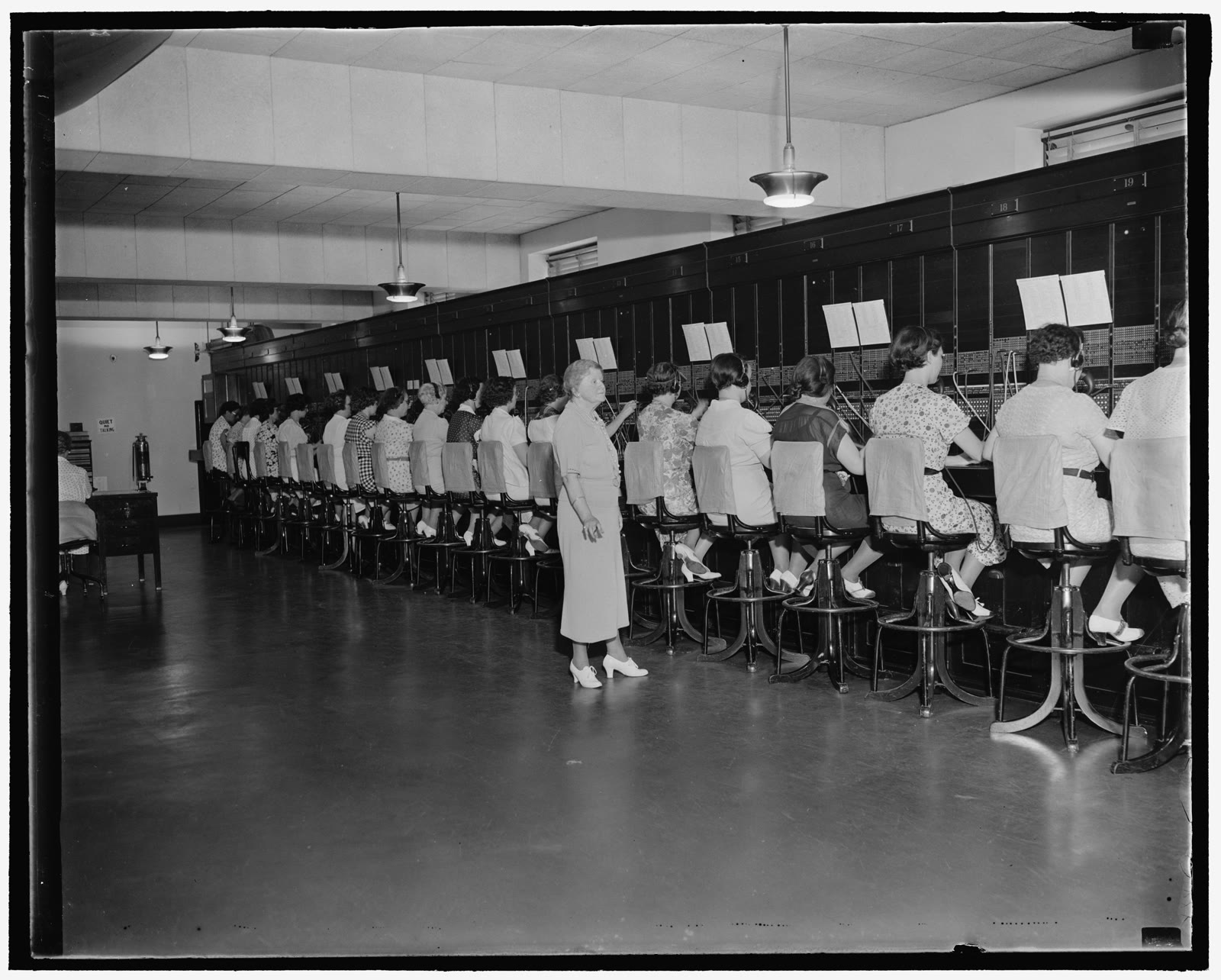
That distinction returns us to the photograph above. In July 1937, Harriott Daley supervised the U.S. Capitol's manual switchboard staff serving 1,200 extensions, seven years after senators' offices received dial telephones.[4][10] The image is not an anachronism. It is evidence of a layered network in which automatic local service, institutional boards, operators, and newer switching systems coexisted.
The three films are most revealing when their central boast is taken seriously but not literally. Dialing did make routine calls faster, more private, and less dependent on a local operator. It accomplished that change by converting one conversational service into a chain of standardized acts distributed across a person, a signal system, and a machine. The operator did not simply disappear into the switch. Her job was decomposed—and its pieces became so ordinary that later callers could mistake learned work for the natural behavior of a telephone.
Sources
- AT&T Tech Channel, “AT&T Archives: Introduction to the Dial Telephone” — official upload of the 1936 theatrical customer-instruction short.
- AT&T Tech Channel, “AT&T Archives: The Step-By-Step Switch” — official upload of the 1951 Bell System employee-training film.
- AT&T Tech Channel, “AT&T Archives: Now You Can Dial” — official upload of the circa-1954 customer-training film.
- U.S. Senate Historical Office, “Senators Balk at Dial Telephones” — institutional history of the Capitol's 1930 dial conversion, subscriber instruction, resistance, and continuing switchboard staff.
- P. Husta, “Saying It With Tones,” Bell Laboratories Record 9, no. 8 (April 1931), pp. 385–386 — contemporary Bell explanation of tones replacing verbal call-state information.
- Sheldon Hochheiser, “Electromechanical Telephone-Switching,” Engineering and Technology History Wiki — reviewed technical history of manual exchanges, step-by-step, panel, crossbar, and direct-distance dialing.
- Smithsonian National Museum of American History, AT&T/Bell Film Collection finding aid, Series 1: Promotional Films — catalogue record for Now You Can Dial, its circa-1954 date, format, producer, and scope.
- U.S. Bureau of Labor Statistics, Manpower Planning for Technological Change: Case Studies of Telephone Operators, Bulletin 1574 (1968) — service-by-service automation sequence and the operator workforce that remained.
- James Feigenbaum and Daniel P. Gross, “Answering the Call of Automation: How the Labor Market Adjusted to Mechanizing Telephone Operation,” Quarterly Journal of Economics 139, no. 3 (2024), pp. 1879–1939 — network diffusion and cohort-level employment effects.
- Harris & Ewing, “First Capitol telephone operator still on job” (July 30, 1937), Library of Congress, LC-DIG-hec-23122 — catalogue record and scan for the archival photograph used as the article image.