Greenwood is often introduced through one famous phrase, "Black Wall Street," and one terrible date, May 31-June 1, 1921. A white mob attacked Tulsa's Black district, destroyed homes and businesses, killed large numbers of residents, and left the neighborhood in ruins.[1][3][4] But the harder historical question begins after the smoke. Why did this event have to be remembered so strenuously in the first place?
The answer is that Tulsa's massacre did not pass directly into stable public memory. Silence was part of its aftermath. Records survived, survivors spoke, and Greenwood rebuilt, yet the event was long misnamed, under-taught, and pushed to the margins of mainstream civic history.[3][4] Greenwood therefore endured first as testimony, photographs, relief paperwork, family memory, and community teaching. Only later did commissions, museums, collections, and memorial institutions convert that memory into a more durable public archive.[1][5][6][7]
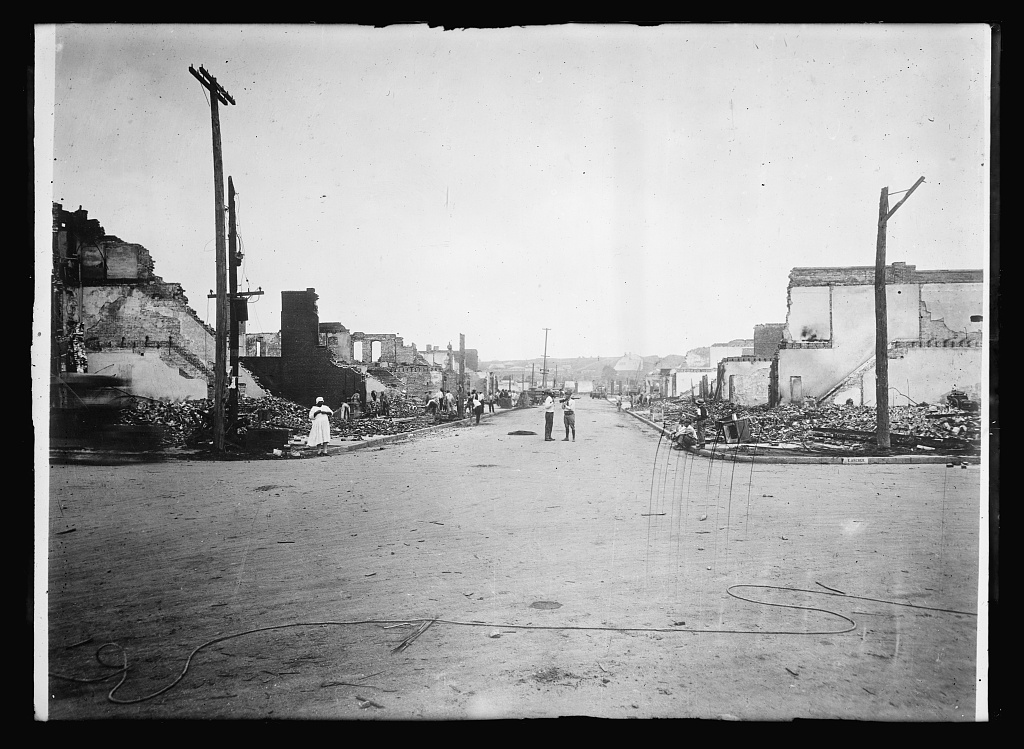
The cover image shows African American residents among the ruins of Greenwood in June 1921.[9] It is the right image for this article because memory in Tulsa began with a visual problem as much as a political one. The destruction was photographed, cataloged, and impossible to deny in material form, yet the meaning of those images still had to be fought over across decades.[4][7][9]
Timeline anchors
- May 31-June 1, 1921: white mobs, aided by public officials and armed white deputies, destroy much of Greenwood; hundreds are believed to have died, and thousands were displaced.[2][3]
- December 31, 1921: Red Cross relief operations in Greenwood end after months of housing, aid, and documentation work.[4]
- 1997: the Oklahoma Legislature creates the Tulsa Race Riot Commission to investigate the event formally.[1]
- February 21-28, 2001: the commission submits and publishes its final report, recommending reparations, a scholarship fund, an enterprise zone, and a memorial tied to any human remains recovered from mass graves.[1][2]
- 2021: the centennial year sharpens public teaching and brings Greenwood Rising into the city's commemorative landscape as a narrative-centered history institution.[6]
- 2024: the first positive identification from the mass-burial investigation, World War I veteran C. L. Daniel, shows that commemoration in Tulsa is still producing new historical evidence rather than merely repeating ceremony.[8]
These dates matter because they show remembrance moving in stages. First came destruction and relief. Much later came official investigation. Later still came a civic language broad enough to join evidence, survivor memory, museum work, and graves research into one public history.
The silence was not an accident after the event; it was part of the event's afterlife
The Oklahoma Historical Society and Tulsa Historical Society both make clear that the massacre's factual outline was substantial from the start: white violence devastated around 35 blocks, municipal and county authorities failed to stop it, Black residents were interned, and the scale of death likely ran far beyond the earliest public count.[1][3] Yet factual existence and public remembrance are not the same thing. National Archives staff noted during the centennial that the massacre had been widely reported in 1921, but for decades it was rarely mentioned publicly in Tulsa and was omitted from many mainstream textbooks and curricula.[4]
That long suppression helps explain why naming matters so much in Tulsa. The Tulsa Historical Society records the later debate over "race riot" versus "race massacre," noting that the older term was embedded in the event's historical handling and in the way responsibility was blurred.[3] The broader shift toward "massacre" was therefore not only semantic cleanup. It was part of reclaiming agency over what the historical record was understood to describe: not mutual disorder, but organized white destruction of a Black community with official participation and official failure mixed in.[2][3]
In this sense, forgetting in Tulsa did not look like total erasure. It looked like distortion, euphemism, and compartmentalization. Enough material remained to prove what had happened, but not enough civic will existed to give that proof continuous public force.
Photographs and relief records kept the massacre materially legible
That is why the visual archive matters so much. The National Archives' Red Cross essay describes a photo album and report documenting destruction, relief, and partial recovery in Greenwood, and it emphasizes that the material offers both evidence of devastation and evidence that people endured it.[4] By December 31, 1921, the Red Cross had provided some form of relief to 2,480 families, helped rebuild more than 700 semi-permanent buildings and homes, and still counted families living in tent-houses.[4] These details matter because they place memory on administrative ground. Greenwood was not just remembered through grief; it was documented through counts, claims, housing, correspondence, and photographs.
The Library of Congress image used here sharpens that point.[9] Black residents stand among wrecked houses and scattered belongings. The scene is intimate, not panoramic. It does not simply say that a district burned. It shows people standing inside the aftermath, forcing the eye to treat the massacre as inhabited destruction rather than abstract damage.[9] The Red Cross and related image archives thus became a strange kind of anti-silence: records produced within relief and observation later turned into proof against the city's own habits of forgetting.[4][9]
NMAAHC's Tulsa collections make the same argument in a broader register. The museum says it gathers objects to fill the silences in national memory and notes that photo postcards of the massacre, originally distributed as declarations of white power, later became evidence used by community members seeking truth and justice.[7] That reversal is one of Tulsa's central memory mechanisms. Material once made inside humiliation and racial domination was eventually repurposed into an archive of accusation.
Community institutions carried the story when formal public memory was thin
Material evidence alone does not teach itself. Institutions do that work. The Greenwood Cultural Center's mission and resources pages show a community-based effort organized around preservation, education, survivor stories, oral-history materials, and historical recordings.[5] The language is revealing: Greenwood's history and people were systemically marginalized, and an institution was needed to make sure that marginalization did not continue through historical loss.[5]
That sentence captures something essential. Greenwood memory survived not only because evidence existed, but because people built places where descendants, teachers, students, and visitors could encounter that evidence in a shaped form. Oral history matters especially here. The massacre is close enough to modern media to have left photographs, but far enough back that survivor testimony became a perishable civic resource. A community institution that records, teaches, and curates those voices is not decorative. It is part of the historical record's survival system.[5]
NMAAHC extends that logic to the national level. Its Tulsa portal says the museum centers survivors' and descendants' testimonies, preserves fragments that illuminate fuller lives, and connects Tulsa to a broader history of racial violence and repair in the United States.[7] That shift of scale matters. Greenwood ceased to be only a local wound once it entered museum, archival, and educational systems that treated it as part of American historical structure rather than as an Oklahoma anomaly.
The commission and the centennial did not create memory from nothing; they changed its operating scale
By the time Oklahoma created the commission in 1997, community memory and documentary evidence already existed.[1][5] What the commission changed was status. The Oklahoma Historical Society explains that the state-authorized body spent roughly three and a half years gathering photographs, interviews, death certificates, court cases, and other records before issuing its final report in 2001.[1] The report itself went further than symbolic acknowledgment. It recommended direct reparations to survivors, reparations to descendants, a scholarship fund, an economic development enterprise zone in historic Greenwood, and a memorial connected to any human remains found in the search for mass graves.[2]
This is the moment when commemoration moved from sorrow to public policy. The report treated memory as something that could require restitution, land-based repair, educational infrastructure, and burial dignity.[2] It also made explicit that what had happened in 1921 was not only mob violence in a narrow sense, but violence institutionalized and tolerated across levels of government.[2] Once that claim entered an official report, Tulsa memory acquired a different kind of leverage.
The centennial year in 2021 changed the public atmosphere again. Greenwood Rising describes itself as a narrative-centered history institution opened in 2021 to tell the story of Greenwood in a holistic way, remember victims and survivors, and connect massacre history to continuing racial challenges.[6] Its exhibitions join Greenwood's economic rise, the massacre, and the community's later struggles under one interpretive roof.[6] That matters because a centennial museum is not only a marker of remembrance. It is a claim that this history belongs in ongoing public visitation, pedagogy, and civic argument.
The graves investigation shows Tulsa memory still moving from symbol toward accountability
The newest turn is not a new monument but new evidence. Tulsa Historical Society notes the mass-graves investigation launched in response to longstanding oral histories.[3] The National Archives reported in November 2024 that research tied to the burial investigation produced the first positive identification, that of C. L. Daniel, a World War I veteran whose death had been recorded in connection with the 1921 violence.[8]
This matters because it shows commemoration doing more than repeating a settled lesson. Tulsa memory still has an evidentiary frontier. Oral tradition prompted investigation; archival work helped narrow identities; forensic research gave one of the dead a name.[3][8] That movement from story to document to identified person is the opposite of civic pageantry emptied of historical content. It is remembrance generating fresh historical knowledge.
What Greenwood's memory history really shows
The most useful way to read Tulsa now is to keep two histories in frame at once. One is the event history of 1921: armed white destruction, official complicity, relief, rebuilding, and denied justice.[2][3][4] The other is the memory history that followed: euphemism, silence, family testimony, community institutions, a state commission, museum work, and graves research.[1][5][6][7][8]
Greenwood survived first as testimony, then as institution. That is why the memory story matters so much. If the massacre had passed smoothly into accepted public history, Tulsa would not need such a long chain of commissions, collections, educational centers, and renewed burial inquiry. The chain exists because forgetting had structure, and remembrance had to build one in return.
Sources
- Oklahoma Historical Society, "Tulsa Race Massacre" - official overview of the commission's creation, the 2001 report, and the archival collection built around the event.
- Oklahoma Commission to Study the Tulsa Race Riot of 1921, Tulsa Race Riot: A Report by the Oklahoma Commission to Study the Tulsa Race Riot of 1921 (2001 PDF) - official report with findings, reparations recommendations, and memorial recommendations tied to mass graves.
- Tulsa Historical Society & Museum, "1921 Tulsa Race Massacre" - local institutional history of the massacre, naming debate, Red Cross relief, commission findings, and ongoing graves investigation.
- National Archives, "The Responsibility is Placed in Your Hands Entirely: Red Cross Relief after the Tulsa Race Massacre" - on the 1921 Red Cross photo album, relief records, rebuilding counts, and the archive's role in keeping evidence visible.
- Greenwood Cultural Center, "Resources" - official community educational portal with survivor stories, oral-history materials, historical recordings, and teaching resources built around Greenwood and the massacre.
- Greenwood Rising, "About" - official statement of the 2021 history center's mission to remember victims and survivors and place Greenwood's history in an ongoing public narrative.
- National Museum of African American History and Culture, "Tulsa Objects in the NMAAHC Collection" - museum portal on filling the silences in national memory through Tulsa objects, photographs, survivor testimony, and reparations-era collections.
- National Archives, "National Archives Aids in Tulsa Riot Mass Burial Identification" - official account of the 2024 identification of C. L. Daniel during the ongoing graves investigation.
- Library of Congress, "After the race riots June 1st, 1921, Tulsa, Okla." - source page for the archival photograph used as this article's image.