Sputnik did not become historically decisive in the United States only because the Soviet Union launched first on October 4, 1957. It became decisive because the launch moved through several public forms faster than Washington could stabilize the meaning. It began as an International Geophysical Year satellite project, arrived in American ears as a radio beep and in American headlines as proof of Soviet technical reach, then widened into a debate about missiles, education, federal organization, and national prestige.[1][2][3]
That sequence matters because it corrects an easy simplification. Americans did not wake up one morning, panic in a single burst, and then serenely build NASA. The crisis had stages. Scientists first understood the technical and symbolic weight of the launch. The broader public then absorbed it as a Cold War humiliation. Congress turned that humiliation into hearings. The Vanguard TV-3 explosion made the anxiety visible. Explorer 1 restored some confidence, but the deeper institutional answer was not one rocket. It was a new administrative structure for space itself.[2][3][4]
In that sense, Sputnik is best read as an event whose importance grew by transmission. The Soviet satellite was physically small, but it crossed too many American fault lines at once: the fear of missile inferiority, the prestige logic of the Cold War, the rivalry between military and civilian programs, and the question of whether the federal government had organized science seriously enough for the new age.[1][2][4][5]
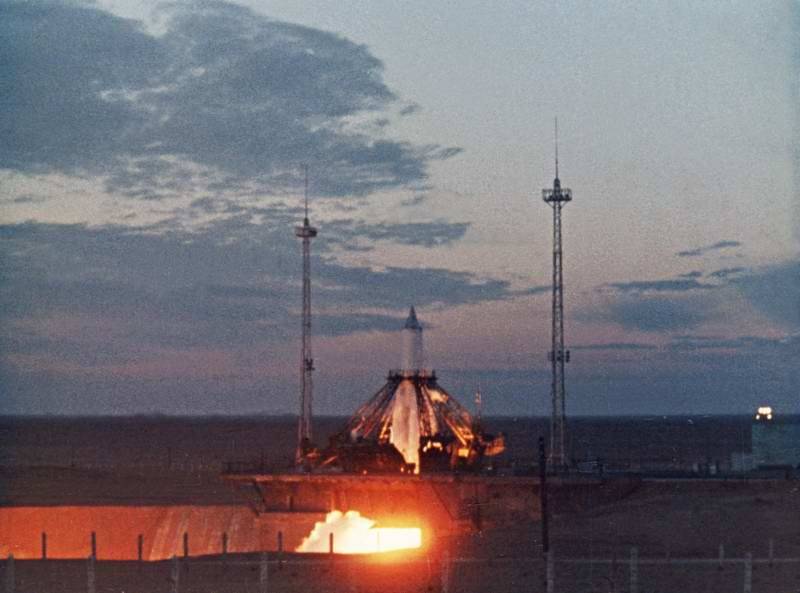
Image context: the lead image is NASA's archival launch photograph of Sputnik rising from Baikonur on October 4, 1957.[3] It belongs here because this article is about sequence under pressure. The launch was visible proof before it was settled policy, and that is why the picture works better than a polished museum model. The event first entered history as light, motion, and timing.
Timeline anchors
- 1952: the International Council of Scientific Unions begins planning the International Geophysical Year, which later includes a resolution encouraging satellite launches for scientific work.[2][3]
- October 4, 1957: the Soviet Union launches Sputnik 1, the first artificial Earth satellite.[1][2][3][5]
- November 3, 1957: Sputnik 2 follows with Laika aboard, intensifying the sense that Soviet capability is widening rather than pausing.[1][2][4]
- November 25, 1957: Lyndon B. Johnson's Senate subcommittee opens hearings on the U.S. response to the satellite and missile problem.[4]
- December 6, 1957: Vanguard TV-3 explodes on the launch pad in front of the world press.[2][4]
- January 31, 1958: Explorer 1 reaches orbit and gives the United States its first successful satellite launch.[2][3]
- July 29, 1958: Eisenhower signs the National Aeronautics and Space Act.[3][4]
- October 1, 1958: NASA opens for business as the civilian organization meant to coordinate the American space effort.[3][4]
These dates show why Sputnik has to be reconstructed as a chain rather than a single shock. The launch, the public reaction, the congressional inquiry, the failed American reply, the successful American reply, and the bureaucratic reorganization all happened within one compressed year.
1) The launch was scientific in form, but political in effect from the first night
The satellite that rose on October 4, 1957 was not large by later standards. The Office of the Historian's milestone page describes Sputnik 1 as the first orbiting artificial satellite, weighing 184 pounds and circling the Earth roughly every ninety minutes.[1] A related Foreign Relations editorial note adds the detail that it weighed about eight times as much as the proposed U.S. satellite and that U.S. Navy tracking stations picked up its radio signals within moments of orbit.[5] Those facts mattered because they made the event legible in two registers at once. Scientists could read an engineering achievement. Politicians and newspapers could read a capability gap.
Roger Launius's NASA history sharpens the first-night atmosphere. He reconstructs the scene at the Soviet Embassy in Washington, where International Geophysical Year participants were still moving through receptions and scientific conversation when the TASS announcement arrived.[2] That location is historically revealing. Sputnik did not emerge from a war room in the American imagination; it erupted inside a scientific international setting already shaped by Cold War mistrust. That is part of why the reaction was so electric. The Americans present knew the launch belonged to the IGY framework, yet they also knew that the rocket able to place a satellite in orbit sat uncomfortably close to the logic of long-range missile delivery.[1][2][5]
The satellite's very simplicity intensified the effect. NASA's later overview notes that Sputnik itself carried no elaborate scientific instrument package, only a transmitter that sent a "beep-beep" signal that radio operators could monitor around the world.[3] Launius makes the same point more sharply: by hardware alone, it was a small aluminum sphere with whip antennas.[2] But historical importance does not always correlate with physical complexity. Because the signal could be heard, the launch escaped the abstraction that often protects technical achievements from mass political consequence. Sputnik entered public life as something distant yet audible, scientific yet humiliatingly concrete.[2][3]
2) The crisis widened when Americans treated orbit as proof of strategic lag
The public and political force of Sputnik came less from the satellite alone than from what Americans inferred from the rocket beneath it. The State Department's history is explicit on this point: the Soviet success fed fears that the United States had fallen behind in new technology, intensified the arms race, and strengthened anxieties about missile superiority.[1] In Cold War logic, an orbiting sphere and an intercontinental ballistic missile were not the same thing, but they rhymed strongly enough to produce alarm. If the Soviets could do this first, many Americans asked, what else had they already solved?[1][2]
Launius describes the mood in language close to national disorientation. He writes that the launch had a "Pearl Harbor" effect on public opinion and pushed Americans into a pre-Sputnik and post-Sputnik sense of time.[2] That phrasing matters because it captures the scale of the psychological jump. Sputnik was not experienced as one more data point in a long technical competition. It was experienced as a rupture in American self-understanding. A country that treated itself as the natural technological leader of the modern world now had to watch another state seize the symbolically pure first in the new domain of space.[2]
The second Soviet launch made recovery harder. On November 3, 1957, less than a month later, the Soviet Union put Sputnik 2 into orbit with Laika aboard.[1][2][4] The rapid follow-on mattered because it suggested momentum. One success can be dismissed as contingency. Two successes in a month look like a program. By late autumn the American question had shifted. The issue was no longer only why the United States had lost the symbolic first. It was whether American institutions were organized well enough to answer a sustained Soviet advantage.[1][3][4]
3) Johnson's hearings and Vanguard TV-3 turned anxiety into a governance problem
This is where the event stopped being only a prestige story and became a state-capacity story. NASA's account of the U.S. response places the hinge on November 25, 1957, when Lyndon B. Johnson's Senate subcommittee began hearings on the perceived missile gap.[4] Over six weeks, 73 expert witnesses and more than 1,300 pages of testimony helped shift the discussion from a narrow battlefield view of space toward a broader argument about scientific organization, civilian uses, and national coordination.[4] The hearings matter historically because they widened the problem definition. Sputnik was no longer simply a Soviet triumph to be answered with patriotic language. It was evidence that the American system itself might be arranged badly.
That widening would have happened more slowly without the catastrophe of December 6, 1957. The United States invited the world press to watch Vanguard TV-3, hoping to demonstrate recovery.[2][4] Instead the rocket rose only a few feet before losing thrust, falling back, and exploding on the pad.[2][4] This was not the worst American technical failure of the era in any absolute sense, but it was one of the most politically destructive because it turned abstraction into spectacle. After weeks of talking about whether the United States lagged behind, the public now had moving pictures of a failed answer.
Launius's reconstruction catches why the damage ran so deep. The White House had hoped a successful Vanguard test would restore prestige abroad and confidence at home.[2] The explosion delivered the opposite. It taught Americans that the crisis could not be mastered by announcement alone. If Sputnik had first unsettled the country's imagination, Vanguard TV-3 disciplined that imagination into a harder conclusion: the United States needed not only success, but a different way of organizing success.[2][4]
4) Explorer 1 answered the launch, but NASA answered the year
The American recovery began on January 31, 1958, when Explorer 1 reached orbit.[2][3] That launch mattered for obvious symbolic reasons, but it also mattered scientifically. The satellite's instruments helped identify what became known as the Van Allen radiation belts, giving the United States an achievement that was not merely reactive nationalism.[2][3] In other words, Explorer 1 did more than get the flag back into the game. It demonstrated that an American satellite could produce knowledge as well as prestige.[3]
Even so, the most durable answer to Sputnik came in paperwork and institutional design rather than on the launch pad. NASA's histories of the period repeatedly return to the same point: the competition between separate military and civilian efforts, the public embarrassment of Vanguard, and the political pressure that followed all contributed to the recognition that the country needed one civilian organization to manage space coherently.[3][4] Congress passed the National Aeronautics and Space Act in July 1958, and NASA opened on October 1, 1958.[3][4]
That sequence is the core of the reconstruction. Sputnik launched on October 4, 1957. By the next summer, the United States had not simply launched its own satellite; it had reorganized a portion of the federal state. This is why the event deserves to be remembered as more than a Cold War embarrassment or a schoolbook "start of the space race." It accelerated a new administrative settlement in which science, defense, prestige, education, and public communication had to be handled together rather than in parallel silos.[1][3][4]
What Sputnik actually changed
The strongest historical reading is that Sputnik changed American tempo before it changed American capability. The United States already had scientists, rockets, and satellite plans.[2][3] What the Soviet launch did was compress time, expose fragmentation, and make delay politically intolerable. Within one year, a scientific surprise had become a test of federal organization, congressional seriousness, public confidence, and international standing.[1][2][4]
That is why the little satellite still matters. Its radio signal did not destroy American power, and its aluminum shell did not by itself prove Soviet supremacy. What it did was more historically interesting. It forced the United States to treat space as a domain requiring coherent civilian institutions, faster decision-making, and a public story equal to technical ambition. The launch, the panic, the hearings, the explosion, the counterlaunch, and the new agency belong to one sequence. Once that sequence is visible, Sputnik stops looking like a single beep in the sky and starts looking like the night a technological event turned into a constitutional one for the American state.
Sources
- Office of the Historian, U.S. Department of State, "Sputnik, 1957" - official overview of the launch, the Cold War shock it produced in the United States, and the way it intensified both the space race and the arms race.
- Roger D. Launius, "Sputnik and the Origins of the Space Age," NASA History Division - detailed reconstruction of the October 4 announcement, the IGY setting, public reaction, Vanguard's failure, Explorer 1, and the road to NASA.
- John Uri, "65 Years Ago: Sputnik Ushers in the Space Age," NASA - chronology of the Soviet launch, Sputnik's technical profile, the follow-on American launch sequence, and the archival image used for this article.
- John Uri, "60 years ago: The U.S. Response to Sputnik," NASA - on Lyndon B. Johnson's hearings, Eilene Galloway's role, the Vanguard TV-3 failure, and the legislative path to NASA.
- Office of the Historian, Foreign Relations of the United States, 1955-1957, Volume XI, document 346, editorial note - contemporaneous official summary of Sputnik's weight, orbit, radio detection, and immediate American awareness.