Executive Order 8802 is often remembered as a first step, and that description is correct as far as it goes. On June 25, 1941, Franklin Roosevelt barred racial discrimination in defense employment and created the Fair Employment Practice Committee, the first federal civil-rights machinery of its kind since Reconstruction.[1] But a close reading of the order shows something sharper than a generic "first." It shows the federal government learning to treat nondiscrimination as a condition of wartime production without yet treating equal citizenship as the whole point.[1][2]
That distinction matters because the order's language is so deliberate. Roosevelt did not issue a broad peacetime labor-rights charter. He issued a war document. Its title speaks of "full participation in the defense program," and its opening clauses justify action in terms of defense production, morale, and national unity.[1][2] The order is therefore not best read as pure moral conversion. It is a pressure document, shaped by Black protest and by the White House's fear that labor exclusion had become politically and strategically expensive.[1][3]
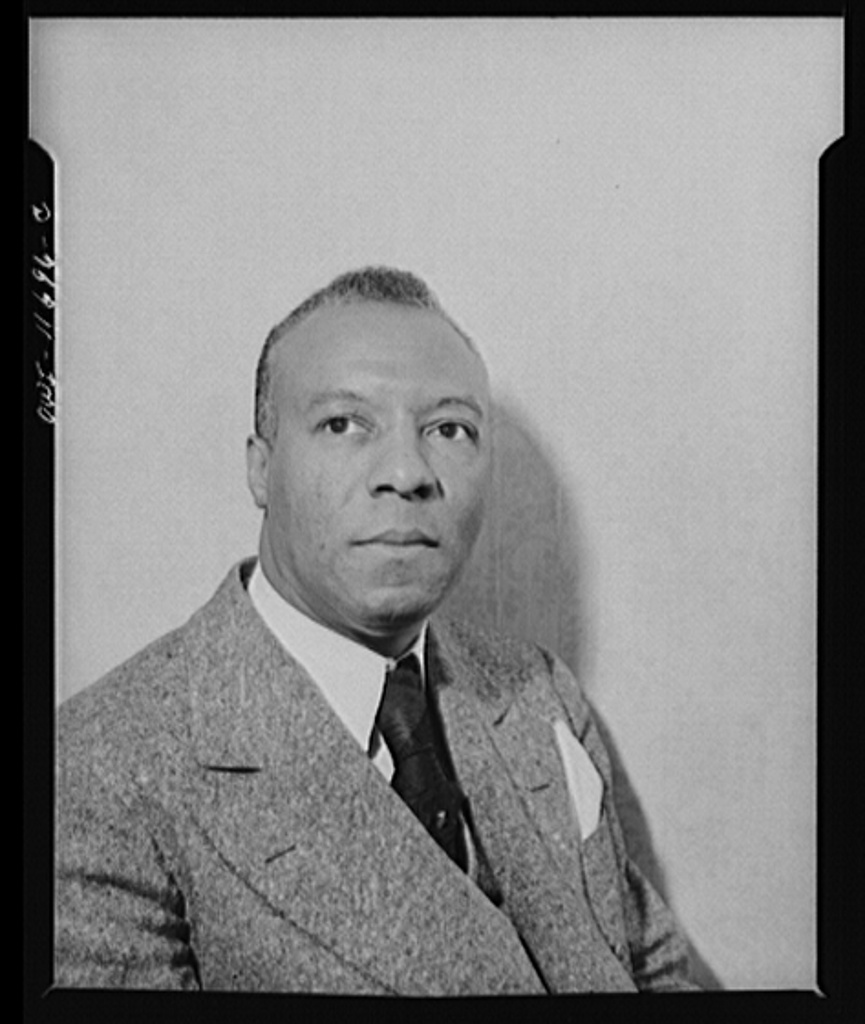
The lead image is a November 1942 Library of Congress portrait of A. Philip Randolph by Gordon Parks.[5] It belongs here because Randolph helps explain why the order reads the way it does. Executive Order 8802 was not handed down into a vacuum. It was won in the shadow of a threatened mass march on Washington, and that origin stays visible in the document's mixture of ambition and caution.[1][3]
Timeline anchors
- March 1941: A. Philip Randolph and allies escalate plans for a March on Washington to protest exclusion of Black workers from defense jobs and segregation in the armed forces.[3]
- June 13, 1941: Eleanor Roosevelt and other intermediaries try to persuade Randolph to call the march off without a full federal concession.[3]
- June 25, 1941: Roosevelt signs Executive Order 8802, prohibiting discrimination in defense industries and government and creating the FEPC.[1][2]
- July 1, 1941: the planned march date passes after Randolph agrees to suspend the demonstration in exchange for the order.[1][3]
- November 1942: Gordon Parks photographs Randolph in Washington, by which time the order's gains and limits are already becoming visible.[5]
These dates matter because they show sequence rather than myth. Executive Order 8802 did not appear as a detached presidential epiphany. Protest threat came first, wartime labor demand formed the background, negotiation followed, and the order arrived only when the White House decided that a march in the capital was a larger risk than a limited federal concession.[1][3]
1) The preamble defines the problem as defense capacity, not equal citizenship by itself
The most revealing lines are near the top. The order says the United States wants "full participation in the national defense program" by all citizens, then notes that needed workers have been barred from defense jobs because of race, creed, color, or national origin "to the detriment of workers' morale and of national unity."[1][2] That phrasing does real historical work. It recognizes discrimination, but it routes the argument through production and cohesion.
In other words, the order does not begin by saying Black Americans possess an enforceable right to equal employment because citizenship demands it. It begins by saying exclusion is sabotaging the defense effort. That is a narrower claim, but it is also a more actionable wartime claim. Once discrimination is framed as lost labor capacity and damaged unity, the federal government can intervene as manager of mobilization rather than only as guardian of principle.[1][2]
This is why the document feels different from a later civil-rights statute. It belongs to the state of emergency. Roosevelt was not yet building a general antidiscrimination regime. He was redefining who counted as necessary to war production. The moral content matters, but it is fused to administrative need.[1]
That fusion should not be dismissed as hypocrisy alone. It was also a breakthrough in federal vocabulary. The order made it newly official that racial discrimination in major industrial hiring was not merely a local custom or a private employer preference. It was now something the federal government could identify as a national problem because the federal government was financing and coordinating the defense buildout itself.[1][2]
2) The real engine of the order sits in contracts and complaints
The second and third numbered sections are the core. Section 2 requires every federal contracting agency to insert a nondiscrimination clause into defense contracts.[1][2] That is the order's strongest move. It ties civil-rights principle to procurement leverage. Employers are not simply asked to behave better. They are told that participation in the defense economy carries a federal condition.
Section 3 then creates the Committee on Fair Employment Practice.[1][2] Its powers are limited, but the design is still historically significant. The committee is instructed to receive and investigate complaints, take steps to redress valid grievances, and recommend further measures to agencies and the President.[1][2] Even if the machinery was underbuilt, the structure marks a change in posture. Workers and organizers now had a federal site, however imperfect, to which discrimination in war work could be named and routed.
This is the part of the document that most justifies calling it a watershed. The order does not only proclaim a value. It builds a channel. A nondiscrimination clause in contracts plus a complaint committee means that the White House had accepted, at least in wartime form, that labor markets tied to federal spending could be governed through federal oversight.[1][2]
That is why the order opened a factory gate. It attached anti-discrimination language to the places where wartime money was flowing fastest. Black workers were not offered abstract sympathy; they were given a narrow claim on the booming defense economy. The claim was conditional and partial, but it was no longer wholly external to the state.[1][2]
3) Randolph's threatened march explains why the opening happened when it did
The NPS account of Randolph is useful because it restores the negotiation pressure behind the text.[3] By mid-June 1941, Eleanor Roosevelt and other allies were trying to stop a mass demonstration they feared could destabilize Washington and expose the administration from the left as well as the right.[3] Randolph and Walter White made the trade explicit: they would call off the march if the President issued an executive order against discrimination in defense jobs and the military.[3]
That bargain matters for how the document should be read. Executive Order 8802 was not simply a benevolent recognition that exclusion was wrong. It was also a preemptive settlement. The White House wanted labor peace, urban order, and racial calm in the capital while the defense state was scaling up.[1][3] Randolph wanted a concrete federal concession that proved Black workers could force the administration to move.
Seen this way, the order belongs to the history of leverage as much as to the history of presidential language. Its political source is collective threat. A protest that never happened still sits inside the final text, because the government was responding not just to arguments, but to the prospect of visible Black mass action in wartime Washington.[1][3]
This origin also explains the order's unusual tone. It is assertive enough to create a committee and impose contractual language, yet cautious enough to remain bounded by defense needs. The administration gave away enough to prevent embarrassment and keep production running. It did not give away everything Randolph's movement demanded.[3]
4) The order's limits are visible inside its scope
Those missing demands are crucial. The NPS account states that Randolph and others wanted both fair access to defense jobs and an end to segregation in the armed forces.[3] Executive Order 8802 did not deliver the second goal. Its operative language covers defense industries and government employment connected to the mobilization apparatus; it does not desegregate the military itself.[1][2][3]
The enforcement problem was also built in from the start. The FEPC was chronically underfunded and understaffed, and many employers ignored or resisted it.[3] The committee could investigate and recommend, but its powers did not match the scale of American racial exclusion.[2][3] This is why the order should be called a narrow opening rather than a solved problem.
That narrowness is not an incidental flaw. It is part of the document's historical meaning. Executive Order 8802 shows what the Roosevelt administration could accept in June 1941: anti-discrimination as a defense-production condition, not anti-discrimination as a full reconstruction of American citizenship. The order widened access to jobs; it did not dismantle the wider architecture of racial hierarchy.[1][2][3]
The image of Randolph from 1942 sharpens that point.[5] By then the order had already entered public memory as a victory, yet Randolph and other organizers knew the argument was unfinished. The state had moved, but it had moved in a wartime channel it still controlled.
What Executive Order 8802 actually changed
The best way to understand Executive Order 8802 is to keep its two scales in frame. At one scale, it was modest and incomplete. It did not desegregate the armed forces. It did not create a permanent nationwide fair-employment regime. Its committee was weak, temporary, and frequently ignored.[2][3]
At another scale, it was a real institutional break. It made nondiscrimination a condition in federal war contracts, created a complaint pathway under presidential authority, and signaled that Black protest could force the defense state to alter its rules.[1][2][3] That is why the order still matters in 2026. It shows the federal government edging from exhortation toward enforcement, but doing so through contracts, emergency management, and production logic rather than through a full equality doctrine.
Executive Order 8802 therefore opened the factory gate without opening the whole state. That is not a reason to dismiss it. It is the reason to read it carefully. The document reveals a specific political formula: organized pressure from below, a wartime administrative need at the center, and a federal response large enough to matter but narrow enough to contain the change.[1][2][3]
Sources
- U.S. National Archives, "Executive Order 8802: Prohibition of Discrimination in the Defense Industry (1941)" - overview, transcript, and context for the order, Randolph's pressure campaign, and the FEPC's creation.
- U.S. Equal Employment Opportunity Commission, "Executive Order 8802" - full text of the June 25, 1941 order, including the contract clause and FEPC provisions.
- National Park Service, "A. Philip Randolph" - on the threatened 1941 March on Washington, negotiations with the Roosevelt administration, the order's issuance, and the FEPC's limits.
- National Park Service, "March on Washington for Jobs and Freedom" - broader movement context linking Randolph's 1941 march threat to later Washington march politics.
- Wikimedia Commons, "File: Washington, D.C. Portrait of A. Philip Randolph, labor leader (LOC) - Flickr - The Library of Congress.jpg" - Gordon Parks's November 1942 Randolph portrait, with Library of Congress metadata and persistent identifier.