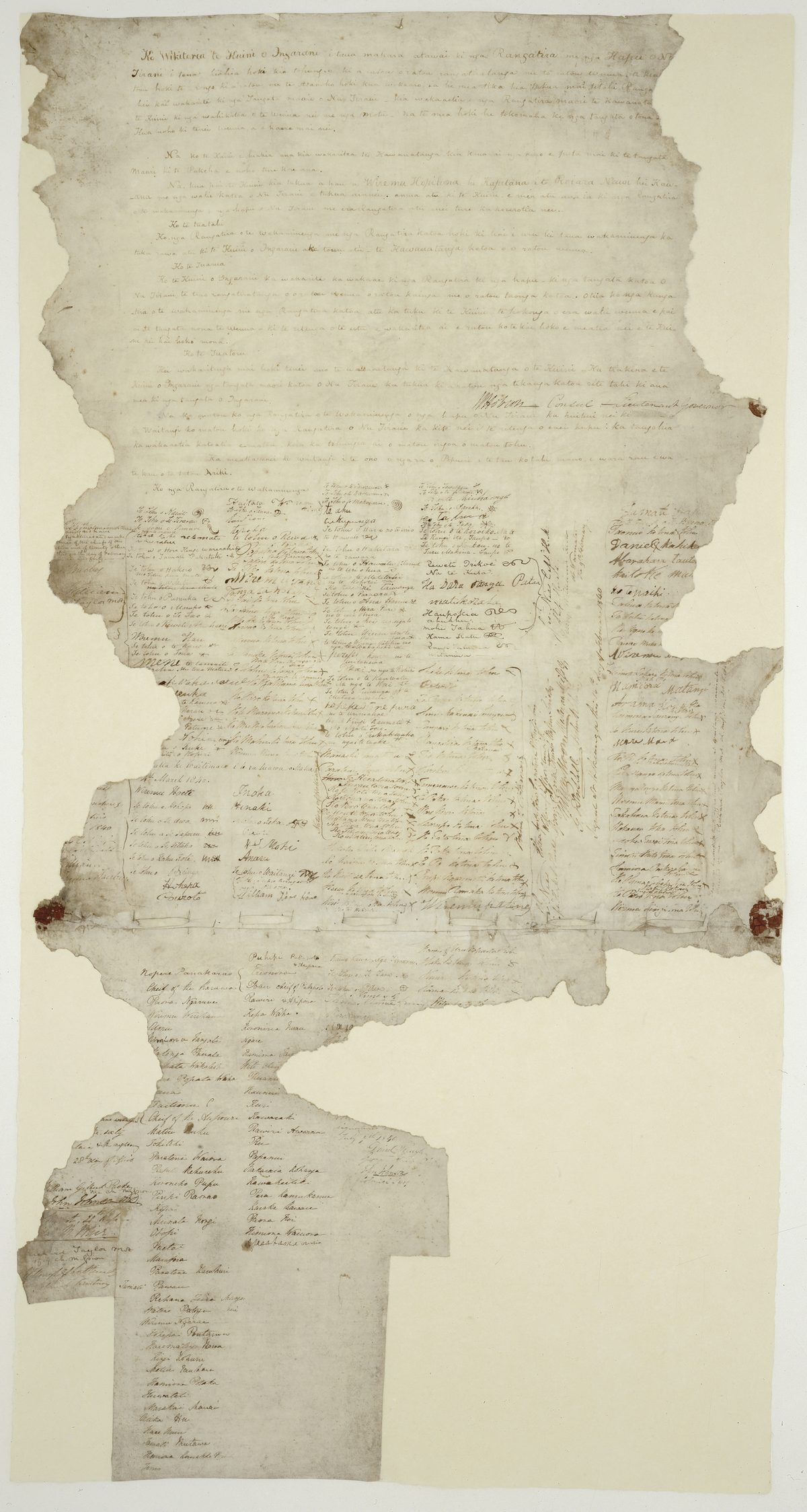
Te Tiriti o Waitangi is often introduced as New Zealand's founding document. That description is accurate, but it can make the document sound more settled than it was at the moment of signing. In February 1840, it was a hurried agreement made through two written texts, oral explanation, missionary translation, British imperial pressure, Maori political calculation, and a landscape of existing hapu authority. Its afterlife has been durable because its key words do not simply match across languages.[2][3][4][5][6]
The treaty was first signed at Waitangi on 6 February 1840. Archives New Zealand describes it not as one sheet but as nine documents, seven on paper and two on parchment, carried around the country over roughly seven months.[2] Archives New Zealand also notes that the treaty was drafted in English, then translated into Maori, debated before the first signing, and eventually signed by more than 500 rangatira as copies moved through different districts.[3] Almost all signed the Maori text.[3][4]
That last point changes the reading. The English text matters because it records British intention in an imperial legal vocabulary. The Maori text matters because it was the text most rangatira actually signed, heard, discussed, and accepted. The historical problem is not that one text is "real" and the other is disposable. The problem is that the agreement worked by placing two political languages beside each other and trusting explanation, context, and future practice to carry the difference.[4][5]
Image context: the cover image is a real archival photograph of the Waitangi Treaty copy. It is useful here because the article is reading Te Tiriti as both text and object: a negotiated political document whose meaning was carried by paper, handwriting, signatures, translation, and later institutional custody.[1][2]
The preamble frames disorder before it names authority
The English preamble begins from British anxieties: increasing British settlement, rapid emigration, the absence of civil government, and the need for laws and institutions.[4] Its logic moves from protection and order toward recognition of the Queen's sovereign authority. The Maori preamble, as set out in the Waitangi Tribunal text page, uses a related structure but a different pressure. It presents the Queen's concern for rangatira and hapu, the desire to secure rangatiratanga and land, and the appointment of a governor so that wrongs do not arise among Maori and Pakeha living without law.[4]
Read closely, the preamble does not yet solve the treaty. It sets up the reason a treaty could be attractive to both sides. For British officials, the document promised a way to regularize settlement, land purchasing, and jurisdiction. For many rangatira, the agreement could be heard as a mechanism for controlling settlers and preserving their own authority in a changing world.[3][5][6]
This is why the preamble matters. It does not merely decorate the three articles. It creates a shared vocabulary of danger while leaving open the question of who would hold final authority once government existed. The treaty begins by naming disorder, then moves quickly into the words that would define the proposed remedy.
Article 1 turns on the distance between sovereignty and kawanatanga
In the English Article 1, the chiefs cede "all the rights and powers of Sovereignty" to the Queen.[4] In the Maori Article 1, rangatira give the Queen "te Kawanatanga katoa" over their lands.[4] That is the hinge on which much of the later argument turns.
The Waitangi Tribunal's public guide explains the issue directly: sovereignty had no direct equivalent in the context of Maori society, and the translators used "kawanatanga," a word connected with governance, biblical usage, and the figure of a governor.[5] The guide distinguishes the English text's sovereignty from the Maori text's kawanatanga, describing the latter as a right of governance and noting that rangatira exercised full authority, mana, over land and resources in their own communities.[5]
The close reading has to resist a tidy replacement. Kawanatanga was not an empty word. It could carry a real grant of governing authority to the Crown. But it did not carry the same totalizing force as the English claim to sovereignty, especially in a Maori political world where authority was distributed among rangatira, hapu, kin groups, and local relationships. Article 1 therefore reads like a transfer in English and like a bounded concession in Maori.
That difference was not merely lexical. It shaped expectations. The Waitangi Tribunal's 2014 statement on the Stage 1 Te Paparahi o Te Raki report says Britain intended to acquire sovereignty but did not clearly explain that intention to rangatira in February 1840. The Tribunal concluded that the northern rangatira who signed then agreed to the Governor having authority over Pakeha and to a relationship of shared power, while retaining authority over their own people and territories.[6]
One can read that conclusion as a modern legal-historical finding, but it also returns the reader to the primary text. Article 1 is short because it depends on context. Its brevity hides the hardest problem: whether a governor's authority over settlement could be made compatible with rangatiratanga, or whether it would expand into a sovereignty claim that swallowed the balance.
Article 2 is where protection becomes authority
Article 2 is the treaty's most densely loaded article. In English, the Queen guarantees "full exclusive and undisturbed possession" of lands, estates, forests, fisheries, and other properties, while chiefs yield the Crown an exclusive right of pre-emption over lands they choose to sell.[4] In Maori, the Queen agrees to protect "te tino rangatiratanga" of lands, homes, and taonga, while chiefs grant the Queen the purchase of land that owners wish to sell at an agreed price.[4]
Here, the key word is not only land. It is rangatiratanga. The Waitangi Tribunal guide says the Maori Article 2 uses rangatiratanga to uphold the authority tribes had always had over lands and taonga, emphasizing status and authority; the English text emphasizes property and ownership rights.[5] Archives New Zealand makes a similar point: the two versions hold different meanings, producing different expectations of the treaty's terms.[3]
That distinction changes the shape of the article. The English text protects possession, then secures Crown control over alienation through pre-emption. The Maori text protects authority, then creates a purchasing channel. Those are related, but they are not identical. Possession can be made to fit a property regime. Rangatiratanga names a political and social authority that is harder to reduce to ownership alone.
This is the treaty's central tension. The Crown could read Article 2 as a land-purchase system nested inside sovereignty. Rangatira could read it as a promise that their authority over whenua, kainga, and taonga would remain intact while the Governor managed incoming settlers and orderly exchange. The later conflict was already latent in the grammar: one side heard a government with protected property rights; the other could hear protected authority with a limited government concession.[4][5][6]
Article 3 gives equality, but not the machinery for balancing Articles 1 and 2
Article 3 appears simpler. In English, the Queen extends royal protection and the rights and privileges of British subjects to Maori.[4] In Maori, the Queen gives Maori the same tikanga as the people of England.[4] The Waitangi Tribunal's guide describes the article as emphasizing equality and equity.[5]
The article matters because it gives the treaty a third promise beyond government and property: protection inside a new political order. It made the agreement more than a land transaction and more than a bare cession document. It offered a status relationship. For rangatira worried about settlers, foreign threats, and disorder, that protection could be a practical benefit rather than an abstract imperial gift.[3][6]
Yet Article 3 also exposes what the text does not specify. Equal rights do not by themselves answer how kawanatanga and rangatiratanga are to operate when they overlap. The treaty does not provide a detailed jurisdiction map, a court structure, a land commission procedure, or a method for resolving every mixed dispute between Maori and Pakeha. It promises protection and equality, then leaves the hardest institutional design to future practice.
That gap is part of the treaty's historical force. It allowed agreement in 1840 because the text could hold several expectations at once. It also created the conditions for later dispute because the written articles did not settle which expectation would prevail when Crown law, settler demand, and rangatira authority came into contact.
The signatures record assent, but not identical understanding
The epilogue in the English text says the signatories had been made fully to understand the provisions and entered into the treaty in its "full spirit and meaning."[4] The Maori epilogue says the rangatira had seen the words, accepted them, and marked their names or tohu.[4] The difference is subtle but important. The English closing stresses complete understanding of the treaty's provisions. The Maori closing records seeing, accepting, and marking the agreement.
The historian's caution begins here. A signature or mark is evidence of assent. It is not automatic evidence that British and Maori signatories attached the same constitutional meaning to every hinge word. Archives New Zealand and the Waitangi Tribunal both push the reader back toward spoken explanation, local setting, and what rangatira were prepared to assent to, not only what Britain intended but did not make clear.[3][6]
That makes Te Tiriti a primary source that cannot be read as silent paper alone. The document points outward: to translation, speech, missionary mediation, prior declarations such as He Whakaputanga, local authority structures, land pressures, and the movement of treaty sheets through places where rangatira made separate decisions at different times.[2][3][6]
What the close reading changes
The strongest reading of Te Tiriti does not flatten it into either a fraud document or a perfectly shared compact. It was an agreement, but an agreement whose written structure carried different political weights in its two texts. The English text speaks with the confidence of imperial sovereignty, pre-emption, and subjecthood. The Maori text speaks through kawanatanga, tino rangatiratanga, taonga, protection, and recorded acceptance. The same three-article architecture holds both.[4][5]
That is why the treaty's modern contest is not simply a later invention. Later politics, courts, tribunals, protests, settlements, and public debates have changed the vocabulary around it, but they did not create the original tension from nothing. The tension sits in the source. Article 1 gives government; Article 2 protects authority; Article 3 extends rights; the preamble promises order; the epilogue records assent. The unresolved question is how those promises were supposed to coexist once the Crown began governing as sovereign.
Te Tiriti's hinge words made agreement possible in 1840 because they could join protection, order, and authority without forcing every contradiction into the open. They also made the document endure because those same words preserved the contradiction for later generations to read, argue, and institutionalize.
Sources
- Wikimedia Commons, "Treatyofwaitangi.jpg" - source page for the archival photograph of the Waitangi Treaty copy used as the article image.
- Archives New Zealand, "Te Tiriti o Waitangi original documents" - archival context for the nine treaty sheets, signatures, materials, and downloadable high-resolution images.
- Archives New Zealand, "The Treaty of Waitangi and how it happened" - background on the treaty's origins, two versions, signing sequence, and British and Maori expectations.
- Waitangi Tribunal, "Maori and English texts" - English text, Maori text, and English translation of the Maori text.
- Waitangi Tribunal, "About the treaty" - guide to the two texts, article meanings, kawanatanga, rangatiratanga, taonga, and pre-emption.
- Waitangi Tribunal, "Report on Stage 1 of the Te Paparahi o Te Raki Inquiry Released" - Tribunal summary of the February 1840 meaning-and-effect findings.