The Rosetta Stone is so famous as a key that it is easy to stop reading it as a document. In the modern story, the stone unlocks Egyptian hieroglyphs; Thomas Young and Jean-Francois Champollion use the readable Greek to recover sounds, names, and grammar that had been closed for centuries.[2][5] That afterlife is real. But the inscription's first job in 196 BCE was more immediate: to make a young Macedonian king legible as a legitimate Egyptian ruler, and to make a council of Egyptian priests legible as active partners in that legitimacy.[2][3][4]
Read as a primary source, the stone is not a dictionary. It is a decree. The British Museum identifies it as part of a grey and pink granodiorite stela bearing a priestly decree concerning Ptolemy V, with 14 lines of hieroglyphic, 32 lines of Demotic, and 54 lines of Greek surviving on the stone.[2] The museum's account also places the decree on the first anniversary of the coronation of the 13-year-old king, after years in which the Ptolemies had lost control over parts of the country.[2] The words are therefore political before they are philological.
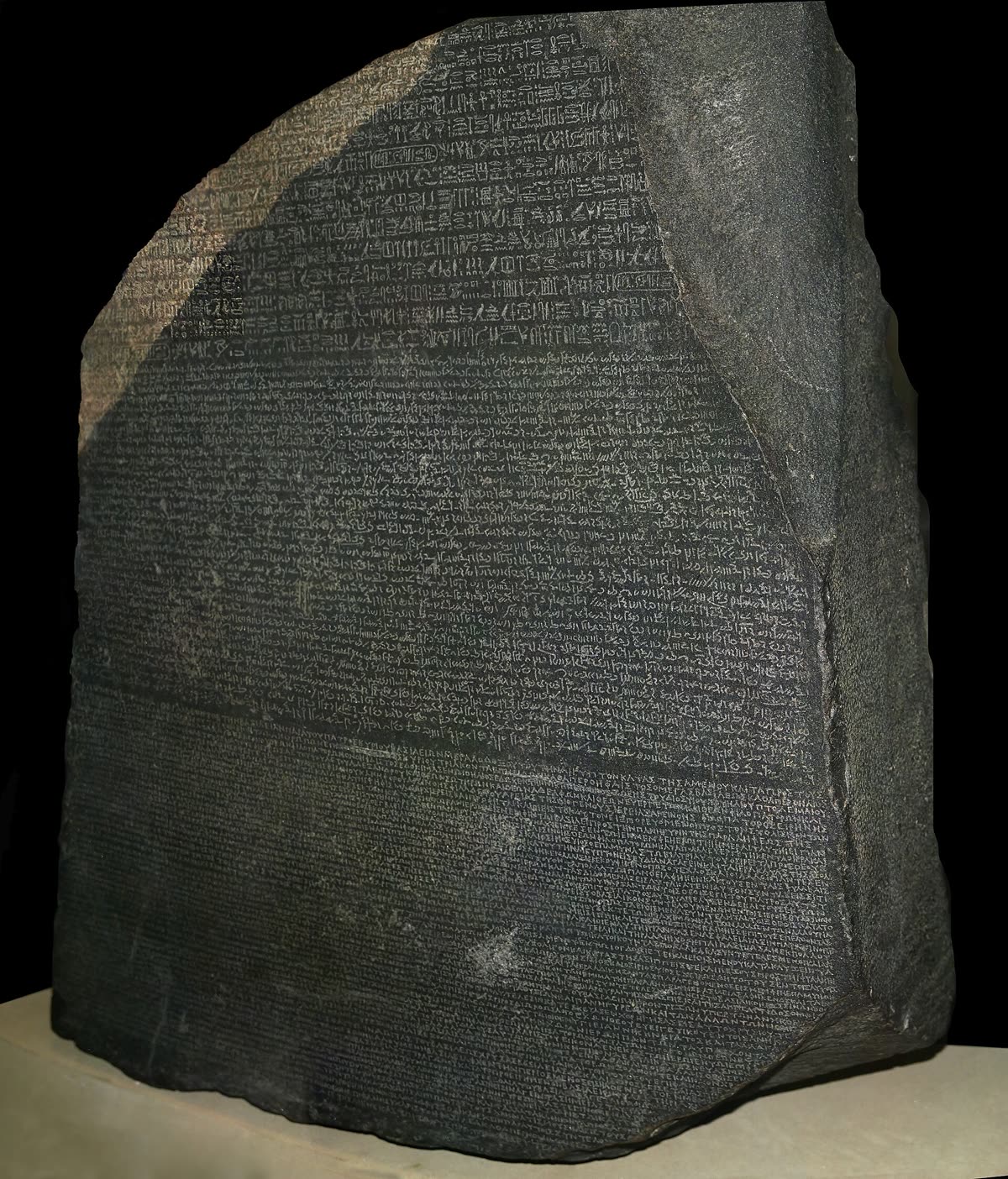
Image context: the cover image is a real photograph from Wikimedia Commons of the Rosetta Stone at the British Museum. It belongs here because the argument turns on the stone's material compression: three registers, one broken slab, and a decree designed to travel through temples as an object of public authority.[1][2]
The first line makes the king young and old at once
The Greek text preserved in the Packard Humanities Institute's inscription database opens by naming the reign of the young ruler who has succeeded his father, then immediately surrounds him with an older vocabulary of divine approval, Upper and Lower Egypt, Ptah, the Sun, and royal victory.[4] That sequence is not decorative excess. It solves a problem the decree cannot avoid. Ptolemy V had inherited kingship as a child, and his adult coronation at Memphis needed to convert vulnerability into continuity.[2][3][4]
The opening formula does this by making youth a managed fact. The king is young, but he is also heir, son, chosen figure, restorer, and victor.[4] The text does not ask the reader to imagine a boy acting alone. It places him inside a chain of sanctioned identities. Ptolemaic rule in Egypt was Greek-speaking and dynastic, but the decree does not let the monarchy remain merely Alexandrian or military. It speaks in the religious geography of Egypt and in the institutional voice of priests assembled at Memphis.[2][3][4]
That matters because the document belongs to a period of instability. The British Museum notes that opposition in the Delta had taken time to suppress and that parts of southern Upper Egypt, including Thebes, were still outside firm government control.[2] Britannica's summary likewise reads the decree as a record of gifts, tax remissions, restored peace after rebellion, and priestly honors returned to the king.[6] The decree's praise is therefore not background ceremony. It is a public repair job.
The priests do not disappear behind royal propaganda
The decree praises Ptolemy, but its institutional speaker is a council of priests. The British Museum's explainer stresses that the inscription is one of several similar Ptolemaic decrees and that copies of the same bilingual, three-script decree have been found elsewhere.[3] That tells us something important about authorship. This was not a private royal boast carved once for a palace. It was a repeatable temple text, issued through priestly assembly and designed for wide placement.[2][3]
The list of royal benefactions shows how the bargain worked. The king is credited with gifts to temples, tax reductions, debt relief, prisoner releases, restored temple services, military action against enemies, and attention to sacred animals and shrines.[5][6] Those claims function in two directions. They present Ptolemy as a pious ruler who protects Egypt's religious order, and they present the priests as the public body able to recognize, codify, and broadcast that protection.
This is why the decree is more than flattery. It stages reciprocity. The priests enumerate what the king has done; in return, they decree statues, shrines, crowns, festivals, titles, and temple display.[5][6] The political mechanism sits in that exchange. Royal power needs priestly publication. Priestly privilege needs royal patronage. The stone survives as a fragment, but the arrangement it records was meant to be multiplied.
Three scripts were an audience map
Modern readers often begin with the three scripts because they explain decipherment. Ancient readers would also have seen audience and hierarchy. The British Museum describes the inscription as hieroglyphic for a priestly decree, Demotic as the native script used for daily purposes, and Greek as the language of administration.[2] The stone therefore does not merely say the same thing three times. It places the same decree into three literate worlds.
That distinction matters. Hieroglyphic script gave the decree temple dignity and an older sacred register. Demotic made the Egyptian text available in the everyday administrative script of the country. Greek placed the decree within the governing language of the Ptolemaic state.[2][5] The visual order of the stone, with hieroglyphs above, Demotic in the middle, and Greek below, is a political diagram without becoming a chart. It lets the same act of loyalty address gods, priests, local administration, and imperial bureaucracy.
The irony is that modern decipherment reversed the stone's ancient status order. Nineteenth-century scholars could read the Greek at the bottom and used it to work back into the Egyptian scripts above.[2][5] What had once been the administrative register became the modern key to the sacred and native registers. The stone's fame comes from that reversal, but the original decree depends on the coexistence rather than the later hierarchy of recovery.
The publication order is part of the argument
Near the end, the decree orders copies to be inscribed in the three scripts and set up in temples.[3][5][6] This instruction is easy to treat as a technical note, yet it is one of the document's clearest political sentences. Authority becomes durable when it is placed where ritual, reading, and repetition meet. A decree spoken once at Memphis could fade. A stela standing near a royal image in temples could keep re-performing the agreement.
The British Museum's blog notes that the Rosetta Stone is one of many stelae designed to disseminate such an agreement and that the wording belongs to a larger formulaic tradition of Ptolemaic priestly decrees.[3] Formula does not make the text empty. Formula is the medium by which a fragile settlement becomes recognizable across space. The words can be copied because the form is already known; the form can carry new names, dates, and crises because it has institutional authority.
The order to publish also explains why the stone could later unlock a script. The decree had to be multilingual enough for its own political environment, and regular enough for comparison. Decipherment was an unintended afterlife of administrative redundancy. The stone became a key because the original regime needed repetition.
What a close reading changes
The Rosetta Stone's modern legend is not wrong. The stone did help scholars recover Egyptian hieroglyphic writing after a long break in readable use.[2][5] But a close reading changes the center of gravity. Before the stone helped Europe read ancient Egypt, it helped a Ptolemaic monarchy and Egyptian priesthood read each other in public.
The decree's structure keeps that bargain visible. It begins with a young king loaded with old sacral titles.[4] It moves through benefactions that bind royal power to temples, taxes, debt, military force, and cult honors.[5][6] It ends by ordering the same agreement into stone, scripts, and temples.[3][5] The famous key was first a machine for repeating legitimacy.
That is why the Rosetta Stone remains more interesting than its metaphor. A "Rosetta Stone" now means a device that decodes something hidden. The actual Rosetta Stone did something more historically specific. It made authority multilingual, local, sacred, administrative, and portable at once. Its fractured surface records not only the recovery of lost writing, but the work required in 196 BCE to make a contested kingdom sound settled.
Sources
- Wikimedia Commons, "File:Rosetta Stone.JPG" - source page for the real photograph of the Rosetta Stone used as the article image.
- British Museum, "stela: The Rosetta Stone" - collection record for EA24, including material, dimensions, line counts, findspot, historical context, discovery, and decipherment notes.
- British Museum, "The Rosetta Stone: everything you need to know" - explainer on the 196 BCE decree, Ptolemy V, copies of the decree, rebellion context, and publication in temples.
- Packard Humanities Institute, "OGIS 90,A" - Greek inscription text for the Rosetta decree, including the opening royal titulary and date formula.
- Project Gutenberg, E. A. Wallis Budge, The Rosetta Stone - British Museum pamphlet text covering discovery, arrival in Britain, script layout, decipherment history, and contents of the inscription.
- Encyclopaedia Britannica, "What Does the Rosetta Stone Say?" - concise summary of the decree's administrative content, royal benefactions, rebellion reference, and temple-publication order.