Ping-pong diplomacy is often retold as a charming Cold War accident: an American player missed the right bus, a Chinese champion offered a gift, and suddenly two hostile governments found a way to talk. The accident matters, but it explains less than the sequence around it. What turned a shuttle-bus encounter into diplomatic history was the speed with which private flexibility, public spectacle, and state calculation locked together.[1][2]
By 1971, the United States and the People's Republic of China had lived for more than two decades with no official diplomatic relations, limited trade, and very little direct contact after the 1949 Chinese revolution.[1][2] Nixon had already begun easing some restrictions, and a secret channel through Pakistan was carrying signals between Washington and Beijing.[2] The table-tennis exchange did not create that strategic opening from nothing. It gave the opening a human face, a press story, and a plausible rhythm: first athletes, then journalists, then envoys, then a president.[2][3]
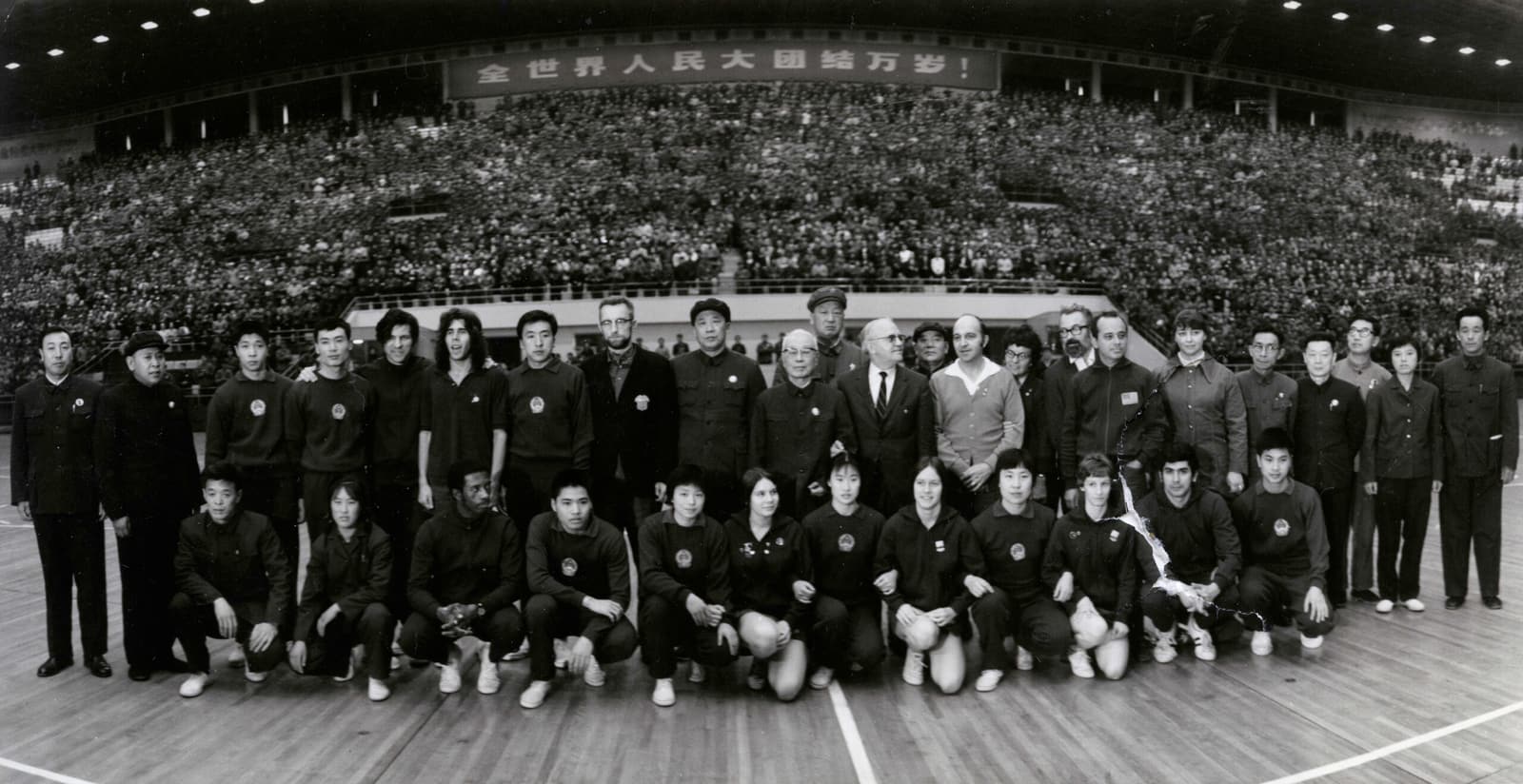
Image context: the cover photograph shows U.S. and Chinese exhibition teams posing in Beijing in April 1971, with a large audience behind them. It comes from the National Museum of American Diplomacy's account of Connie Sweeris's trip materials and is used here because the article turns on public choreography, not only private diplomacy.[1]
Timeline: the small event moved because each step widened permission
- 1949: The Chinese Communist victory left Washington recognizing the Republic of China on Taiwan while the United States and the PRC had no official diplomatic relations.[1][2]
- April 4, 1971: At the World Table Tennis Championship in Nagoya, Japan, Glenn Cowan boarded the Chinese team's bus after missing his own. Zhuang Zedong greeted him and gave him a silk image of Huangshan, creating a photographed encounter reporters could carry.[1]
- April 6, 1971: PRC officials unexpectedly invited the U.S. table-tennis team to visit China.[3][4]
- April 10-17, 1971: Nine U.S. players, officials, spouses, and selected journalists crossed from Hong Kong into mainland China, toured Beijing, Shanghai, and Tianjin, and played exhibition matches.[1][3]
- July 15, 1971: After Henry Kissinger's secret Beijing trip, Nixon announced that he would travel to China the next year.[2][3]
- February 21-28, 1972: Nixon visited the PRC, met Mao Zedong and Zhou Enlai, and the two governments issued the Shanghai Communique.[2]
Nagoya: the accidental scene worked because it was photographable
The first hinge was small enough to look innocent. Cowan had missed his U.S. team bus after practice and boarded the Chinese team bus instead.[1] Zhuang's response mattered because it converted an awkward breach into a gift scene: he shook Cowan's hand and offered him a silk depiction of the Huangshan Mountains. When they stepped off the bus, journalists photographed them together.[1] In the later legend, this becomes spontaneous friendship. In the event itself, it was something more useful: a visible exception to a diplomatic rule.
The encounter had three qualities that made it usable. It was low-ranking, because neither man was a head of state or a foreign minister. It was emotionally legible, because a handshake and gift required little explanation. It was deniable, because both governments could treat it as sport until the political value became clear. Those qualities made the gesture easier to amplify than a formal communique would have been at that early stage.
The National Museum of American Diplomacy records that two days later the U.S. team received an official invitation to travel to China and play exhibition matches.[1] That timing is the key. The bus scene alone would have been a curiosity. The invitation turned it into a corridor.
Passports and bridges: bureaucracy made the exception real
The second hinge was administrative. Before the team traveled onward, U.S. consular officials in Japan altered passport warnings by crossing out "China" on the page that warned against travel to Communist-controlled areas.[1] The detail is almost comic, but it is historically sharp. A black marker became the instrument by which a general prohibition turned into a specific permission.
On April 10, the team left Japan for Hong Kong and crossed a guarded bridge into mainland China on foot.[1][3] The border crossing mattered because it gave the story a physical threshold. Since 1949, Americans had been largely absent from the PRC as public visitors.[1][3] Now a small group crossed under cameras and official attention, carrying paddles, passports, curiosity, and an awareness that they had entered a stage built for more than sport.
Connie Sweeris's later account gives the team-level mood better than official summaries can. She remembered fear and excitement together: little knowledge of China, concern about safety in a Communist country, and the sense that Chinese hosts would avoid any incident because the trip had already become global news.[5] That mixture matters. The athletes were not secret diplomats with full briefing books. They were ordinary enough for the story to feel open, yet watched closely enough for each gesture to carry political weight.
Beijing: friendship matches turned access into broadcast material
Once inside China, the team moved by plane and train to Beijing, Shanghai, and Tianjin.[1] The itinerary included exhibition matches, banquets, selected tours, and tightly managed cultural contact. PBS notes that the team's visit ended an information blockade by allowing journalists, including Americans, to cover the trip from inside the PRC.[3] That press access was part of the event's mechanism. The exchange had to be seen in order to do diplomatic work.
At Beijing's Capital Indoor Stadium, the teams played what hosts called friendship matches before a crowd that the diplomacy museum describes as about 20,000 people.[1] The photograph used for this article belongs to that public theater: players and officials line up in front of a mass audience, so that the game becomes less a contest than a proof of contact. The point was not whether the U.S. players could beat one of the world's strongest table-tennis systems. The point was that Americans and Chinese could be shown entering the same arena under a vocabulary of courtesy.
Zhou Enlai's reception of the team made the political layer explicit. PBS records his banquet remarks as framing the athletes' visit as a new page in relations between the two peoples.[3] The National Archives later described a State Department intelligence brief that treated those remarks and the PRC invitation as a diplomatic signal, even though official relations still did not exist.[4] That is the crucial distinction: the governments had not normalized relations, but they had normalized an image of contact.
The backchannel: sport gave private diplomacy a public tempo
The table-tennis exchange becomes easier to understand when placed beside the secret channel already in motion. The Office of the Historian describes Nixon's use of Pakistani President Yahya Khan as an intermediary to reach the PRC leadership, and notes that by late 1970 the pace of rapprochement was accelerating.[2] In that setting, ping-pong diplomacy was neither pure accident nor pure theater. It was a public tempo that could run alongside private bargaining.
This is why the sequence from April to July matters. In April, the players crossed into China and U.S. audiences followed their movements through newspapers and television.[3] In July, after Kissinger's secret mission to Beijing, Nixon announced that he would visit China in 1972.[2][3] The public could receive the presidential announcement through a story it had already rehearsed: contact had begun, hostility had softened enough for faces and names to circulate, and China was no longer only an abstraction behind a closed border.
The later diplomatic stakes were much larger than table tennis. Nixon's February 1972 trip produced the Shanghai Communique, where the two governments set out positions on Taiwan and created a framework for further normalization.[2] Formal diplomatic relations would still wait until 1979.[4] But the 1971 exchange supplied something policy papers rarely provide by themselves: a sequence of images in which a geopolitical opening could look socially imaginable before it became legally complete.
Why the episode still reads larger than its sport
The strongest interpretation of ping-pong diplomacy is not that sport magically solved Sino-American hostility. The stronger claim is narrower and more durable: sport created a low-risk public channel through which both governments could test whether contact would be legible, tolerable, and useful.[1][2][3] A missed bus became meaningful because it was followed by an invitation, passport work, a border crossing, exhibition matches, press coverage, intelligence interpretation, secret talks, and a presidential trip.
That chain also explains the episode's charm without reducing it to charm. The athletes really did meet, play, travel, and improvise across linguistic and political distance.[1][5] At the same time, their movement was organized inside state interests. The small ball did not move the large world by itself. It gave the large world a smaller object to pass back and forth until the next move could be made in public.
Sources
- National Museum of American Diplomacy, "Ping-Pong Diplomacy: Artifacts from the Historic 1971 U.S. Table Tennis Trip to China" - artifacts, Connie Sweeris photographs, bus encounter, passport modification, border crossing, and exhibition matches.
- Office of the Historian, U.S. Department of State, "Rapprochement with China, 1972" - diplomatic background, secret Pakistan channel, table-tennis invitation, Kissinger trips, Nixon visit, and Shanghai Communique.
- PBS American Experience, "Ping-Pong Diplomacy" - April 1971 chronology, media access, Zhou Enlai banquet, embargo shift, and Kissinger timeline.
- National Archives, "National Archives Highlights 'Ping Pong Diplomacy' in August" - NARA description of the State Department intelligence brief and post-visit diplomatic implications.
- Smithsonian Magazine, Jeff Campagna, "Connie Sweeris, Ping-Pong Diplomat" (March 20, 2011) - interview with participant Connie Sweeris and team-level perspective on the 1971 China trip.