The popular memory of the Torrey Canyon begins with aircraft. A supertanker hits a reef; the British government sends bombers; the sea burns. Every part of that sequence happened, but its compression produces a false history. The tanker grounded on March 18, 1967. The first air strikes came on March 28. Between those dates lay a salvage attempt, an expanding slick, heavy use of chemical agents, oil arriving on Cornish beaches, a fatal explosion aboard the wreck, and a gale that broke the ship into sections.[2][3][4]
The myth is therefore not that Britain bombed the Torrey Canyon. It is that bombing was an instant, singular response—and that this spectacular choice explains the disaster better than the quieter experiments around it. The evidence points elsewhere. By the time aircraft attacked the wreck, the original navigational accident had become three different emergencies: a ship that could no longer be refloated, a coastline being treated with chemicals whose ecological cost was poorly understood, and an international legal problem with no adequate rules for intervention or compensation.
Seen in that order, the bombing looks neither like a masterstroke nor like the cause of everything that followed. It was the last and most visible gamble in a chain of improvisations.
The chronology the spectacle erases
- February 18, 1967: the Liberian-registered tanker left the Persian Gulf for Milford Haven carrying 119,328 tons of crude oil.[2]
- March 18: it struck Pollard Rock on the Seven Stones Reef between the Isles of Scilly and Land's End.[1][2]
- March 20: a contemporary legal report estimated that about 30,000 tons had already escaped.[2]
- March 25: oil began reaching the Cornish coast after a week of attempted containment, chemical treatment, and salvage work.[2][4]
- March 26–27: high seas broke the tanker's back and then divided it into three sections, releasing a further large pulse of oil and ending realistic hopes of refloating it.[2][4]
- March 28–30: British aircraft opened the remaining tanks and tried to ignite their contents with explosives, aviation fuel, napalm, and incendiary devices.[2][4]
- April 4: Prime Minister Harold Wilson defended the sequence in the House of Commons while scientific assessment of the response was still continuing.[4][6]
- May 4: the council of the Inter-Governmental Maritime Consultative Organization began organizing urgent international work on the technical and legal gaps the wreck had exposed.[2]
That list does not excuse any decision. It establishes what each decision could still change.
Myth one: one bad turn explains the whole disaster
The Liberian Board of Investigation placed responsibility for the grounding solely on Captain Pastrengo Rugiati. Its report rejected mechanical failure and identified a series of choices: changing from the safer route west of the Scillies to an eastern passage, entering confined water at speed, remaining on automatic rather than hand steering, and reacting too late when fishing traffic complicated the final alteration of course. When the helmsman first turned the wheel, the automatic system was still engaged; by the time hand steering took over, the reef was too close.[1]
That is strong evidence of navigational negligence. It is not a sufficient explanation of the historical disaster.
The distinction matters because a grounding and a mass-pollution emergency are not identical events. Human error put the hull on Pollard Rock. The scale of what followed depended on a tanker almost 975 feet long, a cargo divided among ruptured and intact tanks, sea conditions that frustrated access, response tools designed for smaller spills, and laws built around damage to ships and cargo rather than oil moving onto other people's coasts.[2] Blame could be concentrated on the bridge; consequence could not.
The formal inquiry's individual verdict also risks making every later choice look inevitable. It was not. The grounding created a narrowing field of options. Government, salvors, local authorities, scientists, armed forces, ship interests, and coastal communities then acted inside that field, often without tested doctrine. The history begins with negligence but becomes more revealing when it asks why so many institutions had to invent their role after the oil was already moving.
Myth two: the government went straight for the bombers
British response began within hours, not ten days later. Royal Navy vessels carrying chemical agents headed for the wreck on March 18, a command post formed at Plymouth, aircraft tracked the slick, scientists were assembled, and local authorities confronted oil landing inside their jurisdictions.[3] At the peak of the early operation, a contemporary report counted 53 ships using as much as 90,000 gallons of detergent a day.[2]
Meanwhile, salvors tried to preserve the most valuable option: remove the ship and its remaining cargo from the reef. Wilson's April 4 statement was the government's own defense and should be read as such. He said the salvors were given the high spring tides because refloating the tanker, if possible, would avoid deliberately opening intact tanks. Pumping the oil into smaller vessels was judged unsafe: the ship's pumps were disabled, volatile gases made repair work dangerous, and another tanker could not approach closely enough in the weather.[4]
The salvage effort was not costless. An explosion killed the salvage captain, and oil continued to escape while officials waited for the tidal window.[4] Critics could reasonably argue that delay protected a diminishing chance of saving the ship while the coast absorbed the risk. The opposing interpretation is that immediate destruction might have released the contents of intact tanks without burning them. Wilson told Parliament that the steel deck covered 16 separate tanks and that opening them could free as much as 90,000 additional tons with no guarantee of ignition.[4]
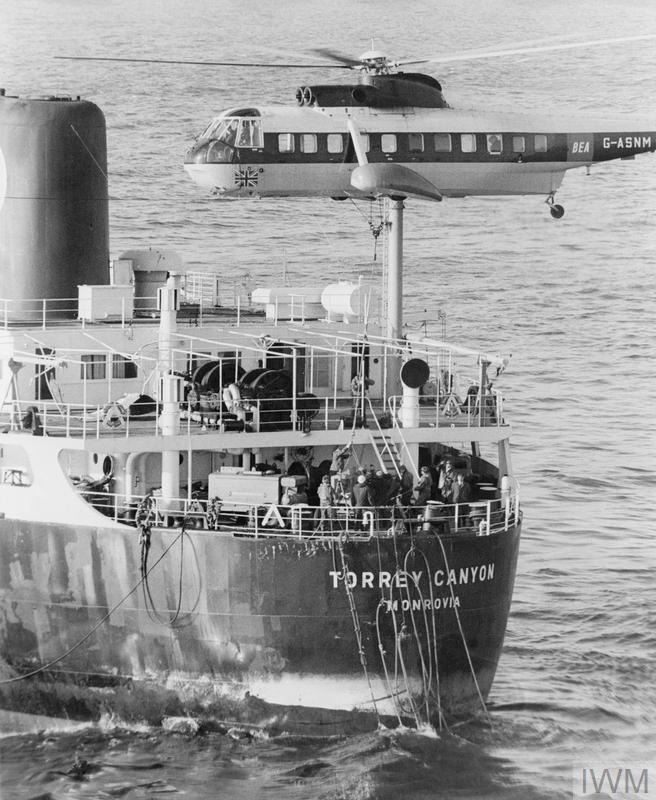
Weather ended the argument before policy did. On March 26, a gale broke the hull into two; by the following day it was in three pieces. The official Admiralty photograph used here records the earlier phase: a helicopter lowering equipment while salvage workers gather on the stranded tanker.[10] The bombers were called in only after the structure those workers hoped to save had failed.
Myth three: bombing either caused the spill or solved it
The strongest evidence rejects both absolutes.
The case against treating bombing as the cause is chronological. Roughly 30,000 tons were estimated to have escaped by March 20; oil reached Cornwall by March 25; and the March 26 breakup released another major pulse before the first strike.[2] The environmental emergency was already dispersed across sea and shore.
The case against treating bombing as a solution comes from the uncertainty built into the plan. Government scientists had successfully burned a 1,000-gallon test pool of Kuwait crude on an inland lake, but a trial on an eight-square-mile patch at sea failed.[4] The air operation therefore combined two opposing acts: explosives opened tanks, while fuel and incendiaries were supposed to ensure that the released oil burned instead of spreading. A contemporary maritime-law report believed oil near the wreck had been destroyed by March 30.[2] ITOPF's later assessment is more guarded: the bombardment was partially successful, but it did not prevent oil from reaching southwest England, the Channel Islands, and Brittany.[5]
One interpretation makes the strikes a reckless piece of political theater—an attempt to be seen attacking an enemy that could not be bombed into submission. The other makes them last-resort damage limitation after salvage and structural integrity had both disappeared. The evidence supports the second interpretation as a description of sequence, but not as proof of success. A confident net verdict would require a reliable tank-by-tank mass balance immediately before and after the strikes: how much oil remained, how much combusted, and how much the explosions released unburned. The cited contemporary accounts do not supply that measurement.
The safest conclusion is narrower. Bombing did not create the Torrey Canyon spill, did not end it, and cannot carry the moral weight of the entire response merely because fire photographed better than emulsified oil.
Myth four: detergent was either cleanup or catastrophe
Chemical treatment was the larger, quieter experiment. Early products could break a surface slick into droplets, reduce the quantity arriving visibly on beaches, and accelerate the removal of oil from rocks. ITOPF credits them with doing some of that work.[5] Officials therefore had a real operational reason to use them. An oiled holiday coast was already an ecological injury and an economic emergency, not simply a cosmetic problem.
But the products were not today's lower-toxicity dispersants. ITOPF describes solvent-based agents used in high concentrations, sometimes undiluted, and concludes that their excessive and indiscriminate application caused considerable environmental damage.[5] What looked like removal from the surface could be redistribution through the water and across the intertidal zone.
The changing official account is instructive. On May 3, 1967, the agriculture minister told Parliament that no discernible effect had been found in open-sea fish and no appreciable damage in commercial fisheries, while acknowledging deaths near heavily treated shores and the need for continued monitoring.[6] Decades of marine-biological work did not simply reverse that statement; it measured a different problem. A later history of the Marine Biological Association's research says its 1968 synthesis found the contemporary dispersants more damaging than the oil itself, and that some sheltered intertidal and shallow subtidal communities took about 15 years to return to their earlier condition.[7]
Commercial catches in the first weeks and ecological recovery on treated rocky shores over years were not equivalent tests. That difference is the evidence boundary. It would be inaccurate to say every application everywhere did more harm than untreated oil. It is equally inaccurate to call the chemicals a cleanup without naming what they killed, where they moved the pollution, and how long recovery took.
Myth five: the disaster produced one modern law
The legal afterlife was a sequence too. In 1967, the basic questions were still open: Should liability require proof of fault? Should it fall on the shipowner, cargo owner, or both? Must insurance be compulsory? How should claims by governments, fishers, tourism businesses, and property owners share a limited fund? Which country's courts should hear them? The contemporary CMI report feared that the British government's response costs could consume the available limitation fund and leave little for private claimants.[2]
The wreck also raised a different question. What authority did a coastal state have to destroy or alter a foreign-flagged ship outside its territorial waters in order to protect its shore? The 1969 Intervention Convention later affirmed a coastal state's right to take necessary measures on the high seas against an oil-pollution danger, while requiring consultation and making excessive action compensable.[9] That balance—permission, necessity, consultation, liability—reads like a legal answer to the uncertainty visible in March 1967.
Compensation developed alongside intervention. The International Maritime Organization describes the Torrey Canyon as the catalyst for an ad hoc Legal Committee, the 1969 Civil Liability Convention, and the 1971 Fund Convention that added another tier of compensation when shipowner liability proved insufficient.[8] The spill did not invent environmental governance in one flash, and later tanker disasters continued to reshape it. It forced separate problems—prevention, emergency power, strict liability, insurance, and shared compensation—into a common international agenda.
That is the legacy the bomber image tends to hide. The memorable act was an aircraft dropping fire on a wreck. The durable response was slower: deciding who may act, who must pay, and how a coastline becomes legally visible before oil reaches it.
What the photograph gets right
The IWM image does not show the initial navigational error, a detergent-treated beach, a parliamentary argument, or a treaty conference.[10] It shows a helicopter hovering beside the stranded tanker as equipment descends to a deck crowded with workers. The ship's name remains legible on the stern. The scene is powerful because it catches the response while refloating still looked possible, before gale and fire turned salvage into destruction.
It would become misleading only if made to stand for the whole event. The Torrey Canyon disaster was not one salvage mission displaced by one spectacular remedy. It was a sequence in which each attempted solution revealed another missing capacity: safer navigation, large-spill response, ecological knowledge, coastal-state authority, and compensation for people who had never owned the ship or its oil.
Bombing was the last experiment because the wreck had run out of reversible choices. The history matters because the world around it still had choices left.
Sources
- Republic of Liberia, Report of the Board of Investigation in the Matter of the Stranding of the S.S. Torrey Canyon on March 18, 1967, issued May 2, 1967 and reproduced in International Legal Materials — flag-state inquiry into route choice, steering, speed, and responsibility.
- Comité Maritime International, Torrey Canyon: Preliminary Report, 1967 — contemporary chronology, ship and cargo data, response scale, cost estimates, and the liability questions raised by the spill.
- NOAA IncidentNews, “Torrey Canyon; Lands End, England” — official U.S. case history of the twelve-day release, command structure, tracking, chemical treatment, and local response.
- UK Parliament, “Torrey Canyon,” House of Commons debate, April 4, 1967 — Harold Wilson's primary-source account of the salvage window, rejected alternatives, breakup, experimental burns, and bombing decision.
- International Tanker Owners Pollution Federation, “Torrey Canyon, United Kingdom, 1967” — retrospective case study of the spill, partial burning attempt, shoreline reach, and damage caused by early dispersants.
- UK Parliament, “Torrey Canyon,” House of Commons written answer, May 3, 1967 — contemporary ministerial assessment of fish, shellfish, detergent exposure, and the limits of early monitoring.
- Paul R. Dando and Eve C. Southward, “The history of the Journal of the Marine Biological Association of the United Kingdom and the influence of the publication on marine research,” Journal of the Marine Biological Association of the United Kingdom, 2020 — retrospective synthesis of Torrey Canyon research and long-term intertidal recovery.
- International Maritime Organization, “Liability and compensation” — institutional history linking Torrey Canyon to the IMO Legal Committee, the 1969 Civil Liability Convention, and the 1971 Fund Convention.
- International Maritime Organization, “International Convention Relating to Intervention on the High Seas in Cases of Oil Pollution Casualties, 1969” — official summary of coastal-state powers, consultation duties, proportionality, and compensation.
- Imperial War Museums, “The Torrey Canyon Disaster. March 1967, at sea on Seven-Stones Reef” — collection record for official Admiralty photograph A 35083, showing salvage equipment being lowered aboard the tanker and used as the article image. Institutional image file.