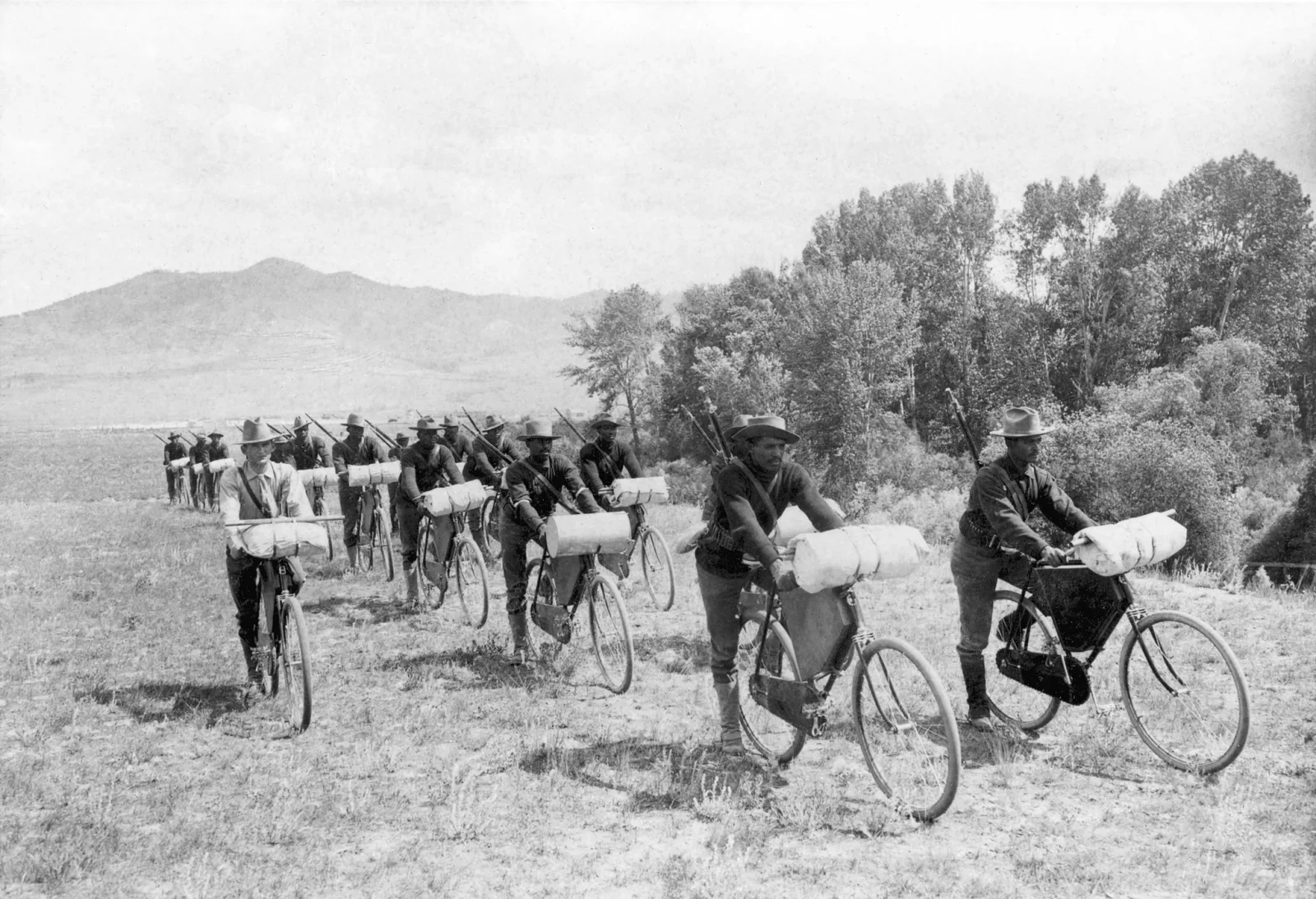
At about six in the evening on July 24, 1897, nineteen Black infantrymen rode into Forest Park in St. Louis. Their journey had begun at Fort Missoula, Montana, on June 14 with a twentieth enlisted rider; by Lieutenant James A. Moss’s accounting, the corps covered precisely 1,900.2 miles during its forty-one calendar days. Crowds and local cyclists escorted them in. Their uniforms were worn, their specially built bicycles were dusty, and one soldier had been sent back before the finish. The nineteen finishers had crossed the Rockies and Great Plains carrying rifles, ammunition, shelter, clothing, utensils, and food.[1][2]
It looked like an experiment with an obvious verdict: the bicycle worked.
But a successful demonstration is not the same thing as an adopted system. The 25th Infantry Bicycle Corps—later remembered as the Iron Riders—had proved that a carefully selected detachment could make an extraordinary journey. It had not proved that bicycles could move an ordinary unit as a self-contained, all-terrain transport system: the expedition relied on a rail corridor, supply stations, an expert mechanic, commercial sponsorship, and at least some usable road or track. Moss himself said the machines had not been tested under fire and conceded that horses were superior in rain and on bad roads.[2]
That boundary explains why the ride could be a triumph and this experimental corps could disappear within weeks. Four mechanisms made the test possible: unusually capable volunteers, a manufacturer willing to supply a prototype fleet, a route that borrowed the railroad’s logistics, and an officer with institutional patrons. The same mechanisms made the result difficult to generalize. Then war redirected the regiment before the Army could run a follow-up trial. The bicycles passed the journey Moss designed; no permanent infantry bicycle organization, doctrine, or procurement program had yet grown around his work.
The Army borrowed a prototype
The experiment began inside a segregated regiment, not in a new transportation office. The 25th Infantry was one of the U.S. Army’s Black regular regiments, its Black enlisted ranks led mainly by white officers. The regiment was headquartered at Fort Missoula, where four companies were stationed. Bicycles were already common at the post when Moss arrived after graduating from West Point in 1894. Colonel Andrew S. Burt encouraged athletics, and informal bicycle drills gave Moss a pool of soldiers who knew the machine before he asked the War Department to study it.[1][2]
The Army’s interest in bicycles did not begin with Moss: its Signal Corps had tested them for messenger work, and National Guard organizations experimented with cyclist units. Moss’s distinctive question was whether armed, loaded regular infantry could use bicycles for extended field movement.[2]
Moss’s first authorized corps in 1896 contained eight enlisted volunteers. One of them, Private John Findley, had worked at Chicago’s Imperial Bicycle Works before joining the Army. Moss made him the unit mechanic. The detachment rode to Lake McDonald and then completed an approximately 800-mile circuit through Yellowstone, carrying field equipment over mountains, streams, rocks, mud, and sand. Those journeys were not mere preliminaries. They created the practical knowledge—how to pack a frame, ford with a bicycle, repair it in the field, and decide when to dismount—on which the longer test depended.[1]
The equipment was also a commercial collaboration. A. G. Spalding & Bros. supplied the machines and fittings at no cost to the government in exchange for the promotional value of an Army service test. For the St. Louis ride, Spalding produced strengthened bicycles to Moss’s specifications, with steel rims, tandem spokes, protected chains, brakes, carriers, frame cases, and long-distance saddles. Each bicycle weighed 32 pounds before loading and about 59 pounds on average when packed.[1][2]
Free equipment lowered the threshold for approval. It also kept the experiment at prototype scale. Nothing in this project established an Army-wide standard machine, maintenance pipeline, training program, or budget beyond ordinary support. Spalding had supplied a bespoke fleet to an enthusiast-led trial. That arrangement was ideal for discovering whether a bicycle could work; it could not show what an Army-wide system would cost or require.
The railroad made a bicycle march possible
Moss designed the June 14–July 24, 1897 route to stress the machines. It moved from Montana’s grades and cold through Wyoming’s scarce water, Nebraska’s loose sand, and Missouri’s heat and mud. Yet it also followed rail lines whenever practical. Railroad tracks offered a navigational spine, water tanks, nearby towns, and an alternate surface when wagon roads dissolved.[1][2]
The Quartermaster Department placed rations roughly 100 miles apart. Carrying only two days of food saved weight and, in Moss’s design, encouraged the planned pace of fifty miles a day. Almost every enlisted rider carried a ten-pound Krag–Jørgensen rifle, fifty rounds, and a bayonet; one carried a shotgun. Each also carried clothing, a shelter half, utensils, and a canteen, while Findley added tools and spare parts.[1][2] The arrangement joined the lightness of a bicycle column to the reach of an existing transport network.
That coupling was efficient until weather broke the schedule. Rain turned the first day’s road to gumbo mud. On June 16, the men pushed over the Continental Divide through sleet and snow. Farther east, drinkable water often came from railroad tanks. In Nebraska’s Sandhills during July 5–9, loose sand forced the corps onto the track for about 170 miles, much of it on foot. The men sometimes traveled hungry because the next ration point remained ahead of them.[2]
The railroad also absorbed failures the bicycles could not. When alkali water sickened Moss near Alliance, he recovered and rejoined the unit by train while Assistant Surgeon James M. Kennedy took command. Moss’s final report acknowledged that several sick soldiers had been put aboard trains and sent as far as a hundred miles forward; without rail, he wrote, carrying them would have been a serious problem.[2] This does not invalidate the test. It defines it. The corps demonstrated rapid light infantry movement along a transport corridor, not a self-contained substitute for every horse, wagon, or railcar.
The machine worked because the unit worked
The popular image is twenty men conquering distance on futuristic wheels. The record shows a more interesting system of human skill. Forty soldiers volunteered for the St. Louis expedition. Moss selected twenty for cycling ability, reliability, and physical condition; five had served in the earlier corps. Some were still inexperienced, but the group included veterans of the packing and repair experiments.[1][2]
Findley’s role was decisive. Frames, spokes, handlebars, bearings, axles, and pedals broke, but the mechanic carried spares and kept the column moving. Moss later noted that Findley rode a bicycle ten or fifteen pounds heavier than any other and suffered just one breakage, repaired in four or five minutes. Careful riders had only a few minor failures; damage clustered among four or five less careful riders.[2] The test therefore measured a maintainable machine in trained hands, not a maintenance-free machine.
The soldiers supplied the other form of redundancy. Sergeant Mingo Sanders and the two squad leaders held command responsibilities. Kennedy led the detachment through the Sandhills when Moss was ill. Nineteen enlisted men reached St. Louis, although sickness, thirst, hunger, heat, cold, and lost sleep marked the route.[1][2] A Nebraska newspaper saw the corps near the end of its Nebraska crossing and reported an average near fifty miles a day, with thirty-eight miles a day in the worst sand country.[4]
At the finish, Moss calculated thirty-four actual travel days, an average of 55.9 miles per travel day, and 6.3 miles per hour. He also estimated that the men had walked between 300 and 400 miles and dismounted, on average, every seven miles because of terrain or road conditions.[2] Those figures belong together. Speed did not come from remaining in the saddle at all costs. It came from treating the bicycle as portable equipment: ride it on a usable surface, push or carry it when necessary, repair it quickly, and keep the detachment moving.
The report proved a niche, not a replacement
Moss’s public verdict was exuberant. He claimed the corps could move twice as fast as cavalry or infantry at one-third the cost and effort. His detailed report praised the bicycles’ durability and the soldiers’ “spirit, pluck and fine soldierly qualities.” But the report’s operational recommendations were narrower than the celebration.[2]
The bicycle needed no forage, made little noise or dust, left tracks that did not reveal direction, and did not require soldiers to remain behind as horse holders. Moss proposed it for courier work, scouting, road patrols, rapid reconnaissance, and seizing a pass or bridge until reinforcements arrived. He explicitly rejected the idea that bicycles should abolish cavalry. In bad weather or on poor roads, he wrote, the horse was better.[2]
This was a credible case for a specialized adjunct. It was not yet a case for a permanent infantry bicycle program. The trial had used selected volunteers, borrowed machines, a mechanic, a surgeon, advance ration drops, rail infrastructure, and no enemy fire. Its most punishing sections exposed a road problem as much as a bicycle problem. A follow-up on improved roads, or a field exercise against an opposing force, might have separated the machine’s limits from the route’s. Moss requested the former—a ride from St. Louis to Minneapolis—but the War Department denied it while the Army’s principal champion of military cycling, Major General Nelson A. Miles, was in Europe.[1][2][3]
The men crossed a racial boundary with the geographic one
The enlisted riders were not chosen because the Army had created a Black technology unit. They were volunteers from the regiment already available at Fort Missoula. Their race nonetheless shaped how the journey was watched and remembered.
Historian Alexandra V. Koelle’s study of photographs, newspapers, and Army reports uses the corps to reveal both differences and similarities in race relations between the new western states and the East.[5] Crowds celebrated the riders in many towns, and thousands came to see their St. Louis camp. Elsewhere, sectional hostility intersected with the journey’s broader racial setting. In a pro-Confederate part of Missouri, a farmer asked whether they were Union soldiers; when the reporter Edward Boos said yes, the farmer ordered the corps off his land, then offered ground below a pigsty.[2] The account does not establish whether Union allegiance, race, or both drove the insult. It does show that the technological spectacle did not suspend the social geography the soldiers crossed.[2][5]
The surviving narrative is uneven too. Moss wrote the official reports; journalist Edward H. Boos supplied dispatches; newspapers described the column. The enlisted men appear most clearly when the sources record what they did—Findley repairing, Sanders commanding, the squads pushing through sand—or when an officer appraises their endurance. That archive makes it especially important not to turn Moss’s experiment into Moss’s feat. The decisive proof was produced by twenty men whose discipline made a fragile logistical design look robust.
Colonel Burt understood the public dimension. When Moss proposed a Fort Missoula–San Francisco expedition on February 7, 1898, Burt endorsed it partly because seeing Black soldiers in uniform might challenge white prejudice.[2][3] His argument was paternalistic and used the racist language of its time, but it recognized that the corps carried more than a transport claim. The riders made Black regular soldiers visible as modern, technically capable representatives of the nation.
War closed the experimental window
The corps returned to Fort Missoula by train in mid-August, and Moss’s detached command ended on August 18, 1897. The War Department released his report on September 20. By the time of the San Francisco proposal the following February, war with Spain was imminent. The Army refused another cross-country test, and on April 10, 1898, the 25th Infantry left Montana for the mobilization that took it to Cuba.[1][2][3]
Mobilization ended the cross-country experiments, not Moss’s advocacy. In October 1898, he proposed a bicycle company for security duties in occupied Havana. The War Department rejected that plan too as its attention shifted toward the Philippine-American War.[1][2]
That sequence matters. There was no definitive institutional finding that bicycles were useless. There was an interrupted development path. It depended on Moss and Miles, neither of whom converted the result into permanent infantry doctrine, procurement, or training before the strategic calendar changed. In later decades the Army’s transport horizon widened toward motor vehicles; the National Park Service retrospectively notes that by World War I trucks could move more soldiers faster under similar road conditions.[1] That later context should not be mistaken for a documented reason behind the decisions of 1897–1898, when absent champions and immediate war priorities are visible in the record.
The Iron Riders’ achievement was therefore neither a failure nor a lost blueprint that the Army merely failed to understand. They demonstrated a real transit capability with identifiable limits. A small, trained detachment could cover distances well beyond an ordinary foot march, carry its weapons and camp, exploit a rail corridor, and survive terrible surfaces without feeding horses. Its speed depended on usable roads or tracks, planned resupply, repair skill, and another system for serious casualties. The test did not establish battlefield performance or define an exact operational niche. It showed where a bicycle unit might belong—and how easily a useful capability can vanish when its advocates, logistics, and moment do not become an institution.
Sources
- National Park Service, “The Twenty-Fifth Infantry Bicycle Corps” — institutional chronology of the 1896 trials, the St. Louis expedition, equipment, route, personnel, report, and aftermath.
- Greg Bradsher, National Archives, “Iron Riders,” Parts I–IV — official series index for the archive-based reconstruction of prior Army cycling, the corps’s formation, equipment, route, reports, and aftermath, with citations to Record Group 94 and contemporary newspapers.
- Historical Museum at Fort Missoula, “25th Infantry Bicycle Corps” — museum account of the corps’s formation, the forty-one-day journey, return of the Spalding bicycles, and rejected 1898 San Francisco proposal.
- Nebraska State Historical Society, “Bicycle Corps” — transcription of the Humboldt Leader report of July 16, 1897, documenting the unit’s passage, pace, reception, and Sandhills performance.
- Alexandra V. Koelle, “Pedaling on the Periphery: The African American Twenty-fifth Infantry Bicycle Corps and the Roads of American Expansion,” Western Historical Quarterly 41, no. 3 (2010), 305–326 — scholarly analysis of the corps’s photographic, press, military, geographic, and racial contexts.
- Wikimedia Commons, “Members of the U.S. Army 25th Infantry Bicycle Corps stationed at Fort Missoula, 1897” — public-domain archival photograph, image 73-0031, Mansfield Library Archives, University of Montana.