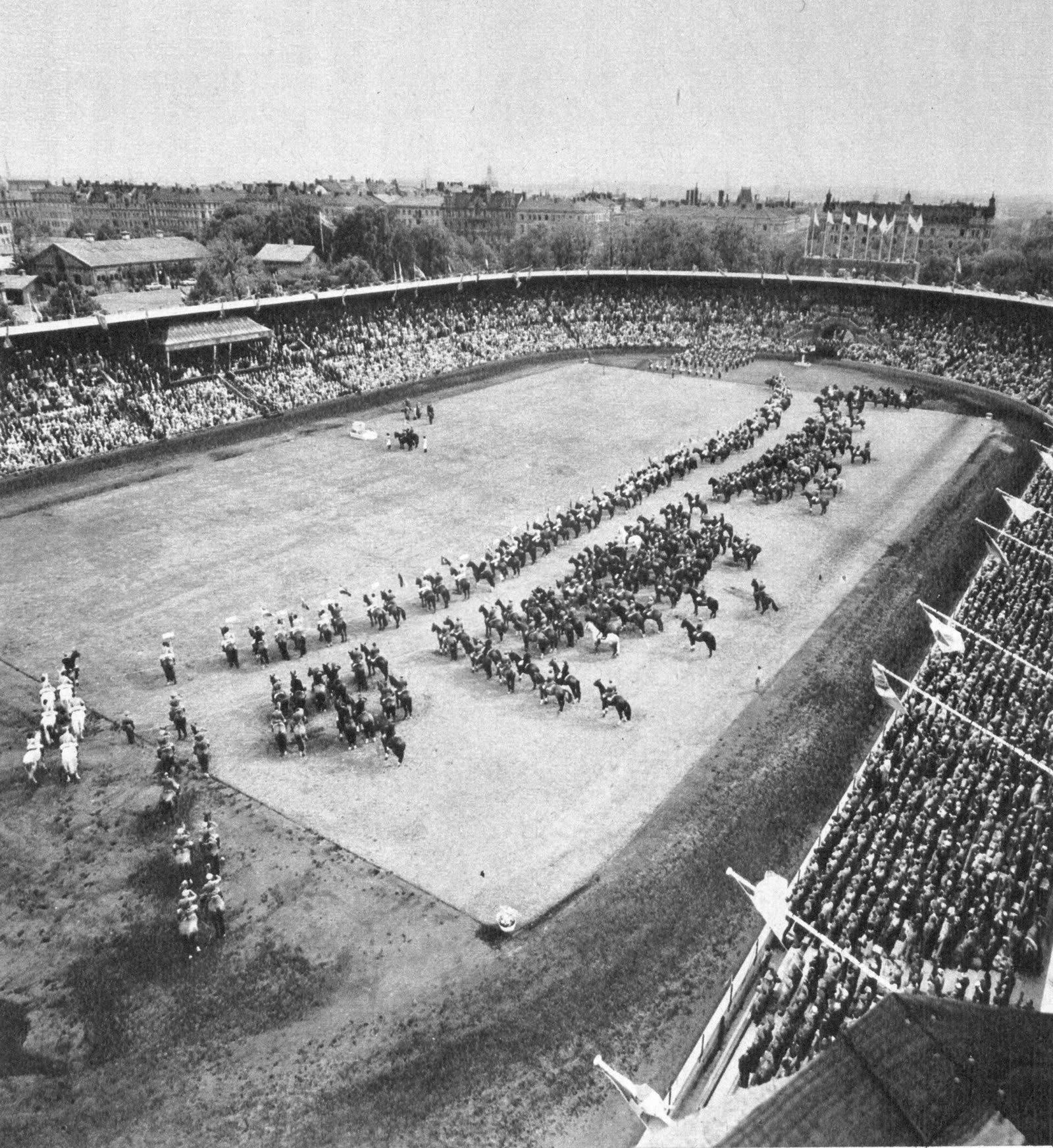
On June 10, 1956, mounted national delegations entered Stockholm Olympic Stadium beneath their flags. King Gustaf VI Adolf opened the Games, Henri Saint Cyr delivered the athletes' oath on horseback, and a flame from Olympia burned in an arena that had already staged an Olympic opening in 1912.[1][4] Everything about the ceremony said Olympics—except the place and the date.
These equestrian events officially belonged to the Melbourne Games. Melbourne's own opening ceremony would not take place until November 22, more than five months later and roughly 15,600 kilometres away.[4] One Olympiad had acquired two host cities, two continents, two seasons, and two openings.
The familiar explanation is that Australian quarantine rules kept the horses out. That is correct, but it leaves the most interesting history compressed into a footnote. A quarantine rule did not automatically create a second Olympic host. The split required a chain of decisions: Australian authorities treated animal-health policy as non-negotiable, the International Olympic Committee accepted an exception to its host-city model, Stockholm converted older equestrian capacity into a new organizing system, and riders moved their horses through a transport network built around the substitute venue.[1][2][3]
The result is a useful case study in how a hard rule outside sport can reorganize sport from the ground up.
The rule did not fit the Olympic clock
Melbourne won the right to host the 1956 Olympics by one vote over Buenos Aires.[3] The choice carried a problem that the selection did not resolve: Australia required imported horses to undergo a six-month pre-shipment quarantine. In 1953, a meeting of federal authorities in Canberra recommended that the rules not be altered for the Games.[2]
That decision was the first indispensable link in the causal chain. The policy did not forbid foreign athletes from entering Australia; it governed the living partners on whom three Olympic disciplines depended. A competition horse was not interchangeable freight. Dressage, jumping, and eventing tested a trained horse-and-rider combination, so replacing imported mounts with locally assigned horses would have changed the competition rather than solved its logistics.
Six months also meant more than an inconvenient delay. It would have pulled horses away from ordinary preparation and European competition schedules, imposed long-distance shipping at both ends of confinement, and forced national teams to build their Olympic campaigns around quarantine rather than performance. The FEI's history says the federal recommendation meant the end of the possibility of holding the equestrian events in Melbourne; the Stockholm organizing committee's official report describes Australia's import stipulations as making the events there impossible.[1][2]
The evidence supports a precise boundary. Quarantine explains why Melbourne could not receive the equestrian competition on acceptable terms. It does not, by itself, explain why the events survived instead of being cancelled.
An animal-health veto became a second host
Once the Australian decision held, the IOC considered three ways out. It could keep the events in Melbourne but allot local horses to visiting riders by lottery; remove equestrian sport from the 1956 programme; or find another host. The first option preserved the map by changing the horse-and-rider competition, the second preserved the single-host principle by losing the sport, and the third preserved the trained partnerships by splitting the Games. The relocation proposal won 30 votes to 13—one vote more than the two-thirds majority it required.[3]
Stockholm had moved early. The Swedish Olympic Committee decided to apply for the equestrian events in November 1953. On May 13, 1954, an IOC vote in Athens gave Stockholm 25 votes, ahead of Paris with 10 and Rio de Janeiro with eight; Berlin and Los Angeles received two apiece.[3] This was not an ordinary satellite venue. Swedish and Australian Olympic accounts describe a serious conflict with the Olympic movement's single-host logic.[3][5] The workaround preserved the sport while leaving the rest of Melbourne's programme intact: the IOC treated the Games as divisible at exactly one seam.
That decision created a new problem: Stockholm had won the events with barely two years to construct a functioning Olympic organization. The official report records an interim committee formed on June 8, 1954, less than a month after the IOC vote. On June 29, representatives working under Prince Bertil formed the Organizing Committee for the Equestrian Games of the XVIth Olympiad.[1] A regulatory veto had become a governance timetable.
Stockholm rebuilt the host-city package
Stockholm could move quickly because it was not starting with an empty map. Its 1912 Olympic Stadium remained available, the Swedish Equestrian Federation supplied institutional knowledge, and the city had military facilities that could be adapted into two Olympic villages at Karlberg and Näsby.[1][3] The old venue mattered, but so did the organizations capable of switching it back on.
The details in the official report show how much work sat behind the word “host.” Invitations went to national Olympic committees in December 1954. The FEI approved special competition regulations in Brussels in December 1955, and organizers distributed them in three languages the following January. Swedish authorities authorized Olympic identity cards that replaced passports and visas for accredited visitors between May 15 and July 15, 1956.[1]
Horses required their own geography. Overseas teams arrived on chartered aircraft. The Soviet horses reached Stockholm by ship from Tallinn after a fourteen-day journey; Portuguese horses spent five days and nights in a freight wagon from Lisbon. Photographs in the report show Australian grooms leading horses from an aircraft and other mounts being unloaded in Stockholm harbour.[1] Moving the event closer to Europe's equestrian networks did not eliminate transport risk. It concentrated the difficult journeys around a venue that could receive them without Australia's six-month condition.
Financing had to be improvised too. Sweden's state and Stockholm municipality offered a combined guarantee of 200,000 kronor rather than direct operating grants. The federation took an early 50,000-kronor bank loan, and an authorized public lottery sold 196,501 of 200,000 tickets, producing a surplus of 183,546 kronor. Ticket sales later brought in nearly 1.94 million kronor.[1] The event was therefore not rescued by a single IOC order. It was assembled through committees, credit, a lottery, ticket buyers, military accommodation, veterinary and stable planning, transport contracts, and an old stadium.
By the opening, 158 participants from 29 nations had come to Stockholm.[4] That scale matters because it distinguishes the event from a reduced qualifying meet. Stockholm staged six medal events and a full ceremonial programme, making the substitute host operationally complete for eight days.
Five months separated one Olympic present
The Stockholm competitions ended on June 17, 1956. Melbourne opened on November 22 and closed on December 8.[4] For equestrian athletes, the Olympics were already history by the time most competitors marched into the Melbourne Cricket Ground. The official unity of the XVIth Olympiad had to bridge a five-month gap.
Ceremony did part of that work. Stockholm used the Olympic flame, oath, flags, medals, and formal title to assert continuity with Melbourne.[1][4] The Australian Olympic Committee's account emphasizes the constitutional oddity; Stockholm's organizers answered it by reproducing the public rituals of a host rather than presenting the week as a detached championship.[1][5]
The causal mechanism is now clear. Quarantine supplied the hard constraint. Australia's refusal to create an Olympic exception made the constraint binding. The IOC preserved the sport by splitting the host function. Stockholm's surviving venue and equestrian institutions made that split executable. A dense layer of finance, accreditation, housing, transport, and ceremony made it credible.
Remove the first link and the horses likely go to Melbourne. Remove the later links and quarantine produces cancellation, not a second host. That distinction is why 1956 should be remembered as more than the year “the horses went to Sweden.” A sovereign rule about animal entry exposed the Olympics as a collection of systems that only looks indivisible when every system agrees on the same place and time.
Sources
- Organizing Committee for the Equestrian Games, The Equestrian Games of the XVIth Olympiad: Stockholm 1956, official report (1959) — organization, finance, accreditation, entries, transport, venues, and ceremonies.
- Fédération Equestre Internationale, FEI Focus No. 8 (2011), Olympic equestrian timeline — the six-month pre-shipment quarantine, 1953 Canberra decision, and Stockholm selection.
- Sveriges Olympiska Kommitté, “Så fick Stockholm ryttar-OS” (2026) — Melbourne's one-vote selection, the IOC's three options, Sweden's application, host voting, and financial risk.
- Sveriges Olympiska Kommitté, “Melbourne/Stockholm 1956” — official Swedish chronology, participation totals, event dates, and ceremonies.
- Australian Olympic Committee, “Melbourne 1956 makes history as equestrian events take place in Sweden” — the split's exceptional status within the Olympic host model.
- Wikimedia Commons, “OS 1956 Stockholm.jpg” — file record for the archival photograph of the 1956 equestrian opening ceremony.