The people waiting in Ames, Iowa, expected a racing car to look like one. They had stood outside for hours. When the American Thomas Flyer finally appeared, it came through at roughly six miles an hour. The Ames Times of March 5, 1908, reported their disappointment, then supplied a better category: “as an endurance contest it is delivering the goods.”[1]
The car was heading to Paris by going west. Before it arrived, its crew would borrow routes built for other kinds of transport, abandon a supposedly essential leg, and discover that reaching the finish first was different from winning. Following that journey reveals how much support an apparently independent machine needed to keep moving.
February: a touring car packs for an expedition
Six cars representing four countries left Times Square on February 12, 1908. The sponsors, Le Matin and The New York Times, had arranged an event that could supply newspaper readers with months of suspense. The American entry was a Buffalo-built, 60-horsepower Thomas Flyer, initially driven by Montague Roberts. Extra fuel tanks turned a production automobile into an expedition vehicle.[2]
Its preparations went well beyond petrol. The National Automobile Museum describes long wooden planks bolted along its sides, ready to become temporary tracks across snow and mud or bridges over streams. Holes in the floor admitted warmth from the engine to the driver's feet. The engine was started by hand crank; chains transmitted its power to the rear wheels.[5]
Those details give the journey a physical scale. The occupants had to start, steer, warm themselves beside, and repeatedly extract a heavy machine. Carrying a few lengths of timber acknowledged a limit that horsepower could not remove: sometimes the car would arrive somewhere before a usable surface did. The crew therefore packed part of the road with them.
That problem appeared almost immediately. Montgomery County's historian, drawing on the Amsterdam Evening Recorder, traces the leading cars onto the Erie Canal towpath on February 13 because snow obstructed the roads. An escort car turned toward Amsterdam, but the American and Italian racers missed the cue and continued. They eventually spent the night in Fonda.[2]
Across America, somebody else's route
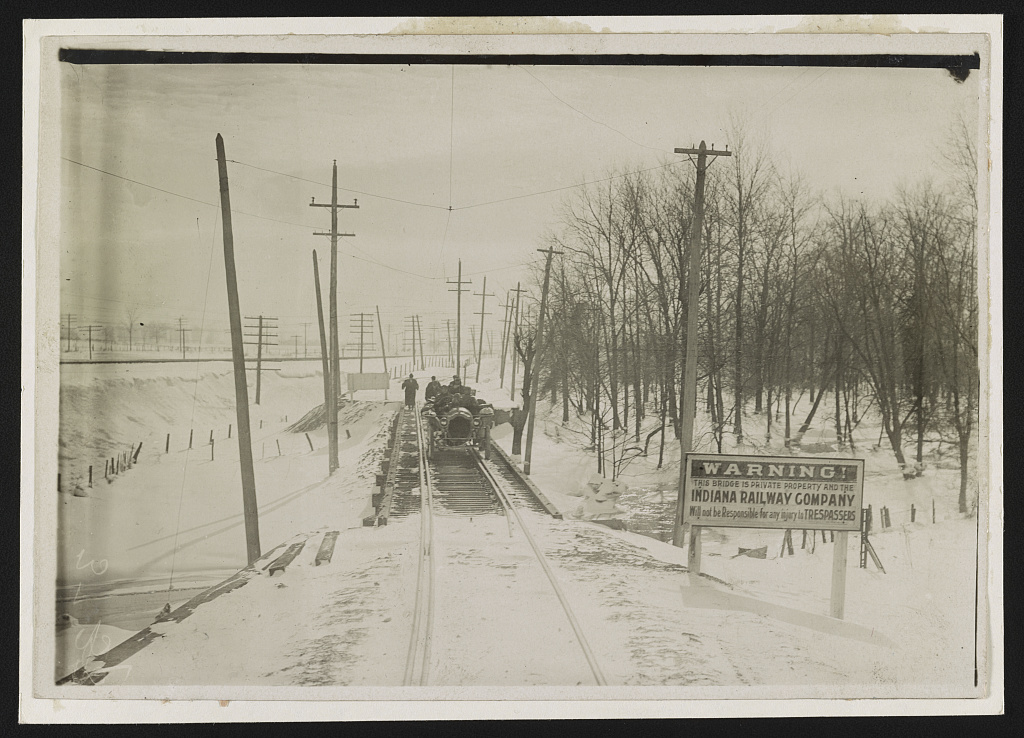
In the Library of Congress photograph above, the Flyer occupies a railroad bridge in snowy Indiana. The archive identifies the photographers as Spooner & Wells. The image records a specific crossing, rather than proving that the whole American journey followed railway tracks. Nevertheless, the bridge makes the car's dependence unusually visible: a structure built to carry trains was helping an automobile proceed.[3]
There is a difference between finding an opening through snow and finding a continuous route across a continent. A canal towpath could solve one day's obstruction. A railway bridge could solve another. Neither guaranteed an onward passage suitable for the same vehicle. The race joined these opportunities together, with the next interruption always capable of undoing an apparent gain.
By March 2, the Flyer had reached Ames. A photograph catalogued by Ames Public Library places it at Duff Avenue and Onondaga Street, with the lumber yard and town water tower behind it. The catalogue distinguishes Roberts, the driver, from George Schuster, the mechanic, and records George Miller's addition to the crew in Buffalo.[4]
That distinction matters to the story's changing center. The driver made the visible entrance into town; keeping the car fit for another entrance required work that spectators could scarcely judge from the roadside. The museum's preserved newspaper extracts also show the German Protos waiting in Ames for repair parts, then needing a dray team to pull it free west of the college.[1]
Local help was part of the event, as much as the cars' flags and their competing manufacturers. The disappointed spectators had briefly mistaken a long procession of repairs and recoveries for a sprint.
April: the map gives way
The American car reached San Francisco in March, then traveled by ship toward Alaska. On April 8 it landed at Valdez. Schuster investigated the trail inland by horse-drawn sleigh and concluded that crossing Alaska would require dismantling the car and moving it by dogsled. The committee dropped the Alaska and Bering Strait section and sent the Americans back toward Seattle.[6]
The distinction between the advertised route and the completed journey is essential. The racers never drove across the Bering Strait. Ames History Museum preserves an account by Italian participant Antonio Scarfoglio of receiving instructions in Seattle to sail for Japan instead. His disappointment shows that the lost northern crossing had been part of the adventure's appeal, even to a competitor still facing enormous difficulties elsewhere.[7]
For the Americans, reconnaissance carried a competitive cost. They had gone north because they were ahead, then lost time investigating a route the organizers abandoned. The committee granted them a fifteen-day allowance. An obstacle encountered on the ground had now become an adjustment to the race's arithmetic.[6]
Through Asia, the railway returns
The route continued through Japan to Vladivostok and across the Asian mainland. J. M. Fenster's history of the race follows Schuster leaving a disabled Flyer on foot to obtain parts after its gears failed. It also describes the German crew using railway beds and Schuster following their example, with special arrangements eventually made for the cars to travel on Russian tracks.[8]
The railway offered a way through, but introduced its own danger: trains already used it. A corridor could be physically passable while remaining difficult to share. Here the race demanded access and coordination as well as mechanical endurance. The earlier Indiana photograph helps us recognize the recurring situation without pretending that an American bridge and a Siberian railway presented identical conditions.
The rivalry continued amid these dependencies. Near Lake Baikal, the Americans arrived just as the Protos was being loaded onto a train connecting with a ferry. The Thomas crew missed that departure. In Fenster's account, a small difference in arrival time produced a much larger delay because movement depended on a scheduled connection.[8]
July: the winner arrives second
The Protos reached Paris on July 26; the Flyer followed on July 30. The German entry, however, carried a fifteen-day penalty for transporting its car by train from Ogden to Seattle. Combined with the Americans' Alaska allowance, the adjustments made the Flyer the winner despite its later arrival.[6]
Driving along a railway and shipping a car on a train were distinct acts. The race's outcome cannot be understood by treating every encounter with rails as the same shortcut. Nor can its changing course be understood simply by tracing a line between the starting and finishing cities. The organizers had to decide which interruptions belonged to the competition and which required compensation.
Back in March, the Ames reporter had already found the right question. How fast did the car look when it passed? Slowly enough to disappoint a crowd. What had it accomplished by continuing? Something much harder to see in a single afternoon. The Flyer reached Paris through repeated acts of repair, assistance, and negotiation. Its achievement becomes more impressive when the people and transport systems that made it possible remain in the picture.
Sources
- Ames History Museum, “Thomas Flyer in Ames”: reproduced reports from the Ames Times, March 5 and March 19, 1908, documenting spectators, repair delays, and assistance.
- Montgomery County Department of History & Archives, “Great Auto Race”: the American entry and the February 13 Mohawk Valley passage, drawing on the Amsterdam Evening Recorder.
- Spooner & Wells, Thomas Flyer crossing a railroad bridge in Indiana, 1908; Library of Congress, Prints and Photographs Division, LC-DIG-ds-10611. Direct archival photograph scan.
- Ames Public Library, Farwell T. Brown Photographic Archive, record 212.1203.3-5: the Flyer at Duff Avenue and Onondaga Street on March 2, 1908, and its crew.
- National Automobile Museum, Passport to Adventure, part 1, final spread, printed page 12: planks, floor openings, hand starting, and chain drive.
- Abbott Kahler, “Paris or Bust: The Great New York-to-Paris Auto Race of 1908,” Smithsonian Magazine, March 7, 2012: Alaska reconnaissance, time adjustments, and Paris arrivals.
- Ames History Museum, “1908 New York to Paris Great Race”: Antonio Scarfoglio's account of the changed Pacific crossing and the abandoned Alaska route.
- J. M. Fenster, “The Longest Race,” American Heritage, November 1996, volume 47, issue 7: Asian repairs, use of railway beds, and the Lake Baikal connection.