A ticket issued to Ian Bell on 16 July 1970 offered passage on the SS Great Britain. Its destination was scarcely an ocean away: from the Y Shed in Bristol's Floating Harbour to the Great Western Dockyard. Three days later, the ship would enter the dock from which it had been launched exactly 127 years earlier. The ticket survives in the SS Great Britain Trust's collection, numbered seven.[1]
It is a small object for such a satisfying ending. A ship leaves, suffers, disappears from everyday view, and finally comes home. Yet the ticket also records a change of occupation. The vessel's travelling life was ending; its life as something people had undertaken to keep was beginning. What, exactly, had Bristol recovered: an engineering achievement, a familiar landmark, or a responsibility without a final sailing date?
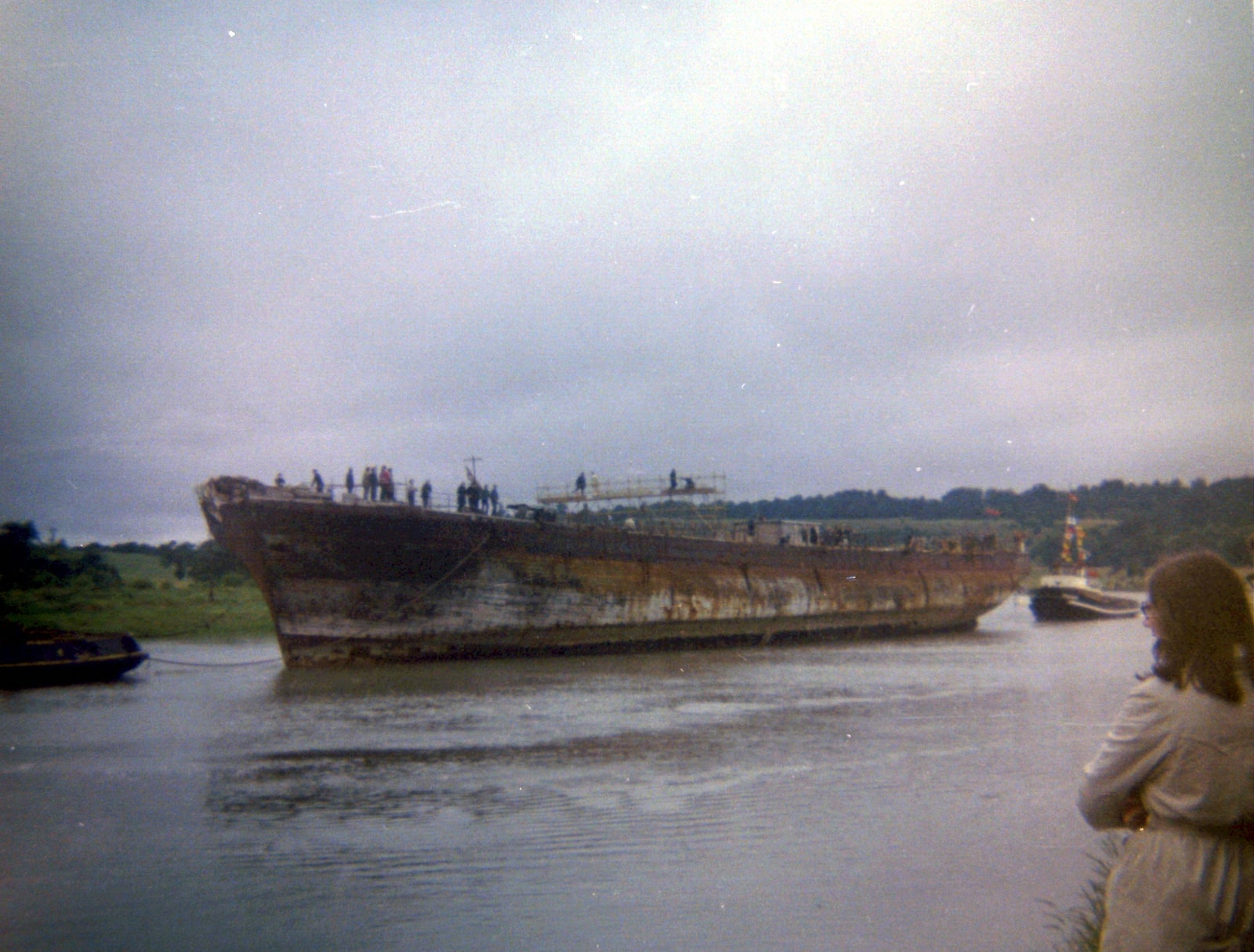
The photograph accompanying this article catches the return in progress, on the Avon in July 1970. Rust streaks the hull, tugs flank it, and a spectator watches from the near bank.[2] It belongs beside that ticket because neither object shows a finished museum. Both preserve the interval when moving an old hull and making it public heritage became the same event.
Learning to see a homecoming
The ship had lived several lives before the rescue. Launched in 1843, it served Atlantic and Australian routes, carried troops, and later became a sailing cargo vessel. After reaching the Falklands in 1886, it became a storage hulk. In 1937, it was taken to Sparrow Cove and sunk in shallow water; recovery followed in 1970.[4] Calling the return a homecoming gathered this wandering history around a single place of origin.
That meaning was not equally obvious to everyone watching. In recollections published by the Trust, Kim Hicks remembers standing on the Clifton Suspension Bridge as an eleven-year-old. The rusty vessel initially seemed an unlikely object of excitement. Her mother's enthusiasm, and the rose petals they scattered down towards it, helped make the occasion legible.[3] This is retrospective testimony, not a transcript made on the bridge. Its value lies in the remembered passage from puzzlement to participation.
Tug deckhand Dave Sidwell recalls a comparable change. Work that began as an ordinary assignment acquired a different weight as the crowds appeared. Pilot Chester Rickards remembered cheering so loud that radio communication became difficult, prompting hand signals and whistles.[3] These accounts make commemoration something people did around a working operation. A child throwing petals and a pilot trying to hear his colleagues occupied the same celebration differently.
The stories complicate the idea that an object carries its importance visibly on its surface. Rust did not explain Brunel to Hicks. Adults, crowds and gestures supplied the connection. The ship's future as a museum would depend on making such connections again, for visitors who had never seen the return.
The last few yards still needed water
The passage through Bristol was a sequence of practical problems. A pontoon had carried the hull across the Atlantic, but the narrower river required it to float independently. At Avonmouth, a crack was sealed with quick-drying concrete. The upriver movement took place on 5 July; the ship then waited in the harbour for sufficient water to reach its final berth on 19 July.[1]
The anniversary made a perfect commemorative date, but a ticket could not supply depth beneath the keel. Tide, clearance and careful positioning still governed the last movement. Bell's short passage is therefore a useful corrective to the photograph's promise of arrival: getting the ship into the city and getting it safely into its dock were distinct achievements.
A homecoming can happen in an afternoon. Securing the thing that has come home takes longer.
A sea made of glass
By 1999, a conservation study warned that continuing corrosion could leave the hull unviable as a visitor attraction within 25 years. Cardiff University's account of the research explains the difficulty: chlorides retained in historic iron can combine with atmospheric moisture to sustain deterioration after recovery.[5] Removing the ship from seawater had not removed the conditions of its destruction.
The response changed the dock itself. In 2005, a glass barrier at waterline level enclosed the lower hull in a controlled environment. A shallow covering of water gave visitors above it the impression of a ship afloat. Below, dehumidifiers maintained the dry conditions needed for conservation, as engineer Nicola Grahamslaw describes in her later account of the system.[6]
There is an elegant tension in that arrangement. The apparent sea helps a visitor imagine departure; the machinery beneath it enables the ship to stay. The glass is both stage setting and protective enclosure. Here, the means of keeping an object alive also help tell its story.
Even the humidity target expresses a choice. Cardiff's case study describes 20 percent relative humidity as an operational compromise for controlling corrosion, rather than the lower level associated with preventing it in the experiments. The research connected expected survival with the resources available to maintain the environment.[5] Preservation acquired a budget, a measurable rate of loss and a continuing obligation to check conditions.
That distinction matters. “Saved” can sound like a completed action. The hull's survival depends on decisions that have to be sustained after the rescuers, donors and cheering spectators have gone.
Which ship should survive?
Restoration also required choosing what visitors would encounter. National Historic Ships describes a museum containing several historical moments: reconstructed early passenger interiors and machinery, accommodation representing troop service, and emigrant steerage informed by contemporary records. Part of the bow remains unreconstructed so that the original framing and plating can be seen.[4]
This is a form of historical editing. Rebuilding every compartment to one date would privilege one career; presenting different periods lets the same hull carry several. The exposed structure serves another purpose. It offers a place to distinguish the surviving vessel from the researched environments built around it. A convincing room and an original iron plate make different kinds of claims on a visitor's trust.
Care has its own changing history. The Trust's sustainability account describes work on sensors, fans, heat recovery and operating controls to reduce the energy demanded by dehumidification.[7] Keeping the ship available to future visitors creates costs in the present, including energy use. The duty inherited from 1970 therefore includes improving the machinery that earlier conservators installed.
Bell's ticket admitted him to a journey with an endpoint. The responsibility assumed around that journey has none so tidy. The most durable commemoration of the homecoming happens in the repeated work of inspecting, interpreting and maintaining what returned. Bristol's welcome is renewed whenever someone makes it possible for another visitor to meet the ship.
Sources
- SS Great Britain Trust / Bristol Dockyards, “The Last Ticket, 1970” — collection item BRSGB-2019.00036, Ian Bell's passage and the final stages of the return.
- Clark Photo Archive, “SS Great Britain returns to Bristol, 1970,” via Wikimedia Commons — archival photograph of the July return; CC BY 2.0.
- SS Great Britain Trust / Bristol Dockyards, “The SS Great Britain Homecoming, 1970” — published recollections of Kim Hicks, Dave Sidwell and Chester Rickards.
- National Historic Ships UK, “ss Great Britain,” register entry 76 — service history and statement of significance, including original fabric and reconstructed interiors.
- Cardiff University, REF 2014 impact case study on preservation of archaeological iron — 1999 condition assessment and research underpinning the ship's humidity controls.
- Nicola Grahamslaw, “SSGB Update,” Iconnect, Autumn 2025, pp. 32–33 — the glass enclosure, dry-air system and continuing conservation engineering.
- SS Great Britain Trust / Bristol Dockyards, “Sustainability” — reducing energy demand while maintaining conditions that protect the hull.