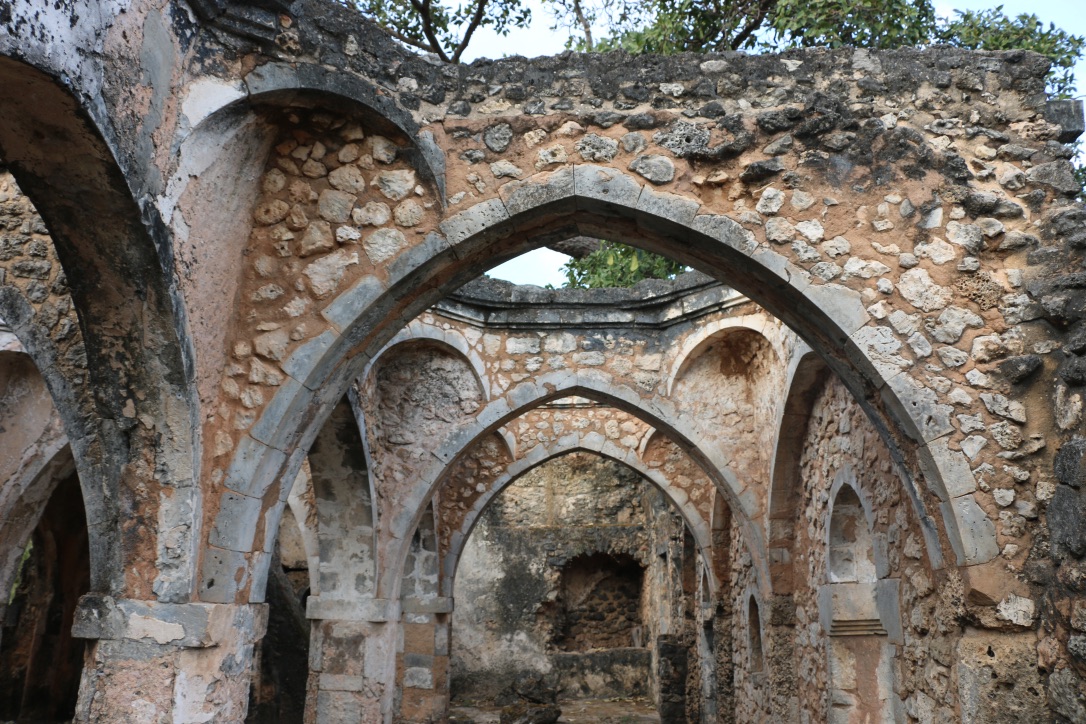
The ruined Great Mosque at Kilwa Kisiwani can look like an answer before it becomes a question. Its coral-stone arches, domes, and orientation toward Mecca place the Tanzanian island inside an Islamic and Indian Ocean world. Persian ceramics and Chinese porcelain reached the port; gold and ivory moved outward. By the thirteenth and fourteenth centuries, Kilwa was one of the coast's great commercial cities.[5]
For much of the twentieth century, historians and archaeologists treated those connections as an origin story. If the coast had mosques, masonry, imported goods, and chronicles naming ancestors from Shiraz, then Persian or Arab settlers must have brought urban civilization to eastern Africa. A later corrective reversed the direction of explanation: Kiswahili is a Bantu language, early coastal settlements grew from African farming and fishing communities, and the material record shows local continuity beneath the spectacular imports.[1][2][3]
The old foreign-founder model is no longer tenable. But its collapse did not make every Persian connection imaginary. Ancient DNA published in 2023 found substantial Asian-related ancestry in many people buried in medieval Swahili stone towns, with mixture beginning by about 1000.[4] That result does not force history back into a contest between "African" and "foreign." It exposes the contest itself as the problem. Cities, languages, family lines, trade networks, and claims to prestige do not all have the same kind of origin.
The foreign-founder case began with what survived best
Stone privileges one version of the past. Coral mosques, tombs, palaces, and houses remain visible after earth-and-thatch buildings have disappeared. Imported bowls enter collections more readily than local food remains or ordinary pottery. Written chronicles travel farther than unwritten household histories. Early researchers therefore built a coast from its most durable and cosmopolitan evidence, then mistook that selection for the whole society.[1][2]
The result was a diffusionist sequence: overseas merchants arrived, introduced Islam and masonry, founded towns, and produced a distinct coastal people. Thomas Spear's 1984 study of Shirazi traditions showed why this interpretation felt self-confirming. European scholars brought a racial assumption that major innovation must have come from outside Africa; written and oral genealogies supplied Persian and Arabian founders. Each archive appeared to validate the other, while the Bantu language, African economy, and mainland relationships of coastal communities received less attention.[3]
This does not mean Swahili narrators merely repeated a European invention. Claims of Shirazi descent existed within coastal societies and did local work. A prestigious overseas ancestor could establish seniority, Islamic standing, rights in a town, or distinction between lineages. In that setting, a genealogy is neither a passenger manifest nor a fairy tale. It is historical memory shaped into a social claim. Spear's intervention was to ask what such a tradition accomplished when told, instead of reading every named founder as a literal migration report.[3]
The distinction matters at Kilwa. A version of the Kilwa Chronicle was written down in the sixteenth century, centuries after the period it narrates. It can preserve memories of Indian Ocean movement and marriage while also arranging the past around later ideas of dynasty and legitimacy. Its lateness does not make it useless. It changes the question from "Did every founder arrive exactly as described?" to "Why did Persian ancestry become the authoritative way to narrate belonging?"[3][4]
The African-continuity case changed what counted as evidence
From the late twentieth century, archaeology and historical linguistics made the coast legible below the stone line. Settlements of farmers, herders, fishers, and craftspeople existed along eastern Africa before the mature stone towns. During the first millennium, some of those communities traded with ships following the monsoon system. From the seventh century onward, shared material practices connected coastal settlements; around the turn of the second millennium, many towns reorganized, expanded maritime exchange, adopted Islam more widely, and built first in coral for mosques and tombs and later at greater scale for houses.[1][2][4]
That is development through connection, not civilization delivered intact. The ordinary assemblage is decisive. The 2023 genetic study summarizes earlier archaeological work showing that imports usually form less than five percent of finds at coastal sites, while crops, livestock, ceramics, and craft traditions continue from earlier African settlements.[4] Kiswahili supplies an independent line of evidence: its grammar and core history are Bantu even though centuries of exchange added vocabulary from Arabic, Persian, and other Indian Ocean languages.[1][4]
Kilwa's own chronology fits this layered account. The island was occupied from the ninth century; its Great Mosque began in the eleventh century and was enlarged in the thirteenth; Kilwa minted coins between the eleventh and fourteenth centuries; and its merchants connected inland African production with Arabia, India, and China.[5] None of those facts requires choosing between a sealed African interior and a transplanted Asian colony. The city was African because it grew within African communities and landscapes. It was cosmopolitan because those communities made the ocean part of their political, religious, and domestic world.
The corrective has its own possible overreach. Proving local continuity can become an argument for cultural purity if every migration is treated as a return of the colonial story. Jeffrey Fleisher and colleagues warned in 2015 that the desire to demonstrate local origins had sometimes pushed continuity too hard, making later maritime forms appear fully present in much earlier villages.[2] A history can reject foreign creation without pretending that urban growth, Islamization, architecture, and seaborne family formation changed nothing.
The DNA recovered migration, not a colonial verdict
The 2023 Nature study added an archive that earlier rounds of the debate did not possess. Researchers generated ancient DNA from 80 individuals associated with six medieval and early modern coastal towns, plus an inland site, with the coastal burials dating mainly from 1250 to 1800. Many individuals carried both African- and Asian-related ancestry. The Asian component was largely Persian-related before about 1500, and the ancestry pattern was strongly sex-biased: African ancestry came predominantly through women and Persian-related ancestry predominantly through men. Genetic estimates place the beginning of this mixture by about 1000.[4]
At first glance, this can sound like vindication for the Shirazi chronicles. It is evidence that men with Persian-related ancestry formed families with African women on the coast, and its timing overlaps with expanding Islam and major changes in coastal towns. It therefore rules out an opposite purity story in which significant migration and intermarriage never happened.[4]
But it does not restore the claim that Persians founded Swahili civilization. Three of the sampled towns—Mtwapa, Songo Mnara, and Faza—did not yet exist when the inferred mixing began. The study's authors conclude that admixed populations later moved into those towns; they were not a foreign colonizing population arriving to construct already waiting cities. The children of these families also adopted a Bantu language, consistent with cultural transmission through African mothers and communities.[4]
The sample boundary is equally important. Most remains came from prominent graves in high-profile towns and are likely to represent elites better than the coastal population as a whole. The sites are weighted toward Kenya; some sampled individuals at Lindi and Songo Mnara showed no recent Asian ancestry; and large stretches of the Swahili world remain unsampled. DNA can identify biological relationships and estimate mixture. It cannot by itself tell us who designed an institution, why a lineage claimed Shirazi status, how an ordinary household understood belonging, or when a culture began.[4]
Each archive answers a different origin question
The apparent contradiction eases once the evidence is kept at its proper scale. Linguistics traces a language community and the direction in which speech was transmitted. Settlement archaeology follows houses, food, craft, exchange, and changes in built space. Chronicles preserve selected memories and show how later communities authorized rank and belonging. Genetics reconstructs ancestry among particular buried people. Monumental ruins reveal urban resources and religious practice, but their durability can hide the majority who lived outside stone walls.[1][2][3][4]
The foreign-founder interpretation was strongest where chronicles, visible architecture, imported objects, and the new genetic evidence converged. Its failure lies in turning connection into creation: it cannot explain the older African settlement base, Bantu language, local material majority, or the fact that admixed communities developed rather than simply replaced the towns around them.[1][2][4]
The African-continuity interpretation is strongest where independent archives agree. Language, settlement sequences, subsistence, ceramics, and regional exchange all place Swahili formation on the eastern African coast. Its weak version, however, turns a necessary correction into an impermeable boundary. It cannot comfortably absorb Persian-related ancestry, Indian Ocean marriages, Islamization, or the deliberate cosmopolitanism built into stone houses, mosques, and commercial life.[1][2][4]
Where the debate now stands
The best-supported synthesis is not a compromise halfway between two origin myths. It changes the unit being explained. Swahili towns arose from African coastal communities whose language and material life had deep regional roots. Those communities became more urban, Islamic, and maritime through choices made within a connected ocean. Migrants from Persia, Arabia, India, and elsewhere did arrive; some formed families and entered elite genealogies. Their presence altered coastal society without becoming its sole author.[1][2][4]
The Shirazi traditions look different within this synthesis. They may carry a refracted memory of real Persian-linked migration, especially in the striking overlap between genealogical claims and the genetic evidence. They also arranged that memory to answer later questions about dynasty, rank, land, and religious legitimacy. A tradition can contain historical contact without functioning as a literal foundation charter.[3][4]
Future evidence could shift parts of this map. DNA from securely dated, pre-1000 burials could show whether mixture began earlier or varied more sharply by region. More non-elite cemeteries could reveal whether the current ancestry pattern belongs mainly to stone-town elites. Earlier manuscripts, better-dated village sequences, and archaeology from Somalia, Mozambique, and the Comoros could test how far Kilwa- and Kenya-centered models travel.[1][4] What would not follow from one new percentage is a verdict on who "made" an entire civilization.
The Great Mosque at Kilwa is therefore neither proof of an imported city nor proof of an isolated one. Its coral came from the coast; its prayer faced beyond it. Both facts belong to the same history.[5][6]
Sources
- Chapurukha Kusimba and Jonathan R. Walz, "Debating the Swahili: Archaeology Since 1990 and into the Future," Archaeologies 17 (2021) — review of the foreign-origin model, African foundations, and post-1990 archaeological debate.
- Jeffrey Fleisher et al., "When Did the Swahili Become Maritime?" American Anthropologist 117 (2015) — open-access synthesis of first-millennium settlements, maritime reorientation, and the limits of a simple continuity model.
- Thomas Spear, "The Shirazi in Swahili Traditions, Culture, and History," History in Africa 11 (1984) — analysis of diffusionist historiography and the social work performed by Persian-origin genealogies.
- Esther S. Brielle et al., "Entwined African and Asian genetic roots of medieval peoples of the Swahili coast," Nature 615 (2023) — ancient-DNA evidence, archaeological context, sampling limits, and the sex-biased ancestry pattern.
- UNESCO World Heritage Centre, "Ruins of Kilwa Kisiwani and Ruins of Songo Mnara" — official chronology and description of Kilwa's architecture, commerce, coinage, and urban remains.
- Wikimedia Commons, "Great Mosque Kilwa Kisiwani Tanzania.jpg" — source page and metadata for Janetmpurdy's 2016 photograph used as the article image.