The polished granite memorial at Duane Street in Lower Manhattan looks like the conclusion of a long story. A ramp enters an open-air chamber; a wall gathers symbols from across the African diaspora; burial mounds mark where human remains were returned to the earth. Architect Rodney Léon's structure gave the site a permanent public form in 2007.[6]
But the African Burial Ground became a memorial before the monument was built. Its decisive features were worked out in arguments, vigils, research protocols, and ceremonies between 1991 and 2003. People challenged a federal building schedule, insisted that excavated bodies be treated as ancestors, changed who directed the scientific work, and required that the dead come home. The architecture came last because the meaning of the place had to be negotiated first.
That sequence gives the site its sharp historical question: who has the authority to decide when the dead are a construction problem, a scientific collection, or a community of ancestors?
The burial ground was mapped before it was remembered
“Rediscovery” can make the events of 1991 sound accidental and clean: workers dig, bones appear, history returns. The evidence is less tidy. A mid-eighteenth-century map recorded the burial ground, and a federally required cultural-resource survey examined the area in 1989, before work began on a 34-story office tower at 290 Broadway. What surprised investigators was not the bare existence of a cemetery but the survival and scale of intact burials beneath later layers of the city.[1]
The ground had served enslaved and free Africans from roughly the 1690s to the 1790s, outside the northern edge of colonial New York. Shut out of churchyards, African New Yorkers buried family and community members across an area that eventually covered about 6.6 acres. The National Park Service estimates that as many as 15,000 people may remain within the larger historic cemetery.[3][5]
When the city expanded, the burial ground was closed, divided into lots, covered with fill, and built over. That fill helped protect many graves even as streets and buildings removed the cemetery from everyday sight. The site was therefore neither wholly unknown nor consciously preserved. It survived physically while disappearing from the civic story New York told about itself.
In 1992, the dispute changed the category of the site
Construction and archaeology initially proceeded together. The later project synthesis published by Howard University Press and hosted by the General Services Administration is unusually candid about the consequences: excavation began without an approved research design adequate to the number and significance of the burials; construction activity damaged some remains; storage practices drew criticism; and the work continued under intense schedule pressure. By July 1992, more than 400 burials had been removed or exposed.[2]
African American activists, clergy, scholars, preservationists, and city officials objected not only to broken bones or hurried technique. They objected to the governing assumption that scientific recovery could automatically “mitigate” the destruction of a sacred place. Public meetings, ceremonies, and protests asserted a different relationship. These were not ownerless specimens simply because lineal descendants could not be named. A broader African descendant community had standing in decisions about excavation, study, reburial, and commemoration.[2][7]
That community did not speak with one voice. Some participants wanted immediate reburial; others supported analysis before return. The disagreement matters because it prevents a comforting but false story in which community feeling simply defeated science. The more consequential demand was that neither the construction timetable nor archaeology alone could set the terms.[2]
On July 27, 1992, Representative Gus Savage convened a congressional hearing in New York. Witnesses attacked the inadequate research plan, damage to burials, and absence of meaningful descendant-community participation. The proposed pavilion beside the office tower was eventually removed from the design, excavation in that portion of the site stopped, and the archaeological field project formally closed in October. The tower itself was completed in 1994 where excavation had already occurred; unexcavated ground was left unbuilt. Preservation here was not a total victory over development. It was a boundary forced into the project.[2]
Howard University changed what research was for
The excavated remains were transferred on November 4, 1993, to Howard University's W. Montague Cobb Biological Anthropology Laboratory after a candlelight vigil and ancestral tribute in New York.[4] Under scientific director Michael Blakey, the project treated the descendant community as its ethical client. That phrase altered both accountability and method.
Public engagement helped set four central questions: the population's origins, transformations from African to African American identities, quality of life under enslavement, and modes of resistance. Community participants urged researchers to speak of “enslaved Africans” rather than reducing people to “slaves,” and to replace the historical label “Negroes Burial Ground” with “African Burial Ground.” The research team included specialists in Africa and the African diaspora and declined to turn socially constructed racial categories into biological facts.[2]
This was not a retreat from evidence. The official synthesis records that community members approved some invasive genetic and isotope studies when those methods could address questions about origin. The 419 people inventoried at Howard—nearly half of them children under twelve—yielded evidence about labor, health, migration, burial care, and the persistence of human dignity under enslavement.[2][3] What changed was the relationship around that evidence: research had named obligations, public questions, and an endpoint.
Reinterment made the memorial visible
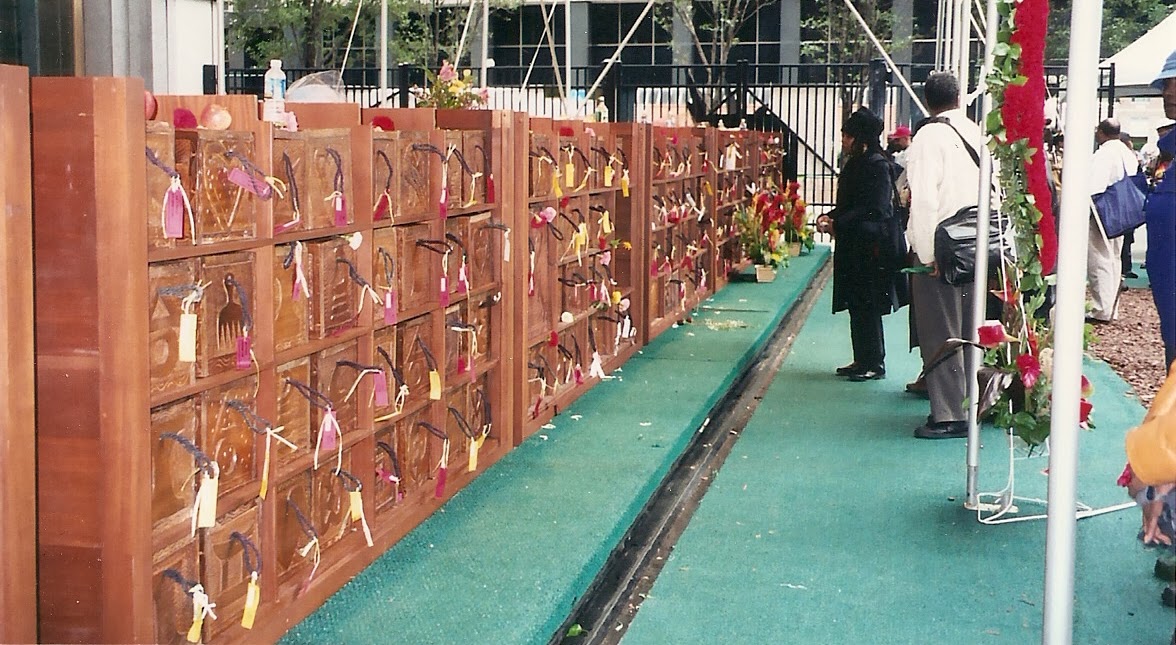
In autumn 2003, the Rites of Ancestral Return carried the ancestors from Howard University through a multi-city procession to Lower Manhattan. Each person's remains was placed in a hand-carved coffin; the coffins were gathered into seven crypts and returned to the preserved ground on October 4. The National Park Service records some 10,000 participants and nearly 8,000 handwritten messages buried with the ancestors.[3][4][9]
The ceremony did not erase the years of laboratory study. It completed an agreement about what study was allowed to mean. Human remains that had moved through construction trenches, temporary storage, and analytical work returned as ancestors in individual coffins, accompanied by words from the living. Libation, procession, and reburial made the descendant relationship physical.
This is why 2003, rather than 2007, is the crucial commemorative date. A memorial is not only an object designed for later visitors. It is also a set of practices that determines custody, speech, and return. By the time granite arrived, the site already had a public, a ritual, and a grave.
Granite fixed a settlement into place
Presidential Proclamation 7984 reserved roughly 15,000 square feet as African Burial Ground National Monument on February 27, 2006.[5] Léon's outdoor memorial opened the following year. Its Ancestral Libation Chamber is open to the sky; its reinterment grove keeps visitors beside the burial mounds; its Wall of Remembrance makes loss and non-forgetting part of the approach.[6]
The design uses Sankofa—the injunction to return to the past in order to move forward—as a present-day ethic of memory. That symbolism should not be confused with certainty about every archaeological detail. Scholars disagree, for example, over whether a heart-shaped tack pattern on one coffin was an Akan Sankofa or part of an Anglo-European coffin-decoration tradition. The uncertainty does not empty the modern symbol of meaning. It draws a useful boundary between what the excavation proves and what a descendant community chooses to make from the past.[8]
The visitor center that opened inside the federal building in 2010 completed another part of the settlement. It presents colonial New York, the scientific findings, and the community campaign that preserved part of the cemetery.[9] Tower, exhibits, outdoor chamber, and graves now occupy the same federal project. Their coexistence is uncomfortable, and historically honest: most of the burial ground still extends beneath the working city, while one preserved portion records the point at which construction was made to stop.
The African Burial Ground did not become public memory merely because bones were found. Discovery supplied evidence; activism changed authority. The descendant community made research answerable, Congress altered the building footprint, Howard joined scientific inquiry to an obligation of return, and reinterment restored the excavated dead to the ground. The monument matters because it preserves that chain—not a frictionless recovery, but a limit successfully placed on what institutions could do to the dead.
Sources
- National Park Service, “History & Culture: African Burial Ground National Monument” — the 1989 survey, 1991 federal construction, scale of the cemetery, and the role of civic engagement.
- U.S. General Services Administration and Howard University, The Skeletal Biology, Archaeology, and History of the New York African Burial Ground: A Synthesis of Volumes 1, 2, and 3, 2009 — official project history, excavation record, descendant-guided research design, findings, and reinterment.
- National Park Service, Christopher Moore, “African Burial Ground in History” — historical use of the cemetery, the 419 excavated individuals, the 2003 reinterment, and participation in the rites.
- National Park Service, “Reinterment” — the 1993 transfer to Howard University, the Rites of Ancestral Return, coffins, crypts, and final return to the site. NPS page and photograph of the 2003 reinterment coffins used for the article image.
- The White House, Proclamation 7984, “Establishment of the African Burial Ground National Monument,” February 27, 2006, reproduced by the National Park Service — the protected parcel, historic period, and monument purpose.
- National Park Service, “Ancestral Chamber” — the memorial competition, Rodney Léon's design, and the 2007 completion. Rodney Léon and AARIS Design, memorial elements and meanings.
- Spencer P. M. Harrington, “Bones & Bureaucrats,” Archaeology, March/April 1993 — a contemporary account of the excavation conflict, protests, congressional intervention, and struggle for descendant-community authority.
- Science History Institute, “The African Burial Ground,” Distillations, 2023 — an interview-rich account of the project and the disputed possible Sankofa reading of the coffin motif.
- National Park Service, “African Burial Ground NM Opens New Visitor Center,” February 27, 2010 — the procession, reburial, 2007 memorial, visitor center, and community-preservation narrative.