
A strike creates an awkward problem for a camera. Its decisive act is labor withheld: a miner does not descend, a train does not depart, a printer does not set type. British Pathé's archival item General Strike In England (1926) begins by making that refusal visible through emptied places—a colliery without its workforce, still rails, a nearly vacant platform. It then turns to crowded roads, improvised lifts, pedestrians, trade-union banners, and a mass meeting.[1]
The sequence seems to give the General Strike a compact visual arc: work stops, ordinary movement is rerouted, organized labor gathers. But the archive's own description interrupts that apparent chronology. It identifies at least part of the march and rally material as May 1, before the all-out stoppage began at midnight on May 3–4. The film is not one camera's continuous report from the nine strike days. It is a composite object whose editing makes separate moments look simultaneous.[1][3]
That disclosure does not make the footage false. It makes the footage historical in a more demanding way. The empty infrastructure documents stoppage; the streets document disruption and adaptation; the May Day crowd documents organized strength and expectation immediately before the stoppage. Their combination shows how an archive can preserve an event while also preserving the visual choices used to explain it.
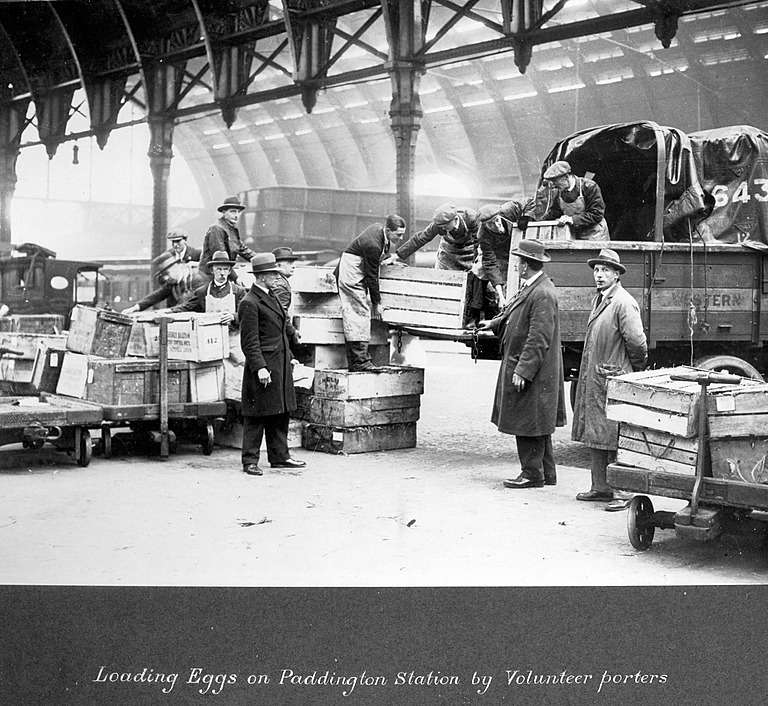
Image context: the cover is a genuine archival photograph, not a YouTube thumbnail or a frame extracted from the film. It shows volunteer porters loading eggs at Paddington Station during the strike. The National Archives preserves it in railway record RAIL 253/76. The staged pose and handwritten caption are part of the original record, revealing how substitute labor was presented as orderly public service.[2]
Before the film: a coal dispute becomes a national test
The General Strike grew from a long dispute over who would absorb the crisis in British coal. Mines had returned to private ownership in 1921 after wartime control. Mine owners sought lower labor costs as exports weakened and the industry struggled. A government subsidy postponed confrontation for nine months, but it expired on April 30, 1926. Owners then locked out miners who would not accept lower wages and longer hours.[2][3]
On May 1, a conference of trade unions approved the Trades Union Congress plan for sympathetic action across crucial industries. On May 2, printers at the Daily Mail refused to print an editorial attacking the proposed strike; the government treated that refusal as a constitutional escalation and ended the last negotiations. The stoppage began at midnight and was fully visible on May 4. More than 1.5 million workers in transport, printing, docks, iron and steel, gas, electricity, and other sectors stopped work in support of the locked-out miners.[2][3]
The action was therefore both industrial and communicative. Transport slowed, but so did the ordinary production of news about transport. The government published the British Gazette, edited by Chancellor of the Exchequer Winston Churchill, while the TUC answered with the British Worker. The government paper described the strike as a threat to constitutional government and emphasized food, fuel, and rail services resuming. The union paper emphasized discipline, solidarity, and an industrial dispute rather than a revolutionary seizure of power.[2][4]
Moving images entered the same struggle over legibility. A camera could show a motionless pit, but it could not show every reason the pit was motionless. It could show a crowd, but a crowd filmed on May Day did not automatically document an action taken three days later. The surviving Pathé item becomes most useful when those limits remain visible.
The archival item and its boundary
The embed below is the official British Pathé YouTube publication of General Strike In England (1926), identified by the archive as film 2524.27. Its description inventories idle industrial sites, disrupted travel, a trade-union march, and a large rally; it also supplies the crucial May 1 qualification.[1] The page does not name the camera operator, establish an original newsreel issue date, or explain when these shots were assembled into the surviving item. It would be misleading to invent that missing chain. What can be established is that British Pathé holds and republishes the footage, and that its present catalogue treats the chronology as mixed.
Empty places can show a stoppage, not its cause
The opening images make an argument with subtraction. Industrial structures remain in place, but the expected bodies and motion are missing. A pithead without miners and rails without trains turn absence into evidence. The shots are especially effective because modern industry usually announces itself through repetition: shifts enter, machinery turns, wagons move, timetables recur. Stop the repetition and the system suddenly looks like scenery.[1]
Yet an empty platform is politically incomplete. Viewed alone, it cannot distinguish solidarity from lockout, fear from instruction, or a shortage of workers from a managerial decision not to run a service. The written record supplies the relationships that the image cannot. Miners had been locked out over proposed terms; the TUC called selected groups out in sympathy; unions told workers in food distribution, health, sanitation, and some construction to remain at work. This was an organized and bounded withdrawal, not a mysterious nationwide disappearance.[2][3]
That boundary matters. The strike did not attempt to stop every socially necessary task. It targeted sectors capable of exerting pressure while allowing selected essential services. The vacant industrial image is therefore accurate but underspecified. It becomes history only when joined to the decisions that produced it.
Movement becomes evidence of both disruption and resistance
The film next finds motion away from the normal network. Cars crowd the road; people share rides, stand in trucks, or walk. These scenes do not show business as usual. Their very improvisation demonstrates that the ordinary system has failed. A lift in the back of a lorry is visible proof that a tram or train is not available.[1][3]
But improvised movement could be framed in opposite ways. To supporters of the strike, it measured the reach of collective action. To the government and Conservative press, every moving vehicle could become reassurance that volunteers and emergency organization were defeating paralysis. The British Gazette repeatedly paired claims of calm with reports that railway services and supplies were returning, while the British Worker insisted that the stoppage remained solid and orderly.[4]
The cover photograph sharpens this contest. Eggs do not move themselves through Paddington Station. Men lift crates between carts and a truck while supervisors or observers face the camera. The National Archives identifies them as volunteer porters, part of a counter-mobilization that drew heavily on ex-servicemen, students, and middle- and upper-class recruits. Many drove vehicles or worked in power and printing because unfamiliar heavy manual work required skills they did not possess.[2]
The photograph therefore records continuity and rupture at once. Eggs are being distributed, but by a replacement workforce assembled because the normal workforce is absent. Calling that scene simply “London functioning” would hide the labor substitution that made it possible. Calling it simply “the country stopped” would hide the government's real capacity to reroute selected flows. The archive is strongest when both facts remain in frame.
The crowd belongs to May Day—and to the film's argument
The later crowd scenes solve a problem the empty pit cannot. Banners, a procession, speakers, and a park filled with people give collective intention a body. One banner carries the international labor slogan “Workers of the World Unite.” The scale of the rally turns scattered workplace decisions into a public movement.[1]
Then the catalogue changes the reading: this is at least partly a May 1 demonstration, filmed while the government and the TUC were still negotiating and before the general stoppage. The crowd is not a neutral shot of “the strike” at an unspecified midpoint. It records anticipation, May Day ritual, and organized labor's visible capacity on the eve of the crisis.[1][3]
That makes the edit more revealing, not less. By placing the rally after empty mines and altered journeys, the film lets a pre-strike crowd explain the stoppage retrospectively. The sequence supplies agency to spaces that otherwise look merely deserted. It tells the viewer: these systems are still because this organized public has chosen solidarity.
The inference belongs to the edit rather than to every frame. No single crowd member in the May Day material can be assumed to have struck, and no banner proves what happened at a particular mine or depot. The montage compresses geography, date, and motive into a national picture. Its historical value lies partly in seeing that compression happen.
Nine strike days did not end the miners' struggle
On May 12, Prime Minister Stanley Baldwin told the House of Commons that the TUC had called off the General Strike. The announcement ended the sympathetic national action, not the underlying coal dispute.[5] The miners remained out for months. By late November, they returned on worse terms, including lower wages and longer hours. In 1927, Parliament restricted sympathetic strikes and mass picketing through the Trade Disputes and Trade Unions Act.[2]
That unequal ending is another reason not to let the film's compact arc stand alone. Empty industry, improvised streets, and a huge crowd make a satisfying visual whole. The political sequence did not close so neatly. The TUC stopped the general action after nine days; reinstatement was uneven; the miners continued without the same national leverage; legislation narrowed what organized labor could lawfully do next.[2][5]
The film survives as neither a fraud nor a transparent window. It is an assembled primary source. Its shots preserve real places, real disruption, and real collective display, while its catalogue preserves the warning that some of those images came before the event they now illustrate. That warning is the key to viewing it well. Archival film does not become less valuable when its seams are disclosed. It becomes possible to read.
Sources
- British Pathé, “General Strike In England (1926)” — official YouTube publication of archival item 2524.27; the description identifies the scenes and notes that part of the demonstration footage predates the strike.
- The National Archives (UK), “The General Strike” — primary-record-grounded history of the coal dispute, strike, government response, volunteers, outcome, and RAIL 253/76 photograph used as the cover.
- Modern Records Centre, University of Warwick, “Broadcasting the General Strike” — chronology and transcribed contemporary broadcasts, strike bulletins, and newspapers documenting stoppage, travel disruption, and competing accounts.
- British Library, “The General Strike at 100: spreading the news in May 1926” — archival account of the British Gazette, British Worker, emergency bulletins, paper controls, and the contest over public information.
- UK Parliament, Historic Hansard, “General Strike (Called Off Forthwith)” (May 12, 1926) — contemporary Commons record of Baldwin's announcement and the immediate parliamentary response.