On May 12, 1879, Judge Elmer S. Dundy ordered the release of Standing Bear and twenty-five other Ponca people from U.S. Army custody. The first point in his ruling supplied the line that would outlive the case: an “Indian is a person” within the meaning of federal habeas corpus law.[1] It sounds like a declaration so fundamental that everything else should follow from it.
Everything else did not follow. The decision did not make Standing Bear a U.S. citizen. It did not restore the Ponca homeland from which the federal government had expelled the tribe. It did not recognize an unlimited right to live on any reservation, and it did not resolve the relationship between individual Native rights and tribal sovereignty. What it did was both narrower and indispensable: it made the government answer in court for holding Native people under federal authority, then found no law that permitted officials to transport these petitioners back to Indian Territory against their will.[1]
The distinction is the key to reading United States ex rel. Standing Bear v. Crook. “Person” opened a courthouse door; it was not a complete political status. Dundy’s opinion crossed that threshold by separating personhood from citizenship, but it also routed Standing Bear’s freedom through the court’s finding that the petitioners had severed their tribal relations and sought to adopt what the judge called “our own civilization.”[1] The result is a genuine civil-liberties landmark written inside the paternalism of nineteenth-century federal Indian law.
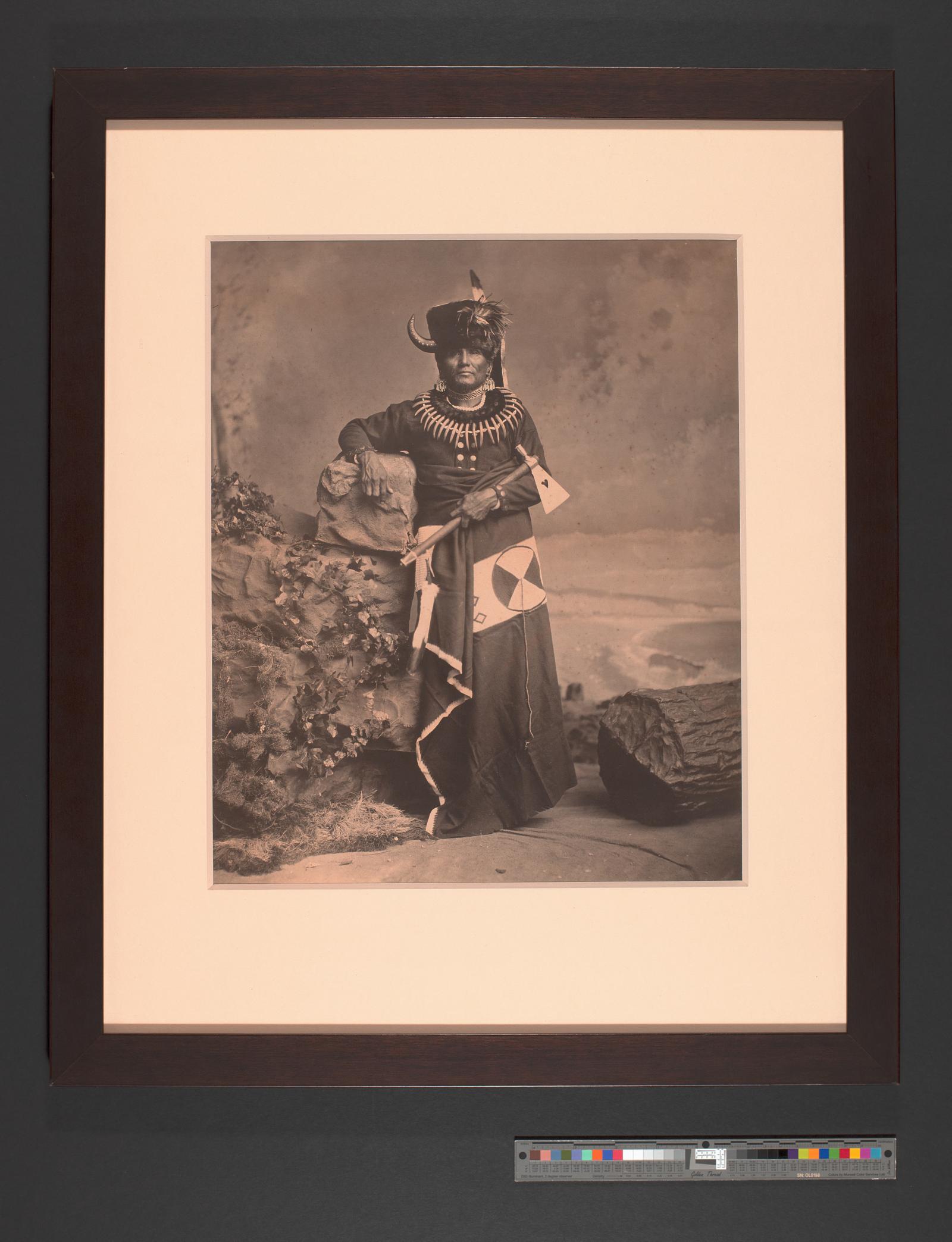
Image context: Charles Milton Bell photographed Standing Bear at roughly the same historical moment as the forced removal and court case. The University of Michigan catalog describes the portrait as an albumen print made around 1877–1880 and records both Western and Ponca elements in his clothing.[6] The physical print matters here because the judgment repeatedly compresses Standing Bear into legal categories—Indian, person, petitioner, former tribal member—while the portrait preserves the specificity of the leader and father who had to enter those categories to get free.
A promised home becomes a custody case
The litigation began with a broken geography. In the Treaty of 1858, the Ponca ceded most of their claimed land while reserving a tract along the Niobrara River “for the future homes” of the tribe. In return, the United States promised to protect the Ponca in possession of that land and to protect their persons and property there.[2] The promise makes the later removal more than a sad migration. The government displaced people from land its own treaty had designated as their future home.
Federal officials forced the Ponca south in 1877. They reached Indian Territory in the summer of 1878 without crops established for the season, and sickness and death followed. The National Park Service records that roughly one-third of the relocated group died; Dundy’s opinion preserves Standing Bear’s testimony that 158 of 581 people died within about a year.[1][4] Among the dead was his sixteen-year-old son, Bear Shield, who asked to be buried in the Ponca homeland.[4]
Standing Bear and a small group left Indian Territory in early January 1879, carrying Bear Shield’s remains north. About two months later they reached the Omaha Reservation in Nebraska, where relatives offered land, work, seed, and equipment.[4] Federal orders followed them. General George Crook’s soldiers arrested the group so that they could be returned south, even though Crook personally sympathized with their position.[4]
That sequence entered court as a question about custody. Standing Bear and twenty-five others petitioned for habeas corpus on April 8. Crook returned the writ on April 18, explaining that he held them under orders ultimately issued at the request of the secretary of the interior. The case was argued in Omaha on May 1 and 2; Dundy issued his decision ten days later.[1][4] The petitioners were not asking the court to rewrite all of federal Indian policy in one judgment. They were asking it to require a legal reason why the Army could seize them and carry them hundreds of miles.
“Person” opens the courthouse door
The federal government’s jurisdictional argument came first. According to Dundy’s account, the U.S. attorney reasoned from an English rule said to reserve habeas corpus for free subjects and argued that only American citizens could invoke the writ in federal court.[1] If that argument succeeded, the government would not need to prove the removal lawful. Standing Bear could not even ask the court to inspect it.
Dundy answered by reading the federal statute’s nouns. The law authorized habeas review when a person was held under color of federal authority or in violation of the Constitution, federal law, or a treaty. “It nowhere describes them as citizens,” he wrote of the statute’s applicants.[1] Citizenship was therefore not the ticket of admission the government claimed it was. A person in federal custody could seek the writ because custody—not nationality, race, or political membership—created the court’s responsibility to inquire.
The opinion’s reasoning is at its strongest when it turns the government’s own power into the reason for review. Native people living off reservation were subject to federal criminal law, Dundy observed. It would be perverse to let the United States arrest them as persons answerable to law but deny that they were persons capable of testing an illegal arrest.[1] Habeas corpus supplied a deliberately modest equality: if federal authority could close around a human body, a federal judge could ask what authorized it.
Even this passage carries the period’s hierarchy. Dundy reaches for a dictionary definition of a living human being, then says it is broad enough to include “even an Indian.” He opens the opinion by contrasting a supposedly weak and “unlettered” race with a powerful Christian nation, while congratulating the petitioners for seeking the dominant society’s civilization.[1] The judgment recognizes shared humanity without escaping the language that had made recognition seem debatable.
That tension does not erase the holding. It defines its scale. Dundy was not announcing citizenship, voting rights, or equal treatment in every field of law. He was deciding that person in the habeas statute included Native petitioners. Standing Bear gained legal standing to challenge custody before he gained any general federal citizenship from Congress.
The Army could remove them—but not send them south
After finding jurisdiction, Dundy did not simply declare every federal action unlawful. He accepted that the commissioner of Indian affairs could remove unauthorized people from the Omaha Reservation and could use the Army to do it. Because Standing Bear’s group were Ponca rather than Omaha, the judge treated their presence there as subject to that removal power.[1]
The decisive question was what the Army could do next. The relevant statute directed troops to take a person removed from Indian country by the nearest safe route to the civil authorities of the territory or judicial district, where ordinary legal process could follow. Crook’s orders instead required him to transport the group to Indian Territory and confine them there.[1]
Dundy found no act of Congress and no Ponca treaty authorizing that destination. In peacetime, he reasoned, military power could not substitute an administrative command for civil process. If the government could force peaceful Ponca people to remain in Indian Territory without a specific legal basis, it could as easily choose a penitentiary or any other place of confinement. The order to Crook therefore exceeded the authority the law actually gave.[1]
This portion of the opinion is easy to lose behind the famous word person, but it is the mechanism that freed the petitioners. The court distinguished three acts that federal officials had treated as one: arresting the group, removing them from the Omaha Reservation, and transporting them to a distant reservation. It accepted the first two within limits and rejected the third. The case became a landmark not because the judge denied all federal power, but because he required each step in a chain of custody to have its own legal authority.
Freedom travels through a troubling word
The opinion’s second route to liberty was expatriation. Standing Bear’s petition alleged that the group had withdrawn from the Ponca tribe, adopted the “general habits of the whites,” and intended to support themselves without government assistance. The government disputed that account. Dundy accepted testimony that the petitioners meant to sever tribal relations permanently, then asked whether an individual Native person possessed a right to do so.[1]
His answer repurposed an 1868 federal declaration that called expatriation a natural and inherent right. That measure grew from the United States’ insistence that people could leave old national allegiances. Dundy applied the principle to tribal belonging: whether tribes were treated as dependent nations or not, he reasoned, an individual could withdraw and live apart from the tribe.[1]
The move was liberating in the immediate case. Federal officials could not use membership in the Ponca polity as a leash that followed Standing Bear wherever he went. Yet the terms of that liberty were not neutral. The court made self-support, separation from government aid, and adoption of white “civilization” evidence that the petitioners deserved freedom. It imagined tribal connection mainly as an allegiance to be escaped, not as a source of law, kinship, land rights, or collective self-government.[1]
That is an inference from the opinion’s structure, not a claim that Standing Bear ceased to be Ponca in his own life. The Ponca Tribe of Nebraska remembers him as a chief whose return exposed the theft of a homeland; its history notes that legal freedom initially left the group with no home to return to because their land had been taken. Only later were 26,000 acres restored.[3] The gap between that tribal account and the court’s vocabulary is revealing. A legal strategy built around severance could win release without describing the whole identity of the people released.
Personhood was a beginning, not a settlement
The judgment’s limits become clearest when set beside what came later. Dundy’s opinion never says that its petitioners became U.S. citizens. On June 2, 1924, forty-five years after the decision, Congress enacted a separate law declaring all noncitizen Native people born within the territorial United States to be citizens. Crucially, that act added that citizenship would not impair any Native person’s right to tribal or other property.[5]
The contrast is sharp. In 1879, the court protected liberty partly by emphasizing a right to leave tribal relations. In 1924, Congress finally wrote general citizenship in terms that expressly preserved tribal property. Neither measure settled the continuing conflicts among U.S. citizenship, tribal citizenship, sovereignty, land, and state political rights. Together, however, they show why “person” and “citizen” cannot be treated as synonyms.
Standing Bear’s victory mattered because it blocked a particularly dangerous legal void. Without it, the United States could claim power over Native people while denying them the procedural identity needed to challenge that power. The writ forced federal officers to produce more than an order from above. It required a lawful chain from arrest to destination, and the chain broke before Indian Territory.[1]
But the best commemoration of the case does not turn one sentence into a completed emancipation. Standing Bear left court free from Crook’s custody, not newly made a citizen and not restored by the judgment to the land promised in 1858. The opinion’s achievement was to make personhood a doorway through which a Native petitioner could carry a claim against the federal government. Its limitation was that the doorway opened most readily when the petitioner was described as walking away from tribal belonging.
Sources
- University of Nebraska–Lincoln, U.S. Law and Race Initiative, “United States, ex rel. Standing Bear, v. George Crook (1879)” — full text of Judge Elmer S. Dundy’s opinion, including the petition, habeas analysis, expatriation reasoning, limits on military removal, and five-part holding.
- Oklahoma State University, Indian Affairs: Laws and Treaties, “Treaty with the Ponca, 1858” — treaty text reserving a Niobrara homeland and pledging federal protection of Ponca persons and property.
- Ponca Tribe of Nebraska, “History” — the Tribe’s account of forced removal, Standing Bear’s return and trial, the absence of a home after release, and later land restoration.
- National Park Service, Missouri National Recreational River, “Chief Standing Bear” — chronology of removal, deaths in Indian Territory, Bear Shield’s burial request, the northward journey, arrest, trial, and decision.
- U.S. National Archives, Indian Citizenship Act of 1924 — scan of the enrolled act declaring noncitizen Native people born within U.S. territory to be citizens while preserving tribal or other property rights.
- University of Michigan Library Digital Collections, “Standing Bear, Chief of Poncas” IIIF manifest — catalog metadata and image record for Charles Milton Bell’s circa 1877–1880 albumen portrait in the Richard Pohrt Jr. Collection of Native American Photography.